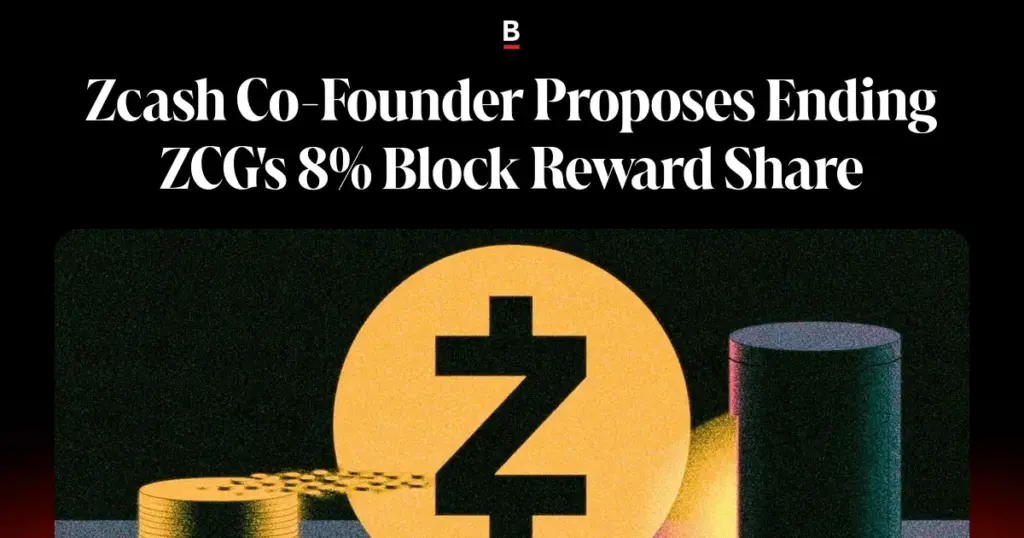
Zcash co-founder Sean Bowe has introduced a new draft Zcash Improvement Proposal (ZIP) that seeks to completely overhaul how the privacy-focused cryptocurrency allocates its newly minted tokens. The proposal calls for ending the long-standing funding stream allocated to Zcash Community Grants (ZCG), which currently captures 8% of every new ZEC generated through block rewards. Instead, Bowe’s draft recommends redirecting that entire 8% share directly to the Network Sustainability Mechanism (NSM).
The motivation behind the proposal centers on the substantial financial reserves currently held by the grant-giving body. Bowe points out that ZCG is sitting on a massive war chest, estimating that the organization holds roughly $125 million in funding reserves. According to the co-founder, these existing resources are more than sufficient to sustain its ongoing operations for the foreseeable future, especially considering that the entity is slated to receive millions of dollars more in incoming funds before the funding spigot is ultimately turned off under current protocol rules.
The debate over the distribution of Zcash block rewards has historically been a central point of discussion among developers, miners, community members, and governance participants. Since its inception, Zcash has utilized structured block reward allocations to fund various ecosystem initiatives, core development, and community-driven projects. These splits are governed through consensus-driven ZIPs that dictate how newly issued ZEC is distributed among miners, development entities like the Electric Coin Company and the Bootstrap Project, and community grant pools like ZCG.
Under the current economic model, a significant percentage of newly minted ZEC is set aside to foster ecosystem growth, support third-party application development, and sponsor research and development within zero-knowledge cryptography. ZCG specifically has operated as an independent committee tasked with reviewing grant applications and distributing funds to builders, researchers, and community advocates who want to contribute to the Zcash ecosystem. Over the years, this funding mechanism has supported numerous technical improvements, privacy tool integrations, and educational initiatives aimed at expanding the reach and utility of the cryptocurrency.
However, as the cryptocurrency landscape evolves, questions surrounding capital efficiency, treasury management, and long-term network security have taken center stage. Bowe’s intervention highlights a growing sentiment among certain stakeholders that treasury reserves accumulated during previous market cycles are more than adequate to cover near-term development needs. By redirecting the 8% block reward allocation toward the Network Sustainability Mechanism, the proposed ZIP aims to channel fresh capital into core network longevity, economic stability, or infrastructure resilience rather than continuing to accumulate surplus funds within grant treasuries that already hold millions in liquid assets.
The Network Sustainability Mechanism functions as a protocol-level approach designed to address the long-term economic security of Zcash as it transitions through its programmed halving cycles and eventual shift toward fixed supply dynamics. As block rewards decrease over time, ensuring that the underlying network remains secure, economically robust, and sustainable becomes a critical priority for the protocol’s core architects. Proponents of strengthening mechanisms like the NSM argue that optimizing the flow of newly issued coins toward foundational network health is essential for protecting the blockchain against potential economic vulnerabilities as block subsidies continue to decline.
The introduction of Bowe’s draft ZIP marks the beginning of what is expected to be a rigorous and closely watched governance debate within the Zcash community. Community members, developers, node operators, and ZCG participants are anticipated to review the financial metrics, weigh the potential impact on future ecosystem development, and debate the trade-offs of shifting significant capital away from community grants and toward network sustainability frameworks. As the proposal moves through the formal Zcash improvement proposal pipeline, it will face community scrutiny, technical reviews, and ecosystem-wide discussions before any final consensus can be reached regarding the future of the 8% block reward share.
 Tokenomics & Digital Assets
 Tokenomics & Digital Assets
 Tokenomics & Digital Assets