
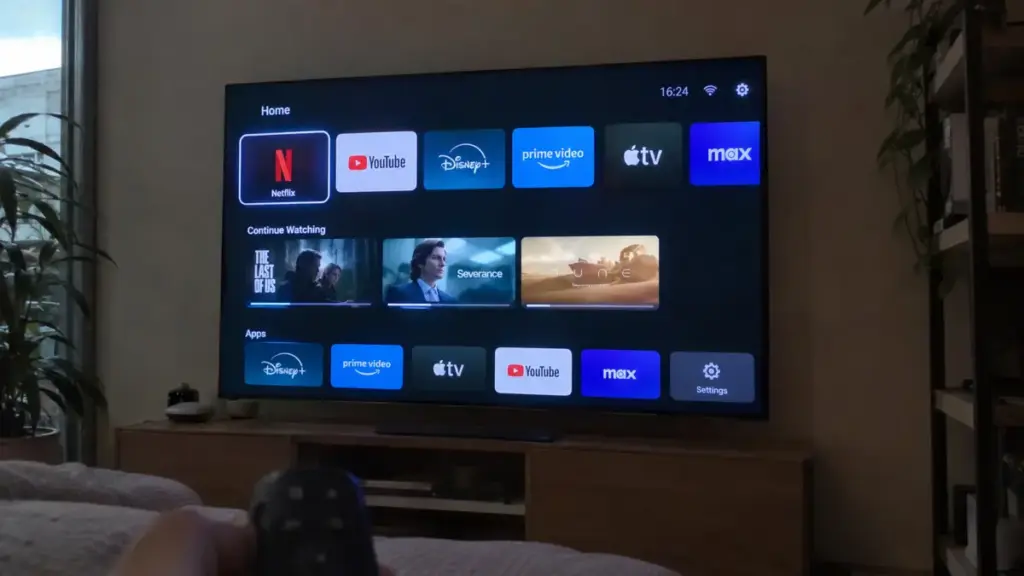
Smart television owners are increasingly turning autonomous artificial intelligence agents toward their living-room displays, commanding the software to rip out intrusive sponsored advertisements, aggressive tracking utilities, and the notoriously sluggish home screens that manufacturers install by default.
The rising consumer trend, which exploded across the social media platform X over the weekend, has rapidly acquired a distinctive label within the developer community: "vibe coding" your TV.
The most widely shared case study involved a Xiaomi television owned by the parents of software developer Gathin T. Posting on the platform on Saturday, Gathin explained that the display forced a sponsored video ad onto the screen before anyone in the household could even navigate to Netflix. Frustrated by the user experience, he fed the television’s specific model number into Claude Code, an advanced coding agent developed by Anthropic, and permitted the AI to operate autonomously.
Operating over the local home Wi-Fi network, the agent successfully located the television, systematically disabled 25 intrusive Xiaomi software packages running in the background, and dynamically wrote an entirely brand-new home screen launcher. Describing the dramatic transformation to his followers, Gathin noted that the interface now "looks like an Apple TV now lol."
The frustration driving this grassroots movement is universally shared. Anyone who has purchased a modern consumer television over the past decade likely lives with the exact same underlying problem, as many contemporary sets run Automatic Content Recognition, commonly known as ACR. This proprietary software quietly fingerprints whatever appears on the screen—including traditional cable broadcasts, video game consoles, and external streaming devices plugged into any HDMI port—and relays that data back to manufacturers so they can sell targeted, data-driven advertisements.
The legal and regulatory pressure surrounding these practices has mounted significantly in recent years. In December 2025, the State of Texas filed a sweeping lawsuit against five major television manufacturers, naming Sony, Samsung, LG, Hisense, and TCL. The legal action alleges that the companies’ smart displays are capable of capturing automated screenshots of what consumers are watching as frequently as every 500 milliseconds, or twice every single second.
Regulatory bodies have attempted to curb these monitoring practices for nearly a decade. In 2017, Vizio agreed to pay a $2.2 million settlement with federal authorities to resolve allegations that the company had collected detailed viewing data from 11 million television sets without obtaining proper consumer consent. However, the regulatory penalty did little to impede the underlying business model. Retail giant Walmart completed an acquisition of Vizio for approximately $2.3 billion in 2024, with corporate executives explicitly highlighting the television maker’s profitable and fast-growing advertising ecosystem as a primary driver of the deal.
In practical terms, this means that a consumer-purchased television continues generating continuous revenue for corporate entities every single time it is powered on.
The phenomenon of vibe coding—a term coined by OpenAI co-founder Andrej Karpathy in 2025 to describe the practice of describing desired software outcomes in plain, conversational language and letting an AI write and execute the underlying code—has unlocked new forms of consumer hardware modification. Earlier this month, video game enthusiasts utilized Claude-based agents to deeply reverse engineer their favorite titles, executing unorthodox software mashups such as embedding the entire world of Minecraft directly inside Elden Ring.
Anthropic’s Claude Code has emerged as the central technical catalyst for this trend because the agent possesses the capability to natively type and execute command-line operations on a user’s computer. Modern Android-based televisions feature the Android Debug Bridge, or ADB, a standard system maintenance tool. Once a user unlocks developer mode on the television by tapping the "Build" number seven times within the settings menu, a computer on the same local network can establish a direct administrative bridge to the set.
The AI agent navigates through this digital door, compiles a comprehensive inventory of every installed software application, and intelligently flags which ones are dedicated to serving advertisements or operating telemetry—background software designed to constantly phone home with user behavior metrics.
Gathin packaged his specific operational prompts into an open-source project hosted on GitHub titled "cleanyourtv." Rather than permanently deleting unwanted system software, the project safely switches the unwanted applications off, ensuring that a single system restore script can effortlessly revert the television to its original state if necessary. The project explicitly avoids "rooting," the riskier process of unlocking full administrative superuser privileges on a device. By Tuesday, the repository listed successfully tested configurations for 107 distinct television models spanning 37 different brands, garnering 10,700 "stars," GitHub’s internal bookmarking metric. On his digital donation page, Gathin noted that several thousand individuals had replicated the process on their own home displays within a span of just two days.
Other developers and enthusiasts quickly demonstrated that the technique could be pushed far beyond basic debloating. Mihir Gupta successfully replaced his television’s bloated 192-megabyte stock launcher with a streamlined custom launcher weighing in at just 83 megabytes. Meanwhile, Ansub Khan reported that the available free memory on his parents’ older Android television rose by approximately 90 percent following a similar AI-assisted cleanup. Ryan Doyle bypassed traditional configuration hurdles entirely by feeding his television’s online product listing directly to Claude, asking the agent if it could manipulate the set, and ultimately configuring a custom screensaver that displayed his live business revenue and recent Stripe payment transactions.
Other users pursued even more radical aesthetic customizations. Rod Pers replaced the standard ad-driven interface with a live, rendered 3D model of his apartment that dynamically reflected real-time changes, such as living room lights and ceiling fans switching on and off. Adrian Friend constructed a minimalist user interface utilizing the interactive animation platform Rive, while other participants reported cleaning up displays for elderly family members who now navigate simplified, ad-free menus.
A rival open-source project named "dumbtv" specifically targets Amazon Fire TV devices, disabling roughly 65 background system packages—including native ACR tracking utilities—before installing a lightweight 41-kilobite launcher completely devoid of internet permissions. The project’s blunt mission statement promises users their core applications, their HDMI inputs, a simple clock, and nothing else.
While the primary cleanup tools function reliably on Android TV and Google TV platforms manufactured by brands such as Sony, TCL, Hisense, Philips, and Xiaomi, alternative operating systems present distinct technical boundaries. Samsung’s Tizen and LG’s webOS utilize entirely different underlying architectures, and Fire TV integrations currently support only the system cleanup phase rather than a complete interface overhaul.
For LG television owners, modifications have largely remained limited to debloating rather than radical interface replacement. Nevertheless, these partial modifications represent a major victory for privacy-conscious consumers, particularly in light of security research demonstrating how LG sets have been found to secretly pinpoint user locations, record voice conversations, and harvest other sensitive data even when the televisions appear to be powered off.
Not every hardware modification experiment has ended in success, however. As the trend gained viral momentum, cautionary tales began surfacing online. One user reported that an autonomous Claude session accidentally bricked his television—industry slang for rendering an electronic device into an expensive, non-functional paperweight—by inadvertently attempting an operating system reboot and uninstalling core system files. Another user found themselves permanently stuck halfway through a Fire TV configuration process.
The documentation files associated with the cleanyourtv project explicitly warn users that network-based ADB connections remain unencrypted. On certain firmware versions, this vulnerability allows any connected device on the same local Wi-Fi network to assume total control of the television, prompting developers to advise users to disable debugging modes once their configurations are complete. Furthermore, AI agents remain susceptible to manipulation; cybersecurity researchers at Microsoft revealed earlier this year that hidden prompt instructions could trick Claude Code into exposing credentials, a critical vulnerability that Anthropic patched in May.
Offering a more pragmatic warning regarding domestic tech support, one X user reminded the online community that successfully modifying a parent’s television should come with a strict caveat: never explain how the AI accomplished the task, because parents inevitably own many other electronic appliances bearing confusing model numbers.
 Web3 & Decentralized Web
 Web3 & Decentralized Web
 Web3 & Decentralized Web







