Payward, the parent company of major global cryptocurrency exchange Kraken, has cleared a critical regulatory hurdle in its ongoing international expansion strategy. The firm announced on Thursday that it has received in-principle approval from authorities in Kazakhstan to operate within the country, marking a significant milestone for both the exchange and the Central Asian nation’s evolving digital asset landscape.
The preliminary authorization positions Payward to ultimately offer a comprehensive suite of financial services to clients in the region, including digital asset trading, investment services as both a principal and an agent, and secure cryptocurrency custody. This strategic move highlights how Kazakhstan has successfully pivoted from a loose haven for opportunistic bitcoin miners seeking cheap energy into a structured, highly regulated jurisdiction striving to institutionalize its digital asset economy.
Payward Secures Regulatory Foothold in Kazakhstan
The formal green light came by way of the Astana Financial Services Authority (AFSA), the independent regulator of the Astana International Financial Centre (AIFC). Under the terms of the in-principle approval, Payward Kazakhstan is cleared to build out its operational framework to manage a digital asset trading facility, deal in investments, and safeguard customer funds within the special financial hub.

It is important to note that this regulatory milestone is an initial step rather than a final operating license. Before opening its doors to the public and commencing fully licensed activities, Payward must satisfy a series of remaining administrative, technical, and compliance requirements set forth by the AFSA.
Once these regulatory conditions are fully met and formal authorization is granted, users based in Kazakhstan will gain direct access to Kraken’s robust global order books. This integration promises to bridge local market activity with deep, established liquidity pools spanning across Europe, the United States, and Asia, offering domestic traders a more integrated and globally connected trading experience.
Dave Ripley, co-CEO of Payward and Kraken, acknowledged the collaborative nature of the regulatory process leading up to the announcement. Speaking on the development, Ripley remarked that the AFSA and AIFC teams have been constructive and rigorous throughout the evaluation, expressing appreciation for their professional engagement as the exchange works toward final compliance.
From Bitcoin Mining Boom to Regulated Crypto Hub
The entry of a major international institutional player like Payward underscores a massive structural transformation within Kazakhstan’s broader cryptocurrency sector over the past half-decade. The nation first captured global headlines during the historic exodus of bitcoin miners from China following Beijing’s sweeping regulatory crackdown in 2021. Seeking refuge from strict prohibitions elsewhere, mining operations flooded across the border into Central Asia, drawn by historically inexpensive electricity, vast reserves of fossil fuels, and an abundance of vacant industrial facilities.

At the peak of this mining migration, Kazakhstan rapidly ascended to become a global powerhouse in the decentralized ecosystem, capturing approximately 18% of the entire network’s global hashrate and ranking second only to the United States in worldwide bitcoin mining production.
However, this staggering expansion did not come without severe domestic consequences. The sudden and massive influx of energy-intensive computing hardware placed an unprecedented strain on Kazakhstan’s national electricity grid, leading to recurring power shortages, rolling blackouts, and widespread public concern over energy security. In response to the crisis, national authorities were forced to step in, imposing a series of targeted interventions, including specialized energy tariffs, mandatory licensing protocols, strict tax regimes, and heightened supervision of mining facilities.
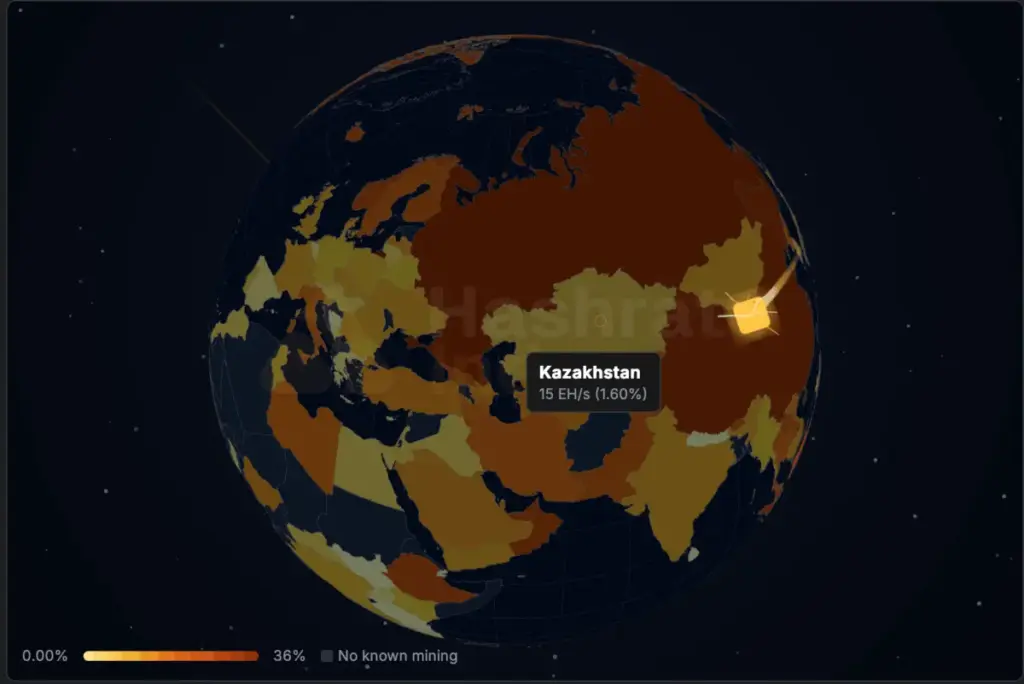
As a result of these tightening regulations and enforcement measures, the country’s share of global computational power has receded significantly. According to the global compute data heatmap maintained by Hashrateindex.com, Kazakhstan currently commands approximately 1.6% of the network’s total hashrate, reflecting a deliberate cooling and scaling back of uncontrolled, energy-draining mining operations.
Rather than attempting to eliminate the digital asset industry entirely, however, the government of Kazakhstan chose to pivot toward a more sustainable and structured approach. Through the development and promotion of the Astana International Financial Centre, policymakers have actively fostered a compliant digital asset strategy designed to attract legitimate, regulated financial enterprises. The national agenda shifted from simply functioning as a low-cost electricity supplier for itinerant miners to building a sophisticated regulatory framework capable of hosting compliant cryptocurrency exchanges, institutional custody providers, and resilient blockchain infrastructure.
Payward’s prospective arrival in the market serves as a clear testament to this broader macroeconomic and regulatory transition. While Kazakhstan initially drew global cryptocurrency companies strictly on the basis of cheap power and loose oversight, it is now successfully attracting top-tier international trading firms eager to operate under formal financial regulations and institutional standards.
 Bitcoin & Major Altcoins
 Bitcoin & Major Altcoins
 Bitcoin & Major Altcoins