North America solidified its position as the most influential region for global cryptocurrency markets during the 12 months leading up to July 1, 2026. Backed by the United States’ deep investor base providing crucial capital, lawmakers updating regulatory frameworks, stablecoins functioning as a widespread global currency, and businesses bridging the gap between crypto and traditional finance, the region continues to export its financial innovations to the rest of the world.
According to data from a major crypto analytics reporting period ending in mid-2026, the United States and Canada topped the unweighted "big-money index," which measures the sheer economic power of covered countries. Their combined crypto economies totaled $3.02 trillion during the 2026 period, representing a modest 1.9% contraction compared to the previous year.

This regional dip was primarily driven by a slowdown within the United States. The U.S. crypto economy contracted by 2.2% period-over-period to $2.78 trillion, an expected outcome amid a challenging bear market. Nevertheless, the world’s largest single crypto economy largely retained the near-doubling of value it achieved during the previous 2025 period. Institutional forces, including the explosive growth of crypto exchange-traded funds (ETFs), accelerating tokenization of real-world assets, and the steady proliferation of stablecoins, proved instrumental in preserving those earlier gains.
Industry leaders point to an overarching theme of structural maturation. Observers note that the foundational building blocks established in 2025 have successfully transformed into tangible products featuring real users, deep liquidity, and active markets throughout 2026. This evolution is particularly visible across three major U.S.-developed product categories driving domestic and international activity: AI commerce, stablecoin rails, and tokenized assets. Meanwhile, Canada’s crypto economy bucked the broader regional downtrend, expanding by 2.3% to reach approximately $250 billion, supported heavily by vibrant peer-to-peer activity and immigrant remittance corridors.

The US Leads the Emerging AI On-Chain Economy
The United States’ commanding lead in the global artificial intelligence development race is rapidly reshaping adjacent sectors, most notably cryptocurrency. Researchers studying x402—one of the most prominent digital payments infrastructure rails enabling AI agents to autonomously execute financial transactions—have gained crucial insights into how this machine-to-machine economy is taking shape.
As autonomous software increasingly pays for services directly on-chain, the United States has emerged as the dominant builder and market. Cornerstone American crypto entities, including stablecoin issuer Circle and Coinbase—the developer of the x402 system—are actively supporting this technological rise. Financial institutions are also taking notice. Major firms are closely monitoring agentic commerce, anticipating that autonomous AI agents will generate substantial, round-the-clock demand for frequent, low-value digital payments.

By the end of the 2026 reporting period, cumulative x402 transactions on Base, the leading blockchain network for agentic commerce, surpassed 138 million. Traditional payment rails like credit card networks are structurally unequipped to process transactions worth fractions of a cent due to fixed processing costs. However, blockchain-based stablecoins capable of settling for less than a single cent make micro-payments economically viable. This unlocks an entirely new market for pay-as-you-go digital goods and services, such as purchasing targeted data via API calls.
Industry executives describe a clean division of labor emerging in the digital payments landscape: traditional card rails are utilized for consumer-prompted agent payments, while stablecoin rails handle machine-to-machine settlements that fall below the economic thresholds of traditional cards. Data from a 16-month observation window ending in September 2026 underscores this trend, revealing that over 87% of x402 payments ranged between a hundredth of a cent and ten cents, with the most frequent transactions falling between one and ten cents.

AI Payments Transition from Experimentation to Stickiness
While agentic commerce remains in an experimental phase, behavioral metrics indicate rapid maturation. In the earliest days of x402, activity was dominated by one-off users executing isolated trades before abandoning the protocol once their initial funds depleted. That dynamic has changed significantly.
Wallets grouped by the quarter in which they were first funded demonstrate increasing commitment. The share of wallets securing a second funding injection within 30 days of creation rose from 70.6% for wallets established in the third quarter of 2025 to 89.3% for those funded in the second quarter of 2026. This recurring funding behavior functions as the on-chain equivalent of renewing a subscription service.

Furthermore, users are adopting the technology with greater purpose. The median time gap between a wallet’s initial funding and its first x402 expenditure shrank from 73 days in late 2025 down to just 18 minutes by the third quarter of 2026. In late 2025, only 4% of wallets initiated a payment within their first hour of funding; by the third quarter of 2026, that figure surged to 67%. Rather than parking value or testing protocols casually, users are funding wallets because a specific machine task is already queued and ready for execution.
As AI agents increasingly function as independent economic actors, transaction data reveals what these models are purchasing on-chain. While early activity was heavily influenced by fleeting memecoin trends, the maturation of x402 has fostered sustainable commerce centered on information services. AI models are systematically purchasing machine-readable knowledge, including code reviews, financial intelligence, and search APIs. Additional spending targets gaming, token issuance, gambling services, agent frameworks, and crucially, model inference—paying other AI agents for computational intelligence.

Geographic data indicates that American-funded AI agents dominate this space, capturing a 30% share of geolocated agent-to-services transactions. U.S. wallets account for 88.1% of geolocated AI model inference payments, 41.8% of payments for agent frameworks and tooling, and 23.2% of data and search API expenditures. Conversely, Chinese-linked wallets have concentrated heavily on security and code analysis, accounting for nine out of ten transactions directed toward smart contract auditing services like AgentLISA, alongside strong positions in financial intelligence and payment rails. Observers attribute the near-absence of Chinese participation in U.S. model inference payments to a combination of AI nationalism and the widespread availability of domestic, open-weight models compared to metered American alternatives.
The US Imports Digital Gold and Exports Digital Dollars
The formalization of digital asset policies has reinforced the United States’ role as the leading global exporter of digital dollars. Stablecoins have effectively converted U.S. sovereign debt into the currency of choice for cross-border businesses and peer-to-peer economies alike, generating billions of dollars in economic activity that benefits both U.S. companies and the federal government.

While exporting stablecoins globally, the United States has concurrently served as a major importer of bitcoin. Following the introduction of spot bitcoin ETFs in early 2024, the U.S. share of global bitcoin activity has risen steadily. In contrast, stablecoins account for a smaller proportion of domestic U.S. crypto activity than they do internationally, reflecting the reality that domestic users already rely on a deeply integrated banking system. International users, however, are pivoting to digital dollars to satisfy monetary needs unaddressed by their local financial institutions.
Cross-border bitcoin flows into and out of the U.S. shifted the country into a net importer position for the first time since 2022. While retail transfers under $10,000 remained net outbound, large-denomination institutional transfers drove net inflows, with transactions exceeding $10 million accounting for tens of thousands of newly arrived coins. This institutional accumulation, supported by discussions surrounding strategic sovereign reserves, contrasts with the steady, incremental expansion of dollar-pegged stablecoins circulating globally. The vast majority of stablecoin order book volume remains pegged to the U.S. dollar, with issuers maintaining massive reserves primarily composed of short-dated U.S. government debt.

Tokenization and the Expansion of Real-World Assets
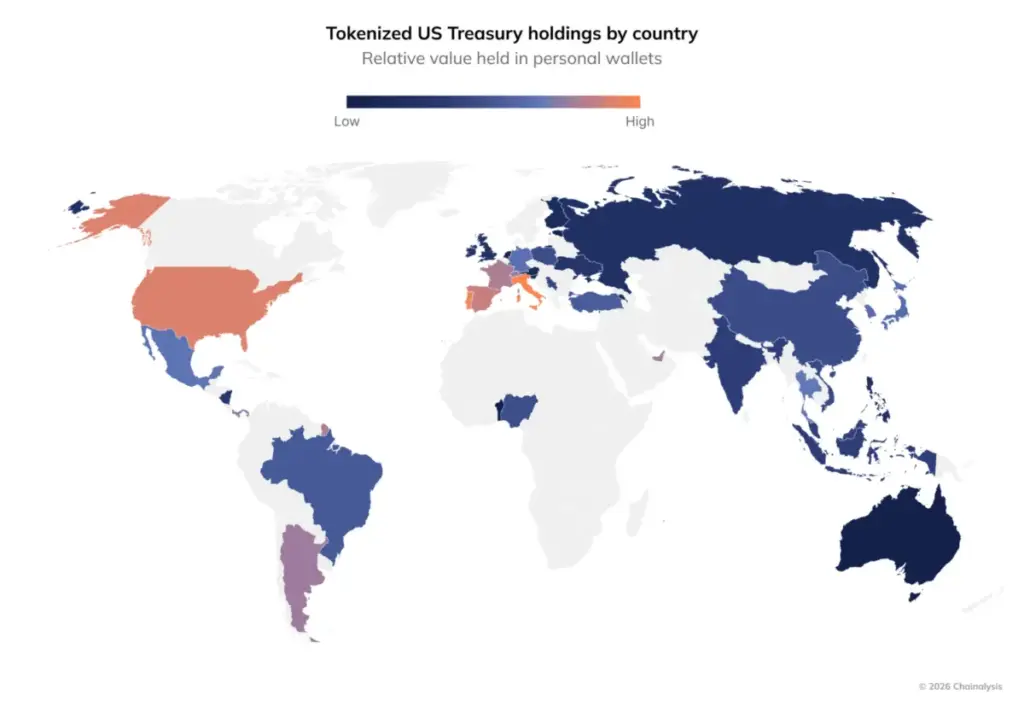
The United States continues to anchor the rapidly expanding tokenization sector. Global tokenized real-world asset (RWA) market values reached $36.07 billion, representing a 135% period-over-period growth rate. Tokenized U.S. Treasury bonds constituted the single largest asset class within this segment, totaling $15.42 billion and commanding nearly 43% of all tokenized RWA value.
While alternative categories like corporate credit and private equity experienced rapid percentage growth from smaller baselines, U.S. Treasury debt expansion dwarfed them in absolute dollar terms. Geolocated holding data reveals that international investors—particularly in European and Asian markets such as Italy, Portugal, Singapore, and Japan—drive significant demand for tokenized U.S. Treasuries. By lowering minimum investment thresholds and removing the requirement for direct U.S. brokerage accounts, tokenization has successfully transformed wholesale government debt instruments into retail-accessible assets globally.

Lending patterns indicate that tokenized Treasuries are primarily acquired as buy-and-hold investments rather than utilized as collateral. While private credit and commodities lending against tokenized assets surged dramatically, tokenized Treasury lending contracted slightly. Analysts note that traditional Treasuries already function as the most liquid collateral in conventional finance, whereas tokenization primarily solves liquidity issues for traditionally illiquid private assets.
Canada Excels in Peer-to-Peer Adoption and Remittances
North northward, Canada’s crypto economy demonstrated resilience by growing 2.3% to reach $247.7 billion during the 2026 reporting period. Despite its smaller scale relative to the United States, Canada maintained one of the most robust peer-to-peer cryptocurrency economies among G7 nations, ranking seventh globally in both domestic and cross-border transaction flows.

Stablecoins captured 44% of Canadian dollar-based order book volume, up from 30% the previous year, with USDC commanding the vast majority of activity. Executive leadership at the Canadian Web3 Council noted that this heavy reliance on USD-denominated stablecoins creates a policy challenge, as domestic capital flows into U.S. debt-backed assets rather than supporting Canadian sovereign debt. In response, Canadian lawmakers have introduced stablecoin legislation to foster domestic, CAD-backed alternatives, though their market capitalization remains negligible compared to USD counterparts.
Canada’s prominent cross-border crypto economy is heavily influenced by its diverse immigrant population, which represents roughly 23% of the country’s total residents—the highest share within the G7. Remittance corridors connecting Canada to nations such as India, China, and the Philippines expanded significantly, with stablecoin and bitcoin transfers across these three specific corridors totaling $2.36 billion through millions of individual transactions. Driven by high traditional remittance costs averaging well over 6% through conventional banking channels, Canadian residents increasingly utilize blockchain rails to execute cross-border transfers for a fraction of a cent.

Furthermore, domestic peer-to-peer transaction volumes in Canada have historically correlated with temporary visa and immigrant population trends, illustrating that populations with active cross-border financial lives readily adopt efficient, cost-effective settlement alternatives when available.
As North America navigates these shifting macroeconomic and technological currents, the defining characteristic of its crypto industry remains its structural influence. With American institutions, issuers, and developers providing the core infrastructure for tokenized assets, digital dollars, and agentic AI commerce, the primary user base continues to scale globally, cementing the region’s pivotal role in the future of international finance.
 Crypto Wallets & Security
 Crypto Wallets & Security
 Crypto Wallets & Security