
North America solidified its position as the most influential region for cryptocurrency markets globally during the 12-year reporting period ending July 1, 2026. Backed by the deep investor base of the United States providing essential capital, lawmakers updating regulatory frameworks, stablecoins serving as a reliable currency, and businesses bridging crypto with traditional finance, developments originating in North America continued to ripple across the international stage.
According to market metrics from the period, the U.S. and Canada claimed the top spots on the unweighted "big-money index," which measures the raw crypto-economic power of covered countries. Their combined crypto economies totaled $3.02 trillion during the 2026 period, representing a modest 1.9% contraction from the preceding year.

This regional dip was primarily driven by a slowdown within the United States. The U.S. crypto economy reached $2.78 trillion, falling 2.2% period-over-period—an unsurprising outcome amid a brutal broader bear market. Nevertheless, the world’s single-biggest crypto economy managed to retain nearly all the dramatic near-doubling of value it posted during the 2025 period. Institutional forces, including the expansion of crypto exchange-traded funds (ETFs), accelerating asset tokenization, and the proliferation of stablecoins, played a pivotal role in preserving those previous gains.
Hoolie Tejwani, Head of Coinbase Ventures, noted that much of the activity observed compared to 2025 reflects the maturation of the industry. The foundational building blocks established in 2025 successfully transformed into operational products with active users, sustainable liquidity, and functioning markets by 2026.

Market observers have turned their attention to a trio of U.S.-developed crypto products attracting major activity both domestically and internationally: AI commerce, stablecoins, and tokenized assets. All three serve as clear manifestations of American influence on the global cryptocurrency ecosystem. Simultaneously, the Canadian market resisted the broader continental downtrend, expanding its crypto economy by 2.3% to approximately $250 billion, supported heavily by its vibrant immigrant populations and active peer-to-peer sector.
The US Leads the AI On-Chain Economy
The United States’ dominant position in the global artificial intelligence development race is actively reshaping every corner of the broader economy, including the digital asset sector. Researchers studying x402—one of the most popular digital payment rails enabling AI agents to autonomously spend money—have gained vital insights into how this machine-driven economy is taking shape.

Autonomous software has begun executing payments on-chain, with the United States emerging as the primary engine for this technology. Cornerstone American crypto enterprises, including USDC issuer Circle and x402 system developer Coinbase, have provided crucial support for this emerging sector. Financial heavyweights are also taking notice; BlackRock Head of Digital Assets Research Will Su noted that the firm is monitoring agentic commerce closely, highlighting that AI agents possess the potential to generate meaningful, round-the-clock demand for frequent, low-value payments.
By the close of the 2026 reporting period, over 138 million x402 transactions had been recorded on Base, cementing it as the leading blockchain for agentic commerce. Traditional payment rails like credit card networks cannot economically process micro-transactions worth fractions of a cent due to fixed processing overhead. However, stablecoins capable of settling for a fraction of a cent make it financially viable for autonomous agents to execute minuscule expenditures, unlocking entirely new markets for pay-as-you-go goods and services such as on-demand API data calls.

Circle characterizes this as a clean division of labor: traditional card rails handle consumer-prompted agent payments, while stablecoin rails power machine-to-machine settlements that are far too small for conventional card economics. Data from the 16 months ending in September 2026 shows that over 87% of x402 payments fell between a hundredth of a cent and a dime, with transaction sizes of one to ten cents proving most common.
AI Payments Are Becoming Stickier
While agentic commerce remains in an experimental phase, distinct signs of maturation are emerging. Early adoption was characterized by transient users testing crypto trades before abandoning the protocol once initial funds ran out. That dynamic has evolved significantly.

When grouping wallets by the quarter in which they were first funded, the share securing a second funding instance within 30 days climbed from 70.6% for wallets established in the third quarter of 2025 to 89.3% for those funded in the second quarter of 2026. This regular top-up behavior mirrors a traditional software subscription renewal. Analysts also tracked a decreasing time gap between initial wallet funding and the first x402 spend. In late 2025, wallets had a median age of 73 days before initiating an x402 payment; by the third quarter of 2026, that interval plummeted to just 18 minutes.
Furthermore, the share of wallets spending within their first hour of funding jumped from 4% in Q3 2025 to 67% in Q3 2026. This temporal compression indicates that newer wallets are intentionally provisioned for immediate agentic commerce rather than passive value storage.

What AI Agents Are Buying with x402
As Tejwani observed, AI agents are evolving into distinct economic actors where every automated entity functions effectively as a new user of the blockchain. While early x402 activity relied heavily on speculative fads like memecoins, the maturation of the protocol has fostered enduring commercial applications, particularly within the information sector.
Millions of transactions now flow from AI wallets into specialized information services, including code review, financial intelligence, and search APIs, satisfying the machine-readable data demands of autonomous models. Additional spending targets gaming, token issuance, gambling services, agent frameworks, and model inference.

Geolocated data indicates that American-funded AI agents dominate this landscape, accounting for a 30% share of agent-to-services transactions globally. U.S. wallets represented 88.1% of geolocated AI model inference transactions, 41.8% of payments to agent frameworks and tool catalogs, and 23.2% of payments to data and search APIs. Conversely, Chinese-linked wallets concentrated heavily on security and code analysis, accounting for 90% of transactions directed toward automated smart contract auditing services like AgentLISA, alongside substantial shares in financial intelligence and payment rails, while largely bypassing U.S.-developed metered inference models in favor of free domestic open-weight alternatives.
The US Imports Digital Gold and Exports Digital Dollars
The formalization of digital asset policies in mid-2025 cemented the United States’ role as the leading exporter of digital dollars. Stablecoins have established U.S. sovereign debt as a preferred currency for peer-to-peer economies and cross-border commerce, generating billions in economic activity globally.

Concurrently, the United States has accelerated its importation of Bitcoin. Following the launch of spot Bitcoin ETFs in January 2024, the U.S. share of global Bitcoin activity has grown steadily. While stablecoins comprise a smaller percentage of domestic U.S. crypto activity compared to foreign markets, American investors increasingly utilize Bitcoin as an inflation-resistant store of value amid rising global government debt. Net cross-border flows show that retail investors send smaller Bitcoin amounts outbound, while institutional entities—bolstered by private demand and discussions surrounding strategic reserves—drive large-scale inbound accumulation.
Stablecoin adoption abroad continues to expand token circulation, with Circle reporting $73.3 billion of USDC in circulation alongside $14.8 trillion in quarterly on-chain volume. While international jurisdictions like the European Union under MiCA and financial hubs in Singapore and Hong Kong have introduced regulatory frameworks for local stablecoins, alternative currencies represent a tiny fraction of order book volume, demonstrating that regulatory readiness currently outpaces global market adoption.

The US Impact on Tokenization
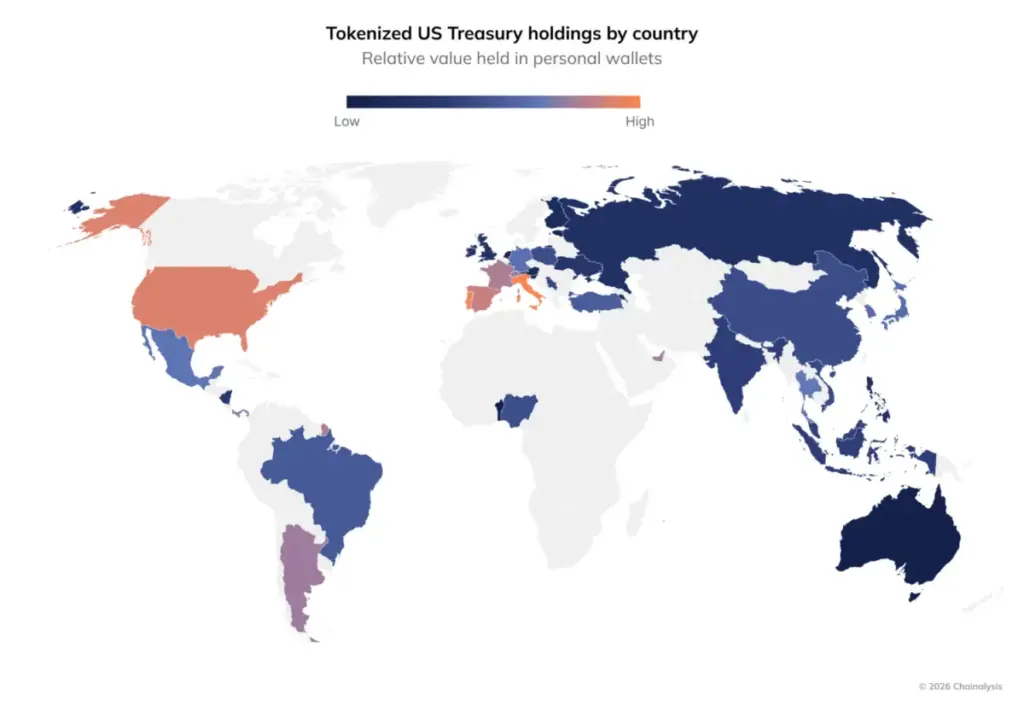
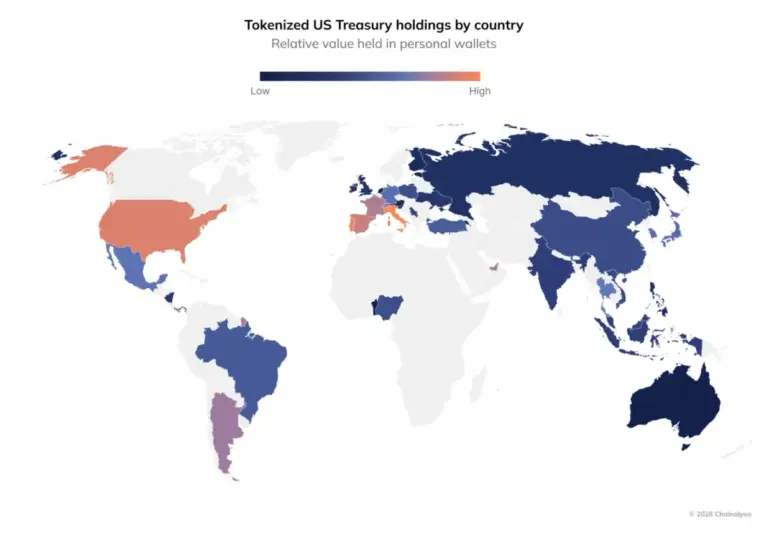
The United States maintained its leadership in the tokenized real-world asset (RWA) sector during the 2026 period. Global tokenized RWA market capitalization reached $36.07 billion at the close of the second quarter of 2026, marking a 135% year-over-year increase. Tokenized U.S. Treasury bonds formed the largest single category, accounting for $15.42 billion or 42.8% of total tokenized RWA value.
While U.S. investors comprise roughly 11.7% of the global tokenized RWA holder base, foreign institutional investors—particularly in Italy, Portugal, and Singapore—drive a significant portion of tokenized Treasury holdings. This mechanism allows international retail and institutional participants to access short-dated U.S. government debt directly without traditional brokerage accounts, reinforcing global demand for U.S. sovereign instruments.

Canada Excels in Peer-to-Peer and Cross-Border Flows
Canada maintained its position as the second-largest crypto economy in North America, growing 2.3% to reach $247.7 billion during the 2026 period. Among G7 nations, Canada exhibited the most robust peer-to-peer crypto economy, placing seventh globally in both domestic and cross-border flows.
Stablecoins captured 44% of Canadian dollar-based order book volume by June 2026, up from 30% the prior year, with USDC leading the market. Industry experts note that heavy reliance on U.S. dollar-denominated stablecoins indirectly supports U.S. sovereign debt rather than domestic Canadian alternatives.

Furthermore, Canada’s foreign-born population—accounting for roughly 23% of the total population—fuels a thriving remittance market. Outbound stablecoin and Bitcoin transfers from Canada to high-volume corridors like India, China, and the Philippines reached $2.36 billion across 3.56 million transactions, offering a cost-effective alternative to traditional remittance channels burdened by high legacy fees. Domestic P2P transaction volumes also mirrored fluctuations in temporary visa and study permit populations, highlighting how individuals with active cross-border financial requirements gravitate toward efficient on-chain settlement rails.
As infrastructure development remains concentrated within North American institutions while user bases expand internationally, regulatory developments across the continent will continue to define the trajectory of digital asset adoption, stablecoin proliferation, and automated economic systems worldwide.
 Crypto Wallets & Security
 Crypto Wallets & Security
 Crypto Wallets & Security







