North America firmly secured its position as the most influential region for global cryptocurrency markets during the 12 months leading up to July 1, 2026. Bolstered by the United States’ deep investor base providing substantial capital, lawmakers updating regulatory frameworks, stablecoins functioning as a widespread global currency, and businesses bridging the gap between crypto and traditional finance, the region continues to export its digital financial trends to the rest of the world.
According to recent data tracking the unweighted crypto-economic power of covered countries, the United States and Canada topped the global "big-money index." During the 2026 reporting period, their combined crypto economies reached a massive $3.02 trillion. This figure represents a modest 1.9% contraction compared to the previous period, a dip primarily driven by a slight slowdown in the United States amid a challenging bear market.

The U.S. crypto economy stood at $2.78 trillion, falling by 2.2% period-over-period. While this contraction is unsurprising within the context of broader market cycles, the world’s single-biggest crypto economy largely retained the near-doubling of value it achieved during the 2025 period. Key institutional forces—such as the expansion of crypto exchange-traded funds (ETFs), accelerating tokenization of real-world assets, and the ongoing proliferation of stablecoins—helped the market hold onto those substantial gains.
Industry leaders note that the slight pullback is less about stagnation and more about structural maturation. Observers point out that the foundational building blocks established in previous years are successfully translating into commercial products with real users, liquidity, and active markets.

The U.S. Leads the Emerging AI On-Chain Economy
The United States’ commanding lead in global artificial intelligence development is actively influencing every corner of the modern economy, including the blockchain sector. Researchers analyzing digital payment rails have focused heavily on x402, a popular infrastructure standard that allows AI agents to independently spend money on-chain, providing a clear window into how machine-to-machine commerce is taking shape.
Autonomous software is increasingly executing paid transactions on-chain, with cornerstone American crypto companies playing a pivotal role in supporting this nascent ecosystem. Circle, the issuer of the leading stablecoin USDC, and Coinbase, the primary architect of the x402 system, have become central pillars for these automated networks. Financial institutions are also taking note; major market players are closely monitoring agentic commerce as AI agents generate meaningful demand for frequent, low-value payments operating around the clock.

By the end of the 2026 reporting period, cumulative x402 transactions on Base, the leading blockchain for agentic commerce, surpassed 138 million. Traditional payment rails like credit card networks are fundamentally unsuited for processing transactions worth fractions of a cent due to fixed processing costs. However, blockchain-based stablecoins capable of settling transactions for a fraction of a cent make micro-payments economically viable. This breakthrough opens up an entirely new market for pay-as-you-go digital goods and services, such as automated data retrieval through application programming interfaces.
Industry experts describe a clean division of labor emerging between traditional and blockchain rails: standard card networks handle consumer-prompted agent payments, while stablecoin-powered infrastructure manages machine-to-machine settlements that are far too small for traditional card economics. The vast majority of x402 activity during the period registered as micropayments, with more than 87% of payments falling between a hundredth of a cent and ten cents.

AI Payments Are Maturing and Becoming Stickier
Although agentic commerce remains in an experimental phase, quantitative metrics indicate rapid maturation. Early iterations of the technology were largely characterized by speculative users making one-off transactions before abandoning the protocol. That dynamic has evolved significantly.
When grouping wallets by the quarter they were first funded, data shows that user commitment has steadily climbed. The share of wallets receiving a secondary funding injection within 30 days of their initial setup rose from 70.6% for wallets funded in the third quarter of 2025 to 89.3% for those funded in the second quarter of 2026. In the on-chain economy, topping up a depleted wallet functions similarly to renewing a software subscription.

Furthermore, users are engaging with the protocol with greater intentionality. The time gap between a wallet’s initial funding and its first x402 spend has sharply compressed. In late 2025, wallets were a median of 73 days old before initiating an x402 payment; by the third quarter of 2026, that duration dropped to just 18 minutes. Approximately two in three new wallets now spend almost immediately after being funded, indicating that users are establishing wallets for specific, pre-planned tasks rather than mere experimentation.
An analysis of what AI agents are purchasing reveals a shift away from short-lived speculative fads toward sustainable information-sector services. Millions of transactions now flow from AI wallets into code review, financial intelligence, and data search APIs. AI agents are also paying for model inference, effectively purchasing AI-generated knowledge and computational power from one another.

The U.S. Dominates AI-to-AI Commerce
American-funded AI agents currently transact more with x402 services than agents originating from any other jurisdiction, holding a 30% share of geolocated agent-to-services transactions. U.S. wallets account for an overwhelming 88.1% of geolocated AI model inference transactions, alongside significant shares of payments directed toward agent frameworks, tool catalogs, and data APIs.
In contrast, Chinese-attributed wallets display a distinct concentration in cybersecurity and financial intelligence. Approximately 90% of transactions directed toward security and code analysis originated from Chinese-linked wallets, primarily flowing into automated smart-contract auditing tools. However, Chinese-funded AI agents accounted for only a negligible fraction of model inference payments. Analysts attribute this divide to "AI nationalism" and economic reality: Chinese markets heavily favor domestic, open-weight models like DeepSeek and Qwen, which are often free to use, whereas American markets rely more heavily on metered, U.S.-developed models.

This rapid adoption introduces unique compliance challenges. Because individual AI transactions occur at speeds and frequencies incompatible with traditional manual checkpoints, regulatory frameworks must adapt. Effective oversight must focus on the initial funding event, the human authorization of budgets, and behavioral anomaly detection rather than per-transaction screening.
The U.S. Imports Digital Gold While Exporting Digital Dollars
The formalization of digital asset policies has cemented the United States’ role as the world’s leading exporter of digital dollars. Stablecoins have effectively transformed U.S. sovereign debt into a preferred currency for cross-border businesses and peer-to-peer economies alike. While stablecoins proliferate internationally and generate billions in economic activity, the domestic U.S. market exhibits a diverging trend: Americans are increasingly accumulating bitcoin.

Since the introduction of spot bitcoin exchange-traded funds, the U.S. share of global bitcoin activity has climbed steadily. Cross-border data indicates that the United States became a net importer of bitcoin, with large-scale institutional inflows heavily outweighing retail outflows. Conversely, stablecoins represent a smaller percentage of domestic U.S. crypto activity compared to international markets, where users adopt digital dollars to bypass local banking limitations.
Circulating supplies of major dollar stablecoins have expanded significantly, with billions in on-chain volume routing through short-term U.S. government debt reserves. This dual dynamic benefits the U.S. economy: imported bitcoin serves as an institutional store of value, while exported stablecoins extend the global reach of the U.S. dollar.

Tokenization and Real-World Assets Expand
The tokenization sector experienced explosive growth, with the global real-world asset tokenization market surging 135% year-over-year to reach $36.07 billion. Tokenized U.S. Treasury bonds remained the single largest asset category, accounting for $15.42 billion—or 42.8%—of all tokenized real-world asset value.
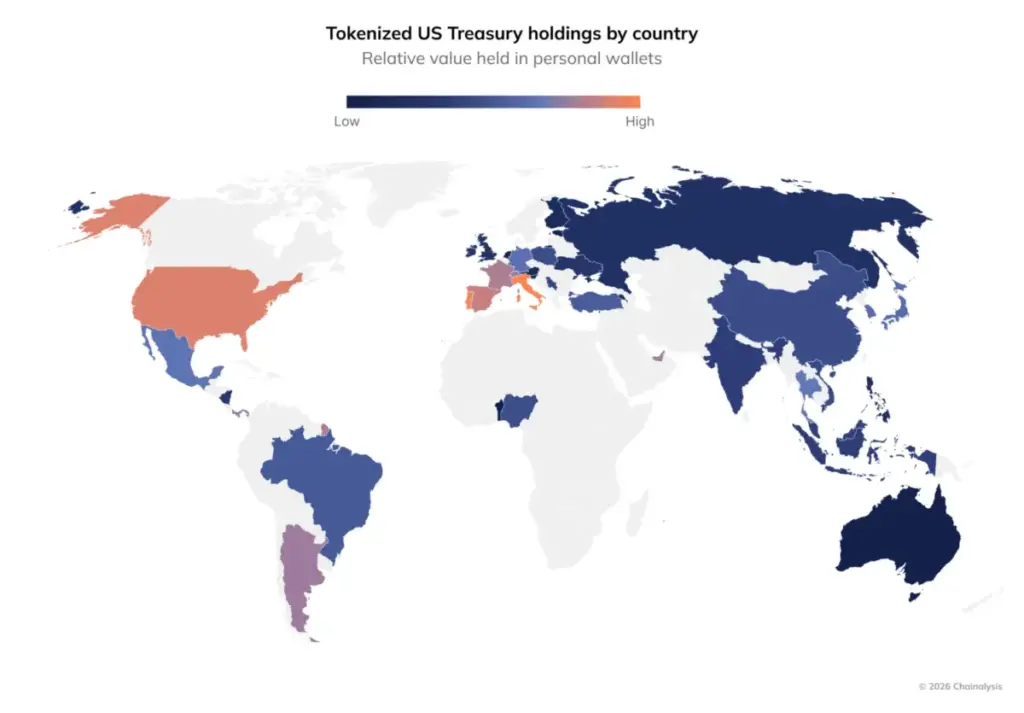
Asset managers, public companies, and financial institutions are increasingly exploring blockchain infrastructure to increase the speed, programmability, and global interoperability of traditional financial assets. While institutional participants continue to utilize permissioned environments for settling tokenized securities, public-chain data shows that retail investors outside the United States are driving significant demand for tokenized U.S. debt, effectively creating foreign demand for American government obligations without requiring traditional brokerage relationships.

Canada Excels in Peer-to-Peer and Remittance Markets
Canada’s crypto economy grew 2.3% during the reporting period, reaching $247.7 billion. Despite its smaller scale compared to the United States, Canada maintains a uniquely robust peer-to-peer and cross-border crypto economy, ranking among the highest in the G7 for everyday digital asset usage.
Stablecoins comprise nearly half of Canadian dollar-based order book volume, with USDC dominating the market. Because these stablecoins are denominated in U.S. dollars, Canadian policymakers are monitoring the trend closely, noting that preference for foreign-backed stablecoins can divert potential demand away from Canadian sovereign debt.

At the same time, Canada’s large immigrant population—representing approximately 23% of the country’s residents—has turned to crypto rails to slash the high costs associated with traditional remittances. Stablecoin and bitcoin transfers from Canada to high-volume corridors like India, China, and the Philippines totaled $2.36 billion across millions of transactions, offering significant savings compared to traditional banking fees that often exceed 6%. Data further indicates that domestic peer-to-peer crypto volumes closely track temporary visa and immigrant population trends, reflecting the practical utility of blockchain rails for individuals managing cross-border financial lives.
As regulatory bodies across North America and international jurisdictions continue to implement new digital asset frameworks, the underlying infrastructure of the global crypto economy remains anchored by American technology platforms, even as its user base expands rapidly across the globe.
 Crypto Wallets & Security
 Crypto Wallets & Security
 Crypto Wallets & Security