North America stood as the most influential region for global cryptocurrency markets during the 12-year reporting period ending July 1, 2026. Driven by a deep U.S. investor base supplying crucial capital, evolving regulatory frameworks, the widespread integration of stablecoins, and traditional financial institutions bridging the gap with blockchain infrastructure, developments originating in North America continue to set the pace for the rest of the world.
According to market metrics from Chainalysis, the United States and Canada captured the top spots on the regional "big-money index," an unweighted measurement tracking the sheer crypto-economic power of covered jurisdictions. Together, their respective crypto economies totaled a massive $3.02 trillion during the 2026 reporting period, representing a modest 1.9% contraction compared to the preceding year.

This minor regional cooling was primarily localized within the United States. The U.S. crypto economy dipped 2.2% period-over-period to $2.78 trillion, an expected outcome amid a challenging bear market. Nevertheless, the world’s single-largest crypto economy successfully retained the near-doubling of value it achieved during the 2025 period. Structural institutional forces—including the expansion of crypto exchange-traded funds (ETFs), accelerating asset tokenization, and the ongoing proliferation of stablecoins—helped cushion the market against deeper losses.
"A lot of what we’re seeing versus 2025 comes down to maturation of the industry," said Hoolie Tejwani, Head of Coinbase Ventures. "The building blocks set in 2025 are turning into products with real users, liquidity, and markets in 2026."

Industry analysts point to three major U.S.-developed product categories driving domestic and international activity: artificial intelligence commerce, stablecoins, and tokenized assets. Meanwhile, Canada’s market moved against the broader regional downtrend, posting a 2.3% increase in its $250 billion crypto economy, fueled heavily by vibrant immigrant populations utilizing peer-to-peer infrastructure.
The U.S. Leads the Emerging AI On-Chain Economy
The United States’ commanding lead in global artificial intelligence development is spilling over into financial technology, creating an entirely new digital payments ecosystem. Researchers tracking the adoption of x402, a prominent digital payments rail enabling autonomous software and AI agents to execute financial transactions independently, have found that the U.S. dominates the builder space.

Autonomous software has steadily begun paying for services on-chain, backed by foundational American crypto enterprises. Stablecoin issuer Circle, which provides USDC as a preferred currency for AI agents, and Coinbase, the creator of the x402 protocol, have been central to this infrastructure. Financial heavyweights are also taking notice. Will Su, Head of Digital Assets Research at BlackRock, noted that the firm is closely observing agentic commerce, explaining that AI agents have the potential to generate meaningful demand for frequent, low-value payments around the clock.
By the close of the 2026 reporting period, more than 138 million x402 transactions had been processed on Base, the leading blockchain network utilized for agentic commerce. Traditional payment rails like credit card networks cannot economically process transactions worth fractions of a cent due to fixed processing overhead. However, stablecoin settlements costing less than a fraction of a cent make micro-payments economically viable, unlocking brand-new business models such as pay-as-you-go data retrieval via API calls.

Circle describes a clear division of labor emerging within digital payments, utilizing card rails for consumer-prompted transactions while relying on stablecoin rails for machine-to-machine settlements that fall below the economic threshold of traditional cards. Data from the 16 months ending September 2026 shows that over 87% of x402 payments ranged between one-hundredth of a cent and ten cents, with the most common transaction size falling between one and ten cents.
AI Payments Transition from Experimentation to Stickiness
Although agentic commerce remains in an experimental phase, behavioral metrics indicate rapid maturation. Early deployments of x402 were dominated by one-off users testing trades before abandoning their wallets once balances were depleted. That dynamic has evolved significantly.

When grouping wallets by the quarter they were first funded, data shows that the share receiving a second funding deposit within 30 days rose from 70.6% for wallets funded in the third quarter of 2025 to 89.3% for those funded in the second quarter of 2026. This behavior mirrors traditional subscription renewals. Furthermore, the duration between a wallet’s initial seed funding and its first x402 transaction has collapsed. While wallets in late 2025 required a median age of 73 days before initiating a spend, that gap compressed to just 18 minutes by the third quarter of 2026. Roughly two in three new wallets now spend almost immediately after being funded, signaling purposeful, operational deployment rather than idle speculation.
Analyzing transactional destinations reveals that AI agents are heavily purchasing machine-readable knowledge and computational resources. Millions of transactions flow into information-focused services, including code review, financial intelligence, search APIs, and model inference.

Geographically, American-funded AI agents dominate this activity, holding a 30% share of all geolocated agent-to-services transactions. U.S. wallets account for 88.1% of all geolocated AI model inference transactions, 41.8% of payments for agent frameworks, and 23.2% of payments for data and search APIs. In contrast, Chinese-linked wallets concentrated their activity heavily in security and code analysis, accounting for 90% of transactions directed toward smart contract auditing services like AgentLISA, alongside strong participation in market intelligence and settlement rails. However, Chinese-funded agents accounted for a negligible 0.1% of model inference transactions, a divergence driven largely by the preference for domestic, open-weight models like DeepSeek and Qwen compared to paid, U.S.-developed metered models.
The U.S. Imports Digital Gold and Exports Digital Dollars
Following the congressional passage of the GENIUS Act in mid-2025, the United States’ role as the world’s leading exporter of digital dollars has been firmly codified. Stablecoins have transformed U.S. government debt into the currency of choice for international peer-to-peer economies and cross-border commercial transactions, generating billions in economic activity for U.S. entities and the federal government.

Conversely, while exporting digital dollars, the United States has simultaneously imported substantial amounts of bitcoin. Since the launch of spot bitcoin ETFs in January 2024, the U.S. share of global bitcoin activity has climbed steadily. While stablecoins comprise a smaller percentage of domestic U.S. crypto activity compared to overseas markets, international users increasingly pivot to dollar stablecoins to satisfy a foreign demand for stability that domestic U.S. banking users do not share. Meanwhile, American investors lean heavily on bitcoin as an inflation hedge and monetary store of value.
Will Su of BlackRock noted that institutional interest in bitcoin remains resilient, driven by sovereign debt levels and expanding global spending. Cross-border bitcoin data indicates that the United States became a net importer of the asset in 2026 for the first time since 2022. While retail-sized transfers under $10,000 generally ran outbound, institutional transfers exceeding $10 million accounted for massive net inflows, supported by both private institutional allocations and implicit sovereign demand discussions regarding a potential Strategic Bitcoin Reserve.

Stablecoin adoption continues to scale alongside traditional financial reliance. Circle reported $73.3 billion of USDC in circulation at the close of the quarter—representing a 19% year-over-year increase—backed by short-dated U.S. government debt. Despite legislative efforts in Europe under the MiCA framework and new regulatory frameworks introduced in Singapore and Hong Kong to foster local currency stablecoins, dollar-pegged tokens continue to dominate global order book volumes, accounting for 99.1% of traded stablecoin volume.
Institutional Acceleration and Tokenized Real-World Assets
The tokenized real-world asset (RWA) market experienced rapid expansion during the 2026 reporting period, with the global market reaching $36.07 billion by the end of the second quarter, marking a 135% year-over-year increase. U.S. Treasury debt served as the single largest real-world asset category on-chain, totaling $15.42 billion and commanding 42.8% of total tokenized RWA value.

"We are seeing asset managers launch tokenized funds, public companies explore putting their equity on-chain, financial institutions build stablecoin infrastructure and tokenized assets become usable within lending, collateral and trading markets," said Tom Murphy, Head of Communications for Securitize.
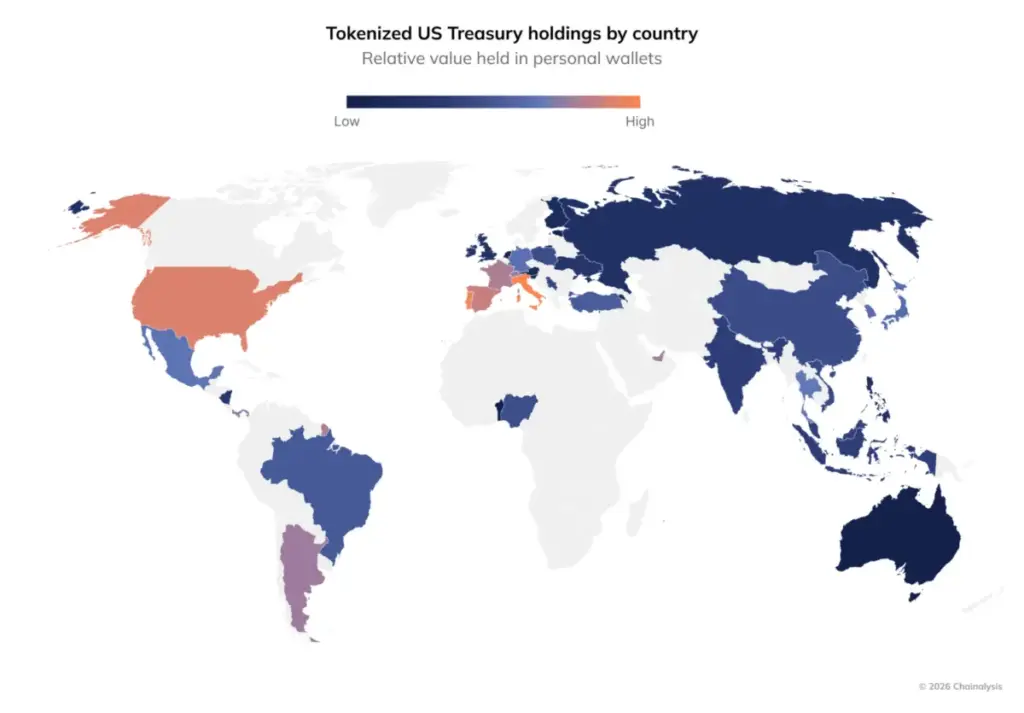
Although U.S. investors account for roughly 11.7% of the global tokenized RWA holder base, the geographical distribution of tokenized U.S. Treasuries reveals a heavy international footprint. Italy, Portugal, and Singapore lead in the total value of tokenized Treasuries held, highlighting how blockchain infrastructure allows international retail investors to access U.S. government yield without requiring traditional brokerage relationships. Furthermore, lending patterns indicate that while private credit and commodities are heavily leveraged as on-chain collateral, tokenized Treasuries are largely bought and held for yield, reflecting their already high liquidity in traditional financial markets.

Canada Excels in Peer-to-Peer and Remittance Economies
Canada maintained its position as the second-largest crypto economy in North America and ranked tenth globally in grassroots adoption. Between July 2025 and June 2026, the Canadian crypto economy expanded by 2.3% to reach $247.7 billion. Notably, Canada registered the most robust peer-to-peer crypto economy among G7 nations, placing seventh globally in both domestic and cross-border transaction flows.
Stablecoins captured 44% of Canadian dollar-based order book volume by June 2026, up from 30% the previous year, with USDC commanding the vast majority of activity. However, this heavy reliance on USD-denominated stablecoins presents a policy challenge for Canadian officials, as it fosters demand for U.S. sovereign debt rather than domestic alternatives. Morva Rohani, Executive Director of the Canadian Web3 Council, noted that policymakers are monitoring these capital flows closely, even as Canada introduces a new stablecoin legislative framework intended to pave the way for domestic Canadian dollar stablecoin issuers.

Canada’s cross-border remittance strength is heavily underpinned by its diverse foreign-born population, which accounts for roughly 23% of the country’s total residents—the highest proportion within the G7. Remittance corridors connecting Canada to India, China, and the Philippines surged significantly during the reporting period. Stablecoin and bitcoin transfers across these specific corridors totaled $2.36 billion, reflecting a 141% year-over-year increase spread across 3.56 million transactions. With traditional remittance fees averaging near 6.7% according to World Bank figures, crypto-based settlement rails providing instantaneous transfers for pennies offer substantial financial savings for migrant workers supporting families abroad.
Data tracking also reveals a direct correlation between Canada’s domestic peer-to-peer crypto volumes and fluctuations in temporary resident permit populations from key remittance nations. As temporary visa allocations expanded or contracted over recent years, domestic P2P transaction volumes closely mirrored those demographic shifts, highlighting how populations with active cross-border financial commitments readily adopt efficient alternative payment rails.

Ultimately, the North American crypto landscape of 2026 demonstrates a clear structural division: American institutions, developers, and regulatory frameworks provide the foundational infrastructure and digital dollar rails, while a vast global user base—ranging from institutional allocators and AI agents to Canadian immigrant communities—drives active day-to-day demand. As international jurisdictions attempt to build localized alternatives, the ongoing evolution of regulatory policies in both the United States and Canada will determine how these technological bridges continue to shape global finance.
 Crypto Wallets & Security
 Crypto Wallets & Security
 Crypto Wallets & Security