
The digital asset market continues to experience heightened volatility, and recent technical developments surrounding ACH point toward a shifting market sentiment. Following an earlier bullish phase that originated from a clearly defined technical springboard, the token is now displaying signs of exhaustion. Market observers and technical analysts are closely monitoring the asset as it struggles to maintain its footing above critical price levels, raising the probability of a broader downside continuation across the upcoming trading sessions.
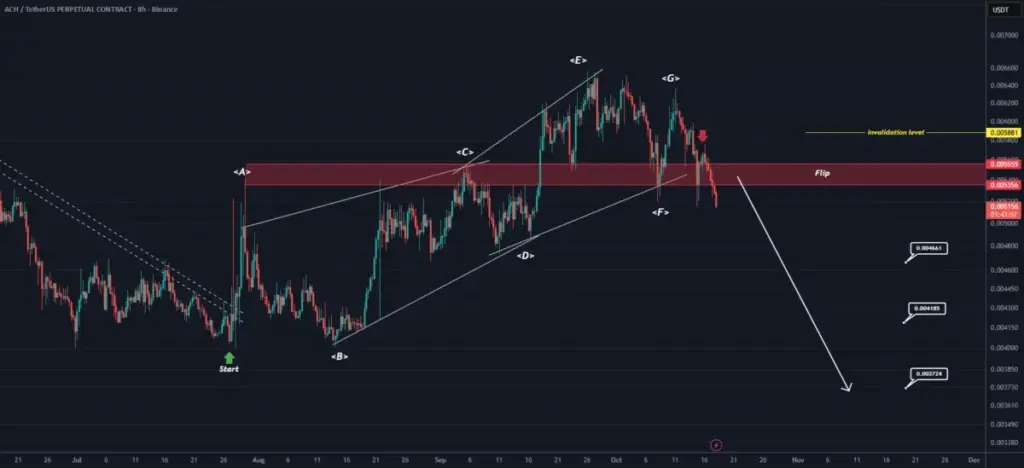
The preceding upward movement in ACH initially took shape from the point marked by the green arrow on analytical charts. However, market participants note that this bullish phase has consistently lacked the necessary underlying strength to establish a lasting trend. One of the primary technical indicators signaling this weakness is the frequent formation of long upper wicks on the price candles. These extended wicks reflect persistent selling pressure and strong rejection whenever the asset attempts to push into higher price brackets. Furthermore, market structure analysis reveals that Wave G appears to have been truncated. In technical terms, a truncated wave strongly suggests that the broader bullish structure has failed to develop its anticipated momentum, leaving the asset vulnerable to a reversal.
Compounding these structural concerns, price action over recent sessions has resulted in the loss of an important Flip zone. In technical analysis, a Flip zone represents a critical price region that historically acts as support or resistance, and losing such a level is frequently interpreted as a significant sign of weakness. Market participants are now watching to see whether the asset will consolidate and hold firmly below this lost barrier. Should the price remain capped underneath this zone, further downside movement becomes an increasingly probable outcome, shifting the near-term technical outlook decidedly in favor of the bears.
In the event that the bearish continuation materializes as projected, ACH could retrace its steps toward the low established during the previous bullish phase. Beyond that initial retest, the asset faces the potential for further depreciation toward the three distinct downside targets explicitly mapped out on the technical charts.
As traders and analysts navigate these uncertain market conditions, discussions surrounding trade management and risk mitigation have taken center stage. The projected targets provide a roadmap for managing open exposures, with market participants considering strategic maneuvers such as taking partial profits at the first target level, known as TP1. Securing partial gains allows traders to effectively reduce their overall market exposure while simultaneously giving any remaining position the flexibility to pursue subsequent downside targets if the bearish trajectory persists.
Nevertheless, experts emphasize that rigorous risk management remains an essential pillar before opening any position in such volatile environments. Traders are advised to define clear stop-loss parameters, calculate their position sizes with precision, and strictly avoid risking capital that exceeds what they can comfortably afford to lose. In technical trading scenarios, invalidation levels serve as vital safety boundaries. For the current bearish outlook on ACH, a daily candle close above the designated invalidation level would technically invalidate the entire downside scenario, signaling a potential shift back toward market stability or renewed upward pressure.
For the time being, the primary focus among market participants remains fixed on the recently lost Flip zone and whether ACH can sustain its demonstrated weakness below this critical threshold. Observing the unfolding price action will provide crucial insights into whether the anticipated bearish continuation will fully develop or encounter unexpected buying support.
Market analysts reiterate that these projections represent a technical analysis scenario rather than a guaranteed financial outcome. Navigating such environments requires patience, appropriate confirmation signals from the market, and disciplined risk management practices at every stage of the trade lifecycle. As always, the information and technical frameworks circulating across analytical platforms are intended for informational purposes and do not constitute formal financial, investment, or trading advice endorsed by underlying data providers or platforms.
 Crypto Investing & Trading
 Crypto Investing & Trading
 Crypto Investing & Trading







