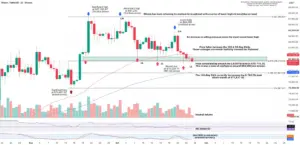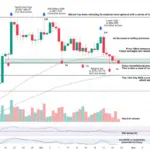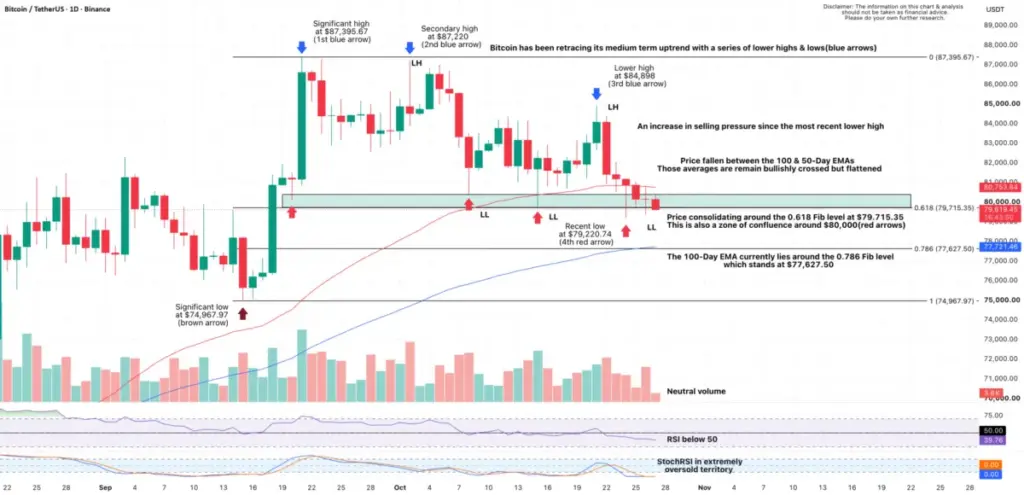
Bitcoin is currently navigating a precarious technical juncture, consolidating tightly around the psychologically and structurally significant $80,000 support zone. This pivotal area brings together a critical confluence of technical indicators, most notably the 0.618 Fibonacci retracement level positioned at $79,715 alongside the closely watched 50-day Exponential Moving Average (EMA). While market bulls are actively stepping in to defend this zone, preventing an immediate and catastrophic collapse, the conspicuous lack of any meaningful upward recovery is causing growing anxiety among traders and market observers alike.
The digital asset’s inability to bounce decisively from this multi-indicator support floor highlights a broader vulnerability within the current market cycle. Although buyers retain enough conviction to prevent prices from sliding further in the immediate term, the underlying market dynamics suggest that the path of least resistance is increasingly skewed toward caution. As participants monitor order books and liquidity clusters around the $80,000 mark, the lingering question remains whether this defense mechanism will hold or eventually succumb to prevailing selling pressures.
This delicate phase of consolidation follows a pronounced cooling-off period from Bitcoin’s recent local peaks. Ever since scaling the heights of $87,395, the leading cryptocurrency has been engaged in a sustained retracement of its broader medium-term uptrend. During this corrective phase, price action has carved out a textbook series of lower highs and lower lows—a classic structural hallmark of a shifting market bias.
The latest rejection of higher prices occurred following a push toward $84,898, an event that sharply reinforced this emerging bearish structure. As the cryptocurrency surrendered those gains and retreated back toward its foundational support levels, selling pressure notably intensified. This persistent inability to sustain rallies above mid-range resistance zones demonstrates that market participants are increasingly utilizing upward movements as exit liquidity rather than accumulation opportunities, further cementing the short-term dominance of sellers.
Technical complications are also materializing on the daily moving average front, where momentum is visibly fading. Bitcoin’s price has now slipped directly into the narrow band resting between the bullishly crossed 100-day and 50-day EMAs. While the technical integrity of the initial bullish crossover remains structurally intact on the charts, both moving averages are visibly beginning to flatten out.
This loss of upward momentum is widely interpreted as a warning sign that the medium-term trend is losing its underlying engine. When moving averages flatten and price action becomes trapped within compressed moving average bands, it typically precedes a volatile expansion in either direction. In Bitcoin’s current context, the flattening slopes emphasize how quickly the prevailing bullish narrative is losing its grip, leaving the asset highly sensitive to incoming macroeconomic catalysts or sudden shifts in exchange liquidity.

Should the current support fortification around the $80,000 threshold ultimately fail to withstand persistent selling, market attention will shift downward to the next major lines of defense. The primary area of interest in a breakdown scenario lies at the 0.786 Fibonacci retracement level, pegged at $77,627. Crucially, this technical level sits almost directly alongside the 100-day EMA, creating another formidable confluence zone.
Historically, these deeper retracement levels and major moving averages act as magnets for institutional interest and algorithmic buying programs. If prices do travel south toward the upper-$77,000 region, it is anticipated that a fresh wave of buyers may look to step back into the market, viewing the deeper discount as an attractive long-term entry point. However, reaching that destination would require a definitive break of the current psychological floor, an event that could accelerate short-term liquidations across derivatives markets.
Underpinning these structural developments is a decidedly cautious momentum profile across major oscillators. The Relative Strength Index (RSI) continues to hover comfortably below the neutral 50 centerline, signaling that sellers retain overall control of the short-term momentum landscape. Meanwhile, the Stochastic RSI has dipped deep into extremely oversold territory, a reading that often precedes short-term bounces or localized relief rallies, even within a broader corrective trend.
Interestingly, overall trading volume remains relatively neutral. This lack of aggressive expansion in volume during the current consolidation phase suggests that while sellers certainly hold the tactical advantage, the market has not yet witnessed the kind of aggressive, high-volume capitulation that typically characterizes a decisive breakdown. Instead, the price action reflects a grinding, low-conviction drift toward lower boundaries, leaving the market suspended in a state of watchful waiting.
In summary, Bitcoin finds itself approaching a defining crossroads as it consolidates tightly around a critical confluence of daily support parameters. The primary concern for market participants remains the structural context of this consolidation, which follows a clear, unyielding sequence of lower highs and lower lows. This pattern inherently increases the probability of a eventual downside extension if buying interest dries up completely.
Nevertheless, baseline support continues to hold its ground for now, and deeply oversold conditions across secondary momentum indicators leave ample room for an unexpected relief recovery. A decisive breakdown below current thresholds would instantly shift market focus toward the $77,627 support zone, whereas bulls must urgently begin reclaiming lost territory to dismantle the heavy bearish pressure that has defined recent trading sessions.
 Crypto Investing & Trading
 Crypto Investing & Trading
 Crypto Investing & Trading