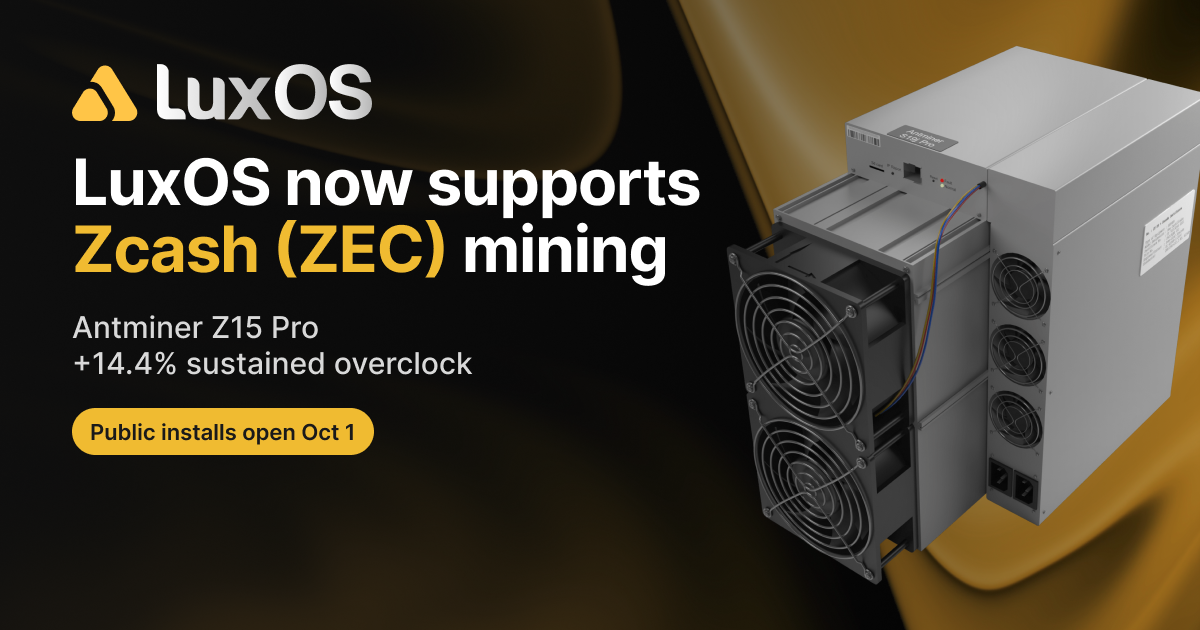
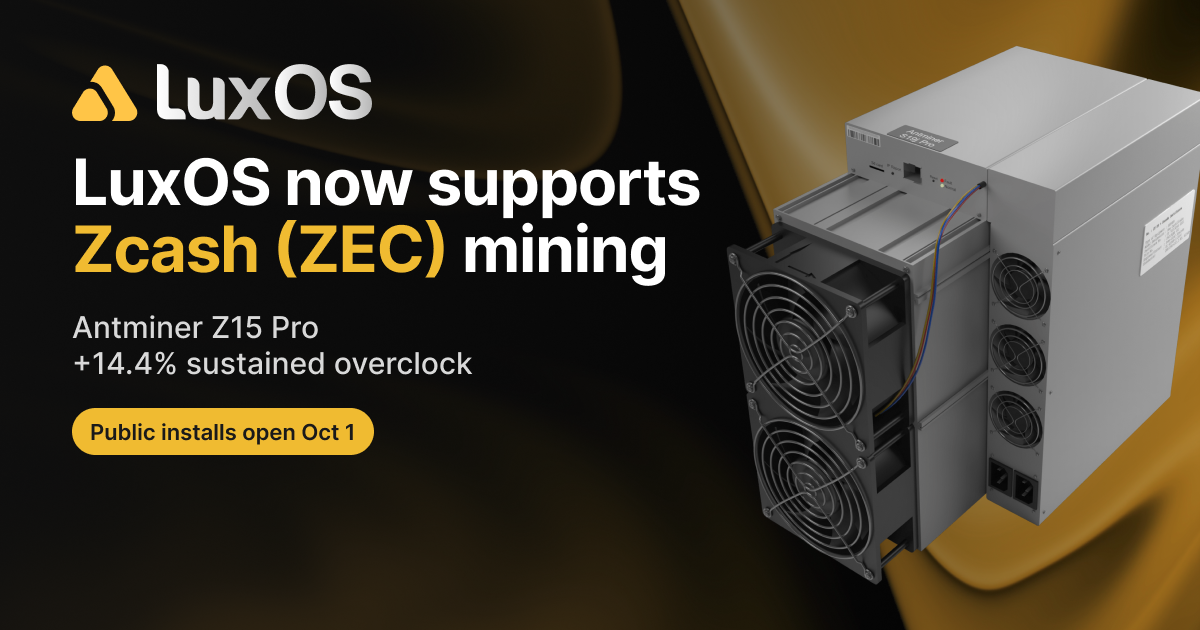
Luxor Technology Corporation has expanded the capabilities of its flagship mining operating system, announcing support for the Antminer Z15 Pro. This development marks the first time LuxOS has extended its advanced tuning, monitoring, and management stack beyond Bitcoin ASICs to an Equihash machine. Public installations for the new firmware are scheduled to open on October 1, 2026.
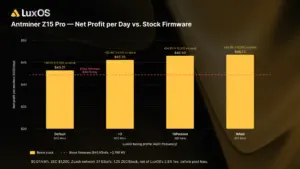
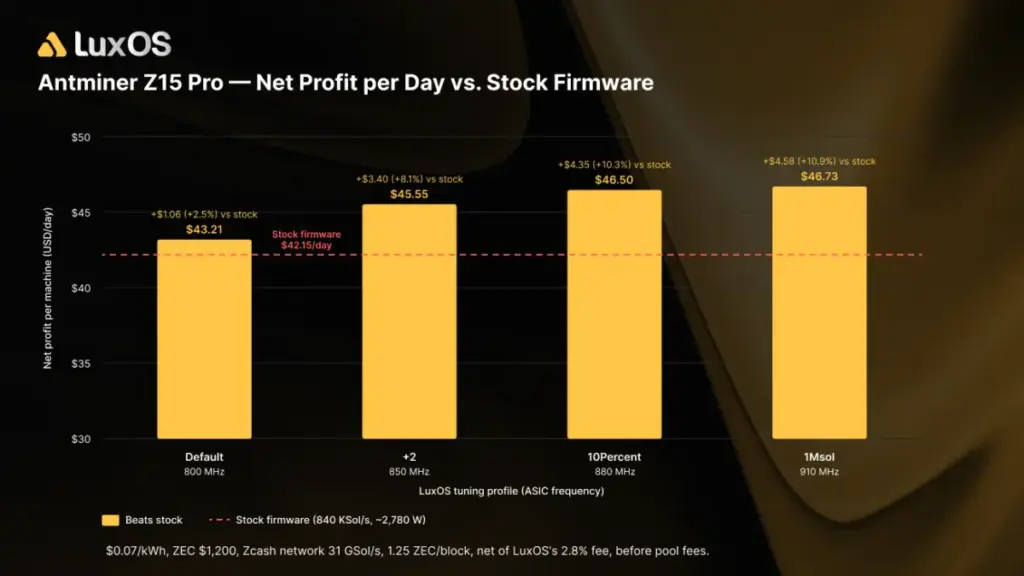
The integration comes at a notable time for the Zcash network. With ZEC trading near $1,200 and the network hashing at approximately 31 GSol/s, a stock Antminer Z15 Pro typically nets around $42 per day assuming a power cost of $0.07 per kWh. However, testing conducted by Luxor on early deployment units indicates that running LuxOS can elevate net earnings to approximately $47 per day under the same power pricing, even after accounting for the firmware’s 2.8% developer fee.
Bridging Bitcoin Fleet Management to Equihash Hardware
Until now, LuxOS has operated exclusively within the Bitcoin mining ecosystem, providing operators with granular controls, automated tuning profiles, and robust health diagnostics. The Antminer Z15 Pro represents a strategic shift, introducing those same enterprise-grade capabilities to Equihash hardware.
On stock firmware, the Antminer Z15 Pro functions as a rigid, fixed-performance box delivering roughly 840 KSol/s. Factory configurations do not offer supported methods for adjusting frequency or voltage, nor do they provide operators with per-chip performance metrics or advanced health scoring. By replacing factory controls with LuxOS, the firmware transforms the sealed unit into a fully customizable machine that can be calibrated to align with specific local power tariffs and cooling infrastructures.
The core trade-off introduced by firmware optimization remains consistent across mining hardware architectures: achieving higher hashrates per machine requires increased power consumption. Whether that efficiency trade makes financial sense depends heavily on regional electricity expenses and prevailing cryptocurrency market prices.
Financial Impact and Performance Metrics
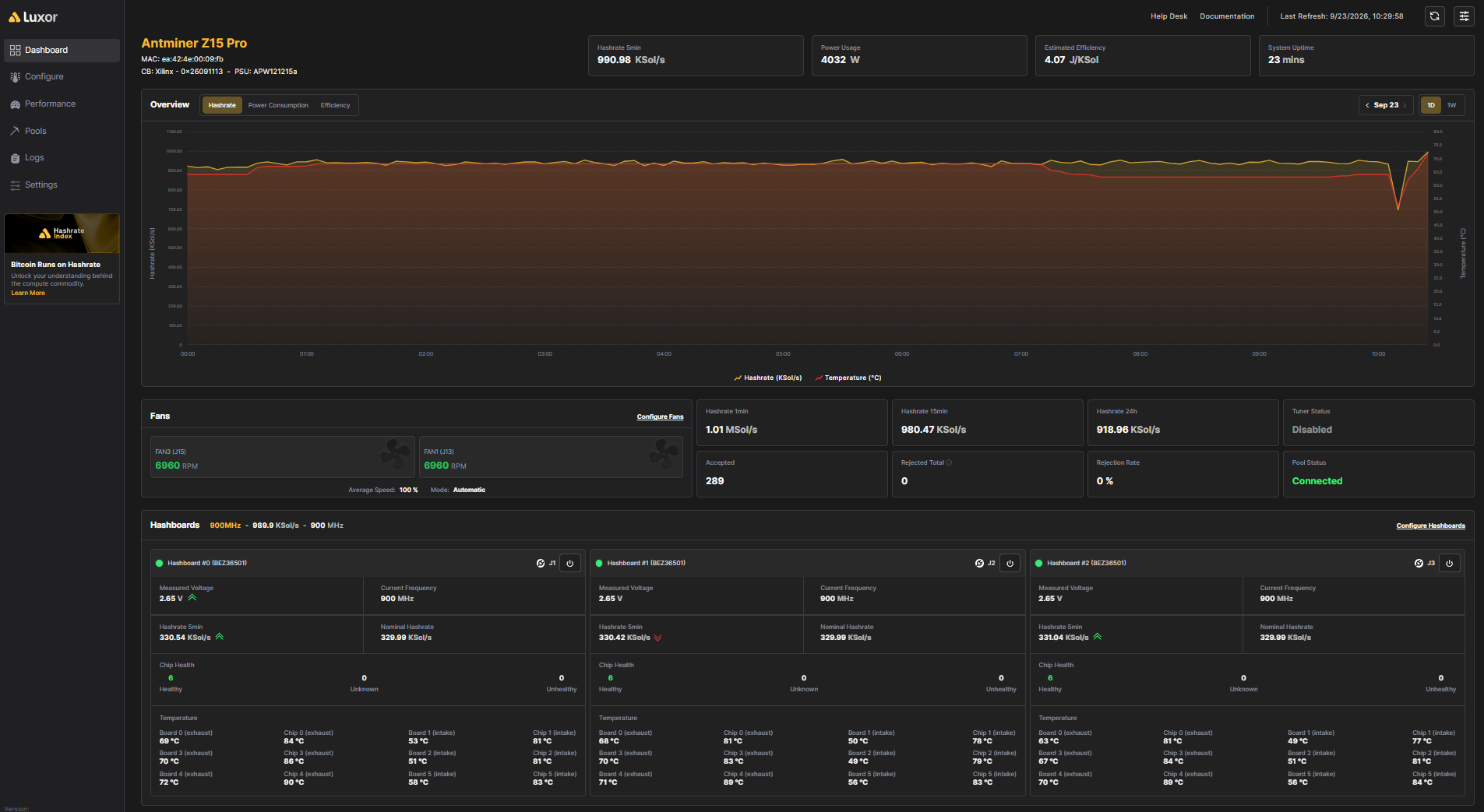
Under testing conditions measured in late September 2026, the LuxOS-equipped Antminer Z15 Pro achieved a sustained output of approximately 961 KSol/s net of the firmware fee, compared to the stock specification of 840 KSol/s. This performance increase comes with a rise in power draw, moving from a stock baseline of approximately 2,780 watts to roughly 4,032 watts on the tested performance profile.
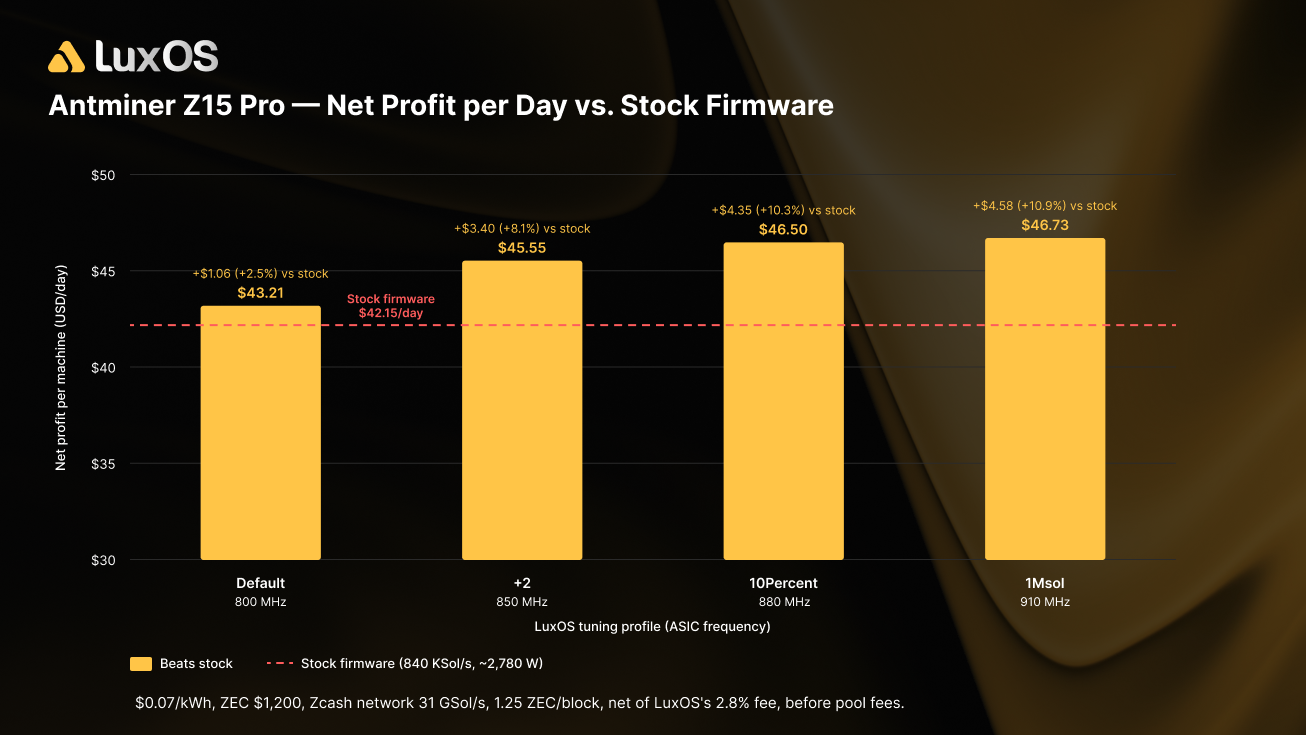
When evaluated against current network economics—assuming ZEC at $1,200, a network hashrate of 31 GSol/s, 1,152 blocks per day, and a miner reward of 1.25 ZEC per block—the financial implications become clear. Over an initial 90-day operational window following installation, a machine running LuxOS generates an estimated $4,223 in net earnings, compared to $3,794 on stock firmware. This creates a cumulative gap of $429 per machine.
For operators scaling their operations, this performance delta can influence capital expenditure recovery timelines. Based on hardware quotes for Asia EXW futures delivery, simple payback periods shorten from approximately 177 days on stock firmware down to roughly 159 days when running LuxOS, under the baseline market assumptions.
Key Sensitivities: Power Tariffs and Asset Pricing
Fleet profitability on the Z15 Pro under LuxOS remains sensitive to two primary variables: local electricity costs and the market price of Zcash.
An analysis of power cost sensitivities demonstrates that at a $1,200 ZEC valuation, the net daily financial gain provided by the overclock remains positive across standard industrial electricity rates. At $0.04 per kWh, the net gain reaches $5.67 per machine daily. At $0.07 per kWh, it sits at $4.77, dropping to $3.87 at $0.10 per kWh, and $2.36 at $0.15 per kWh. Calculations indicate that the overclock profile maintains gross-margin positivity up to roughly $0.23 per kWh, meaning nearly all grid-connected operators will see financial benefits, though higher power bills will capture a larger share of the gross revenue.
Conversely, asset price fluctuations introduce another layer of operational calculation. Holding electricity costs constant at $0.07 per kWh, the net daily gain from LuxOS tuning registers at $1.33 when ZEC trades at $600, scaling to $3.05 at $900, $4.77 at $1,200, and $6.48 at $1,500. The breakeven point for the aggressive tuning profile sits at approximately $370 per ZEC. If market prices fall below that threshold, the additional power required to sustain the higher hashrate outweighs the value of the extra rewards generated.
Network difficulty and broader hashrate expansion also act as equalizing forces. If total Zcash network hashrate climbs, gross revenues for both stock and optimized units adjust downward proportionally, preserving the relative percentage gap established by the firmware optimization.
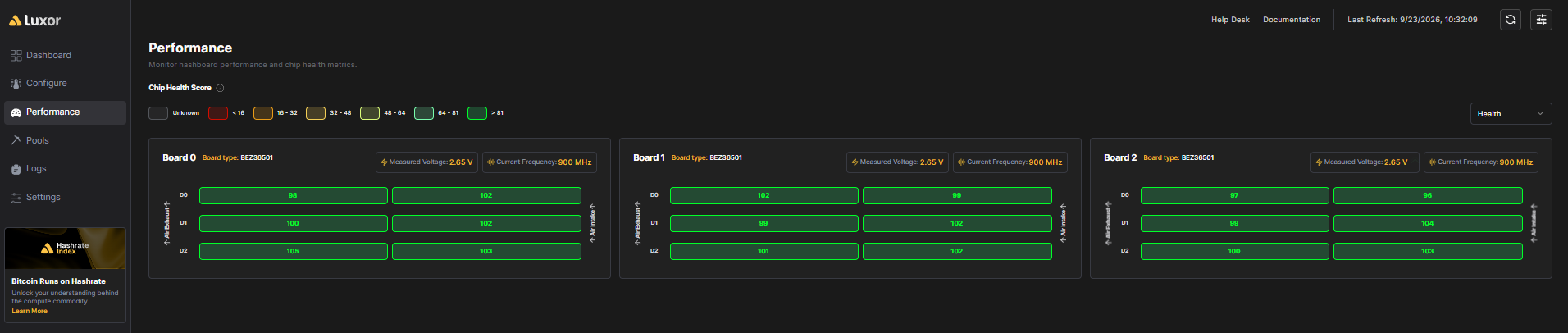
Fleet Visibility and Operational Controls
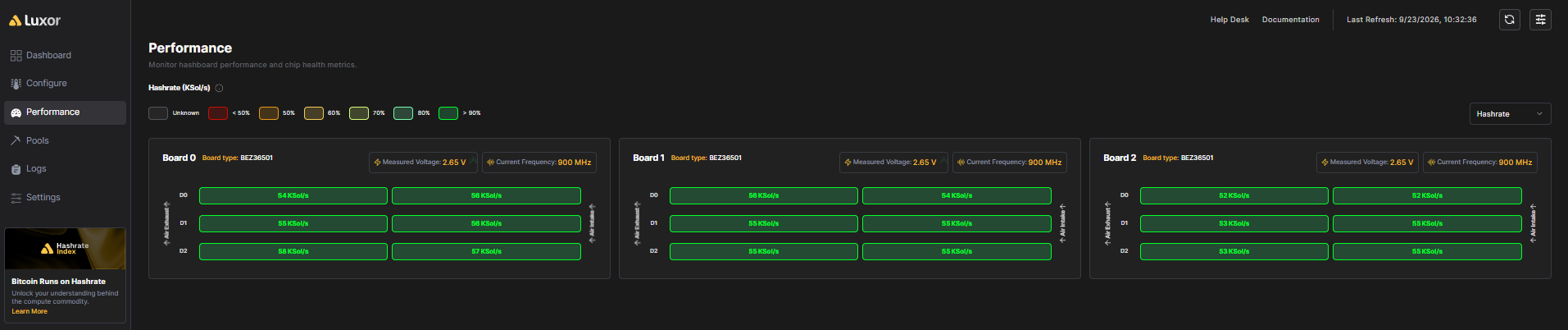
Beyond raw hashrate expansion, the introduction of LuxOS to the Z15 Pro provides operators with deep diagnostic visibility. Test telemetry from deployed units demonstrates stable performance, maintaining zero rejection rates and verifying the health of all onboard chips across extended operational cycles. The interface delivers per-chip hashrate tracking and granular health scoring across every hashboard, allowing mining operations to identify thermal anomalies or hardware degradation before they result in unexpected downtime.
Luxor has confirmed that the firmware remains pool-agnostic, allowing operators to direct their newly tuned machines to any existing Zcash mining pool without changing infrastructure. While early access and preview deployments are underway, public installation releases for the Z15 Pro are scheduled to roll out broadly at the beginning of October, with plans to evaluate support for additional Equihash hardware models as development continues.
 Cryptocurrency Mining
 Cryptocurrency Mining
 Cryptocurrency Mining