
More than 6,500 digital infrastructure leaders descended upon the Caesars Forum in Las Vegas for Yotta 2026, marking another milestone for an event that has rapidly doubled in size and outgrown its previous home at the MGM Grand. The gathering brought together over 600 chief executive officers, 300 speakers, and 350 exhibitors spread across more than 180 distinct sessions. Among the thousands on the ground were Luxor executives, including CEO Nick Hansen and COO Ethan Vera, who spent three days navigating discussions centered on powered shells, data center software, hardware scoping, and capital financing. Vera also appeared live from the press room on Blockspace Live to discuss the evolving landscape of compute derivatives and Luxor’s expanding artificial intelligence product suite.
While mainstream coverage of summits like Yotta frequently gravitates toward headline-grabbing chip architectures and raw megawatt figures, the deeper narrative for industry veterans lies in the physical realization, financing, and operation of enterprise compute infrastructure. As the digital infrastructure landscape matures, the underlying dynamics of how power, real estate, and silicon interact are undergoing a structural transformation.
The Language of Compute is Changing
Yotta co-founder George Rockett framed the event around a convergence that has effectively already taken place, noting that physical buildings, electrical power, advanced semiconductors, and financial capital stopped being separate conversations long ago. The conference agenda thoroughly reflected this reality, featuring dedicated tracks exploring the complexities of financing massive infrastructure buildouts, grid interconnections, graphics processing unit economics, zoning and permitting hurdles, and public acceptance.
What remains relatively new, however, is the evolving vocabulary dominating these boardrooms and panels. Terms like offtake, index, forward curve, residual value, and basis risk have transitioned from traditional commodity-market jargon into the default language for discussing GPUs. A buyer who, just three years ago, might have simply asked how many H100 units they could acquire now approaches the market with sophisticated questions regarding asset yields, utilization risk allocation, and the projected residual value of the hardware five years down the line.

This trajectory mirrors the evolution of Bitcoin mining. Application-specific compute, specifically SHA-256 hashrate, transformed over several years from an obscure technical specification into a transparently priced and easily hedgeable commodity. That progression required distinct milestones: a public reference price with hashprice in 2020, over-the-counter forwards in 2022, and eventually CFTC-approved listed futures by 2024. Today, general-purpose compute supporting artificial intelligence and high-performance computing finds itself positioned somewhere between the first and second steps of that established financial pathway.
Compute Derivatives Are Stuck on Index Construction, Not Demand
Even as three cash-settled compute futures initiatives move through the regulatory pipeline—including offerings from the CME Group utilizing Silicon Data’s H100 and B200 rental indexes, Intercontinental Exchange featuring Ornn’s Compute Price Index, and Nodal Exchange incorporating Compute Desk benchmarks—none have officially launched. The Commodity Futures Trading Commission notably extended its review period for the CME contracts by an additional 45 days, pushing a targeted October listing into November to examine complex questions regarding how easily GPU rental prices can be manipulated when transactions flow primarily through brokers, cloud platforms, and bilateral agreements.
Industry stakeholders emphasize that the delay stems from structural challenges surrounding index construction rather than a lack of market appetite. Existing indexes are predominantly built upon on-demand bare metal rentals, which represent a relatively thin slice of how compute actually trades in the broader marketplace. Most of the industry continues to transact through long-term bare metal rental agreements, while short-term contracts are frequently managed via token generation. Because long-term contracts remain proprietary and marketplaces share pricing metrics only when commercially advantageous, index providers face structural hurdles in securing enough data to clear rigorous regulatory standards.
This mirrors the OTC-first sequence observed in the SHA-256 hashrate forward market. While exchange-listed, cash-settled futures dominate financial headlines, the physical compute derivatives market already exists at a massive scale through long-term bare metal contracts established between neoclouds and frontier AI laboratories. As index providers and trading desks work to bridge these data gaps, publishing reference tools like the Ornn Compute Price Index and the AI Hardware Price Index provides the necessary transparency and price discovery required for a maturing asset class.

Token Margins Are Thin, While Compute Revenue Remains Bankable
Conversations among operators at Yotta consistently converged on a central tension: while nearly everyone agrees that the ultimate consumer-facing product is tokens, almost nobody has established a foolproof method for underwriting them. Selling AI tokens increasingly resembles a traditional commodity business rather than a high-margin software enterprise, driven by margin compression and fierce competition across the software stack.
Open-weights token prices are expected to eventually find a firm floor because providers running optimized servers on owned hardware cannot sustain double-digit gross margins below operational costs indefinitely. Frontier model pricing has already shown signs of stabilizing, and open-weights pricing should follow a similar trajectory. Concurrently, hardware data underscores the escalating financial stakes for operators. Medians on the AI Hardware Price Index price an 8-GPU B300 node significantly higher than preceding generations, reflecting rising capital requirements per node. Because this capital must generate returns regardless of short-term token price fluctuations, the most dependable revenue in the infrastructure stack belongs to those providing the underlying compute rather than those selling tokens.
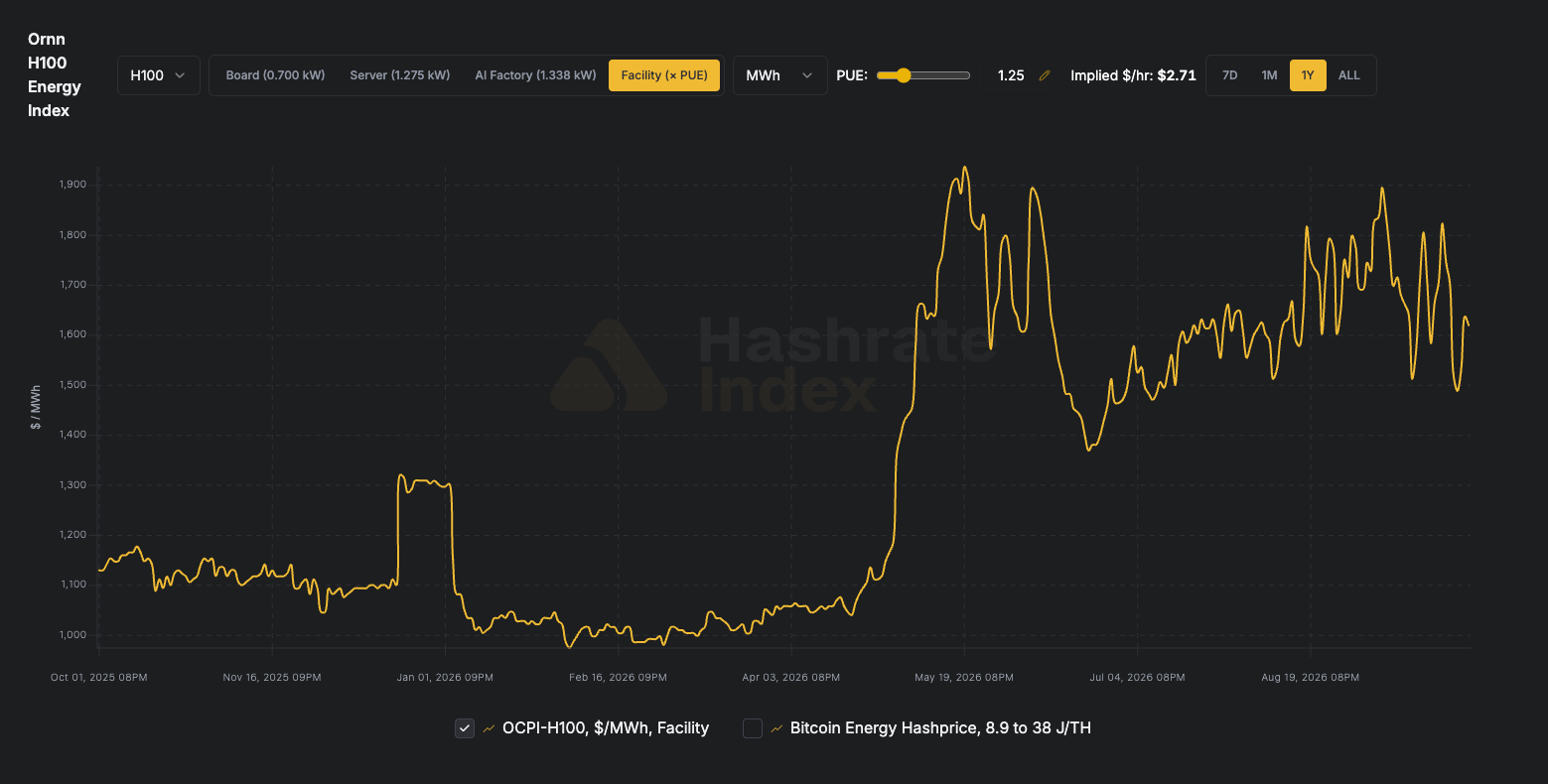
Labs either rent raw capacity or acquire hardware directly, but in both scenarios, they commit substantial capital upfront. This guaranteed commitment forms the bedrock of the compute provider’s revenue stream, shielding operators from the shifting popularity of specific artificial intelligence models. For data center site owners, success is measured not by token prices, but by the financial return generated when a unit of power operates a GPU, tracked closely through energy-denominated compute price indexes.
Financial backing is scaling rapidly to meet these infrastructure demands. Major financial institutions have entered memoranda of understanding with technology leaders to establish massive compute financing platforms targeting hundreds of billions of dollars in third-party capital, utilizing the hardware itself as collateral. This model treats GPU clusters similarly to toll roads or power plants, a framework that relies heavily on predictable, bankable revenue streams.

Modular Data Centers Move From Concept to Working Reality
Physical exhibitions at Yotta offered clear signals of hardware maturation, particularly within the outdoor Campus Exhibit on Forum Plaza. Attendees were able to walk directly inside working-scale modular data centers, microgrid generators, and closed-loop liquid cooling systems. A significant number of providers are moving beyond conceptual renderings, showcasing production-ready deployments designed to compress deployment timelines.
The primary driver behind this modular shift is project sequencing. While electrical interconnection approvals, regulatory permitting, and long-lead electrical equipment dictate the overall timeline, prefabricated infrastructure pods allow operators to accelerate deployment schedules. Unlike traditional mining containers that typically rely on forced-air cooling across ASICs, modern AI pods are sophisticated liquid-cooled environments engineered around high-density racks equipped with complex manifolds, coolant distribution units, and advanced leak detection mechanisms.
Procurement preferences are also shifting toward enterprise-grade reliability. Operators are increasingly demanding established hardware brands, comprehensive multi-year warranties, and immediate on-site technical support to ensure that multi-million-dollar clusters maintain high availability. This procurement philosophy represents a departure from traditional ASIC acquisition strategies, prioritizing operational uptime and robust vendor support over minimal upfront hardware costs.
International Interest Rises as Domestic Permitting Tightens
Domestic expansion faces mounting hurdles as electrical constraints are compounded by evolving regulatory policies. State-level moratoriums on new hyperscale data centers, growing numbers of localized zoning restrictions, and proposed federal oversight bills have complicated the development landscape. Combined with regional forecasts where power demand outpaces generation and transmission buildouts, the resulting regulatory and timeline risks are prompting capital to look abroad.
International markets are increasingly attracting infrastructure investment, supported by a notable shift in financing perspectives. Lenders and offtakers who historically viewed emerging-market compute as uninvestable are now willing to underwrite projects backed by creditworthy offtake agreements. Jurisdictional risk is increasingly treated as a pricing input rather than an outright disqualifier, provided the underlying contracts meet strict institutional standards.
This dynamic draws parallels to the global migration of Bitcoin mining hashrate toward regions with abundant, stranded energy resources. However, AI infrastructure introduces stricter latency limitations and heightened requirements for political and economic stability. Operators with established global footprints and grid-management experience are finding unique opportunities to bridge the gap between heavy capital availability and regional power constraints.
As Yotta 2026 demonstrated, digital infrastructure is rapidly evolving into a standardized commodity market complete with transparent pricing curves, structured credit facilities, and rigorous energy management demands. For the operators best positioned to navigate the intersection of power and silicon, the future belongs to those who stay closest to the source of energy.
 Cryptocurrency Mining
 Cryptocurrency Mining
 Cryptocurrency Mining