
The landscape of retail trading capital allocation has evolved significantly, introducing alternative pathways for traders seeking access to funded accounts. Among these developments, instant funding models have emerged as a prominent option, removing the traditional evaluation phase that historically sat between a retail trader and a funded account. Rather than navigating a multi-week challenge characterized by strict profit targets and drawdown rules, participants utilizing instant funding models pay an upfront fee to receive capital allocation immediately.
While this approach streamlines the process of accessing capital, it typically involves smaller initial allocations and a higher cost per dollar of exposure compared to traditional routes. Crucially, the fundamental evaluation concept does not disappear entirely; instead, it is relocated from the period before funding to the period after funding has been granted. This shift alters the risk-transfer dynamics between the funding provider and the trader, reshaping how early uncertainty and account management are handled in practice.
Why the Evaluation Exists at All
To understand the mechanics of instant funding, it is necessary to examine the underlying purpose of evaluation periods in modern proprietary trading models. A funding provider is fundamentally not gifting money to market participants; rather, it is renting its risk capacity in exchange for a share of any generated profits.
An evaluation period exists primarily because forcing a trader to prove consistency across dozens of distinct trades acts as a filter. This filtering mechanism helps separate sustainable trading results driven by repeatable decision-making from short-term outcomes driven purely by luck. Removing that filter at the outset does not eliminate the underlying problem of market uncertainty. Instead, it simply relocates who absorbs the early uncertainty: the trader is thrust directly into live conditions, while the provider assumes immediate exposure to unverified behavioral patterns.
How Instant Funding Actually Works
Skipping the traditional multi-week challenge does not mean skipping essential risk controls. Core safeguards such as daily loss limits, maximum drawdown thresholds, and conservative initial allocation sizes remain firmly in place. In many instances, these protective parameters are even tighter in instant funding models than in standard evaluations.
Funding providers systematically price the missing screening process directly into the upfront fee structure and the constrained allocation size, rather than absorbing the cost within a testing period. In essence, the trader is paying a premium for speed and immediate market access, rather than paying for looser or more lenient operational rules.
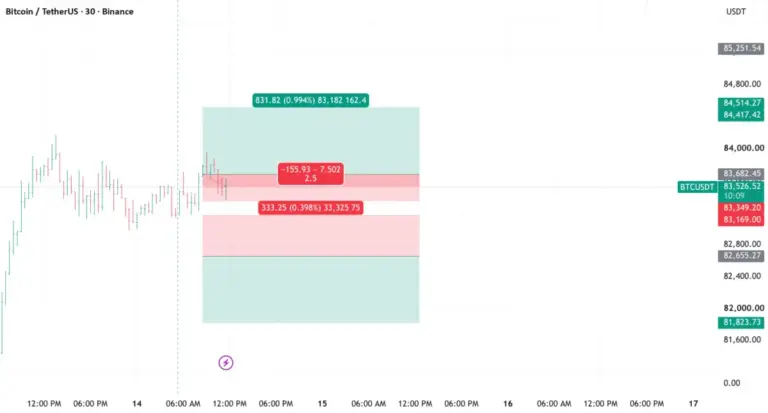
On a live market chart, such as the current one-hour view of BTCUSDT, this structural distinction matters directly to the participant’s survival. Sharp price wicks and rapid reversals that often look like normal, acceptable volatility on a one-hour timeframe can easily breach a daily loss limit within a matter of minutes. This danger escalates significantly if position sizing incorrectly assumes the account behaves like a personal trading account rather than a strictly rules-bound capital allocation.
A common misconception among market participants is treating the absence of a required challenge as synonymous with having no risk of losing the account. In reality, an instant funding account can be lost just as easily—and sometimes substantially faster—because there was no preliminary practice period to expose weak behavioral habits before real, unforgiving drawdown limits applied. Experienced market participants tend to view instant funding and traditional evaluations as two distinct risk-transfer structures, rather than classifying them simply as an easy path versus a hard one.
Balancing Trade-Offs and Strategic Objectives
The trade-off inherent in these models becomes straightforward once stated plainly: instant funding buys immediate time by placing capital in the trader’s hands right away, but it usually costs more per unit of capital and often caps position sizing lower until a verifiable track record is established. Conversely, a standard evaluation costs less upfront but demands weeks of disciplined, highly regulated execution before any external capital is genuinely at stake. Neither approach removes the fundamental need for a consistent, repeatable trading process; they only change the timeline of when that process gets tested by live market conditions.
Before choosing either path, it helps for a trader to evaluate what they are actually optimizing for. The core decision usually centers on whether the priority is speed to receiving funded capital or maximizing the probability of still holding that capital three months down the line. These are fundamentally different strategic goals, and operational choices such as position sizing, stop-loss placement, and trade frequency should accurately reflect whichever objective truly matters to the individual making the financial decision.
In practical execution, the chosen account type must actively shape behavior before the very first trade is placed. Position sizing needs to be calculated strictly against the hard drawdown limit imposed by the provider, rather than against personal risk tolerance alone. Daily loss limits must be treated as absolute hard stops for the day’s activity rather than soft targets or guidelines that can be bent under pressure.
Ultimately, the underlying principles governing these funding models remain clear: traditional challenges test consistency before funding is granted, while instant funding tests consistency after funding has been delivered. The operational rules do not disappear; they simply relocate. Consequently, cost and speed move in opposite directions, requiring traders to align their risk management frameworks with the structural realities of the capital model they choose to employ.
Disclaimer
The information and publications are not meant to be, and do not constitute, financial, investment, trading, or other types of advice or recommendations supplied or endorsed by TradingView. Read more in the Terms of Use.
 Crypto Investing & Trading
 Crypto Investing & Trading
 Crypto Investing & Trading