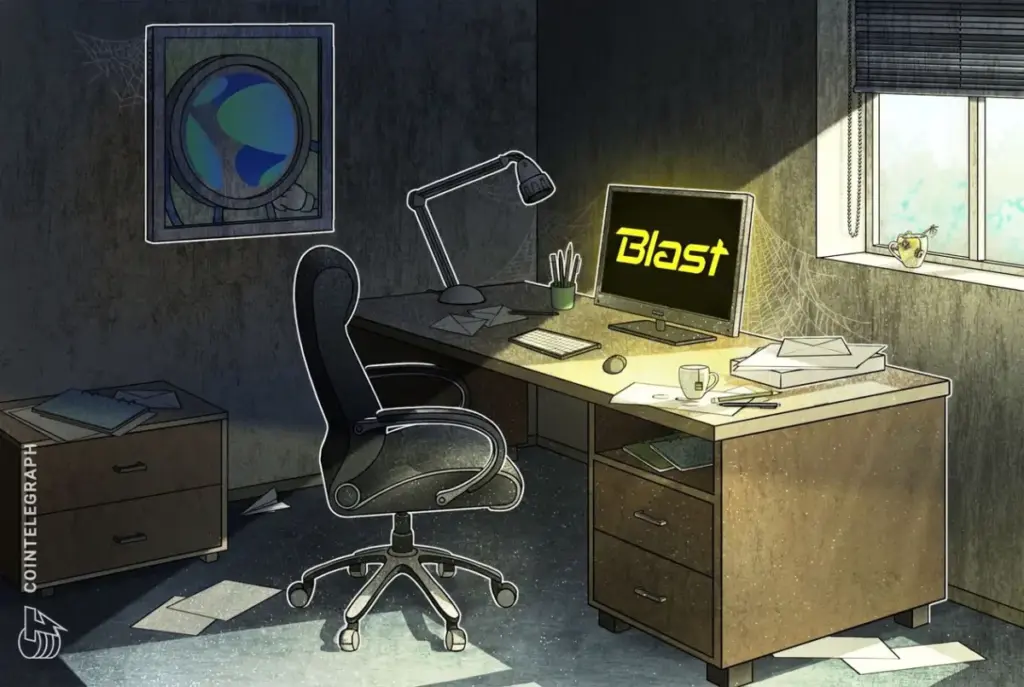
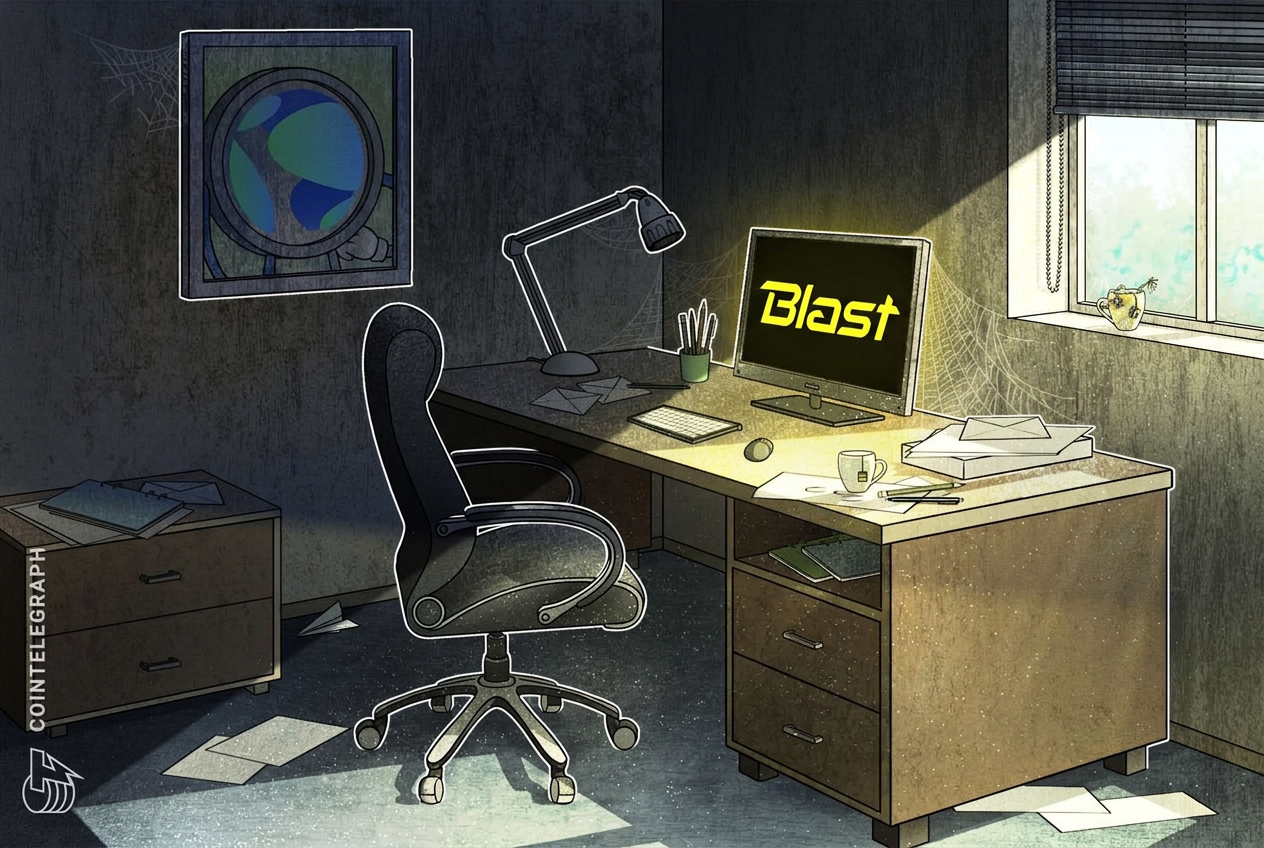
Ethereum layer-2 network Blast is shutting down its operations after finding that its ongoing operating costs have significantly exceeded the revenue generated by the blockchain network.
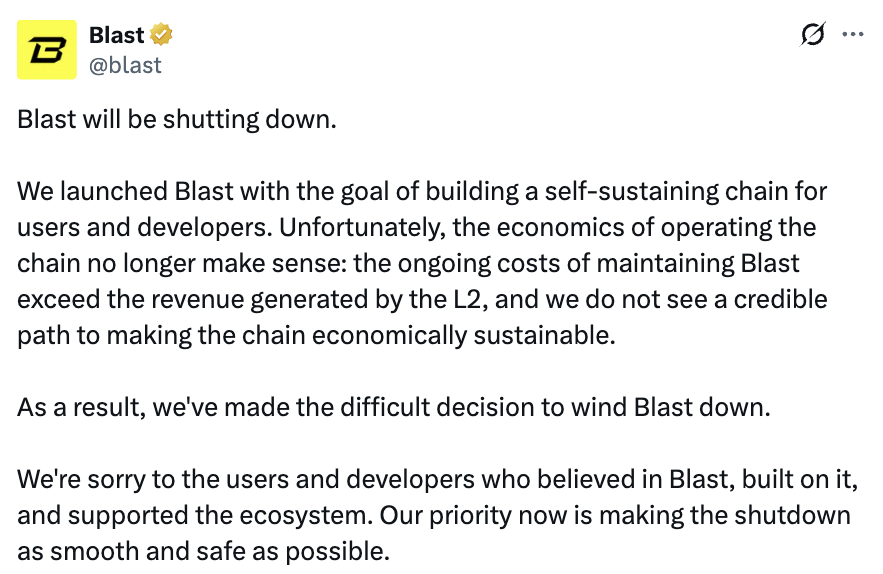
In a formal announcement shared on X on Friday, the Blast team revealed that there is no longer a "credible path" to achieving long-term economic sustainability for the chain. Consequently, the project operators have urged all users to withdraw their digital assets back to the Ethereum mainnet as the network prepares to wind down its infrastructure.
"We launched Blast with the goal of building a self-sustaining chain for users and developers," the team stated in their official communication on X. "Unfortunately, the economics of operating the chain no longer make sense."
To facilitate the wind-down process, the network will reduce its standard withdrawal delay period to 24 hours. However, the platform noted that withdrawals will be temporarily unavailable while Blast officially unwinds its Lido-staked assets, a complex technical procedure that is expected to take approximately one week to complete.
Users have been given a firm deadline of October 26 to withdraw their funds conveniently through Blast’s official user interface. Following this date, assets will technically remain accessible on-chain, but the standard web interface will no longer support simple point-and-click withdrawals. Instead, users who fail to act before the deadline will be required to interact directly with the underlying Blast bridge contracts deployed on the Ethereum mainnet.
The Blast team has confirmed that they will publish detailed instructions regarding how to withdraw funds directly through the bridge contracts ahead of the October 26 cutoff date. In the interim, the team has strongly urged all community members, liquidity providers, and developers to move their assets back to the Ethereum mainnet well in advance of the deadline to avoid any unnecessary complications.
Blast Emerged From Blur’s NFT Boom
The closure of Blast marks a striking downturn for a network that originated with immense momentum during a high-profile expansion phase for decentralized finance and non-fungible tokens. Blast was originally founded by Tieshun "Pacman" Roquerre, the visionary developer behind the prominent NFT marketplace Blur.
Blur officially launched in October 2022 with a strategic focus on catering to professional and high-volume NFT traders. By offering targeted token incentives, platform rewards, and optimized trading speeds, Blur rapidly challenged established giants in the sector, most notably OpenSea. By the end of 2022, Blur had successfully surpassed OpenSea in total trading volume, extending its dominant market lead into early 2023. This rapid ascendance was heavily fueled by its aggressive token airdrop campaigns and trader reward structures, which captured the attention of the broader cryptocurrency community.
Capitalizing on the success and brand recognition of Blur, Roquerre unveiled the concept for Blast in November 2023. The layer-2 scaling network was designed to offer native yield generation on Ether and prominent stablecoins, combined with an intensive points program tied to an anticipated and highly publicized token airdrop.
This multi-faceted marketing and financial strategy proved extraordinarily effective at attracting early liquidity. Before the network even launched its official public mainnet in February 2024, Blast had already accumulated more than $2 billion in total deposits from eager users seeking to maximize their yields and secure future token allocations.
However, Blast’s explosive initial growth ultimately proved difficult to sustain over the long term, particularly as the broader digital asset ecosystem faced a prolonged downturn in the non-fungible token market and shifting macro conditions within decentralized finance.
According to comprehensive market data from DefiLlama, Blast’s total value locked in decentralized finance experienced a relentless decline after peaking at approximately $2.2 billion in June 2024. In the months following that all-time high, the network’s TVL fell by more than 98%, stripping away the vast majority of the capital that had originally propelled its launch.
The parent ecosystem surrounding Blast experienced parallel struggles. Blur, the foundational NFT marketplace that birthed the network, underwent a similarly severe contraction in user activity and locked capital. At its early 2024 peak, Blur’s total value locked rose comfortably above $200 million. In the wake of shifting market dynamics and diminished trading volumes across the NFT sector, that figure has since plummeted, with Blur’s total value locked standing at roughly $27 million.
The convergence of plunging total value locked, declining network fees, and persistent operational overhead ultimately created a financial deficit that the Blast team could no longer justify absorbing. By choosing to shutter the network and guide users back to the Ethereum mainnet, the team is bringing an end to one of the most heavily capitalized, yet ultimately unsustainable, layer-2 experiments of the recent market cycle.
 Non-Fungible Tokens (NFTs)
 Non-Fungible Tokens (NFTs)
 Non-Fungible Tokens (NFTs)