In a coordinated international operation, law enforcement agencies from the United States and Europe have dismantled the primary web infrastructure of Virtualine, a prominent and prolific bulletproof hosting provider that served as a critical backbone for the global cybercrime ecosystem.
The U.S. Attorney’s Office for the Eastern District of Virginia and the FBI Washington Field Office announced the court-authorized seizure of virtualine.net on October 27, 2026. The high-profile takedown was executed with critical investigative and operational assistance from international partners, including Germany’s Polizei Hessen, the Netherlands’ Politie Midden-Nederland, and the United Kingdom’s National Crime Agency.
The operation also heavily relied on private-sector intelligence support. Blockchain analytics firm Chainalysis worked alongside OverRIPE, an independent coalition of security researchers and professionals dedicated to tracking and mitigating malicious hosting threats, to provide essential intelligence that helped international authorities disrupt Virtualine’s extensive infrastructure.
Understanding Bulletproof Hosting and Its Role in Cybercrime
Bulletproof hosting (BPH) providers represent a specialized and highly dangerous segment of the web and server hosting industry. These services deliberately ignore abuse complaints, Digital Millennium Copyright Act (DMCA) takedown notices, and formal inquiries or takedown requests from law enforcement agencies. By offering offshore infrastructure explicitly designed to resist disruption and censorship, BPH providers enable persistent, long-term criminal operations that would otherwise be shut down rapidly by standard hosting companies.
Throughout the digital underground, these providers facilitate a vast array of illegal activities. Their servers frequently house ransomware command-and-control infrastructure, sophisticated phishing kits, malware distribution networks, carding shops, infostealer logs, and illicit online marketplaces.
Virtualine—which operated under multiple aliases over the years, including Secury, Massgod, Spamhouse, Lanedo, and Omegatech—was particularly brazen in its operations. Rather than attempting to conceal its illicit business model behind a facade of legitimacy, the provider openly advertised its services to cybercriminals on prominent Russian-language and English-language cybercrime forums, such as Exploit.in and HackForums.
The provider’s public posture on these forums highlighted the sheer defiance typical of high-tier bulletproof hosts. In a September 2024 post on Exploit.in, a representative of Virtualine bluntly told a prospective user that the platform could be utilized for virtually any illicit activity. Specifically, the provider stated that customers could use Virtualine for all illegal and black-hat activities, explicitly naming phishing, carding, email spam, and port scanning, while carving out exceptions only for child exploitation content and terrorism.
The bravado continued into June 2025, when the provider boasted on HackForums that "Virtualine ignored more abuse than your last three therapists." As law enforcement pressure intensified globally, Virtualine even attempted to innovate its criminal business model. In March 2026, the provider began marketing what it called an "additional protection plan." This feature promised that upon receiving a formal law enforcement request or takedown notice, Virtualine would automatically migrate a customer’s criminal infrastructure to a shell company completely unaffiliated with Virtualine before reactivating the server elsewhere.

Despite publicly claiming to restrict certain severe harms—such as disclaiming the hosting of child sexual abuse material—federal prosecutors accuse Virtualine of severe hypocrisy and direct involvement in heinous offenses. According to the Justice Department, Virtualine knowingly hosted a criminal online forum that actively sold access to sexually suggestive and sexually explicit images and videos of both minors and adults. Furthermore, the platform promoted a hack-for-hire service designed to illicitly break into victims’ accounts and steal intimate content.
On-Chain Exposure to the Global Cybercrime Ecosystem
To facilitate payments from its criminal clientele while evading traditional financial oversight, Virtualine accepted direct Bitcoin payments through unhosted wallet addresses. This technical setup allowed cybercriminals to pay for hosting services without triggering standard Know-Your-Customer (KYC) or anti-money laundering compliance checks that are typically required at centralized, hosted cryptocurrency exchanges. Once the funds were collected, the Justice Department noted that Virtualine actively laundered the proceeds to obscure their illicit origins.
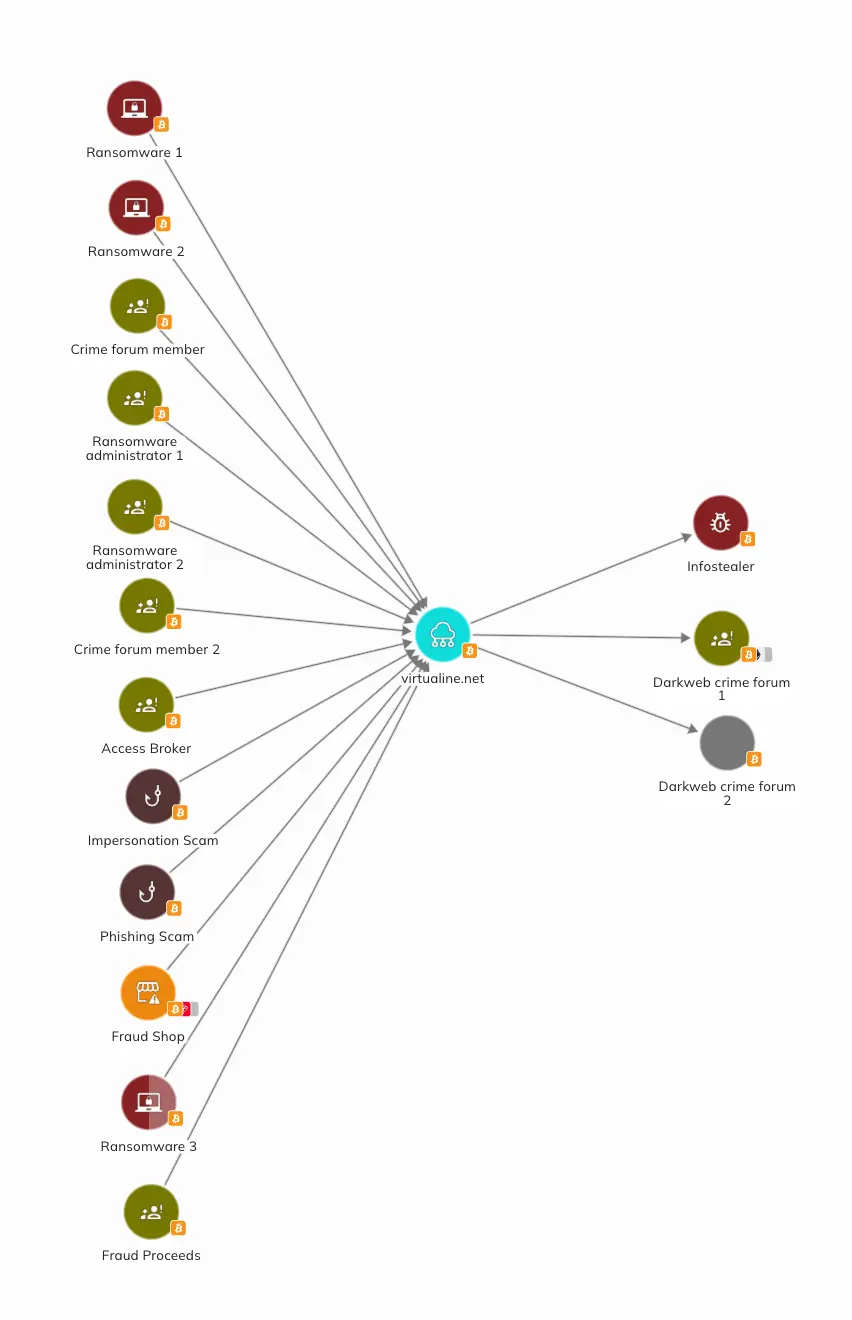
An examination of Virtualine’s financial footprint reveals deep integration with the wider criminal underground. Data and network mapping from Chainalysis Reactor demonstrate that Virtualine’s on-chain addresses maintained direct exposure to a broad cross-section of the global cybercrime economy. These wallets transacted with and received funds from prominent ransomware operators, infostealer infrastructure, Russian-language cybercrime forums, illicit marketplaces, and various scam and phishing operations.
This deep financial and operational interconnection illustrates the systemic role that bulletproof hosting providers play in sustaining the modern cybercrime economy. A single piece of BPH infrastructure does not merely serve one isolated criminal; instead, it simultaneously supports ransomware extortion campaigns, mass credential theft, digital fraud, and the distribution of illicit material, with cryptocurrency functioning as the common, borderless settlement layer that keeps the enterprise profitable.
Implications for Compliance Teams and the Cybersecurity Landscape
The successful seizure of the virtualine.net domain underscores a fundamental reality for cybersecurity and financial compliance professionals: bulletproof hosting providers are the foundational infrastructure that allows ransomware gangs, infostealer networks, and online fraud rings to scale their operations globally. Without reliable, disruption-resistant hosting, these criminal networks face constant operational friction and forced migrations.
For cryptocurrency compliance teams and financial institutions, exposure to payment addresses linked to known bulletproof hosting providers serves as an invaluable early warning signal of broader downstream risk. Wallets that interact with BPH services frequently cross paths with ransomware proceeds, fraudulent operations, and major cybercrime marketplace flows. Recognizing this systemic risk, Chainalysis has updated its product suite to label the cryptocurrency addresses associated with Virtualine, enabling compliance officers to flag and screen for these dangerous connections in real time.
The disruption of Virtualine marks a significant collaborative victory for international law enforcement and private-sector threat intelligence. By cutting off the web domain and exposing the financial conduits of a provider that openly mocked legal authorities, agencies in the United States, Germany, the Netherlands, and the United Kingdom have dealt a meaningful blow to the infrastructure underpinning international cybercrime.
 Crypto Wallets & Security
 Crypto Wallets & Security
 Crypto Wallets & Security