The cryptocurrency industry’s aggressive financial backing of United States Republican politicians has alienated Democratic lawmakers whose crucial support is ultimately required to pass comprehensive federal digital asset legislation, according to former New York Governor Andrew Cuomo.
Speaking during a high-profile panel alongside OKX CEO Star Xu at the Token2049 conference, Cuomo argued that the digital asset sector has heavily favored the Republican Party in an effort to fast-track major regulatory frameworks, most notably the CLARITY Act. While this strategy has succeeded in building formidable legislative momentum on one side of the aisle, it has simultaneously created a partisan divide that threatens to stall long-term regulatory certainty.
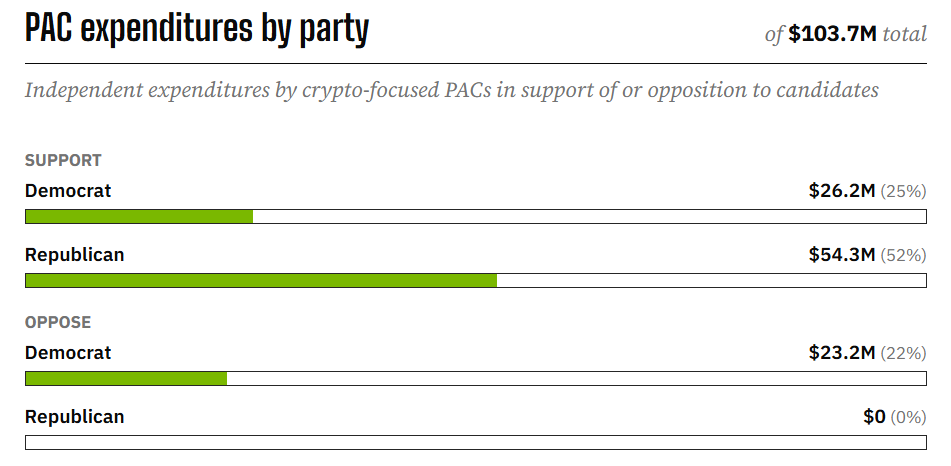
Data compiled by political finance monitors underscores this partisan disparity. According to figures tracked by Tech Influence Watch, crypto-focused political action committees have poured $54.3 million into supporting Republican candidates during the ongoing 2026 election cycle. By comparison, spending in support of Democratic candidates stands at a significantly lower $26.2 million. Furthermore, crypto-aligned PACs have directed an additional $23.2 million toward opposing Democratic candidates, highlighting a clear imbalance in electoral strategies.
"When you invest heavily in the Republican Party, by definition, you’re going to alienate Democrats," Cuomo stated during the panel discussion, pointing to the natural political friction such lopsided funding creates in Washington.

Despite these hurdles, the legislative landscape in Washington remains fluid. Prediction markets, including recent figures from Kalshi, have pointed to a shifting political climate, placing the probability of Democrats winning both chambers of Congress at roughly 61%. Cuomo noted that a Democratic-controlled Congress could pursue various paths regarding digital assets, ranging from attempting to roll back executive and agency-driven crypto initiatives implemented by the current administration to eventually collaborating with the White House to pass a bipartisan version of the CLARITY Act.
Emphasizing the absolute necessity of bipartisan cooperation in the divided capital, Cuomo warned that single-party reliance is insufficient for sustainable policy. "You need Democrats to pass the bill. You need Republicans. You have to be more balanced," he added.
Democrats Aren’t Anti-Crypto, Says Cuomo
Addressing common misconceptions within the digital asset community, Cuomo strongly pushed back against the narrative that the Democratic Party is inherently opposed to cryptocurrency and blockchain technology.
"There’s a sense that Democrats are anti-crypto," Cuomo remarked, challenging the prevailing industry sentiment. "As a matter of fact, I could argue that the crypto technology is exactly suited to the Democratic Party. It’s empowering people who otherwise wouldn’t have access to financial products, and the Democratic Party has been working to do that all its life."
While major cryptocurrency legislation has historically attracted votes from both sides of the aisle, Republicans have generally maintained a much higher level of internal unity when voting on primary industry bills. The legislative record shows notable instances of bipartisan cooperation alongside deep partisan splits. In July 2025, 78 House Democrats crossed party lines to join 216 Republicans in passing the CLARITY Act, though the measure still faced opposition from 134 Democrats who voted against it. In the Senate, a separate milestone was reached in June 2025 when 18 Democratic senators supported the passage of the GENIUS Act.
However, partisan tensions flared later in the year. During a September procedural vote in the Senate, all participating Democratic senators alongside four Republicans voted against advancing the CLARITY Act. Much of the Democratic opposition at that time was driven by mounting concerns regarding potential conflicts of interest tied to digital asset businesses associated with the Trump administration.
Despite these legislative roadblocks, channels for dialogue have remained open. Following the stalled procedural vote, a group of seven Democratic senators issued a joint statement reaffirming their ongoing commitment to working toward the successful passage of the CLARITY Act.
Major industry political action committees are also showing signs of a more diversified electoral approach. Fairshake, one of the most prominent crypto-focused PACs in the United States, announced that it would back 32 House candidates ahead of the upcoming November midterm elections. The endorsement list reflects a deliberate effort to reach across the political aisle, comprising 19 Republican candidates and 13 Democrats, as the sector navigates the complex realities of American electoral politics in pursuit of enduring regulatory frameworks.
 Crypto Regulation & Policy
 Crypto Regulation & Policy
 Crypto Regulation & Policy