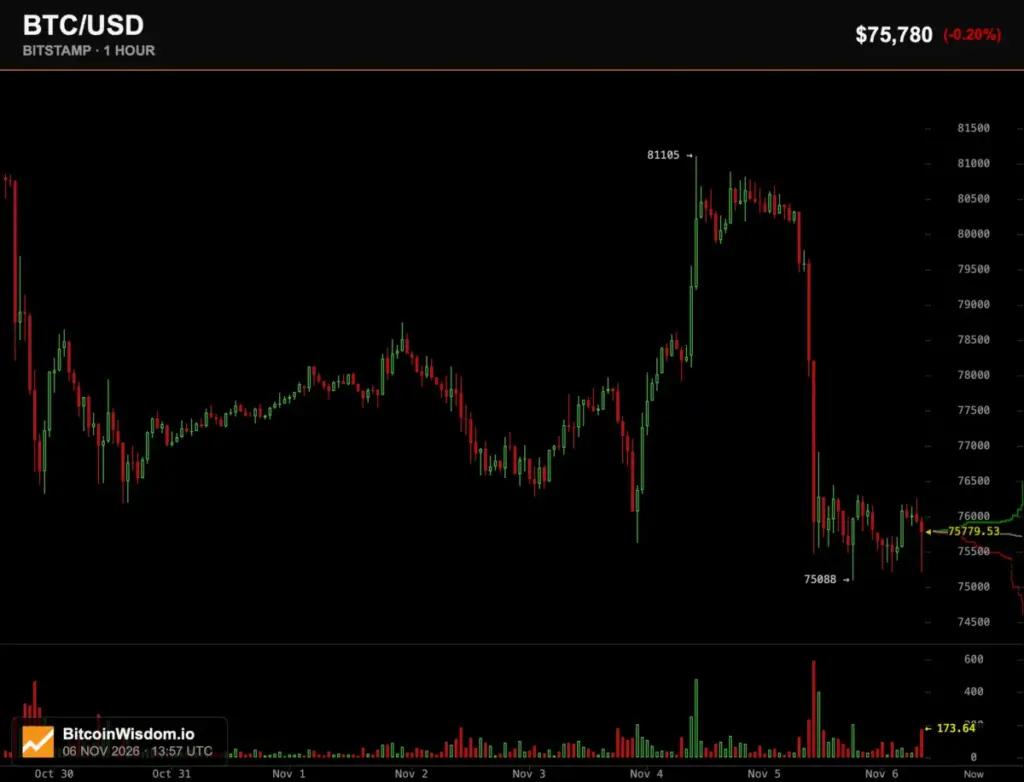
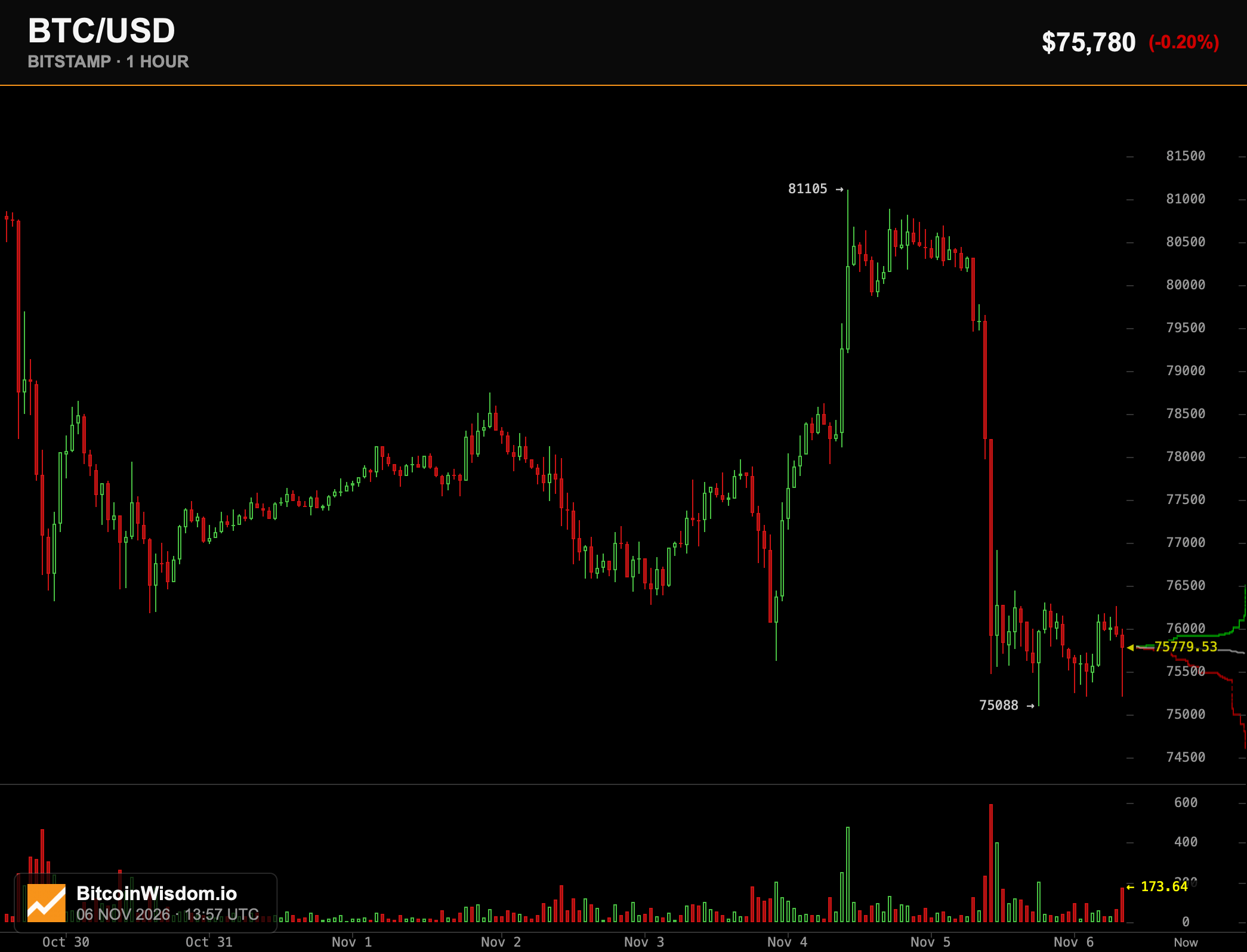
Bitcoin derivatives markets experienced a notable wave of deleveraging and repositioning as the leading cryptocurrency pulled back sharply from its recent local highs. Bitcoin futures open interest fell by 1.88% over a 24-hour window, settling at $52.04 billion. The contraction in market exposure coincided with a nearly 5% decline in the cryptocurrency’s spot price, bringing bitcoin down to $75,783 during early trading hours on Friday, Nov. 6, 2026.
Data compiled by cryptocurrency analytics platform Coinglass revealed declining exposure across several major centralized derivatives exchanges. At the same time, a closer examination of the options market exposed a curious divergence between outstanding positions and daily trading volume. While long-term call options continued to dominate overall open interest, put options surged in recent trading volume. With billions of dollars in contracts tied to upcoming November and December expirations, market participants are now left confronting competing expectations regarding bitcoin’s next major directional move.
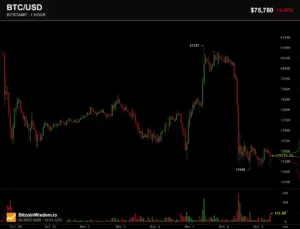
The latest downward price pressure follows a period of robust upward momentum that earlier in the week pushed bitcoin to a local high of $81,105 on Bitstamp. However, the asset quickly reversed course, retreating to a low of $75,088 and marking a roughly 7.4% correction from its weekly peak. This sudden sell-off injected a fresh wave of caution into the broader derivatives landscape, prompting active traders to scale back their risk profiles and reduce leverage across the board.
Bitcoin Futures Open Interest Drops as Traders Reduce Exposure
According to Coinglass metrics, aggregate bitcoin futures open interest stood at 686,570 BTC, translating to a nominal value of approximately $52.04 billion. A granular look at the data showed that open interest steadily eroded across multiple timeframes, dipping 0.50% over the preceding hour, 0.75% over four hours, and 1.88% across the full 24-hour cycle.
Among individual platforms, Binance maintained the largest share of the market, commanding $10.58 billion in open interest, which accounted for roughly 20.33% of the global total. The Chicago Mercantile Exchange (CME) followed closely behind with $7.13 billion, while institutional and retail favorite Bybit accounted for $6.11 billion. The derivatives contraction was broadly distributed among the industry heavyweights, with CME recording a 4.46% daily reduction that nearly mirrored Binance’s 4.45% contraction.
Other major venues experienced similar downward adjustments. Bitget saw its open interest decline by 4.96%, though certain platforms bucked the prevailing trend, such as Gate, which registered a 5.21% increase over the same period. Financial analysts note that falling open interest generally signifies that market participants are actively closing out existing positions rather than rolling them over. However, because these figures are denominated in fiat currency, the sharp drop in bitcoin’s spot valuation also naturally deflated the total dollar-value of outstanding exposure. Consequently, these macro statistics alone cannot fully determine the exact degree of leverage that has been unwound from the system.
Bitcoin Options Show Calls Leading Open Interest While Puts Dominate Volume
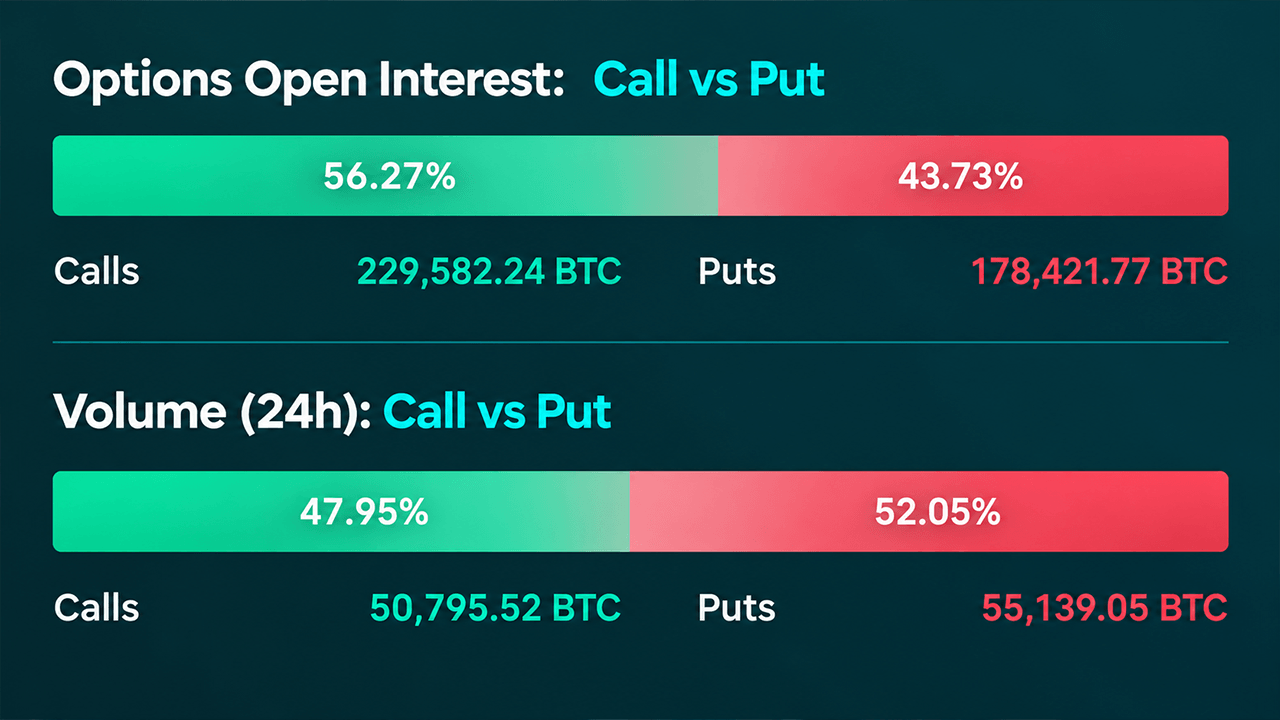
While the futures market pointed toward a straightforward reduction in active risk, the options market presented a far more complex and layered picture. Coinglass statistics revealed that call options continued to represent the majority of outstanding bitcoin options positions, accounting for 56.27% of the total with 229,582.24 BTC. In comparison, put options lagged behind in cumulative open interest, holding 178,421.77 BTC.
Yet, when shifting the focus to short-term trading velocity, the volume metrics told an entirely different story. Over a 24-hour window, put option volume surged to 55,139.05 BTC, capturing 52.05% of total market activity, while call options trailed slightly with 50,795.52 BTC traded. This stark divergence indicates that while legacy and longer-term positioning remains heavily tilted toward bullish upside exposure through calls, recent transactional flow has heavily favored downside protection via puts.
Market researchers emphasize, however, that an increase in put trading volume does not necessarily translate to outright bearish speculation or panic selling. Traders frequently purchase put options as an insurance policy to hedge existing long portfolios against sudden market downturns, or they may be actively selling puts and closing out older contracts depending on their individual trading strategies.
Data from Deribit, the world’s leading cryptocurrency options exchange by volume, highlighted the diverse strike prices capturing market attention. Deribit’s largest single listed open interest position resided in the Dec. 25 $80,000 call, which carried an impressive 8,143.1 BTC in open interest. This was followed closely by the $100,000 call holding 6,737.2 BTC, while the $60,000 put accounted for a substantial 6,629.4 BTC. These contrasting figures illustrate that traders are maintaining significant exposure to ambitious higher valuations while simultaneously holding robust downside barriers at much lower price levels.
November Bitcoin Options Expiration Draws Attention to $74,000 Puts
As traders looked toward the near-term calendar, attention quickly gravitated toward the upcoming November expiries. Deribit’s Nov. 27 contracts dominated the 24-hour options volume rankings, with downside strikes capturing the vast majority of market turnover.
The $74,000 put led the charge with 2,259 BTC traded, closely followed by the $69,000 put at 1,736.8 BTC and the $75,000 put at 1,634.7 BTC. The tight clustering of these heavily traded contracts around and just below bitcoin’s prevailing market price on Friday placed downside strike prices squarely at the center of recent market activity.
Coinglass expiration statistics further illuminated the structural positioning across major exchanges, showing that Deribit’s largest displayed notional concentration centered around the Dec. 25 expiry, where the theoretical max-pain price hovered near $76,000. By contrast, Binance’s largest displayed concentration pointed toward the Nov. 27 expiration, where the max-pain level stood higher at approximately $80,000.
In derivatives theory, the max-pain price represents the specific settlement level at which the aggregate payout to all outstanding options holders is minimized. While derivatives traders frequently monitor these calculations to gauge potential price gravitation as expiration dates approach, financial experts routinely caution that the metric does not serve as a guarantee of where the underlying asset’s price will ultimately settle.
CME Bitcoin Options Open Interest Contracts From Earlier 2026 Peaks
Broader structural trends across institutional platforms also highlighted a cooling off period compared to earlier in the year. Data from CryptoQuant detailing CME options activity illustrated a substantial contraction when compared to the elevated positioning recorded during the market spikes of February and March 2026. Recent institutional activity has remained largely anchored to shorter-dated expirations, while the pronounced, put-heavy spikes that characterized earlier months have largely dissipated.
These CME figures stand in contrast to the broader cryptocurrency derivatives ecosystem, where aggregate bitcoin futures open interest still manages to hold comfortably above the $52 billion threshold despite the latest round of market liquidations and contractions. Furthermore, historical Coinglass metrics confirm that total futures exposure remains considerably below the speculative peaks recorded during previous market cycles, suggesting that traders have already purged significant amounts of systemic leverage over recent months.
The fundamental distinction between futures and options markets remains critical when analyzing these trends. Futures open interest measures outstanding contracts that expose investors directly to underlying price fluctuations, whereas options provide market participants with flexible instruments to express directional views or hedge against adverse volatility.
Even as bitcoin successfully holds its ground above the $75,000 threshold, its spot valuation remains precariously close to the heavily traded $73,000 and $74,000 November put strikes. Meanwhile, late-quarter December contracts continue to maintain substantial upside exposure. The ongoing reduction in futures open interest points to a general trimming of speculative risk, but the complex dynamics within the options market reveal a deeply divided trader base—one where bullish calls dominate existing structural inventories, yet bearish puts command the lion’s share of immediate daily trading volume.
 Bitcoin & Major Altcoins
 Bitcoin & Major Altcoins
 Bitcoin & Major Altcoins