Crypto asset investors monitoring market trends for tactical positioning now have two new data sets to evaluate, though both require careful context. Recent onchain metrics show that the number of nonempty bitcoin wallets has declined by nearly 109,000 in less than a month, while users have rushed to create more than 900,000 wallets on the popular messaging application Telegram within a mere 48-hour window. However, a deeper examination reveals that the contraction in bitcoin addresses is far from dramatic, while the massive surge in Telegram wallet creation is not nearly as impressive as initial figures might suggest.
Onchain analysts at Santiment recently highlighted that the total count of nonempty Bitcoin wallets reached 59.99 million on October 16 before declining by just under 0.2% by November 10. While Santiment categorized this modest shift as an indication that retail investors are giving up, the analytics firm was quick to clarify that this trend does not automatically signal a shrinking utility for the world’s largest cryptocurrency. In fact, they noted that such behavior could ultimately develop into a positive indicator for the broader market cycle.
Potentially Bullish, Again
During extended market downturns, smaller retail traders frequently consolidate holdings or completely empty their wallets as prevailing fear intensifies across the ecosystem. According to historical market behavior, this specific type of retail capitulation has frequently served as a necessary foundational
ingredient preceding many of the major cryptocurrency market recoveries. Santiment analysts noted that this particular signal becomes increasingly bullish if wallet balances continue to drop while the underlying asset price stabilizes and stops falling.
As previously reported by market analysts in late October, Santiment had already suggested that a bitcoin price bottom might be approaching as the network observed roughly 30,000 fewer active nonempty wallets compared to the mid-October peak. Analysts cautioned at the time that a sustained breakdown below the $79,000 threshold would likely delay the arrival of a potential market bottom. In the weeks following that observation, BTC has pulled back by roughly 7%, trading near the $74,000 range at the time of reporting.
Same Bitcoin, Different Numbers
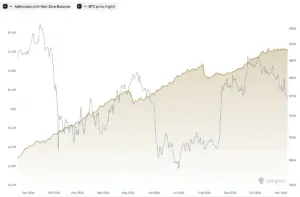
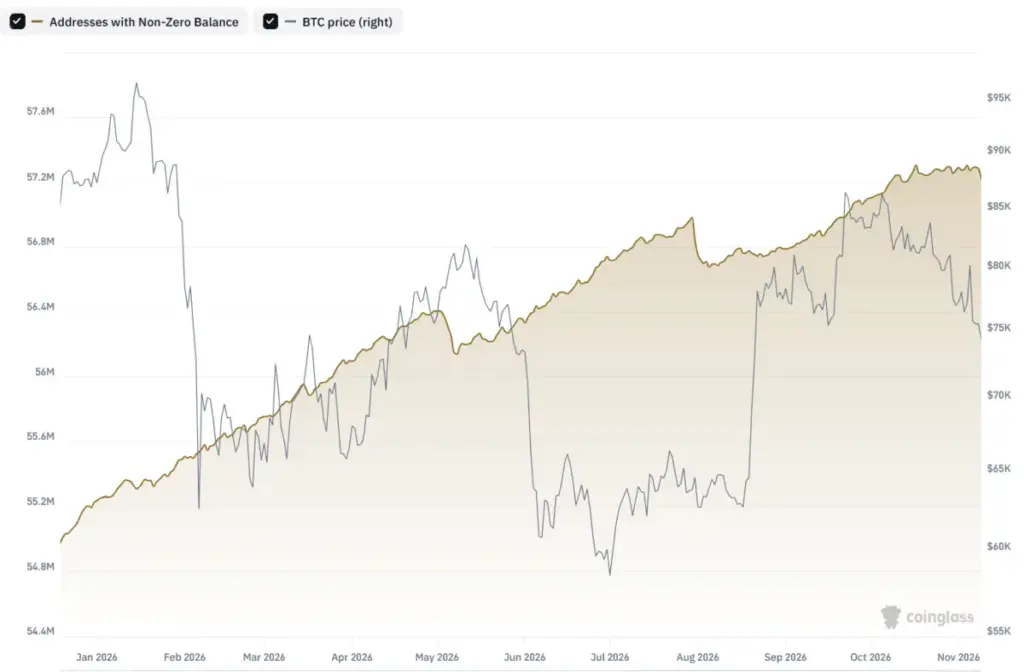
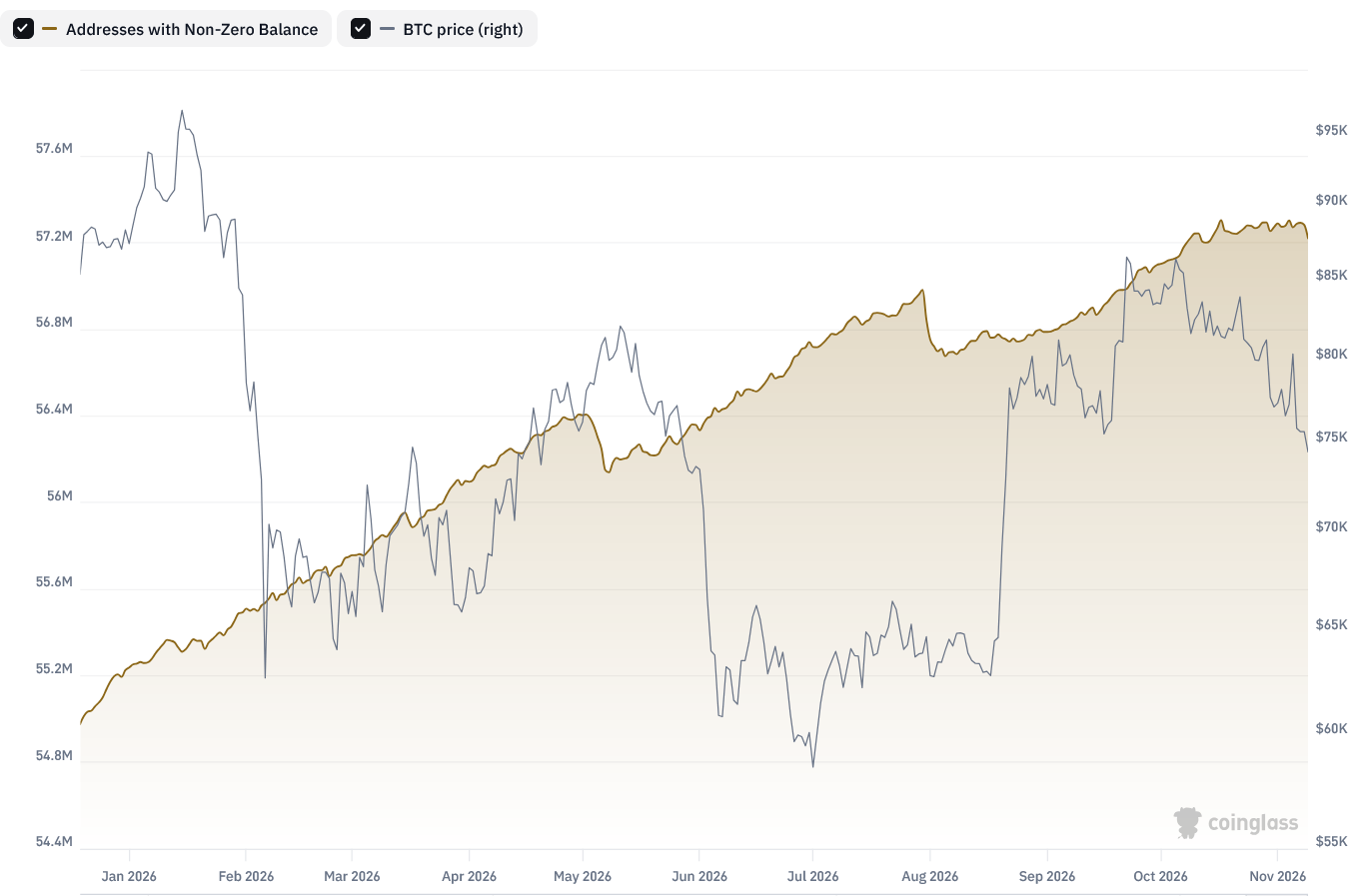
Navigating onchain analytics often reveals discrepancies, just as there is no single uniform price for bitcoin across various global trading platforms. Different onchain tracking providers frequently report varying figures for the exact same metrics due to methodological differences in address classification. For instance, data from Coinglass indicates that the total number of nonempty BTC wallets reached a record 57.3 million on October 17, which is roughly 2.7 million lower than the figures reported by Santiment.
Furthermore, Coinglass data showed that by November 8, the metric remained virtually unchanged, standing just 0.04% lower than the previous period. When compared against the data from 30 days prior, the metric actually registered a slight increase of 0.1%. These minor fluctuations underscore the challenge of relying solely on address counts to gauge retail investor sentiment, particularly because a significant portion of modern crypto buyers acquire bitcoin through centralized custodial exchanges or gain exposure via spot exchange-traded funds, neither of which requires the creation of an individual, self-hosted onchain wallet.
Many New Wallets, Few Funded Ones
Turning attention to the messaging application space, Telegram’s ecosystem metrics have also sparked widespread discussion. Pavel Durov, the co-founder and CEO of Telegram, announced on November 9 that more than 700,000 wallets—commercially referred to as Money wallets—had been created on the platform over the preceding 48 hours. By the time of this writing, that figure had quickly escalated to surpass 930,000 creations over a similar two-day window, bringing the cumulative total of generated wallets to nearly 2.85 million.
However, data sourced from GRAM Explorer paints a more sobering picture of actual network utilization. Out of the nearly 2.85 million wallets generated, only about 178,000 maintained an active balance, a figure that fluctuated continuously during the reporting period. These funded wallets collectively held approximately 1.73 million GRAM tokens, formerly known as Toncoin, representing a fiat value of roughly $1.9 million. This calculates to an average holding of approximately 9.7 GRAM, or roughly $11, per funded wallet.
Activity within the Telegram ecosystem remains robust despite low initial balances. On November 9 alone, Telegram wallets facilitated more than 675,000 onchain transactions, representing a 59% increase compared to the previous day’s volume. However, public blockchain explorers do not currently provide historical historical data tracking the precise velocity of changes in funded wallet counts over longer horizons.
According to technical documentation provided by the Ton network, the native wallet interface typically appears within the application only after Telegram enables explicit wallet access for a given user account. Despite this UI restriction, users are technically capable of receiving GRAM tokens even if they have not yet formally opened or activated the wallet interface. The native wallet infrastructure supports GRAM alongside various Telegram digital collectibles, including platform gifts and unique usernames, while its underlying smart contract architecture is designed to accommodate other tokens issued natively on the Telegram-supported Ton blockchain.
Empty Wallet Potential vs. Reality
Consequently, the metrics shared publicly by platform leadership and blockchain explorers largely reflect the high-speed deployment of wallet accessibility features and the initial influx of token distributions, rather than sustained, active participation. At present, only about 6% of the total opened wallets maintain an active token balance. Given that Telegram boasts a massive user base exceeding 1 billion monthly active users, the current pool of funded wallets represents less than 0.29% of the platform’s total monthly audience. Telegram initially introduced these wallet features to a limited cohort of users in late August before expanding availability significantly on October 9.
A similar dynamic can be observed within the Bitcoin network, where more than 200,000 new addresses continue to be generated on a daily basis. Despite this steady stream of address creation, the metric offers limited insight into whether genuine net-new users are joining the network. Because Bitcoin wallets natively generate a fresh, unique address for virtually every individual transaction to enhance privacy and security, a single user frequently cycles through numerous addresses, many of which are utilized only once.
GRAM Crashed Despite Wallet Rollout
Ultimately, the recent fluctuations observed in both bitcoin and Telegram wallet statistics largely constitute short-term market noise when viewed against a broader macroeconomic and structural backdrop. Over the course of the year, the total count of nonempty Bitcoin wallets has managed a steady increase of nearly 4%. Conversely, with only about 6% of newly created Telegram Money wallets holding any balance while the broader rollout continues, the future adoption curve remains speculative. If current onboarding rates hold steady over time, theoretical projections suggest that upwards of 60 million Telegram users could eventually maintain funded wallets.
Despite the heavy focus on network metrics and wallet deployments, token valuations have faced severe downward pressure. Bitcoin has experienced declines of roughly 11% over a 30-day period and roughly 30% over a 1-year timeframe. Meanwhile, GRAM has suffered even steeper contractions, falling 25% and 49% over the same respective periods. To date, the much-anticipated wallet rollout has failed to provide a meaningful catalyst for GRAM’s price action. Since Telegram formally expanded broad wallet access on October 9, the token has declined at a rate more than twice as severe as bitcoin, despite managing a modest 5% daily bounce on November 10.
 Bitcoin & Major Altcoins
 Bitcoin & Major Altcoins
 Bitcoin & Major Altcoins