DefiLlama, long established as a dominant force in cryptocurrency analytics and data aggregation, is leveraging its market positioning to enter the prediction sector by settling bets based directly on its own data feeds.
On October 20, DefiLlama announced a strategic partnership with Trueo, a permissionless prediction market protocol operating on Base. The collaboration introduces a suite of decentralized markets that settle dynamically using DefiLlama metrics. These initial offerings cover critical onchain verticals, including protocol revenue, DeFi exploits, and high-profile chain metrics, bringing a novel layer of forecasting and financial instruments to the decentralized finance ecosystem.
In the current market landscape, protocol revenue has emerged as a central narrative for valuing decentralized applications, operating similarly to traditional earnings for corporate businesses. Conversely, security breaches and protocol exploits remain one of the industry’s most persistent vulnerabilities. The new markets created through the DefiLlama and Trueo collaboration attempt to put a live, crowd-priced value on both of these distinct operational realities. While the venues are still in their infancy and currently feature modest liquidity pools, industry participants anticipate that these structured forecasting opportunities could gain significant traction as the onchain economy matures.
How the Markets Work
The initial deployment features a diverse array of monthly and weekly offerings. The current slate spans six monthly revenue targets tracking prominent protocols including Hyperliquid, Pump, Uniswap, Aero, Papertrade, and Collector Crypt. Additionally, the platform hosts October exploit and bad debt markets for major lending protocols like Aave and Morpho, alongside weekly binary markets predicting whether any major security breach exceeding one million or five million dollars will occur across the wider cryptocurrency landscape.
Participants trade within these prediction venues using TYD, Trueo’s USDC-backed stablecoin. The minting mechanism operates such that a single TYD token generates one YES share and one NO share, with the winning side ultimately redeeming for a full TYD token upon market resolution.

Significantly, YES and NO shares each trade independently within their own Uniswap liquidity pools. This structure allows traders to interpret share values directly as implied probabilities; for instance, a YES share trading at 0.82 TYD reflects an 82 percent implied probability of the event occurring.
While DefiLlama provides the definitive source of truth data for resolving the contracts, Trueo’s optimistic oracle handles the settlement process. This mechanism incorporates bonded proposals, a twelve-hour challenge window, and an established escalation path for managing disputes. As part of the partnership arrangement, DefiLlama earns creator fees functioning as the curator for each individual market.
Because these venues are relatively new, they feature modest liquidity ranging from approximately $10,000 to $25,000 per market. This characteristic has resulted in various pricing inefficiencies that analytical traders can potentially navigate.
Earnings Estimates for Onchain Businesses
The introduction of these prediction markets follows a broader market evolution in how decentralized applications are evaluated. As digital asset markets increasingly value crypto projects based on holder revenue and fundamental business metrics rather than speculative momentum alone, the industry has largely lacked the traditional corporate earnings ritual. In traditional finance, publicly traded companies experience stock price volatility driven by analysts publishing consensus estimates and subsequent earnings beats or misses.
The DefiLlama revenue markets introduce a crowd-priced equivalent to this financial tradition. Because onchain earnings are transparent and print in real time, each prediction market page displays the current financial run rate directly alongside the prevailing market odds.
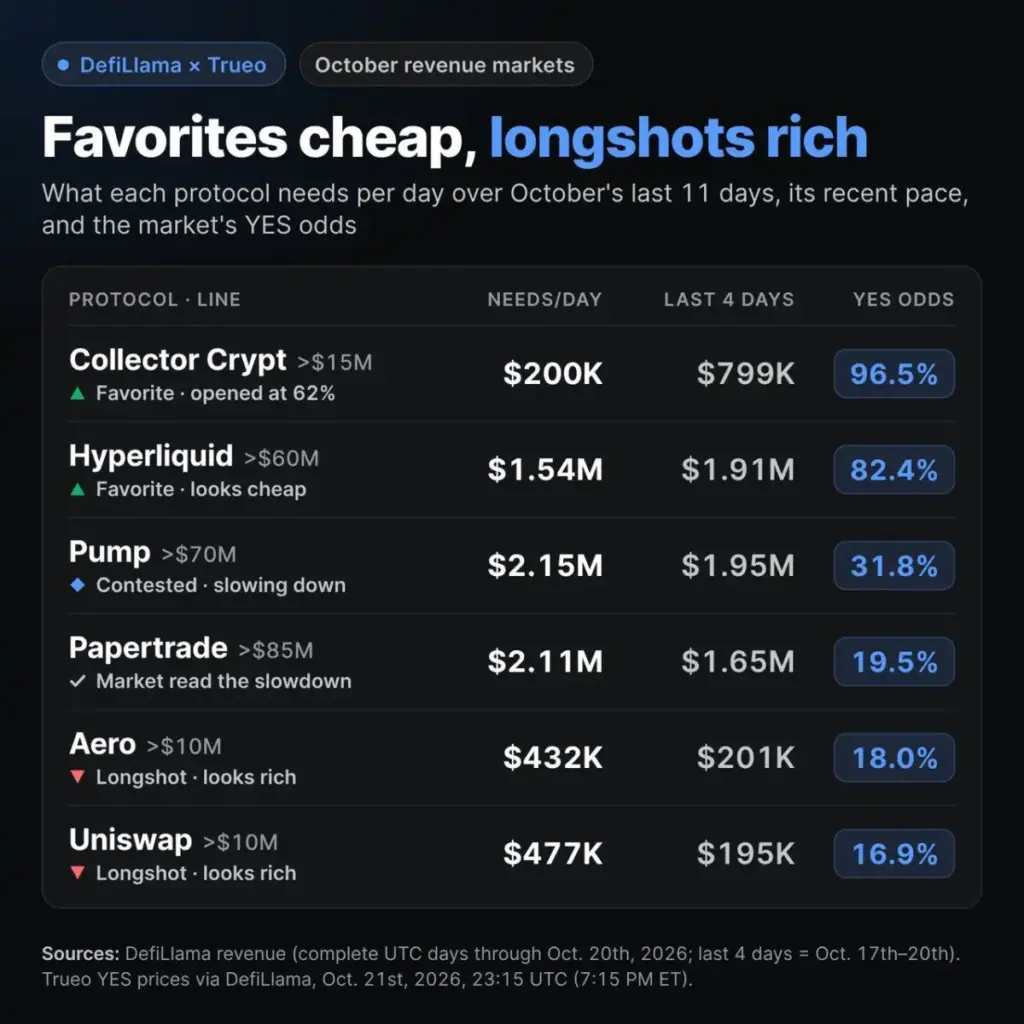
A review of October revenue data through the twentieth of the month compared against the targets required by each tracked protocol over the final days of the period reveals distinct behavioral trends among market participants. Notably, market favorites are currently trading at a relative discount. Collector Crypt, for example, required approximately $200,000 per day to clear a fifteen-million-dollar monthly milestone, despite its worst full day of October comfortably exceeding that figure at $218,000. Nevertheless, the prediction market opened at a modest sixty-two percent probability. This pricing dynamic prompted DefiLlama Chief Revenue Officer Patrick Scott to remark that market participants appeared to be selling dollars at a discount. A similar pattern appeared with Hyperliquid, which averaged roughly $2.15 million in daily revenue against a required $1.54 million, while the prediction market maintained an eighteen percent probability of the protocol missing its target.

Conversely, longshot contracts have frequently traded at richer valuations. Uniswap required roughly $477,000 per day to hit a ten-million-dollar monthly target, a figure exceeding its best single day of October sustained over an eleven-day stretch. Similarly, Aero required roughly ninety percent of its best historical daily performance sustained through the end of the month. Despite these steep requirements, both protocols traded at seventeen to eighteen percent odds, reflecting optimistic pricing despite challenging mathematical hurdles.
Meanwhile, platforms like Papertrade exhibited more rational alignment with actual activity. The exchange recorded approximately $61.8 million in revenue from its launch on October tenth through October twentieth. While a simple linear average suggested an eighty-five-million-dollar monthly total was virtually guaranteed, initial launch day volumes accounted for a disproportionate share of that figure, and daily revenue subsequently experienced a downward trend. The prediction market accurately anticipated this deceleration, with implied probabilities adjusting downward swiftly as momentum cooled.
Market observers have noted that these pricing patterns closely mirror the favorite-longshot bias, a well-documented phenomenon observed at traditional horse racing tracks for decades. Retail bettors frequently overpay for longshots while underpaying for favorites, particularly within thin and newly established markets where liquidity is still developing. This dynamic has highlighted numerous potential arbitrage opportunities for attentive participants.
Putting a Price on Hack Risk
In addition to revenue forecasting, the partnership has introduced specialized markets designed to price security risks and exploit vulnerabilities across the decentralized finance sector. DefiLlama executives have pointed out that pricing an exploit at a low probability, such as one percent, allows protocol stakeholders or investors to purchase YES shares as a mechanism to fully hedge their exposure against potential platform failures.
The exploit markets are divided into two distinct categories that behave differently based on historical data. Weekly markets are priced tightly against historical precedent. With only a few days remaining in the assessment period, the market predicting a hack exceeding one million dollars traded at over eighty percent probability, while the market for a breach exceeding five million dollars hovered near fifty percent. These figures closely match DefiLlama’s historical database, which indicates that a significant majority of comparable historical timeframes experienced a breach of at least one million dollars.
However, looking at broader macro trends, the ongoing year has experienced a higher frequency of security incidents compared to previous periods. DefiLlama logs have recorded significantly more million-dollar-plus hacks than in prior years, suggesting that weekly YES contracts may occasionally be undervalued if the elevated frequency of security breaches persists as a structural regime.

Protocol-specific exploit markets, conversely, are priced with a noticeable premium. Contracts tracking major lending protocols like Aave and Morpho factor in both protocol exploits and the generation of significant bad debt. The inclusion of bad debt represents a critical metric, as recent high-profile security incidents across the broader ecosystem have frequently involved complex collateral and bridge failures that left prominent lending markets exposed to multimillion-dollar deficits rather than direct smart contract code exploits.
When evaluated against traditional smart contract cover and decentralized insurance protocols, the cost of protection via prediction markets differs significantly. Established cover protocols often quote lower absolute premium costs for basic minimum terms, but they typically require claimants to provide proof of direct personal financial loss, enforce deductibles, and maintain restrictive coverage definitions that may exclude complex systemic collateral failures. In contrast, purchasing a YES share on a prediction market pays out automatically upon the occurrence of the defined event, regardless of whether the holder suffered personal losses. Much of the premium attached to these protocol-specific prediction markets reflects both this broader structural trigger and the persistent favorite-longshot bias that makes longshot insurance contracts expensive to maintain.
Addressing the Hacker Problem
A frequently raised concern regarding the implementation of prediction markets tied to exploits and protocol failures is the potential for malicious actors to manipulate outcomes by intentionally executing exploits to profit from their short positions.
Industry analysts and DefiLlama representatives have addressed these security concerns by noting that the economic incentives inherent in prediction markets rarely align with the financial realities of executing major exploits. Abusing a prediction market to manipulate outcomes would substantially increase the likelihood of detection and law enforcement intervention while offering relatively minimal financial compensation compared to the substantial capital a malicious actor could secure by executing a successful exploit directly without public market positioning. Furthermore, as these markets expand in scale and liquidity, they begin to function similarly to decentralized short positions on protocol health, providing transparent risk metrics for the broader ecosystem.
The ongoing expansion of these prediction markets depends heavily on continued user adoption, technological migration to networks with higher throughput and deeper liquidity, and the willingness of the broader decentralized finance community to integrate these risk-pricing tools into their operational frameworks. DefiLlama leadership has indicated an openness to broadening the scope and variety of prediction markets if initial reception remains positive, signaling that data-driven financial forecasting may play an increasingly prominent role in onchain risk management.
 Tokenomics & Digital Assets
 Tokenomics & Digital Assets
 Tokenomics & Digital Assets