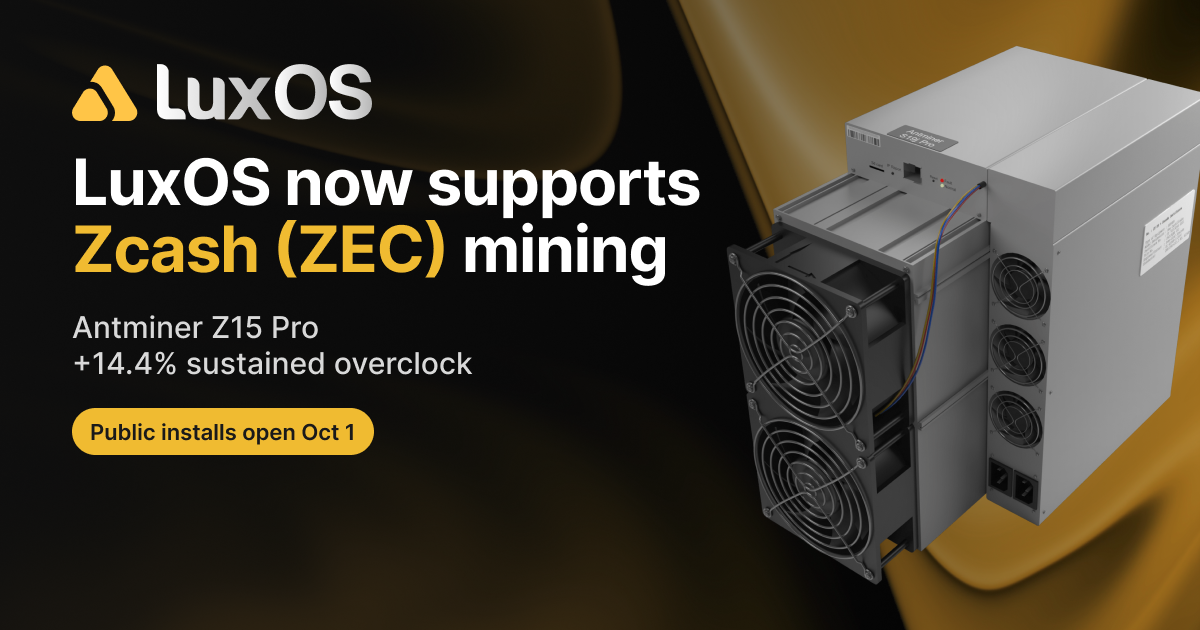
As the cryptocurrency mining industry continuously seeks efficiency gains to combat fluctuating market dynamics and rising energy costs, firmware development has emerged as a critical battleground. Luxor Technology Corporation has announced a major expansion of its flagship mining operating system, LuxOS, marking its first-ever support for Equihash hardware. The initial integration targets the Bitmain Antminer Z15 Pro, transforming a previously rigid, factory-locked machine into a fully tunable asset equipped with advanced monitoring and tuning capabilities traditionally reserved for Bitcoin ASIC fleets.
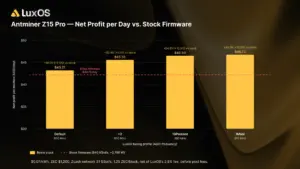
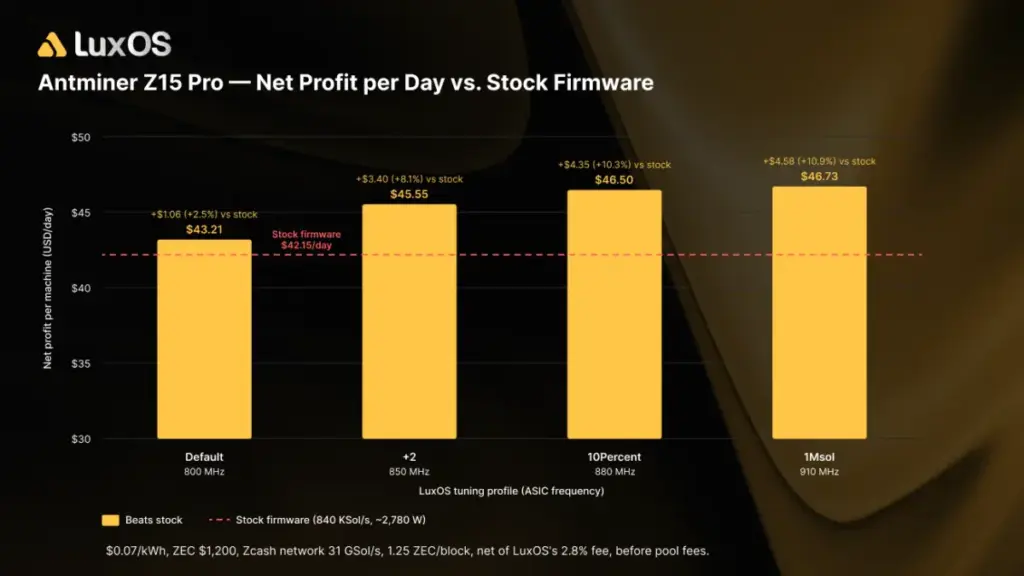
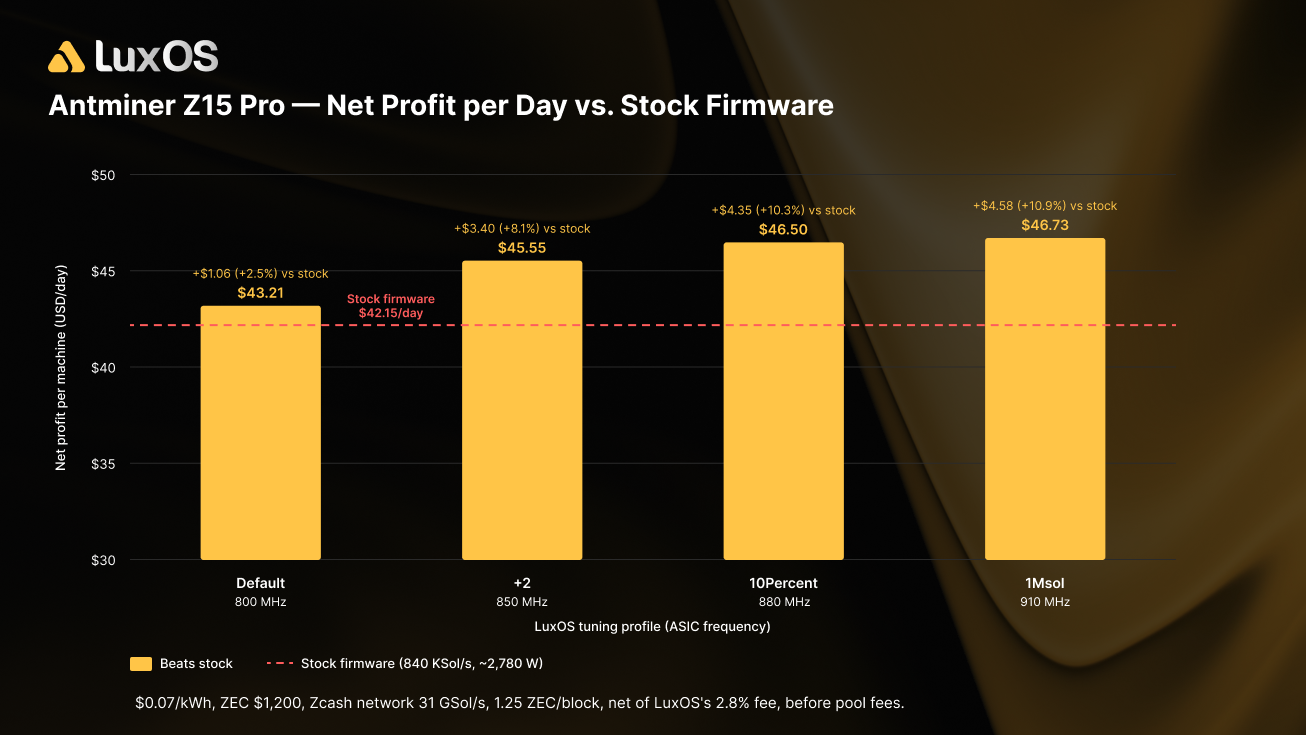
The integration arrives at a notable time for the Zcash network. With ZEC trading near $1,200 and the network hashing at approximately 31 GSol/s, a stock Antminer Z15 Pro typically yields roughly $42 per day under a power cost of $0.07 per kWh. However, early testing of the LuxOS firmware on a test machine demonstrates a net daily return of approximately $47 under the exact same power pricing conditions, even after accounting for the platform’s 2.8% fee. Following the successful initial rollout, public installations for the new firmware are scheduled to open on October 1.
Breaking the Mold: The First Equihash Machine on LuxOS
Until now, LuxOS has operated exclusively as a firmware solution for Bitcoin ASICs. The inclusion of the Antminer Z15 Pro represents a significant shift, bringing enterprise-grade tuning, granular monitoring, and health-scoring features to privacy-focused Equihash hardware.
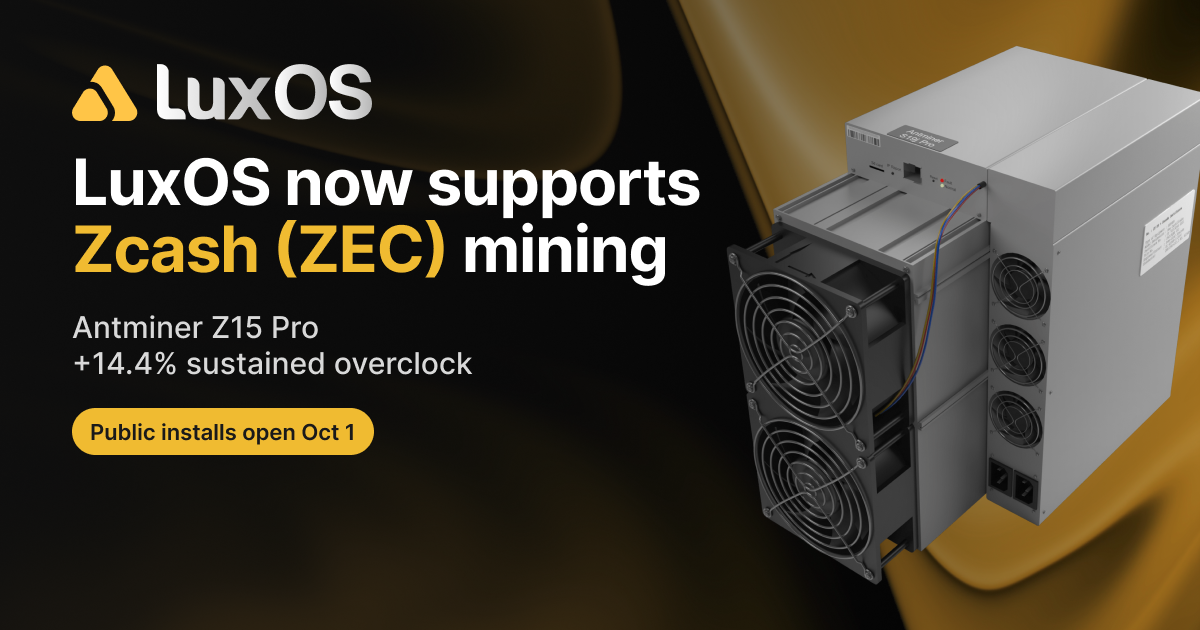
On stock firmware, the Antminer Z15 Pro functions as a fixed 840 KSol/s unit. Factory specifications leave operators with no supported mechanism to adjust operating frequency or voltage, no per-chip visibility, and no advanced telemetry to track thermal or performance degradation over time. LuxOS fundamentally changes the operational profile of the machine, converting a sealed hardware unit into a flexible asset that can be precisely calibrated to match an operator’s specific power rates and thermal management infrastructure.
The performance trade-off introduced by custom firmware relies on the classic overclocking balance: higher hash output per machine in exchange for increased power consumption measured in watts per KSol. Whether this equation proves profitable depends heavily on localized electricity expenses and prevailing digital asset valuations.
Unlocking Hidden Potential on Stock Hardware
Under factory conditions, the Antminer Z15 Pro delivers a fixed hashrate of 840 KSol/s while consuming approximately 2,780 watts, translating to an efficiency of 3.31 joules per KSol. When running the LuxOS test profile, the machine achieves a sustained hashrate of 961 KSol/s at roughly 4,032 watts, with peak test runs reading even higher.
To evaluate the economic impact of this performance shift, market analysts point to current network metrics: a ZEC price of $1,200, a network hashrate of 31 GSol/s, a daily block production of 1,152 blocks, and a miner reward of 1.25 ZEC per block, totaling 1,440 ZEC distributed to miners daily. Factoring in the 2.8% LuxOS software fee and excluding pool fees, the financial returns demonstrate a clear advantage for tuned hardware over a standard 90-day operational window.
Over the first 90 days following deployment, an Antminer Z15 Pro running LuxOS generates approximately $4,223 in net earnings, compared to $3,794 on stock firmware. This creates a $429 performance gap per machine. Considering an acquisition cost of $7,475 per unit—based on Luxor quotes for Asian ex-works January-February 2027 futures—the simple capital payback period shortens from approximately 177 days on stock firmware down to roughly 159 days with LuxOS.
Analyzing Fleet Economics and Sensitivities
For industrial mining operations managing large fleets, calculating net profitability requires examining key external variables, primarily electricity costs and token valuation.
Power expenses heavily dictate the extent of the financial advantage. At a ZEC price of $1,200, the net daily gain achieved through the overclock ranges from $5.67 per machine at an electricity rate of $0.04 per kWh, to $4.77 at $0.07 per kWh, $3.87 at $0.10 per kWh, and $2.36 at $0.15 per kWh. The overclocking profile maintains a theoretical breakeven point at approximately $0.23 per kWh, indicating that the firmware delivers gross-margin positive results for the vast majority of grid-connected commercial operators. The primary variable influenced by power pricing is simply the net retention of those gains after utility bills are settled.
Token price volatility introduces another critical layer of sensitivity. Maintaining a baseline power cost of $0.07 per kWh, the net daily gain per machine sits at $1.33 when ZEC trades at $600, expanding to $3.05 at $900, $4.77 at $1,200, and $6.48 at $1,500. The breakeven threshold for the overclock occurs at roughly $370 per ZEC. If market prices fall below that mark, the additional electricity required to power the overclocked state outweighs the value of the extra cryptocurrency produced, at which point standard configurations become more economically favorable.
Network hashrate fluctuations similarly impact both operational models proportionally. If total Zcash network hashing power expands from 31 GSol/s to 40 GSol/s, revenue for both stock and tuned units declines by roughly 22.5%, causing the absolute dollar-denominated gain to shrink while the relative performance gap remains constant at approximately 14.7% net of fees.
Real-World Operational Data
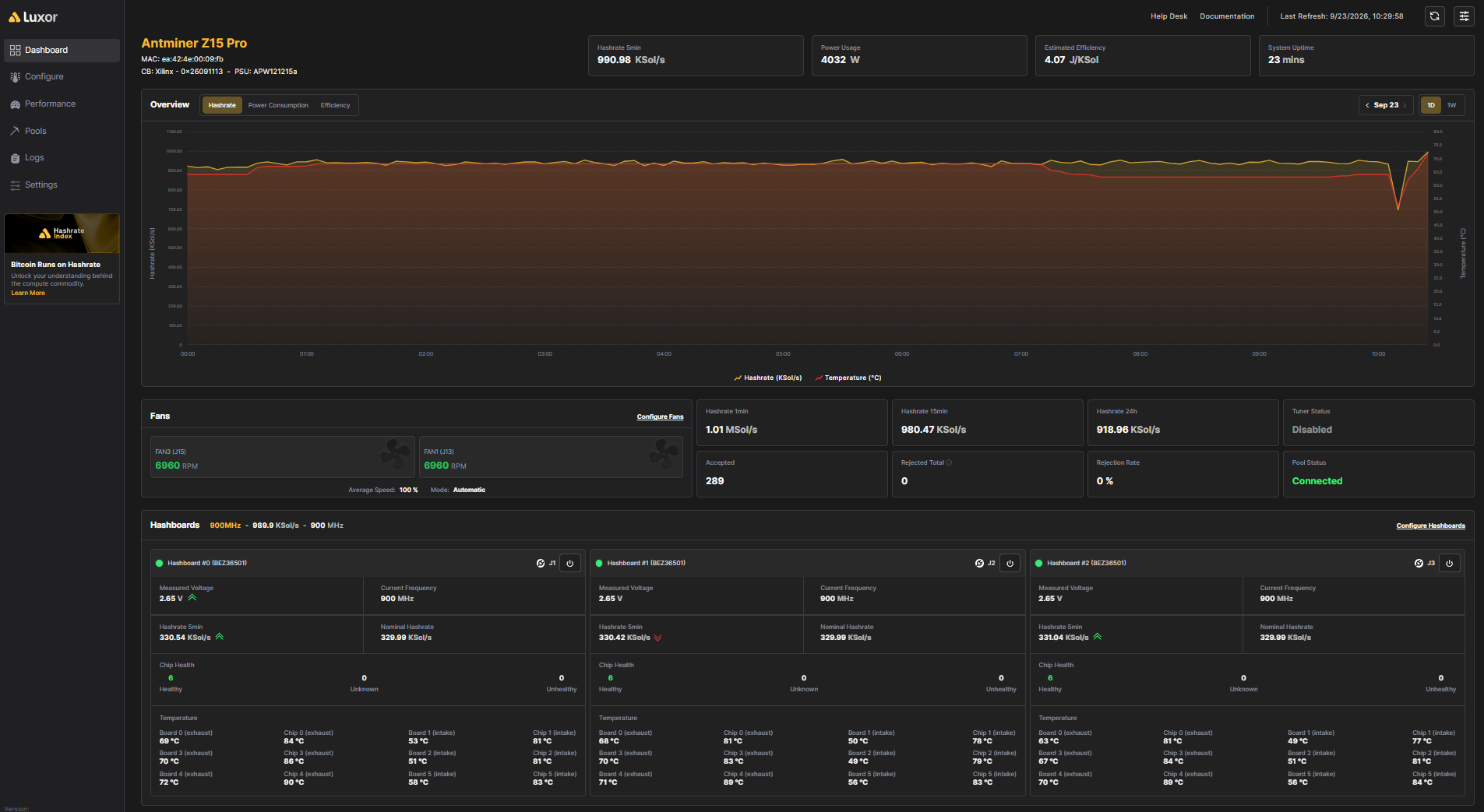
Early deployments of the Z15 Pro running LuxOS provide a clearer picture of stability and thermal performance under continuous operation. Telemetry data from test units highlights consistent performance, maintaining approximately 991 KSol/s throughout the day at a draw of 4,032 watts, while registering a 0% hardware rejection rate across all active hashboards.
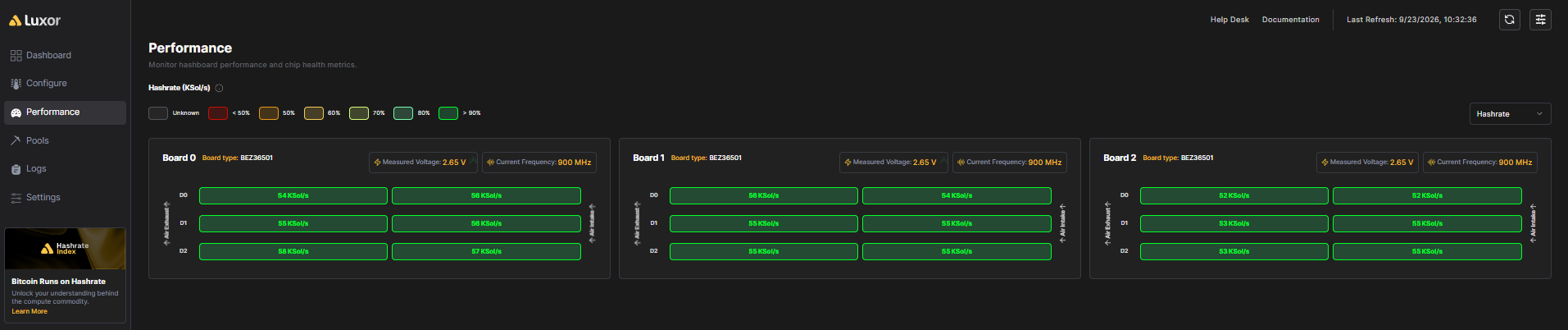
Granular monitoring tools integrated into the firmware provide visibility down to the individual chip level, ensuring that every chip across all three hashboards operates above 90% of its designated target. Furthermore, real-time health-scoring metrics allow operators to immediately identify thermal anomalies or hardware stress before it results in unexpected downtime, bringing an unprecedented level of predictive maintenance to Equihash mining infrastructure.
Setup and Compatibility
Deploying LuxOS on supported hardware maintains compatibility with existing operational infrastructure. The firmware remains entirely pool-agnostic, allowing operators to direct their hashpower to whichever Zcash mining pool they currently utilize without altering their downstream accounting or payout systems.
While current firmware support is dedicated specifically to the Bitmain Antminer Z15 Pro, Luxor has indicated that development pipelines are evaluating expansion to other popular Equihash hardware models as market demand evolves. Operators deploying the firmware are advised to carefully verify their power distribution units, electrical circuit capacities, and facility cooling headroom prior to engaging overclocking profiles.
Luxor Technology Corporation continues to develop hardware, software, and financial infrastructure tailored to the global compute and energy sectors. Alongside its new firmware capabilities, the company maintains a diverse product suite spanning Bitcoin mining pools, hardware brokerage, hashrate derivatives, energy advisory services, and its enterprise miner management platform, Commander, alongside the data analytics platform Hashrate Index.
 Cryptocurrency Mining
 Cryptocurrency Mining
 Cryptocurrency Mining