illion Crypto Economy Amid Global Market Downturn
As the global cryptocurrency market faced a significant downturn, Western Europe demonstrated notable economic resilience. Between July 2025 and June 2026, the region’s all-in crypto economy totaled $2.08 trillion, establishing it as the second-largest digital asset market worldwide. During this reporting period, overall activity grew by a modest 1.2%, placing Western Europe among only three regions globally to record positive growth, trailing just behind Sub-Saharan Africa and Latin America.
The regional landscape is currently being reshaped by new regulatory frameworks, rising institutional investment, and closer ties to traditional financial systems, although the exact manifestation of these trends varies considerably from country to country. Stablecoins are rapidly gaining traction, the euro is playing an increasingly prominent role in global crypto trading, and exchanges are actively building cross-regional user bases.

For Christopher Beck, co-CEO of Boerse Stuttgart Digital, a leading European crypto infrastructure provider, these developments are part of a much broader shift in how digital assets are perceived and utilized. Institutional adoption is accelerating, marking a structural transition from crypto being viewed merely as an emerging asset class to becoming an increasingly mainstream financial product. However, this evolution is unfolding as the region grapples with rising economic uncertainty and changing user preferences, factors that profoundly influence how crypto is adopted and where trading activity is concentrated.
Six Markets Account for Two-Thirds of Western Europe’s Crypto Economy
The United Kingdom retained its position as Western Europe’s largest individual crypto economy, recording $424.5 billion in volume and accounting for 20% of the regional total. As a longstanding global financial hub featuring deep capital markets and a well-established banking sector, the UK’s crypto market has naturally evolved as an extension of its traditional financial services landscape. Yet, activity in the UK declined by 8% over the reporting period, largely driven by a notable drop in decentralized exchange (DEX) activity.
Germany followed closely as the region’s second-largest crypto economy at $288.8 billion, with France securing the third spot at $215.8 billion. Germany experienced another modest contraction, once again driven primarily by declining DEX volumes, while France’s crypto economy remained broadly flat. Elsewhere in the region, Spain, with $156.1 billion, and Switzerland, with $132.8 billion, both recorded growth, largely fueled by increased activity on centralized exchanges.

Together with the Netherlands, which registered $207.8 billion, these six markets accounted for roughly two-thirds of Western Europe’s entire crypto economy, highlighting a heavy concentration of activity within the region’s leading financial centers. Industry experts point to this dynamic as evidence of a maturing crypto economy entering a new phase of structural growth.
Faustine Fleuret, Global Head of Public Affairs at decentralized credit infrastructure provider Morpho, notes that the market is witnessing a clear move from pure experimentation with crypto toward the integration of blockchain technology into core financial activities. Banks, asset managers, and fintech companies increasingly recognize that on-chain finance is not a parallel system competing with traditional finance, but rather a new technological infrastructure upon which they can securely build.
The Euro’s Growing Role in Crypto Reflects Its Strength in Traditional FX Markets
One of the most telling indicators of the region’s expanding digital asset economy is the euro’s growing role as a bridge asset, mirroring its longstanding position of strength in global foreign exchange markets. According to data from the Bank for International Settlements, the euro was involved in 28.9% of global foreign exchange turnover in April 2025. To ensure comparability with crypto order-book data—which captures one-sided trading pairs rather than both sides of a traditional foreign exchange transaction—analysts utilize half this figure, or 14.5%, as a benchmark.

Recent data suggests the euro is increasingly serving as a vital gateway into crypto markets. By the end of the study period, euro-denominated trading accounted to 11.8% of crypto volume across 33 leading government-issued currencies. This represents a substantial increase from previous periods, bringing the euro’s share of crypto trading much closer to its adjusted foreign exchange benchmark.
This growth coincides precisely with the implementation phase of the European Union’s Markets in Crypto-Assets regulation. MiCA establishes a harmonized regulatory framework for crypto-asset issuers and service providers across the bloc, helping to reduce uncertainty for investors and making it significantly easier for new providers to enter multiple EU markets simultaneously.
Laurynas Spangevičius, General Manager at Robinhood Europe, points to the profound significance of this regulatory shift. He notes that the single most impactful regulatory development for European crypto has been the complete rollout and enforcement of the MiCA framework, replacing prior uncertainty with mainstream, long-term investor confidence.

Western Europe’s Stablecoin Holdings Outpace Global Growth
Research indicates that stablecoins are playing an increasingly critical role in how individuals across Western Europe hold and manage digital assets, with stablecoin holdings in personal wallets increasing across every country measured. This shift carries substantial weight as stablecoins become more widely integrated, forcing Europe to confront broader questions about how these digital currencies fit into its traditional financial architecture.
Stablecoin holdings across the region surged by an impressive 131%, far outpacing the global growth rate of 52%, with Austria and France recording the strongest gains. This rapid expansion elevated the region’s share of global stablecoin balances from 3.4% to 5.1%. Several factors contributed to this trend, including rising interest among European consumers in alternative ways to store and transfer value, alongside the expansion of the euro-backed stablecoin market fostered by MiCA’s regulatory framework.
As stablecoins gain deeper traction across Europe, their potential impact on financial stability is drawing intense scrutiny. In September 2026, the European Central Bank and EU national central banks called for modifications to MiCA’s requirements regarding how stablecoin issuers hold their reserves. They argued that the current minimum threshold of maintaining 30% of reserves in deposits at European banks—scaling up to 60% for significant issuers—could create vulnerabilities for traditional banks if large-scale redemptions triggered sudden, massive withdrawals.

Concurrently, traditional financial institutions are beginning to influence the market more directly. Jan-Oliver Sell, CEO of Qivalis, a consortium-backed, MiCA-regulated stablecoin initiative, points to several emerging use cases for regulated euro stablecoins, including serving as the on-chain cash leg for tokenized assets and enabling conditional, programmable payments between businesses, such as automated payment-on-delivery systems. A spokesperson for Spanish multinational bank CaixaBank adds that such collective efforts are crucial in helping Europe avoid total dependence on US dollar-denominated stablecoins.
How Changing Euro Bond Yields Shape Bitcoin and Tokenized Gold Trading
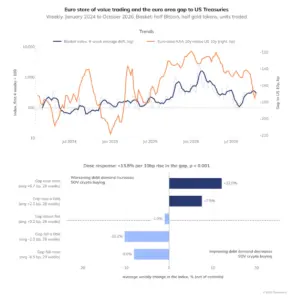
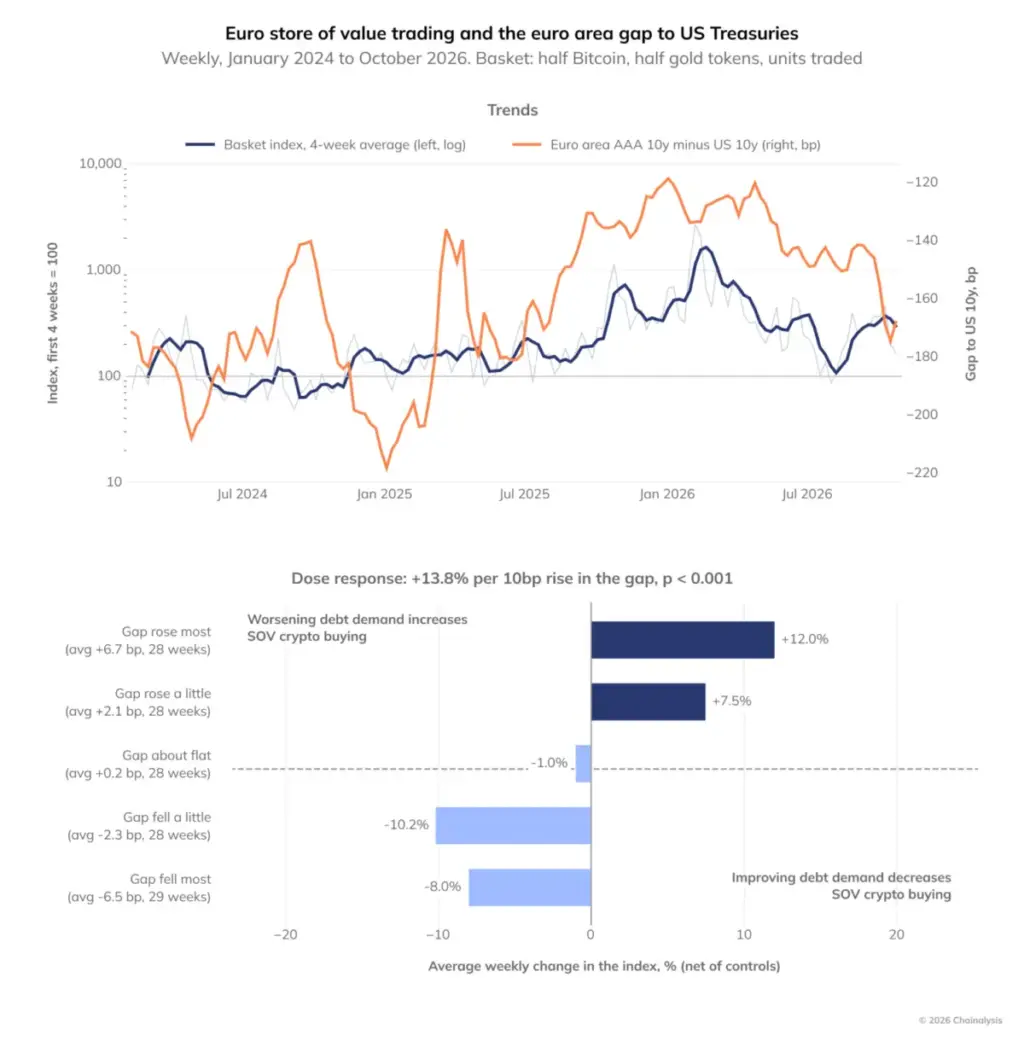
The research also highlights a compelling correlation between rising euro-area government bond yields relative to US yields and increased euro-denominated trading in Bitcoin and tokenized gold. This relationship is emerging amid growing concerns over Europe’s public finances, as mounting fiscal pressures fuel persistent questions about sovereign debt risks. While these concerns have intensified sharply in recent months, they are the culmination of years characterized by high public debt, successive economic shocks, and persistently weak regional growth.
France has emerged as a primary flashpoint in these mounting fiscal anxieties. Rising sovereign debt and persistent political gridlock have unsettled domestic bond markets, with French 10-year government bond yields climbing above 5.14%, marking the highest level seen in over two decades.

Against this volatile backdrop, analysts examined whether shifts in sovereign risk perceptions coincided with changes in demand for alternative assets. Utilizing weekly data from July 2025 to June 2026, researchers compared yields on the highest-rated euro-area government bonds with US government bond yields and trading activity in Bitcoin and tokenized gold. The data revealed a clear pattern: as euro-area yields rose relative to US yields, euro-denominated trading in Bitcoin and tokenized gold increased relative to dollar-denominated trading, whereas narrowing yield gaps coincided with weaker euro-denominated trading.
When euro yields rose by approximately 2 basis points relative to US yields, euro trading was about 7.5% higher relative to dollar trading. When yields rose by roughly 7 basis points, euro trading climbed to about 12% higher, while falling euro yields resulted in a corresponding 8% to 10% decline. This data suggests that market participants increasingly broaden their portfolios to include alternative store-of-value assets as confidence in the fiscal outlook of the euro area comes under pressure.
Prediction Markets and Changing European User Behaviors
Prediction markets are further extending crypto’s reach beyond traditional digital assets, allowing users to speculate on real-world outcomes ranging from geopolitics to macroeconomic events. To examine this trend within Europe, analysts reviewed European wallet activity involving geopolitical event contracts, noting that findings predate the European Securities and Markets Authority’s July 2026 classification of certain event contracts under existing EU restrictions on retail binary options, which effectively banned prediction markets within the bloc.

The research revealed that wallets based in Western Europe allocated nearly twice as large a share of their prediction market volume—74% compared to a global 49%—into negative outcomes of US-Iran binary markets during the 2026 period. Notably, these negative outcome bets delivered weaker average returns than positive outcome positions. This trend suggests that prediction markets may serve not only as objective forecasting venues, but also as emotional or ideological outlets for expressing localized viewpoints on complex geopolitical developments.
After Years of Strong Growth, the UK Contracts as the EU Expands
The United Kingdom’s crypto economy has historically outpaced the rest of Western Europe, but that growth advantage has recently reversed. While the UK remains the region’s largest individual crypto market, its economy contracted by 8% during the 2026 period. In contrast, the rest of Western Europe grew by 3.8%, with the EU specifically recording 2.2% growth.
This divergence raises critical questions regarding past growth drivers and the relative stability observed within the EU. The initial implementation of MiCA in late 2024 may have temporarily constrained regional growth as providers absorbed compliance costs and regulatory uncertainty. However, as domestic providers approached the July 2026 transition deadline, the clarity provided by MiCA spurred a wave of authorizations, granting providers passporting rights to expand seamlessly across the entire EU bloc without requiring separate licenses in each member state.

Conversely, the UK market lacked a comparable regulatory buildup to offset the broader international crypto market downturn, which saw the total global market capitalization fall by 50%. The UK slowdown may also reflect a cautious wait-and-see approach adopted by industry participants ahead of the Financial Conduct Authority finalizing its updated cryptoasset rules and opening its new authorization gateway.
The UK Leads the Region in Domestic Stablecoin Activity
Despite its broader market contraction, the UK has emerged as a regional leader in domestic stablecoin activity. During the 2026 reporting period, domestic stablecoin transfers—defined as wallet-to-wallet transactions within the UK—surged to $2.09 billion, a massive jump from $109 million during the previous 12 months. The UK single-handedly outpaced the rest of Western Europe combined, which recorded $1.41 billion in domestic transfers, accounting for 65.2% of regional growth and 60% of total domestic transfer value.
Furthermore, UK retail holders are increasingly utilizing stablecoins as a store of value rather than solely as a medium of exchange. During the 2026 period, 1.03% of eligible UK retail personal wallets converted at least 80% of their crypto holdings into stablecoins, up from 0.66% the previous year. This conversion rate was the highest among the six major European markets analyzed, outpacing the Netherlands, Italy, Finland, Sweden, and Germany.

Crucially, this conversion trend did not appear to be a panic-driven reaction to market downturns; UK conversions peaked between July and September 2025, prior to Bitcoin reaching its autumn high, pointing to a gradual, structural change in how UK holders manage their digital capital.
Amid Fiscal Pressures, French Users Embrace Self-Custodied Stablecoins
In France, heightened economic and political uncertainty fueled by rising public debt and parliamentary gridlock has prompted distinct shifts in digital asset behavior. On-chain data reveals three clear indicators that French users are turning toward self-custodied stablecoins to manage their assets: a rising share of stablecoin withdrawals from centralized exchanges, an increasing number of self-custody wallets holding stablecoins, and growing individual balances within those wallets.
France climbed from 10th place in 2023 to 1st place by 2026 among Western Europe’s largest crypto markets regarding the share of stablecoin-related withdrawals from centralized exchanges, accounting for 54.2% of French service withdrawals and surpassing Germany. Simultaneously, the number of French personal wallets holding stablecoins expanded 3.4-fold, rising from 3,577 in June 2025 to 12,255 by June 2026. French self-custody stablecoin balances grew by 192% during the reporting period, vastly outperforming the 2% growth in traditional French bank deposits over the same timeframe.

Spanish Exchanges Draw Increased Pan-European Inflows
Spain’s crypto market is increasingly attracting users from beyond its national borders, solidifying the country’s position as a vital destination for digital asset activity across the wider European market. While inflows to Spanish-registered exchanges from both domestic and international users have grown steadily since 2024, cross-border activity has accelerated at a much sharper pace.
By the 2026 reporting period, inflows from users elsewhere in Europe surpassed those from Spanish users, making international customers the primary source of funds flowing into Spain’s registered exchanges. Inflows from Western European users to Spain-registered platforms rose by 79.1%, significantly outpacing the 24.6% growth recorded across Spain’s broader domestic crypto economy.
Industry leaders attribute this trend to the structural characteristics of neighboring markets. Gabriel Ayala, Director of API and Banks at Bit2Me, notes that the absence of large, consolidated domestic operators in countries like Portugal and Italy—due to linguistic factors or regulatory fragmentation—has created openings for established Spanish platforms to attract international users by combining competitive product offerings with regulatory compliance under the newly unified European framework.

Ultimately, Western Europe’s crypto economy is being decisively reshaped by an intricate mix of evolving user behaviors, institutional participation, and regulatory maturation. As market participants navigate changing macroeconomic conditions, the region’s future trajectory will depend heavily on its ability to adapt to unified regulatory standards while maintaining robust links to traditional financial infrastructure.
 Crypto Wallets & Security
 Crypto Wallets & Security
 Crypto Wallets & Security