Multicoin Capital co-founder Kyle Samani has predicted that an increasing number of crypto companies will choose to build their infrastructure on Solana rather than Ethereum, citing Solana’s superior ease of use and greater overall functionality.
Speaking during an episode of the Cointelegraph show Trade Secrets, Samani asserted that Solana is positioned to flip Ether in market capitalization during "this market cycle." He forecasted that Ethereum could gradually lose its long-held edge as the default smart contract network choice for developing crypto enterprises.
"They’ll all switch their default over to Solana because it’s the most functional network for all of them and it’s just easier to consolidate their operations around Solana to the extent that they can," Samani explained during the interview.
Samani and Multicoin Capital amassed a sizable early position in Solana, and the co-founder has remained one of the network’s most prominent and steadfast proponents for years. For Samani’s prediction to materialize, Solana’s SOL token would need to achieve roughly a five-fold increase from its current market capitalization of $58 billion to surpass Ether’s standing market capitalization of $293 billion.
During the discussion, Samani offered a critical assessment of Ethereum’s current adoption metrics. He argued that "today, no one really uses Ethereum" for active transactional volume outside of niche sectors, claiming the network largely maintains its leading valuation position due to stablecoins and stablecoins borrowed against Ether as collateral.

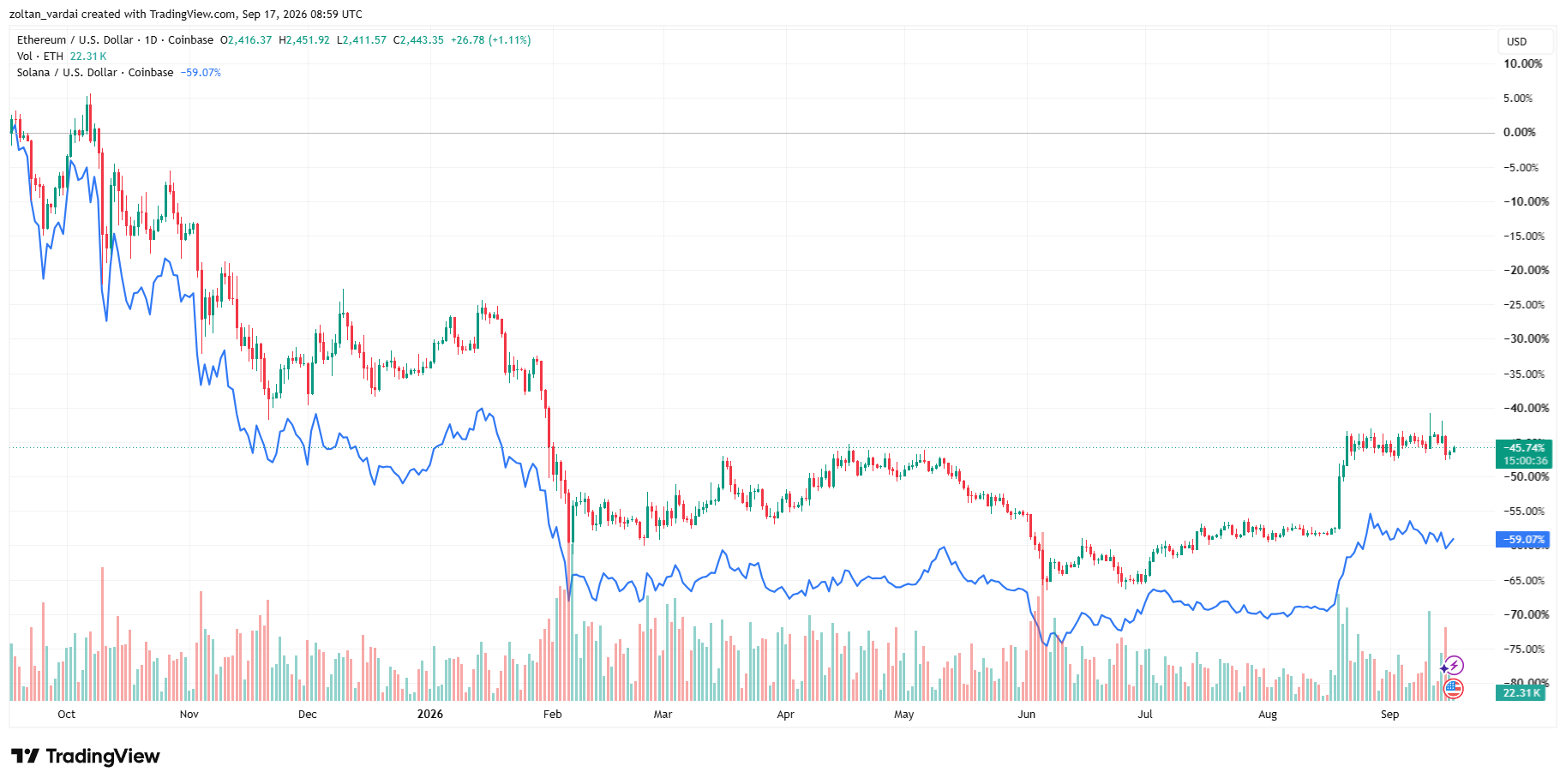
Market data from TradingView indicates that SOL and ETH have largely moved in lockstep in percentage terms amid recent broader market upturns. Over a recent 30-day window, Ether rose by 30%, while SOL gained 34%. However, analysts note that Solana’s percentage rise comes off a smaller base and followed a steeper decline during the preceding bear market. Over the course of a single year, SOL fell by 59%, while Ether experienced a milder 45% decline.
Did Samani Ragequit Crypto?
The bold predictions come on the heels of a turbulent period for the veteran investor. In February, Samani announced that he was stepping down as a managing partner of Multicoin Capital after a decade in the cryptocurrency industry, describing the departure at the time as a "bittersweet moment."
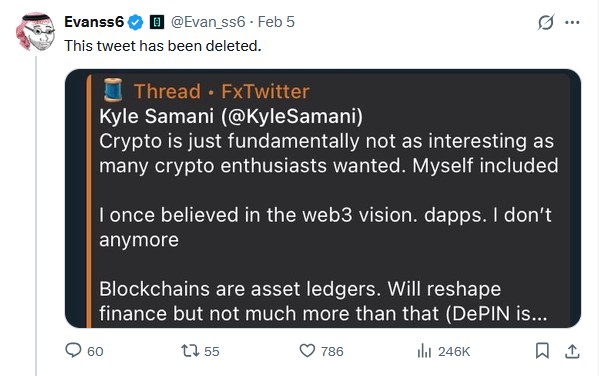
During his exit, Samani appeared deeply dispirited regarding the short-term trajectory of the digital asset industry. Reports circulated that he briefly published and subsequently deleted a post on X, formerly Twitter, in which he stated that he no longer believed in the traditional Web3 vision of decentralized applications. At the time, he remarked that crypto was fundamentally not as interesting as many enthusiasts, including himself, had originally hoped.
However, if Samani experienced a crisis of confidence, it proved to be remarkably fleeting. By September, he returned to the active crypto fold, accepting a position on the United States board of directors at the digital asset trading platform Backpack.
Ethereum Has ‘Questionable’ Value Accrual
Elaborating on his critical stance, Samani stated that he remains firmly "bearish" on Ethereum’s capacity to accrue fundamental value, despite it retaining the crown as the largest smart contract network by total value locked.
"It’s a $400 billion to $300 billion asset that has questionable value accrual, if any, and it’s not growing at all," Samani said. He added that he finds it difficult to understand why rational investors would want to hold Ether at its current valuation, noting that he sees a wide array of alternative investment opportunities available at much more reasonable prices across the digital asset ecosystem.
Reiterating his bullish thesis for Solana, Samani argued that commercial entities will increasingly pivot toward what he described as the most functional network on the market, facilitating easier operational consolidation for firms scaling up their infrastructure.
While SOL accounts for less than one-fifth of Ether’s overall market capitalization, on-chain metrics show that Solana has already outpaced the Ethereum network in both weekly and monthly fee generation. According to data tracked by DefiLlama, Solana generated $23 million in network fees over a recent 30-day stretch, securing fourth place among all blockchain networks in monthly fee generation. In contrast, Ethereum generated $12.6 million during the same period, placing it in sixth place.
Solana Became One of Multicoin Capital’s Top Bets
Samani’s journey in the blockchain sector dates back to 2016, when he first discovered permissionless finance and smart contracts through Ethereum, which he frequently describes as his primary entry point into the crypto space. Over time, however, he lost faith in the ecosystem, becoming deeply dissatisfied with the strategic approach Ethereum developers adopted toward network scaling, which heavily prioritized layer-2 rollups over mainnet capacity.
He discovered Solana shortly after founding Multicoin Capital in May 2017. Recognizing the architectural differences, Multicoin went on to lead some of Solana’s earliest private investment rounds in 2018, positioning the firm for massive financial gains as the network matured.
The early bet proved to be among the most lucrative investments in Multicoin Capital’s history. The firm reported managing $5.9 billion worth of assets by May 2025, cementing its status as one of the most prominent and influential investment funds in the global crypto industry.
Before diving headfirst into the world of blockchain technology and venture capital, Samani co-founded and served as the chief executive officer of Pristine, a healthcare IT company that developed specialized enterprise software for Google Glass utilized by surgeons in medical environments.
 Crypto Startups & Venture Capital
 Crypto Startups & Venture Capital
 Crypto Startups & Venture Capital