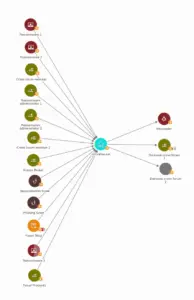
The landscape of digital surveillance and law enforcement technology has expanded significantly with the emergence of Webloc, a powerful tracking application developed by Penlink that allows police departments to locate individuals using data harvested from everyday smartphone applications. According to recent investigative reports and company documents reviewed by media outlets, the system capitalizes on the constant data streams generated by common mobile software—including weather utilities, video games, email clients, and religious applications—to build comprehensive historical and near real-time movement profiles of citizens.
The existence of Webloc sheds light on the growing market for commercial geolocation intelligence tools utilized by public safety agencies. While law enforcement has historically relied on warrants served to telecommunications providers for cell tower dumps or carrier-specific location data, tools like Webloc bypass traditional telecom channels entirely by tapping into the vast, unregulated ecosystem of mobile advertising technology and app-based data brokers. This development has intensified ongoing debates among privacy advocates, legal scholars, and civil liberties organizations regarding the scope of digital surveillance and the adequacy of current legal frameworks in protecting personal data from state intrusion.
According to internal company documents and investigative findings, Webloc functions by ingesting massive quantities of location data continuously emitted by standard smartphone applications. When users grant location permissions to apps on their phones—often for seemingly innocuous purposes, such as checking a local forecast, synchronizing an inbox, playing a mobile game, or finding the time for religious services—that location data is frequently packaged and sold through complex data supply chains. Penlink’s software aggregates these disparate streams, enabling investigators to reconstruct the movements of a targeted individual over a retrospective period of up to twelve months.
Furthermore, the platform is designed to update this information on an hourly basis, providing law enforcement officers with a near real-time tracking capability that rivals specialized military or intelligence-grade hardware. Rather than following a suspect forward in time from the moment an investigation begins, detectives using Webloc can look backward, mapping out where a specific smartphone has traveled, where its user slept, worked, and socialized, and how those patterns changed over the course of a year.
One of the most potent and controversial features of the Webloc system is its geofencing and reverse-location analysis capability. According to documents reviewed by journalists, law enforcement officers can interact with a digital map interface, zeroing in on a specific geographic coordinate and querying the database to identify all smartphones that were present at that precise location during a designated window of time.
By analyzing what company descriptions refer to as "billions of location data points," police can generate lists of device identifiers belonging to individuals who happened to be in the vicinity of a protest, a political rally, a crime scene, or a sensitive medical or religious facility. This reverse-location methodology has previously drawn sharp criticism from federal judges and privacy experts when utilized in the context of geofence warrants served on tech giants like Google, as it inherently sweeps up the location data of numerous innocent bystanders who happened to be in the wrong place at the wrong time. With tools like Webloc sold directly to police agencies, this capability becomes an integrated, on-demand feature rather than requiring a specific legal compulsion for a major tech platform on a case-by-case basis.
The integration of commercial data brokers and third-party software developers into the law enforcement investigative toolkit highlights a critical loophole in contemporary privacy protections. Historically, constitutional safeguards such as the Fourth Amendment in the United States placed strict limits on the government’s ability to track citizens without a warrant, establishing a reasonable expectation of privacy in one’s physical movements over time. However, the legal status of commercially acquired location data remains a subject of intense litigation and legislative debate. Because consumers routinely click through lengthy terms of service agreements and grant location permissions to private application developers, companies argue that this data is collected voluntarily or shared pursuant to private contracts, potentially skirting the strict warrant requirements that would otherwise govern direct police tracking.
Privacy advocates and digital rights organizations have consistently warned about the dangers of this unregulated data pipeline. Critics point out that when police departments acquire commercial surveillance software, they gain access to a backdoor that circumvents statutory privacy protections and legislative oversight. The ability to monitor populations via weather apps, games, and email clients transforms ordinary consumer technology into a pervasive surveillance apparatus. Furthermore, because these data streams originate from third-party brokers, the provenance, accuracy, and chain of custody of the data can sometimes be opaque, raising questions about its reliability when introduced into criminal proceedings or used as the sole predicate for establishing probable cause.
The developer behind Webloc, Penlink, has established a long-standing presence in the law enforcement technology sector, providing lawful interception and telecommunications surveillance solutions to police agencies and government bodies for years. The introduction of Webloc represents a strategic expansion into the burgeoning field of commercial geolocation intelligence, aligning with a broader industry trend where private tech firms monetize consumer data streams for government use. As police departments increasingly supplement traditional investigative techniques with digital intelligence platforms, public scrutiny over data collection practices, geolocation tracking, and civil liberties continues to grow.
The ongoing revelations surrounding tools like Webloc emphasize the urgent need for comprehensive legislative reform governing the acquisition and use of consumer location data by law enforcement. As smartphones remain an indispensable part of modern daily life—requiring users to trust countless applications with granular personal information—the tension between public safety investigations and individual privacy rights remains one of the most critical legal and social challenges of the digital age.
 Cyber Security & Cryptography
 Cyber Security & Cryptography
 Cyber Security & Cryptography