In a major blow to the global cybercrime economy, international law enforcement agencies have executed a court-authorized seizure of virtualine.net, the primary web domain belonging to Virtualine, a prominent bulletproof hosting (BPH) provider accused of facilitating a wide array of illicit digital activities. The operation, announced on October 27, 2026, by the U.S. Attorney’s Office for the Eastern District of Virginia and the FBI Washington Field Office, marks a critical milestone in the ongoing cross-border effort to dismantle the foundational infrastructure sustaining modern cyber threats.
The high-stakes takedown was the result of close collaboration between American authorities and key international partners, including Germany’s Polizei Hessen, the Netherlands’ Politie Midden-Nederland, and the United Kingdom’s National Crime Agency. Furthermore, private sector intelligence and technical support played an indispensable role in unraveling Virtualine’s hidden network. OverRIPE, a coalition of independent security researchers and professionals dedicated to tracking and combating malicious hosting threats, worked alongside blockchain analytics firm Chainalysis to provide vital intelligence to law enforcement, ultimately helping to disrupt the provider’s sprawling infrastructure.
Understanding the Threat of Bulletproof Hosting
To fully grasp the significance of the Virtualine operation, security experts emphasize the critical role that bulletproof hosting providers play in the broader cybercrime landscape. Unlike conventional web hosting services that maintain strict compliance standards and respond promptly to abuse reports, DMCA takedown notices, and law enforcement inquiries, BPH providers intentionally turn a blind eye to illicit activities. By offering offshore infrastructure explicitly designed to resist disruption, seizure, and takedowns, these specialized providers create safe havens for persistent criminal operations.
The infrastructure managed by bulletproof hosts is typically utilized to anchor a wide spectrum of malicious activities. This includes hosting ransomware command-and-control servers, distributing phishing kits, disseminating malware, operating carding shops, storing infostealer logs, and running illicit dark web marketplaces. Without these resilient hosting environments, many complex, multi-jurisdictional cyberattacks would struggle to maintain the continuous uptime required to achieve their criminal objectives.
Virtualine, which operated under a variety of alternative aliases including Secury, Massgod, Spamhouse, Lanedo, and Omegatech, was particularly brazen in its business model. Rather than attempting to mask its illicit operations beneath a veneer of legitimacy, the provider openly advertised its services to prospective criminals on prominent underground cybercrime forums such as Exploit.in and HackForums.
Court documents and investigative findings reveal the sheer audacity of Virtualine’s marketing strategy. In a September 2024 post on Exploit.in, a representative for Virtualine explicitly told a prospective user that the platform could be utilized for virtually any malicious purpose, stating, "You can use Virtualine for all illegal/black hat activities (including phishing, carding, email spam, port scanning and all others) except for child contents and terrorism activities." The provider continued its provocative public posturing as late as June 2025, boasting on HackForums that "Virtualine ignored more abuse than your last three therapists."
As international pressure mounted and law enforcement agencies increasingly targeted illicit hosting infrastructure, Virtualine attempted to adapt its business model to evade detection. In March 2026, the provider rolled out what it marketed as an "additional protection plan." This specialized service promised that upon receiving an official law enforcement inquiry, Virtualine would automatically migrate a customer’s criminal infrastructure to a shell company entirely unaffiliated with Virtualine before seamlessly reactivating the server under a new guise.

Despite publicly disclaiming the hosting of child sexual abuse material in its forum advertisements, prosecutors allege that Virtualine’s operations extended into deeply severe forms of exploitation. According to federal authorities, the hosting provider knowingly maintained a criminal online forum that actively sold access to sexually suggestive and sexually explicit images and videos depicting both minors and adults. Furthermore, this forum promoted specialized hack-for-hire services designed to illicitly infiltrate victims’ personal accounts and steal intimate content.
On-Chain Exposure and the Cryptocurrency Connection
A cornerstone of Virtualine’s operational model was its financial architecture, which relied heavily on cryptocurrency to maintain the anonymity of
its criminal clientele. The provider accepted direct Bitcoin payments through unhosted wallet addresses. This deliberate setup allowed cybercriminals to pay for hosting services without triggering the automated compliance checks, identity verification procedures, and transaction monitoring protocols mandatory at centralized, hosted cryptocurrency exchanges. Once the funds were collected, the Justice Department asserts that Virtualine systematically laundered the proceeds to obscure their illicit origins and distance the revenue from its criminal sources.
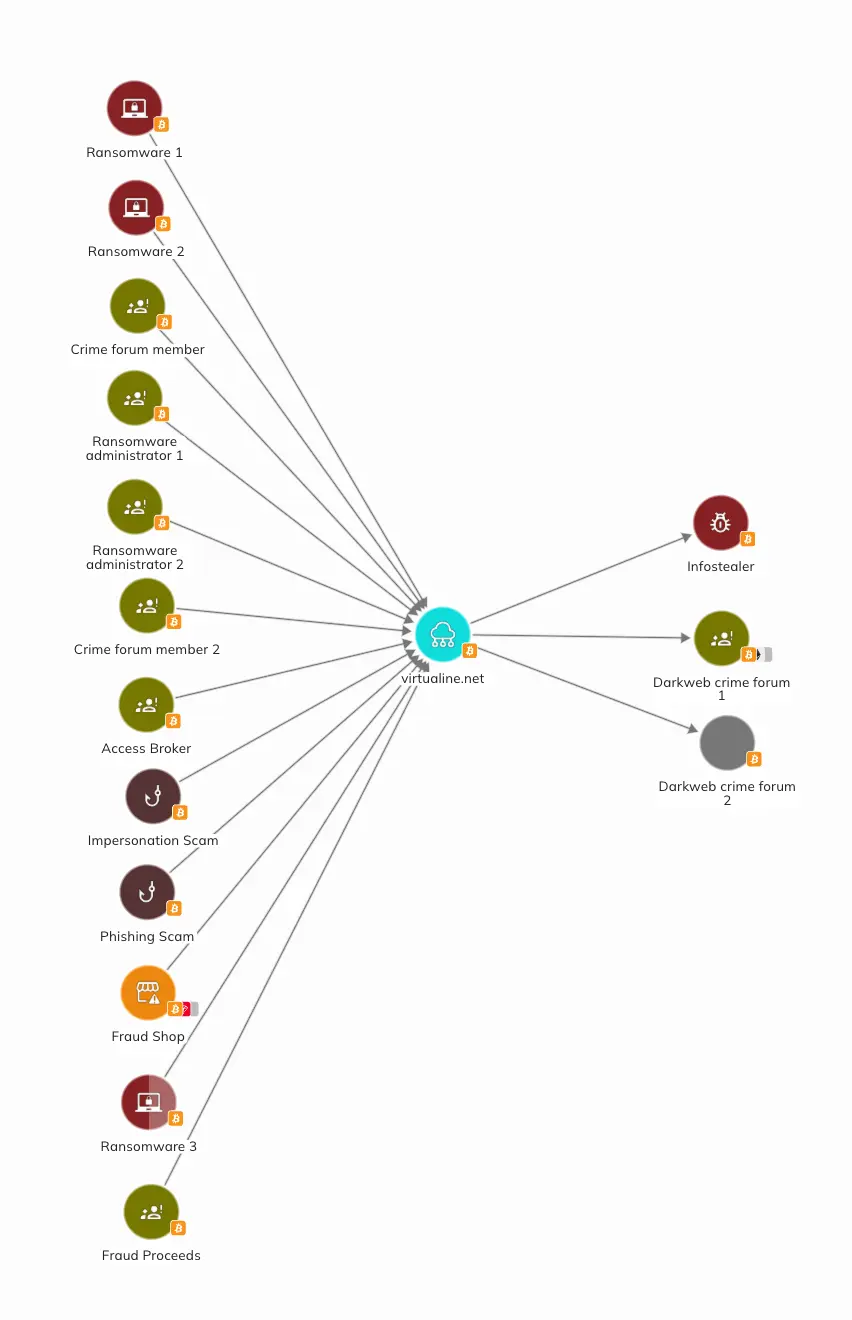
Detailed blockchain analysis conducted during the investigation revealed the extensive scope of Virtualine’s financial footprint within the digital underground. Intelligence gathered through tools such as Chainalysis Reactor demonstrated that Virtualine’s wallet addresses maintained direct transactional exposure to a broad cross-section of the global cybercrime ecosystem. The on-chain data linked the hosting provider directly to ransomware operators, infostealer infrastructure, Russian-language cybercrime forums, illicit dark web shops, and numerous scam and phishing payment addresses.
This profound interconnectivity highlights the systemic risk posed by bulletproof hosting providers to the wider digital economy. A single BPH provider often acts as the connective tissue for disparate criminal enterprises, simultaneously supporting ransomware extortion campaigns, widespread credential theft, large-scale financial fraud, and the distribution of illicit material, with cryptocurrency functioning as the universal settlement layer that binds the ecosystem together.
Implications for Compliance Teams and Financial Institutions
The coordinated takedown of virtualine.net serves as a stark reminder to financial institutions, virtual asset service providers, and corporate compliance teams regarding the downstream risks associated with alternative payment channels and high-risk infrastructure. The enforcement action underscores the reality that bulletproof hosting providers are not isolated actors; rather, they represent foundational infrastructure that enables complex crimes like ransomware, infostealers, and online fraud to scale globally.
For cryptocurrency compliance teams, identifying and tracking exposure to BPH payment addresses can serve as a crucial early warning indicator for broader financial crime risks. Wallets associated with bulletproof hosts frequently interact with the same liquidity pools utilized by ransomware gangs, scam networks, and underground marketplaces. Recognizing this interconnected threat model, Chainalysis has updated its product suite to include specific risk labels for the cryptocurrency addresses tied to Virtualine, enabling compliance professionals to proactively screen for and mitigate potential exposure.
As international law enforcement continues to dismantle the digital infrastructure supporting transnational cybercrime, operations against entities like Virtualine demonstrate the growing efficacy of cross-border cooperation between government agencies and private sector security analytics firms in neutralizing the online enablers of modern digital crime.
 Crypto Wallets & Security
 Crypto Wallets & Security
 Crypto Wallets & Security