North America remained the most influential region for the global cryptocurrency markets during the 12 months leading up to July 1, 2026. Driven by the United States’ deep investor base supplying vital capital, shifting regulatory frameworks, the widespread integration of stablecoins as a foundational currency, and corporations bridging the gap between traditional finance and decentralized assets, the region continues to dictate international crypto trends. What happens within North America’s crypto industry is routinely exported to the rest of the world, making its economic health a bellwether for the global ecosystem.

According to latest market metrics, the United States and Canada claimed the top spots on the unweighted "big-money index," which measures the sheer economic power of covered countries. Combined, their respective crypto economies totaled $3.02 trillion during the 2026 reporting period. While this represents a modest 1.9% contraction compared to the previous year, the regional dip is primarily attributed to a minor slowdown in the United States amid a broader, challenging market cycle. The U.S. crypto economy dipped 2.2% to $2.78 trillion, an unsurprising outcome within a harsh bear market. Crucially, however, the world’s single-biggest crypto market managed to retain nearly all of the dramatic, near-doubling gains it posted during the 2025 period. Institutional catalysts—such as the expansion of crypto exchange-traded funds (ETFs), accelerating asset tokenization, and the proliferation of stablecoins—bolstered these enduring valuations.
Industry leaders point to structural maturation as the driving force behind this stabilization. Hoolie Tejwani, Head of Coinbase Ventures, noted that much of what defined the market compared to the previous year came down to the maturation of the industry. The fundamental building blocks established earlier transformed into functional products with real users, liquidity, and active markets. Across the region, developments in AI commerce, stablecoins, and tokenized assets have captured immense domestic and international activity, underscoring North America’s lasting imprint on global digital finance. Meanwhile, the Canadian market resisted the broader continental downtrend, expanding by 2.3% to reach a $250 billion economy, propelled in large part by its uniquely active peer-to-peer ecosystem and immigrant populations.

The United States Leads the AI On-Chain Economy
The United States’ commanding lead in global artificial intelligence development is actively reshaping adjacent sectors, most notably cryptocurrency. Researchers studying x402—one of the most widely adopted digital payment rails allowing autonomous AI agents to spend money independently—have found profound insights into how the on-chain machine economy is taking shape. Autonomous software is increasingly executing on-chain transactions, with foundational American crypto firms providing the underlying support. Companies like Circle, issuer of the leading agent currency USDC, and Coinbase, the creator of the x402 protocol, are actively facilitating this shift.

Traditional financial institutions are also paying close attention. Will Su, Head of Digital Assets Research at BlackRock, noted that the firm is closely monitoring agentic commerce, observing that autonomous AI agents have the potential to generate meaningful demand for frequent, low-value payments around the clock. By the close of the 2026 reporting period, cumulative x402 transactions on Base, the leading blockchain for agentic commerce, had surpassed 138 million. On-chain rails unlock economic activity that remains entirely unfeasible on legacy financial networks, specifically micro-payments. Traditional credit card networks cannot profitably process transactions valued at fractions of a cent, but stablecoin settlements costing less than a penny make it economically viable for machines to spend infinitesimal amounts. This capability opens entirely new markets for pay-as-you-go digital goods and services, such as dynamic data retrievals via API calls.
Circle characterizes this emerging dynamic as a clean division of labor: card rails are suited for consumer-prompted agent payments, while stablecoin rails power machine-to-machine settlements that fall well below standard card economics. Transaction data indicates that the vast majority of x402 activity during the 16 months ending September 2026 consisted of micro-payments. Over 87% of payments fell between a hundredth of a cent and ten cents, with the most common transaction size ranging from one to ten cents.

AI Payments Are Becoming Increasingly Sticky
Although agentic commerce remains in an experimental phase, quantitative metrics signal rapid maturation. Early-stage x402 activity was largely characterized by speculative one-off users who abandoned protocols after depleting initial funds. However, subsequent cohorts of active wallets show significantly higher commitment levels. Grouping wallets by the quarter in which they were first funded reveals that the share securing a second funding round within 30 days rose from 70.6% for wallets established in the third quarter of 2025 to 89.3% for those funded in the second quarter of 2026. This behavior mirrors a digital subscription renewal, demonstrating that users consistently find sufficient utility to replenish depleted balances.

Furthermore, users are engaging with the technology more purposefully. The median time gap between a wallet’s initial seed funding and its first x402 spend dropped from 73 days in late 2025 to just 18 minutes by the third quarter of 2026. While only 4% of newly funded wallets made a payment within their first hour in late 2025, that figure climbed to 67% by late 2026. Rather than parking value or testing protocols casually, users are funding wallets because specific operational tasks are already queued, signaling structured, recurring utility.
What AI Agents Are Buying On-Chain

Initially dominated by fleeting trends and speculative memecoins, the maturation of x402 has fostered sustainable forms of machine commerce, particularly within the information sector. Millions of transactions now flow from AI-controlled wallets into specialized knowledge services, including code review, financial intelligence, and search APIs. This consumption aligns directly with the operational needs of large language models, which continuously require structured, machine-readable data. In addition to data feeds, AI agents frequently purchase model inference, gaming services, token issuance tools, and specialized agent frameworks.
Geographic analysis indicates that American-funded AI agents dominate this space, accounting for 30% of all geolocated agent-to-services transactions globally. U.S.-based wallets represent 88.1% of all geolocated AI model inference transactions, 41.8% of payments to agent frameworks and tool catalogs, and 23.2% of payments directed toward data and search APIs. Conversely, Chinese-linked wallets exhibit distinct utilization patterns, concentrating heavily on security and code analysis, such as smart contract audits via models like AgentLISA, alongside financial intelligence and payment rails. However, Chinese-funded operators rarely purchase U.S.-metered model inference, relying instead on domestic open-weight models like DeepSeek and Qwen, which are freely accessible.

The U.S. Imports Digital Gold and Exports Digital Dollars
The formalization of digital asset policies in mid-2025 cemented the United States’ role as the world’s premier exporter of digital dollars. Stablecoins have transformed U.S. government debt into the currency of choice for international peer-to-peer economies and cross-border commerce. Throughout the 2026 reporting period, stablecoin adoption expanded aggressively abroad, generating billions of dollars in economic activity that benefits both U.S. corporate issuers and the federal government.

Concurrently, the United States has emerged as a major importer of Bitcoin. Following the launch of spot Bitcoin ETFs in early 2024, the U.S. share of global Bitcoin trading and holding activity has climbed steadily. While stablecoins comprise a relatively smaller portion of domestic U.S. crypto activity compared to foreign markets—where users adopt digital dollars to offset local banking deficiencies—American investors lean heavily on Bitcoin as a decentralized store of value. Institutional interest in Bitcoin as an alternative monetary asset has intensified amid rising global sovereign debt levels.
Cross-border data reveals that the U.S. transitioned into a net Bitcoin importer in 2026 for the first time since 2022. While retail transfers under $10,000 trended net outbound, large-denomination institutional transactions flipped the balance, with the bracket exceeding $10 million driving substantial inflows. Furthermore, stablecoins continue to circulate globally without touching traditional correspondent banks, with issuers like Circle reporting vast circulatory supplies backed primarily by short-dated U.S. government debt. This dual trend—importing scarce digital gold while exporting yield-generating digital dollars—solidifies the foundational strength of the U.S. financial ecosystem.

The U.S. Impact on Asset Tokenization
Tokenization experienced explosive growth during the 2026 period, with the global real-world asset (RWA) tokenization market reaching $36.07 billion by the end of the second quarter, marking a 135% year-over-year increase. U.S. Treasury debt served as the single largest real-world asset category on-chain, accounting for $15.42 billion, or 42.8% of total tokenized RWA value. Institutional participation expanded rapidly as asset managers launched tokenized funds and corporations explored equity tokenization.

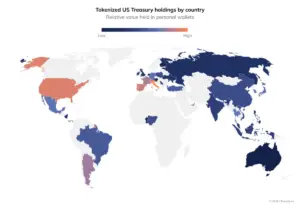
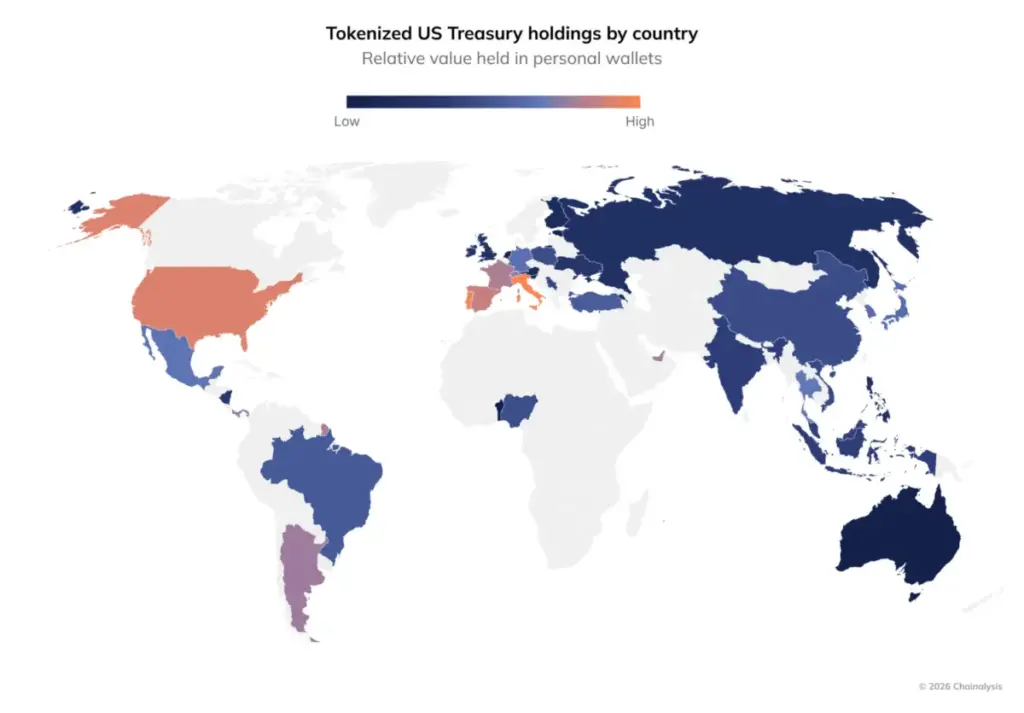
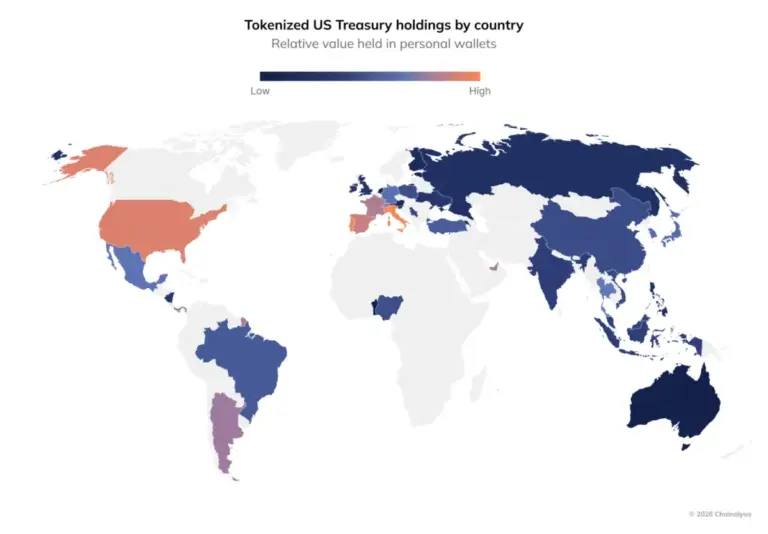
Although U.S. residents constitute a balanced share of the overall tokenized RWA holder base, tokenized U.S. Treasuries exhibit a heavily international footprint. Institutional and retail investors from jurisdictions such as Italy, Portugal, and Singapore represent significant segments of tokenized Treasury holdings by value, while countries like Japan drive high holder counts with smaller positions. By lowering minimum investment thresholds and bypassing complex brokerage requirements, tokenized Treasuries enable retail investors globally to acquire direct exposure to U.S. sovereign debt.
Canada Leads Global Peer-to-Peer and Remittance Markets

North America’s northern neighbor maintained a resilient crypto footprint, with Canada’s digital asset economy expanding 2.3% to $247.7 billion during the 2026 reporting period. Notably, Canada demonstrated the most robust peer-to-peer crypto economy among G7 nations, ranking seventh globally in both domestic and cross-border flows. Stablecoins dominated Canadian order books, capturing 44% of volume by mid-2026, with USDC taking the lion’s share of activity.
Canada’s high foreign-born population—representing approximately 23% of residents, the highest share in the G7—fuels a thriving remittance economy. Financial corridors connecting Canadian residents to India, China, and the Philippines expanded significantly, with stablecoin and Bitcoin remittance transfers totaling $2.36 billion across millions of transactions. Driven by high traditional banking fees, expatriates increasingly rely on low-cost blockchain rails to fulfill cross-border financial obligations. Domestic P2P transaction volumes closely tracked fluctuations in temporary visa and study permit populations, highlighting how individuals with active cross-border ties naturally gravitate toward efficient decentralized alternatives.

Ultimately, North America’s defining characteristic in the current crypto landscape is its role as an infrastructure architect. While international users drive demand for dollar-denominated stablecoins, tokenized Treasuries, and AI payment rails, American developers and institutions control the foundational protocols. As regulatory bodies in Canada, the United States, and international markets refine digital asset legislation, the interplay between localized policy and global on-chain adoption will dictate the trajectory of the digital economy.
 Crypto Wallets & Security
 Crypto Wallets & Security
 Crypto Wallets & Security