

Cryptocurrency investors across the United States who failed to accurately report their digital asset trades in previous years may soon find a clear pathway to regulatory compliance, thanks to a legislative measure currently advancing through the United States Congress.
The initiative is centered around Section 502 of the Digital Asset Tax Certainty Act, designated as H.R. 10357. Under the provisions of this proposed legislation, the United States Treasury secretary would be mandated to establish a formal Digital Asset Voluntary Disclosure Program within 12 months of the bill officially becoming law. This specialized framework would provide eligible taxpayers with a structured opportunity to correct past digital asset tax violations by submitting amended returns and settling any underlying tax liabilities, alongside applicable interest and a designated program penalty.
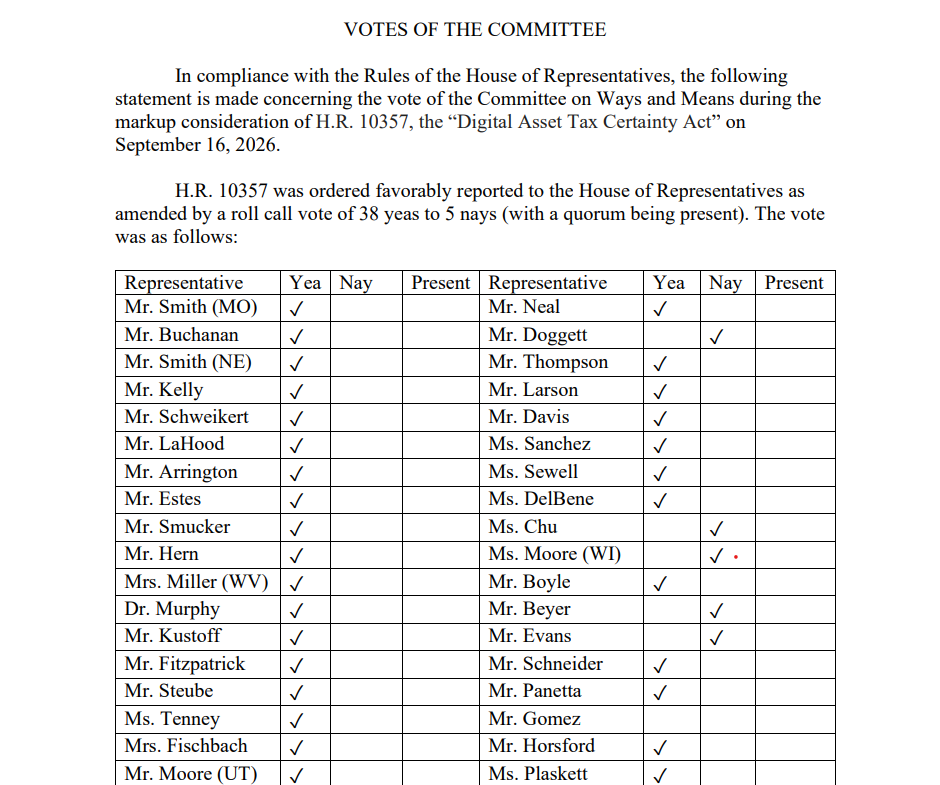
The legislative momentum behind the bill took a significant step forward on September 16, when the House Ways and Means Committee approved the measure by a decisive 38-5 vote. Despite this strong committee backing, the legislation has not yet been enacted into law. It still faces the necessary hurdles of passing through the full House of Representatives and the Senate before it can be presented to the president for a final signature.
Andrew Gordon, executive director of Digital Asset Tax Action, emphasized the potential magnitude of the measure in an interview, noting that it represents a substantial shift that could aid a large cohort of ordinary taxpayers while currently flying largely under the radar of public attention.
A Gap in the System

The advancement of this legislation arrives as American cryptocurrency investors navigate their first filing season under the newly implemented 1099-DA broker reporting rules. These regulations grant the Internal Revenue Service unprecedented visibility into digital asset transactions across centralized platforms and brokers. While industry participants generally acknowledge that these new reporting standards will streamline compliance going forward, tax professionals point out a glaring omission: they do not address the complex tax liabilities accumulated during the years prior to their implementation.
Gordon noted that a substantial share of investors failed to report their transactions correctly over the years, largely because existing tax procedures do not offer individuals who made honest mistakes a predictable, straightforward mechanism to resolve their past liabilities. He explained that under current conditions, a crypto investor who discovers they have misreported or completely omitted their digital asset activity from previous tax filings faces an uphill battle with no ideal resolution method. Investors frequently realize years after the fact that they fundamentally misunderstood the complex tax treatment governing crypto-to-crypto trades, or that they struggled to accurately track and aggregate their activity across multiple decentralized and centralized platforms.
What Taxpayers Could Get
The Internal Revenue Service maintains an existing Voluntary Disclosure Practice, but that administrative channel is specifically designed for taxpayers who willfully violated tax rules and consequently face potential criminal exposure. For individuals whose past reporting errors stem from confusion or oversight rather than intentional evasion, the current remedy involves filing amended returns. However, the resulting penalty treatment through standard channels lacks the consistency and predictability that a dedicated framework like Section 502 aims to introduce.
Sharon Yip, a certified public accountant and the founder of Crypto Tax Advisors, noted that reporting errors among everyday crypto investors remain remarkably widespread. Drawing from her firm’s professional experience, she observed that many clients omitted digital asset activity from their filings simply because they operated under the misconception that no taxable event occurred until they converted their crypto back into fiat currency. Other clients relied on incomplete or fragmented exchange records, or incorrectly classified various types of transactions.
Yip emphasized that the current tax system lacks a standardized process that grants non-willful crypto investors predictable penalty treatment or a clear path toward resolution. She added that a crypto-specific disclosure program could effectively fill this structural gap by introducing a defined correction period, reduced and predictable penalties, and much-needed certainty for individuals who step forward of their own accord.
What the Bill Would Offer
Under the terms outlined in Section 502, participating taxpayers would generally be required to file their amended returns within a 24-month window following the formal establishment of the program. The bill establishes two distinct penalty tracks depending on the nature of the taxpayer’s past omissions.
Significantly lower rates are designated for taxpayers who certify, under penalty of perjury, that their previous violations were neither fraudulent nor willful. Those who file their corrections within the first 12 months of the program would face a 0% penalty on the first $25,000 of tax deficiency per year, and a modest 5% penalty on any amounts exceeding that threshold. Conversely, for individuals who do not submit this certification, much harsher rates apply, including a 25% penalty on the first $25,000 and 40% on amounts above it, with these financial penalties scaling upward should taxpayers miss the initial enrollment window.
In addition to these financial provisions, the bill provides relief from specified civil penalties. Furthermore, taxpayers who opt not to certify are nevertheless protected from criminal referrals based on information they properly disclose for the specific tax offenses covered by the provision.
Yip advises that taxpayers interested in utilizing such a program should proactively examine their transaction histories across various exchanges and wallets. This preliminary review helps identify which specific tax years require correction before attempting to assess whether their past mistakes meet the criteria of being genuinely non-willful. Because making a false certification carries severe legal consequences under the penalty of perjury, she strongly recommends seeking professional guidance whenever taxpayers feel uncertain about their standing.
The potential introduction of Section 502 provides a timely intervention for the broader market, particularly in light of findings from a 2026 report published by CoinTracker and Coinbase. That research revealed that only 49% of surveyed crypto users correctly understood that disposing of or selling digital assets can constitute a taxable event, underscoring the deep educational and compliance challenges that have characterized the sector for years.
 Crypto Regulation & Policy
 Crypto Regulation & Policy
 Crypto Regulation & Policy







