
Bad news for the broader economy has once again translated into a windfall for risk assets. In a familiar dynamic that often dictates modern financial market cycles, disappointing macroeconomic indicators have significantly eased the pressure on the Federal Reserve to implement aggressive monetary tightening, immediately breathing new life into cryptocurrency markets.
The latest catalyst arrived via the U.S. Bureau of Labor Statistics, which reported that the economy added a meager 29,000 jobs in September. This figure fell drastically short of the 84,000 positions economists had widely anticipated. Compounding the disappointment, job gains from the two previous months were revised downward by a combined total of 60,000 positions, while the national unemployment rate ticked upward to 4.2%.
For Wall Street and digital asset investors alike, the interpretation of this weak labor market data was swift and unambiguous: the immediate pressure on central bankers to continue aggressively hiking interest rates has largely evaporated. Lower interest rates or even a pause in monetary tightening generally bodes well for high-beta, risk-on investments, and Bitcoin responded immediately. The largest cryptocurrency by market capitalization surged sharply following the macroeconomic release, reinforcing technical momentum during a month traditionally celebrated by traders as "Uptober."
Before analyzing the immediate market reaction, the broader monetary policy backdrop provides essential context for institutional and retail investors. On September 16, the Federal Reserve raised benchmark interest rates by a quarter point in a unanimous vote, lifting the target range to between 3.75% and 4.00%. That move marked the central bank’s first rate hike since 2023, signaling a renewed era of tighter monetary policy and less "cheap money" available for speculative investments. Although higher borrowing costs traditionally create headwinds for volatile asset classes, Bitcoin absorbed the initial September shock far better than traditional equity markets anticipated.

In the weeks following that decision, however, central bank officials have notably softened their rhetoric and began signaling caution. New York Fed President John Williams stated publicly that there was "no need for urgency" regarding further immediate policy adjustments, while Fed Vice Chair Philip Jefferson noted that policymakers may require additional time to assess incoming economic data before deciding whether another rate increase is warranted.
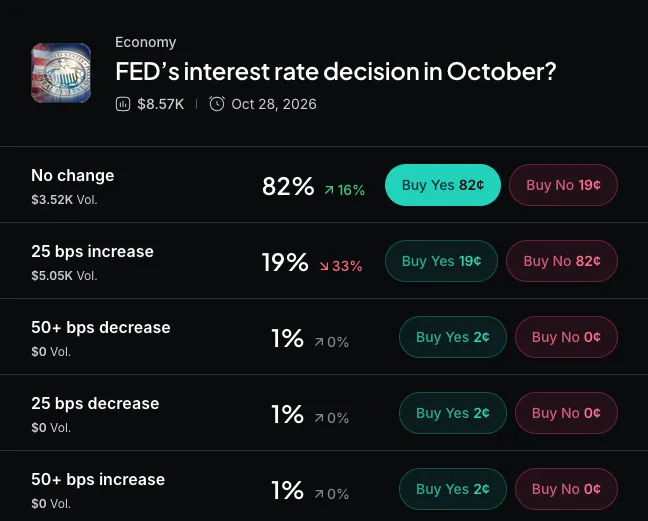
The cooling labor market data has cemented this dovish pivot in the minds of market participants. According to the CME FedWatch tool, the implied probability of an interest rate hike at the upcoming October meeting plummeted dramatically following the employment report, dropping from 70% earlier in the week to a mere 14%. Major prediction markets, including Kalshi, Polymarket, and Myriad, strongly reflect this consensus, pricing in roughly 80% odds that the Federal Reserve will hold rates steady during its scheduled announcement on October 28.
The crypto market responded enthusiastically to the shifting monetary landscape. The total cryptocurrency market capitalization climbed back above the $3 trillion threshold, registering a 2.5% increase over a 24-hour period. Concurrently, the Crypto Fear & Greed Index rose to a reading of 71, placing market sentiment firmly in "greed" territory. Institutional demand also remained robust, with spot Bitcoin exchange-traded funds recording positive net inflows of $102 million on the day, while Bitcoin’s market dominance hovered near 59.1%.
Bitcoin price: Staring at the ceiling
Against this supportive macroeconomic backdrop, Bitcoin’s price action has captured the intense focus of traders. Bitcoin recently traded up 1.57% on the day, changing hands at $86,152.75 after opening the session at $84,824.05. During the intraday session, the daily price candle tested a high of $87,173.15, bringing it within striking distance of the crucial $87,354.33 September high. That level represents the top of the current trading range and serves as the primary yearly resistance barrier that bullish market participants must decisively clear to sustain the rally. On the downside, the session low registered at $84,492.18.
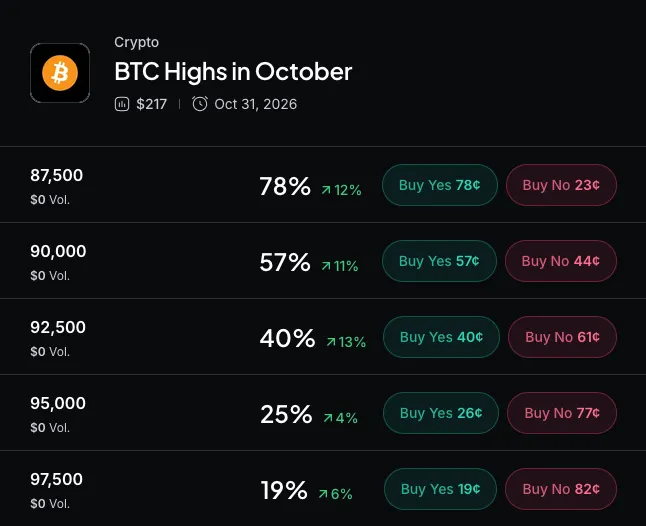
The previous September high was established at the culmination of a robust recovery rally that saw Bitcoin surge 16.5% from a swing low of $74,977.57. Since touching that local peak, the asset has largely consolidated in a sideways pattern just below resistance. A closer examination of technical indicators sheds light on whether the current momentum has sufficient strength to break through this stubborn ceiling.
The Average Directional Index, commonly known as the ADX, measures the underlying strength of a market trend regardless of its direction, with readings above 25 generally confirming the presence of a legitimate trend. Bitcoin’s ADX currently stands at an elevated 41.8. Furthermore, the directional indicator lines place buyers firmly above sellers, confirming that the current movement is characterized by a strong, structured uptrend rather than choppy, directionless consolidation. However, exceptionally high ADX readings can also indicate that a trend is maturing.
Additional momentum is visible through Exponential Moving Averages, which place greater statistical weight on recent price action. The daily chart displays the fast 50-day EMA positioned clearly above the slower 200-day EMA, forming a classic bullish configuration that indicates short-term price momentum is outpacing the broader, long-term trend. Additionally, the shaded technical cloud situated beneath the price action has remained green since mid-August, functioning as a reliable structural cushion during minor pullbacks.
The Relative Strength Index, which gauges buying and selling pressure on a scale from 0 to 100, currently reads 68.1. While this figure signals robust underlying buying momentum, it places the asset dangerously close to the traditional 70 overbought threshold, a level where institutional traders and short-term speculators frequently begin taking profits off the table.
Meanwhile, the Squeeze Momentum Indicator reads "off" with a positive value of 2.2, signifying that the period of tight price compression which preceded the recent breakout has concluded, and market volatility has successfully expanded to the upside. Bitcoin’s current price sits at approximately 78.4% of the calculated band range, keeping it comfortably within the upper half of the channel.
While the broader technical outlook leans decidedly bullish, the current market setup carries distinct trade-offs and potential vulnerabilities. With the RSI hovering near overbought territory and the macro environment remaining complex—particularly as a December rate hike remains part of the market’s baseline expectations and Treasury yields stay elevated—traders are exercising caution. Market participants are looking for a confirmed daily price close above the $87,354 resistance level, supported by sustained ADX strength, before declaring a definitive breakout. Until then, the Federal Reserve’s upcoming policy meeting on October 28 remains the next major macroeconomic hurdle for risk assets to clear.
 Decentralized Applications (dApps)
 Decentralized Applications (dApps)
 Decentralized Applications (dApps)