Holding digital assets is widely touted by enthusiasts and market participants as one of the most reliable ways to build long-term wealth within the cryptocurrency ecosystem. However, nearly a decade after the historic retail mania of late 2017 and early 2018 brought digital currencies into the mainstream consciousness, market history demonstrates that this strategy has not worked universally across every single coin.
A prime example is XRP, the payments-focused cryptocurrency native to the XRP Ledger and historically positioned as one of the largest digital assets by total market capitalization. While the broader cryptocurrency market has experienced monumental multi-year expansions, XRP continues to trade remarkably well below its cycle high set during the historic bull run of late 2017 and January 2018.
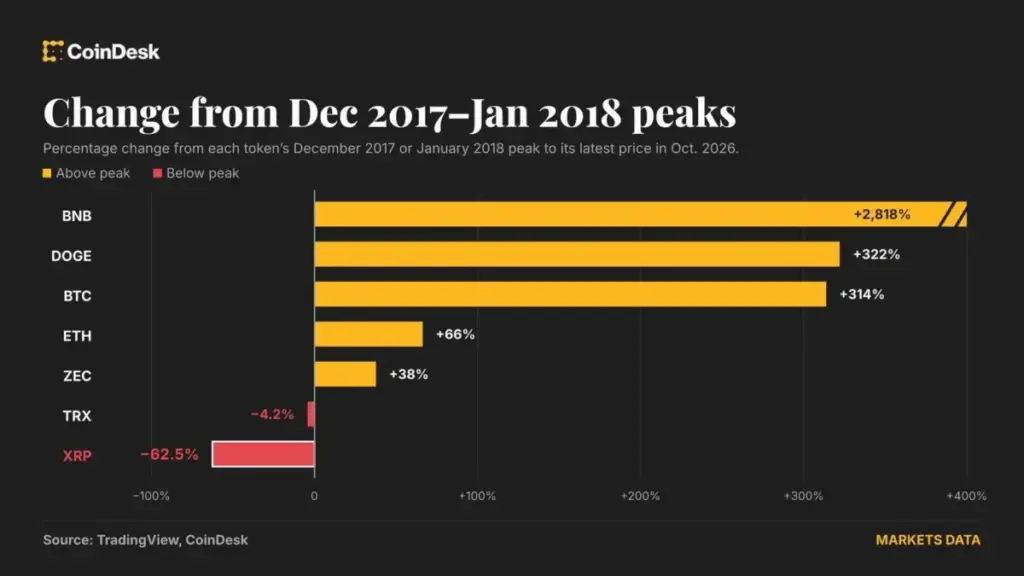
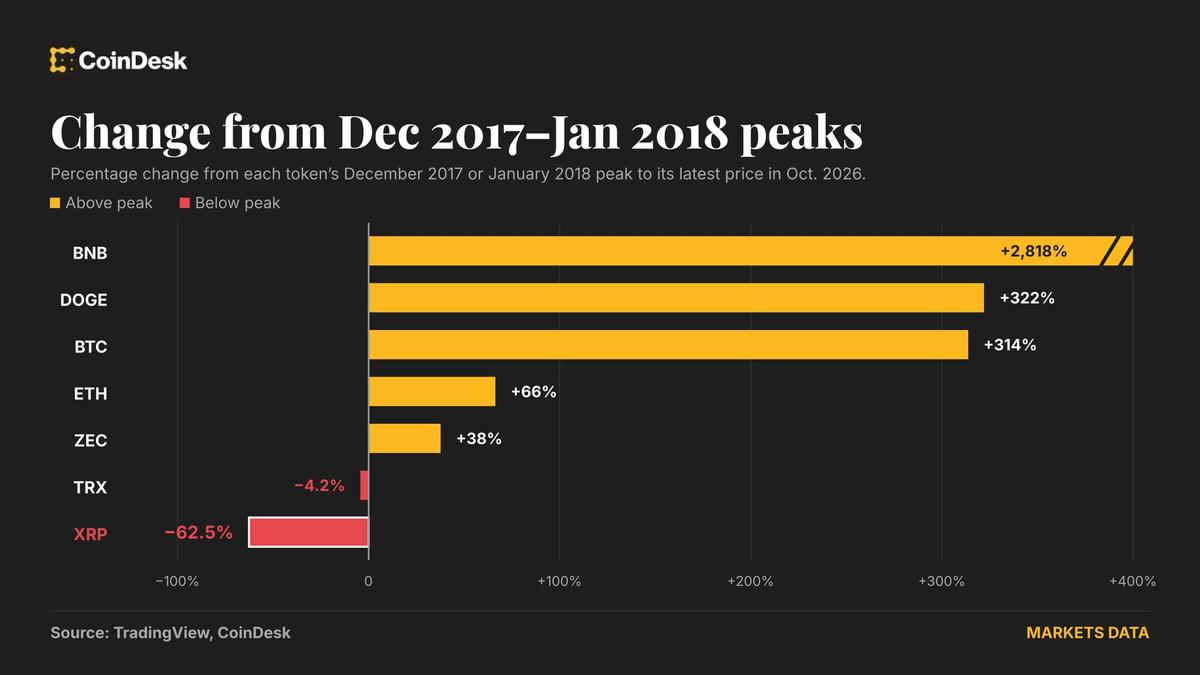
At the time of writing, XRP trades at approximately $1.33, representing a staggering 62.5% decline from its early January 2018 peak of $3.55. This means that retail and institutional investors who purchased XRP near its all-time high during that era remain significantly underwater nearly nine years later. While the asset did experience a brief moment of relief when it managed to marginally top its old record by reaching $3.66 in July 2025, that milestone was short-lived before prices crashed back down.
The stark underperformance stands in sharp contrast to other major digital assets from the same vintage. Bitcoin, the world’s leading cryptocurrency, has surged roughly 314% from its December 2017 peak of $19,804, currently trading comfortably above $80,000. Alternative digital assets have experienced even more explosive long-term growth. Dogecoin is up approximately 322% from its January 2018 high, while Binance Coin (BNB) has posted a phenomenal gain of about 2,800% over the same extended timeframe. Major smart contract platforms and foundational assets have similarly outperformed; ether remains up 66% from its previous cycle benchmarks, and privacy-focused zcash has managed a 38% increase, while Tron sits just slightly below its peak with a minor 4% drop.
Even though flagship assets like bitcoin and ether have experienced meaningful pullbacks from their own respective 2025 cycle peaks, they remain comfortably and securely far above the high-water marks they established during the 2017 craze. XRP, conversely, finds itself struggling to reclaim the heights of a bygone era, prompting industry analysts and market experts to examine the structural, economic, and regulatory factors behind its prolonged stagnation.
Too Many Coins and Supply Dilution
When seeking to explain why XRP’s price performance has decoupled so dramatically from its historical milestones, market analysts frequently point first to the mechanics of token supply and dilution.
Nicolai Sondergaard, a senior research analyst at the digital asset analytics firm Nansen, noted that the circulating supply of XRP has expanded considerably over the years. According to Nansen’s data, the circulating supply grew by roughly 63%, moving from 38.7 billion tokens in 2017 to 63.1 billion tokens, while the overall market capitalization of the asset fell by only about 3%.
This fundamental shift means that there is significantly more XRP distributed across the open market, causing each individual token to represent a much smaller fractional share of virtually the same total economic value.
Oliver Carding, head of marketing at the institutional digital asset management firm Tesseract Group—which oversees more than $500 million in assets—suggests that XRP presents a notably different narrative when evaluated through the lens of total aggregate value rather than its spot price per token.
Carding explained that when measured by total network value rather than individual token pricing, XRP has actually recovered ground. Because there is roughly 63% more XRP in circulation today than there was at the 2018 peak, an identical total circulating market capitalization naturally translates to a per-token price that is roughly 39% lower.
Weaker Institutional and Retail Demand
Beyond supply-side dynamics, analysts highlight a clear disparity in demand, particularly when evaluating the impact of regulated financial products. In recent years, U.S.-listed exchange-traded funds have served as a primary gateway for institutional capital to flow seamlessly into the digital asset class. While investment vehicles tied to bitcoin and ether have successfully attracted billions of dollars in cumulative inflows, funds dedicated to XRP have lagged significantly behind the broader market trend.
Paul Howard, senior director at the prominent market-making firm Wincent, emphasized that exchange-traded fund adoption has been notably muted for XRP relative to its larger peers like bitcoin and ether. Market data compiled by SoSoValue indicates that XRP-focused funds have managed to pull in a modest $1.80 billion in total investor capital since debuting nearly a year ago. By comparison, spot bitcoin ETFs have frequently demonstrated the capacity to attract well over $1 billion in net inflows during a single trading session.
Compounding this softer institutional interest is a broader contraction in on-chain and trading activity. Metrics provided by Nansen reveal that XRP spot trading volume has dropped by 53.5%, perpetual futures volume has contracted by 44%, and the number of active network addresses has fallen by 10.7%, pointing to a general cooling of speculative and transactional engagement.
Ripple’s Strategic Focus
The commercial focus of Ripple, the financial technology company closely associated with the development and distribution of the XRP ecosystem, has also played a role in shaping the token’s market trajectory. Rather than aggressively chasing high-velocity retail sectors such as decentralized finance, artificial intelligence tokens, and memecoins—all of which have captured massive speculative capital flows and achieved deeper integrations with broader financial markets—Ripple has maintained a steady focus on institutional cross-border payment infrastructure.
Howard noted that Ripple has dedicated substantial resources toward building out enterprise payment corridors, stablecoin products like RLUSD, and trade financing mechanisms designed to leverage the underlying ledger and its native asset. While these developments are aimed at long-term utility, Howard observed that such an enterprise-centric strategy has diverted market attention and capital away from core retail speculation around XRP itself. Furthermore, the massive capital rotation into decentralized finance ecosystems built around competing networks like Ethereum, Solana, and other alternative layer-1 chains has established entirely new investment narratives that XRP has largely bypassed.
The Burden of the SEC Lawsuit
Perhaps the most formidable headwind facing XRP for much of the past decade has been its protracted legal battle with United States financial regulators.
The regulatory saga began in December 2020, when the U.S. Securities and Exchange Commission filed a high-profile lawsuit against Ripple and two of its top executives. The regulatory agency alleged that the company had conducted an unregistered securities offering by raising approximately $1.3 billion through the sale of XRP.
The litigation cast a dark shadow over the asset’s market standing for years. A federal judge eventually issued a landmark ruling in 2023, determining that programmatic sales of XRP executed on public digital asset exchanges did not constitute securities offerings, though sales directed toward institutional investors did violate securities laws. In 2024, the court ordered Ripple to pay a $125 million financial penalty. The multi-year legal battle finally concluded in August 2025, when both Ripple and the SEC formally dropped their respective appeals.
Carding pointed out that this prolonged period of regulatory uncertainty provides critical context for understanding why XRP entirely missed the opportunity to revisit or surpass its historical 2018 highs during the major crypto bull run of 2021—a period during which prominent platforms like Coinbase felt compelled to suspend trading of the token.
While the formal conclusion of the legal drama in August 2025 saw XRP trading above the $3 mark, the asset has since pulled back significantly. Carding noted that following the final resolution of the case, XRP experienced a drawdown of about 59%, comparing unfavorably to drawdowns of 32% for bitcoin and 44% for ether over the same post-settlement stretch, with its circulating market capitalization declining by roughly 56%.
A Broader Market Phenomenon
Despite its unique struggles, XRP is far from being the only digital asset from the early cycles that continues to trade below its historical milestones. Carding noted that when evaluated strictly on a price basis, six out of the other nine assets that populated the top ten market capitalization rankings during that fateful week in January 2018 remain underwater relative to those historical levels.
For market participants and analysts closely monitoring XRP’s future prospects, observing relative strength indicators remains essential. Carding suggests keeping a close eye on XRP’s performance measured directly against bitcoin, alongside tracking net monthly token distributions following scheduled escrow releases and monitoring shifting allocations within institutional fund holdings.
In practical terms, this approach involves watching whether XRP continues to underperform bitcoin even during periods when the rate of new token supply entering the open market slows down due to Ripple’s systematic escrow releases. If supply growth decelerates yet XRP persistently lags behind bitcoin, it would serve as a clear indication that organic investor demand for the asset is continuing to soften.
 Global Crypto Markets
 Global Crypto Markets
 Global Crypto Markets