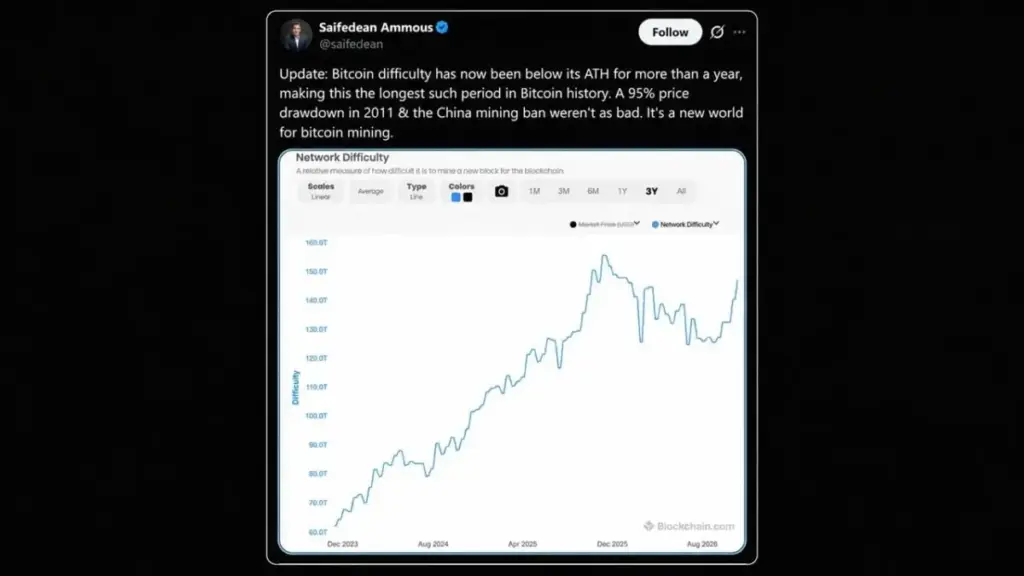
Bitcoin’s mining difficulty has now spent 374 days below its October 2025 all-time high, marking the longest continuous stretch in the network’s history and surpassing a grim record previously established in the wake of the 2011 market crash.
The milestone highlights a deeply challenging environment for the world’s decentralized computing infrastructure, reflecting a combination of lackluster cryptocurrency price action, escalating operational overheads, and a shifting corporate landscape as major mining firms pivot toward artificial intelligence and offload their treasuries.
The milestone was initially brought to widespread attention by economist and author Saifedean Ammous, who flagged the sobering statistic on social media. Ammous pointed out that the network’s difficulty level has remained suppressed for more than a year, emphasizing that historical crises such as the severe 95% price drawdown in 2011 and the sweeping China mining ban of 2021 did not trigger a prolonged suppression of this magnitude. "It’s a new world for bitcoin mining," Ammous wrote.
To understand the significance of this metric, one must examine how Bitcoin regulates its network. Mining difficulty is a quantitative measure of how hard it is to find a cryptographic hash that meets the network’s required target—essentially determining how difficult it is to discover a new block. To ensure that the network remains predictable and secure, the protocol automatically adjusts this difficulty roughly every two weeks, or every 2,016 blocks. This built-in feedback loop ensures that blocks continue to arrive at an average frequency of roughly every 10 minutes, regardless of whether a massive influx of computing power joins the chain or a substantial cohort of miners disconnects.
A review of historical metrics on Mempool.space confirms that the network’s difficulty quotient previously reached an all-time high of 155.97 trillion at block 921,312 on Oct. 29, 2025. Every automated adjustment executed by the protocol since that date has landed below that watermark. As of today, that unbroken stretch has officially reached 374 days.
How It Compares to 2011 and 2021
Prior to this current cycle, the record for the longest duration spent beneath an all-time high belonged to Bitcoin’s formative era. Following a difficulty peak on Aug. 1, 2011, the network required until July 30, 2012, to surpass that level once more—a span of 364 days that directly mirrored the brutal 2011 market crash highlighted by Ammous.
A more recent structural shock occurred in 2021, when regulatory crackdowns in China forced a massive share of the global mining fleet offline almost overnight. That event triggered a dramatic contraction in the network’s hashrate, but the subsequent recovery was relatively swift. Difficulty peaked on May 13, 2021, and fully recovered to a new high by Jan. 21, 2022, representing a recovery window of approximately 253 days.
The current cycle has unfolded differently, characterized by a milder initial percentage drop that has nonetheless metastasized into a prolonged period of stagnation. The difficulty metric ultimately bottomed out at 124.93 trillion in mid-June 2026, following a steep 10.09% downward adjustment that brought the metric roughly 20% below its historic peak. This sharp reduction aligned with broader market reporting noting that mining difficulty had plummeted to its lowest level since July 2025 as the global hashrate cooled down significantly.
The Recovery Stalled Just Short
Despite the prolonged nature of the slump, recent months had shown signs of a tentative, albeit fragile, recovery. The gap between the current difficulty and the 2025 record had been steadily closing as the protocol registered a notable 5.92% upward adjustment on Oct. 16, followed by another 5.54% increase on Oct. 29, which pushed the metric to 148.36 trillion—sitting just 4.9% shy of the all-time high. Concurrently, the network’s seven-day hashrate managed to reclaim the psychological milestone of 1 zettahash per second in late October, returning to the threshold after lingering below it for nearly eight months.
However, the momentum appears to have stalled. Current network estimates indicate that the next automated adjustment will reverse course, pointing toward a downward correction of approximately 3.7% by the end of the current epoch. This impending drop will push any potential new all-time high further out into the future, frustrating hopes for a swift return to peak difficulty levels.
Why Miners Are Struggling
The persistent headwinds facing the mining sector are largely driven by a combination of sluggish price action for Bitcoin and mounting operational expenses. At the time of reporting, bitcoin is changing hands just under the $76,000 threshold—a price point that falls well short of providing the abundant profit margins required to justify the aggressive capital expenditure and infrastructure buildouts seen during previous market highs.
Compounding these financial pressures, publicly listed mining corporations have increasingly elected to liquidate their token holdings while simultaneously pivoting their high-powered infrastructure toward the more lucrative artificial intelligence sector. Recent reports illustrate this systemic shift: major mining player Riot Platforms offloaded $750 million worth of bitcoin, while competitor Hut 8 dumped $250 million from its holdings. In an even more definitive departure from pure-play crypto mining, Keel Infrastructure liquidated its entire $192 million bitcoin treasury to exit the mining space entirely, while other industry heavyweights like Terawulf and IREN have redirected significant resources toward AI computing infrastructure as traditional mining revenues continue to contract.
The regulatory and political landscape has also introduced new layers of friction for the industry. Following recent political shifts, lawmakers have increasingly scrutinized the energy demands of large-scale computing facilities, with various legislative proposals exploring data center limitations that could disproportionately impact Bitcoin miners who find themselves competing directly with AI data centers for limited local power supplies.
What It All Means
It is important to note that a prolonged stretch below peak difficulty does not inherently signal a vulnerable or failing network. The hashrate has successfully rebounded above the 1 zettahash per second mark, and blocks continue to be processed and added to the blockchain on a reliable schedule, demonstrating the robust and self-correcting nature of Bitcoin’s consensus mechanism. Instead, the persistent lag in difficulty serves as an empirical indicator that the relentless, exponential growth in global mining power has encountered a substantial structural wall.
The upcoming difficulty adjustment serves as the immediate benchmark for the sector’s near-term trajectory. While current projections lean negative, a sustained and robust rebound in the spot price of bitcoin could quickly revitalize mining margins, incentivize dormant hardware to rejoin the network, and push the difficulty ratio back on a path toward uncharted territory.
 Bitcoin & Major Altcoins
 Bitcoin & Major Altcoins
 Bitcoin & Major Altcoins