DefiLlama, long established as a dominant force in cryptocurrency analytics and data aggregation, is leveraging its market positioning to settle wagers quite literally. On October 20th, DefiLlama announced a strategic partnership with Trueo, a permissionless prediction market protocol built on the Base network, to launch specialized prediction markets that settle strictly based on verified DefiLlama data. This initial suite of offerings spans protocol revenue milestones, DeFi exploits, and several high-profile blockchain metrics, effectively bringing traditional financial forecasting tools directly into the decentralized finance ecosystem.
In the current market landscape, protocol revenue has firmly established itself as the primary metric driving sector sentiment and valuation. These new revenue-focused prediction markets function similarly to crowd-priced earnings estimates for traditional onchain businesses, allowing market participants to speculate on whether specific platforms will hit predetermined financial goals over a given monthly cycle. Conversely, security exploits and hacks remain one of the most persistent specters haunting the decentralized finance space. By introducing exploit markets, the platform is putting a live, tradable price on systemic smart contract and protocol risk.
While the initiative is still in its early stages and the overall size of these betting venues remains modest for now, industry observers suggest these trading opportunities possess strong potential to scale significantly in popularity. The initial slate of offerings includes six monthly revenue prediction lines covering prominent ecosystems such as Hyperliquid, Pump, Uniswap, Aero, Papertrade, and Collector Crypt. Additionally, the platform has introduced October exploit or bad debt markets targeting major lending protocols like Aave and Morpho, alongside weekly markets tracking whether any significant hacks exceeding $1 million or $5 million will hit the wider cryptocurrency landscape.
Trading within these markets is conducted using TYD, which serves as Trueo’s USDC-backed stablecoin. The mechanics of the protocol dictate that a single TYD token mints a unified position consisting of one YES share and one NO share, with the winning side ultimately redeeming for one full TYD upon resolution. Crucially, the YES and NO shares each trade independently within their own respective Uniswap liquidity pools. This structure allows market participants to easily interpret pricing; for instance, a YES share trading at 0.82 TYD directly translates to an 82 percent implied probability of that specific outcome occurring.

While DefiLlama’s comprehensive data serves as the absolute source of truth for the final outcomes, Trueo’s optimistic oracle handles the actual resolution process. This mechanism relies on bonded proposals, a standard 12-hour challenge window for disputing results, and an established escalation path to handle contested outcomes. For its role in the ecosystem, DefiLlama earns creator fees as the designated curator for each individual market. Because these liquidity pools currently range between roughly $10,000 and $25,000 apiece, analysts note that many of the initial offerings present compelling opportunities for mispricing and early arbitrage.
The launch of these markets fills a noticeable void in the digital asset sector. Back in August, analysts highlighted holder revenue as crypto’s new equivalent to a dividend metric, noting that the broader market is increasingly evaluating decentralized projects much like traditional cash-generating businesses. However, the crypto industry has historically lacked the broader ceremonial ritual of traditional equities, where independent analysts publish consensus estimates and stock prices swing dramatically based on corporate earnings beats and misses. These DefiLlama-backed revenue markets provide a crowd-priced proxy for that missing infrastructure, particularly because onchain earnings print in real time and individual market pages display the current run rate directly alongside the prevailing market odds.
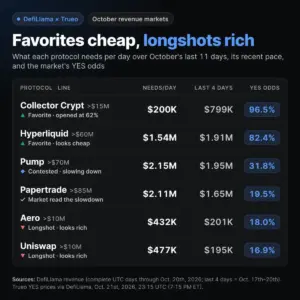
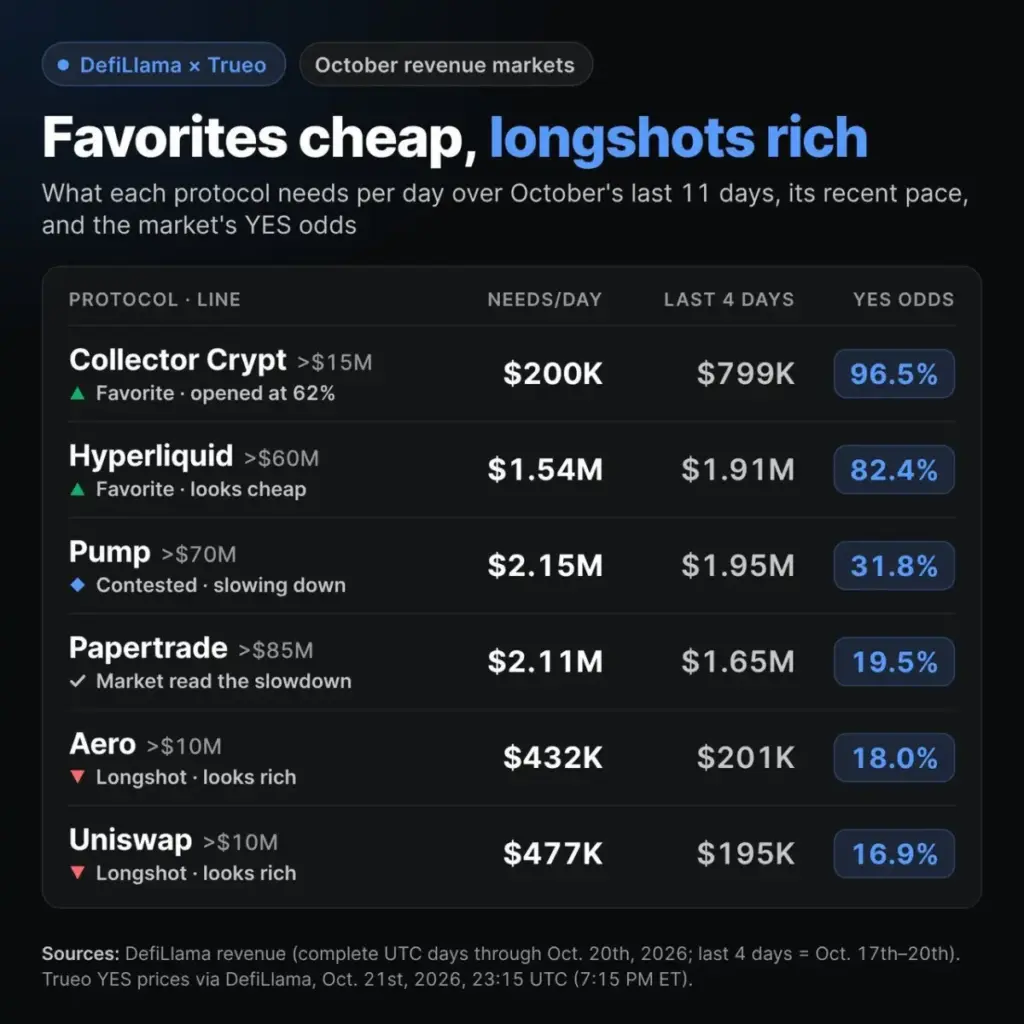
An analysis of October revenue data through the twentieth of the month compared against what each tracked protocol requires over the final days of the period reveals several distinct behavioral trends among speculators. Most notably, market favorites are currently trading quite cheap relative to their actual performance metrics. For example, Collector Crypt requires roughly $200,000 per day to clear a $15 million monthly revenue milestone. Given that its worst full day of operation in October exceeded $218,000, market participants raised eyebrows when its prediction market initially opened at a mere 62 percent probability. This pricing anomaly prompted DefiLlama Chief Revenue Officer Patrick Scott to later remark on social media that speculators were essentially selling dollars for ninety-four cents.
A similar dynamic is visible with Hyperliquid, which has averaged roughly $2.15 million per day against the approximately $1.54 million it strictly needs to hit its target, yet the prediction market still assigns the protocol an 18 percent chance of missing its goal. On the flip side of the equation, longshots are currently trading unusually rich. Uniswap requires roughly $477,000 per day to hit a $10 million monthly threshold, a figure that exceeds its best single day of October sustained consecutively for eleven straight days. Similarly, Aero needs to maintain approximately 90 percent of its best historical daily performance through the end of the month. Despite these steep requirements, both protocols trade at roughly 17 to 18 percent odds. While both platforms did manage to clear $15 million in September, achieving a repeat performance requires an immediate and furious operational acceleration.
Meanwhile, platforms like Papertrade are experiencing market pricing that aligns much more closely with their actual activity levels. The high-leverage exchange booked approximately $61.8 million in revenue from its October 10th launch through the twentieth. While a naive mathematical average would suggest an $85 million monthly total is guaranteed, launch day alone accounted for roughly $25.2 million, and daily revenue has steadily slid from $7.5 million down to $1.45 million following October 15th. At this recent pace, Papertrade is on track to finish closer to $80 million, a trajectory that the prediction market accurately anticipated as odds slid from 68 percent down to 19.5 percent in under two days.

Financial historians and market researchers note that these distinct pricing behaviors are classic demonstrations of the favorite-longshot bias, a phenomenon that has been documented at traditional horse racetracks for decades. Individual bettors consistently tend to overpay for longshots while underpaying for favorites, particularly within thin, newly established prediction markets. This structural tendency is precisely why Patrick Scott pointed out on launch day that substantial opportunities exist for traders willing to arbitrage these nascent markets.
Beyond protocol earnings, the introduction of exploit prediction markets offers an entirely different mechanism for risk assessment. Patrick Scott noted that if the broader market prices a protocol exploit at a one percent probability, spending that equivalent one percent to purchase YES shares effectively allows a developer or investor to fully hedge their exposure. However, the two distinct categories of exploit markets currently operating behave in fundamentally different ways.
The weekly exploit markets are closely priced to historical statistical norms. With roughly five days remaining in their respective cycles, the market tracking a potential hack exceeding $1 million sat at 82.7 percent, while the market for a hack exceeding $5 million sat at 50.6 percent. According to DefiLlama’s internal hacks database, roughly 82 percent of all five-day stretches over the preceding twelve months experienced a hack of at least $1 million, while 47 percent witnessed a breach exceeding $5 million. In this specific case, the prediction market is pricing the trailing base rate with near-perfect accuracy.
The primary complication is that the broader cryptographic threat environment has run remarkably hot. DefiLlama has logged 111 hacks exceeding $1 million so far this year, compared to just 70 during the entirety of the previous year. Over the prior six months, an overwhelming 92 percent of all five-day stretches featured at least one major exploit. If this elevated security regime persists, the weekly YES shares may actually be underpriced relative to current risk levels.
In contrast, the individual protocol markets are currently priced to reflect a heavy risk premium. With roughly ten days left in October, the YES share for Aave traded at 6.8 percent, while Morpho traded at 11.9 percent. The Aave market specifically pays out upon the occurrence of either a hack exceeding $1 million or the accumulation of $1 million in bad debt. This second pillar represents a highly relevant risk factor, as Aave’s most significant recent scare did not stem from a software bug. When the rsETH bridge operated by Kelp DAO suffered a major security drain in April, attackers borrowed heavily against the stolen collateral on Aave V3, leaving the lending protocol modeling between $124 million and $230 million in potential bad debt.

When evaluating pure cost, traditional onchain insurance remains significantly cheaper for the time being. Nexus Mutual, one of the most prominent decentralized cover protocols in the sector, quoted approximately $6.75 to cover $10,000 worth of deposits on Aave V3 for its standard 28-day minimum term. Securing equivalent protection through Trueo currently requires purchasing roughly $680 worth of YES shares at a 6.8 percent probability, and that expenditure would only cover the remaining ten days of October, subject to available liquidity and market slippage.
Industry analysts emphasize that these instruments are not entirely equivalent products. Nexus Mutual requires claimants to provide verifiable proof of their own personal financial loss, enforces a mandatory five percent deductible, and likely would not have covered a complex collateral blowup of the scale seen in the Kelp DAO incident. Conversely, a Trueo YES share pays out automatically based on predefined blockchain data, regardless of whether the token holder lost a single dollar of their own funds. While some of the premium embedded in the prediction market reflects payment for this broader, unconditional trigger, the remainder of the pricing gap is once again attributed to the prevalent favorite-longshot bias, where insuring against a rare exploit functions as the ultimate longshot wager.
A recurring question raised by market observers is whether this prediction market infrastructure could be maliciously exploited by malicious actors or hackers themselves. Addressing these concerns, Scott argued that attempting to abuse a prediction market to amplify profits would ultimately increase the perpetrator’s probability of getting caught by drawing intense public scrutiny. Furthermore, he noted that the potential financial payout from manipulating a prediction market offers very little compensation compared to the substantial sums blackhat hackers can secure by simply executing the underlying exploits they have prepared.
As these exploit markets expand, industry participants note that achieving sufficient liquidity to meaningfully protect large-scale protocol deposits will require careful calibration. If these venues scale to massive sizes, a YES share could theoretically become an attractive secondary financial incentive for a particularly opportunistic attacker. Consequently, the ideal structural balance for a hack prediction market is one that possesses enough liquidity to provide valuable intelligence to the broader market, without growing large enough to incentivize the very attacks it tracks.
Further development and expansion are anticipated across the sector in the near future, driven by both incoming liquidity—such as Trueo’s planned migration to the Ethereum mainnet—and an anticipated broadening of market offerings. Scott indicated an eagerness to launch numerous additional prediction categories if market reception to the initial rollout remains positive, signaling that data-backed wagering is poised to become an increasingly prominent fixture of the decentralized finance landscape.
 Tokenomics & Digital Assets
 Tokenomics & Digital Assets
 Tokenomics & Digital Assets