The discovery, published on October 8, 2026, in the journal Science, has forced researchers to revisit long-standing assumptions about how and where these mysterious cosmic flashes originate. While the signal itself lasted for mere milliseconds—a standard duration for fast radio bursts—its journey back to Earth spans an epoch known to scientists as "cosmic noon." During this intense period, when the universe was a mere three billion years old, galaxies were undergoing a furious frenzy of star formation. However, the true surprise of FRB 20240304B lies not in its staggering distance or raw intensity, but rather in the unexpected nature of its home address.
To pinpoint the exact origin of the signal, an international team of researchers had to enlist the unparalleled capabilities of the James Webb Space Telescope, demonstrating how cutting-edge space infrastructure can solve deep-space mysteries that leave ground-based observatories searching in the dark.
What are fast radio bursts and why do they matter?
Every so often, the universe coughs up a blink-and-you-miss-it pulse of high-energy radio waves. These enigmatic events, officially classified as fast radio bursts, typically last for only a fraction of a millisecond. Yet, despite their ephemeral nature, they carry a wealth of invaluable clues about where matter sits scattered across deep space, how galaxies evolve over time, and the violent life-and-death cycles of stars.
Since the very first fast radio burst was serendipitously discovered in archival data back in 2007, astronomers have logged thousands of similar events originating from all corners of the cosmos. Despite this growing catalog, the scientific community remains locked in vigorous debate regarding what, precisely, triggers these immense bursts of energy.
For years, the leading suspect has been the magnetar—a specialized, highly exotic type of neutron star possessing an unimaginably extreme magnetic field. Magnetars fit the theoretical profile exceptionally well because they are capable of dumping massive amounts of energy into their surroundings in a remarkably short span of time. Furthermore, a subset of known fast radio bursts exhibit repeating patterns, a characteristic that feels entirely consistent with the physics of a dense, compact stellar remnant.
However, a persistent challenge remains in modern astrophysics. The farther back in time and space that astronomers catch a burst, the more difficult it becomes to reconcile how its progenitor source could have formed so early in the history of the universe. This exact hurdle is what makes the latest detection such a compelling breakthrough for researchers attempting to map the stellar lifecycle.
FRB 20240304B: a signal that crossed most of cosmic history
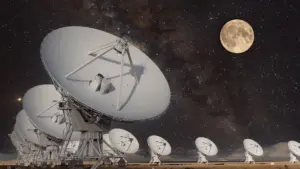
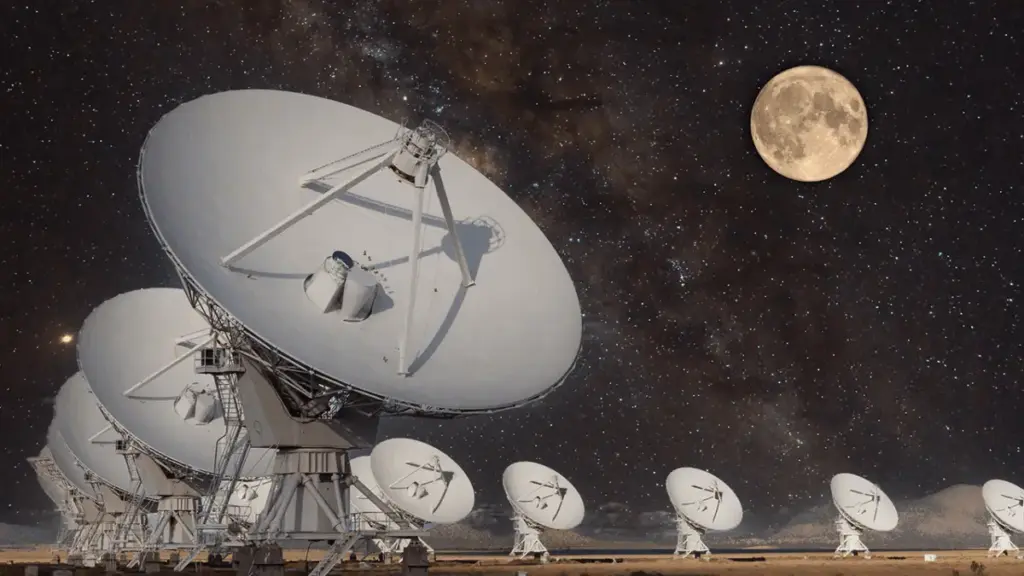
That fundamental puzzle is precisely why FRB 20240304B has the global astronomy community leaning in to examine the data. Detected in March 2024 using the MeerKAT radio telescope—a massive array consisting of 64 interlinked receptor dishes spread across the arid landscape of South Africa’s Northern Cape—the burst lasted for approximately 0.001 seconds, aligning with the standard profile of a fast radio burst.
What stubbornly refused to fit the standard mold, however, was the sheer distance the signal had traversed. By analyzing the precise properties of the incoming radio waves, including the frequency-dependent delay caused by intervening material, the research team calculated that the signal traveled roughly 10.8 billion years to finally reach the sensors on Earth.
This staggering temporal expanse means that the pulse was emitted when the universe was only about three billion years old. This specific window represents cosmic noon, the legendary era in cosmological history when galaxy formation and stellar birth rates reached their absolute peak. Catching a transient event from this distant epoch provides astrophysicists with a pristine laboratory to study conditions in the early universe, free from the evolutionary noise of more recent galactic neighborhoods.
Why the James Webb follow-up changed the story
Pinpointing the exact galactic host of such a distant and faint signal is notoriously one of the most challenging tasks in modern observational astronomy. When ground-based optical and radio telescopes initially looked toward the designated patch of the night sky, they came up completely empty. The culprit behind this observational roadblock was cosmic expansion itself; as the light and energy from the host galaxy traveled across billions of years of expanding space, its wavelengths were severely stretched, shifting the visible light deep into the infrared spectrum.
Recognizing that ground-based optical instruments were blind to the stretched wavelengths, the research team turned to the James Webb Space Telescope. Operating primarily in the infrared spectrum ranging from 0.6 to 28.5 microns, the spaceborne observatory was custom-built to peer through the cosmic veil and resolve precisely these kinds of obscured, ancient targets.
When the James Webb Space Telescope trained its massive golden mirrors on the coordinates provided by MeerKAT, the resulting images revealed a profound surprise. Instead of pointing toward a large, mature, and established galaxy—which standard theoretical models would typically predict for a burst of this magnitude—the signal originated from a modest dwarf galaxy.
Calculations revealed that this host galaxy is roughly one thousand times less massive than conventional models would anticipate for a fast radio burst of this power. Even more striking to the researchers, detailed spectroscopic analysis estimates that an astonishing 90% of the stars within this dwarf galaxy formed within a remarkably narrow window of just the last 30 million years.
This discovery suggests a neat theoretical alignment: the extreme environment, characterized by a fresh surge of stellar births, implies that the fast radio burst could plausibly originate from a newly minted magnetar residing within a vibrant, young star-forming region. It proves that powerful high-energy events are entirely capable of erupting from seemingly unassuming, miniature cosmic nurseries early in the history of the universe.
What this discovery means for the next wave of space science
Beyond serving as a fascinating window into the birth mechanisms of exotic stellar remnants, discoveries like FRB 20240304B hold profound utility for observational cosmology because fast radio bursts effectively double as unique cosmic probes.
As the radio pulse journeyed across intergalactic space for over ten billion years, its lower radio frequencies were subtly distorted and delayed by ionized gas lurking in the vast, otherwise invisible spaces between galaxies. By meticulously analyzing these dispersion fingerprints, the research team was able to extract hidden data, even managing to infer the presence of a previously unknown group of galaxies situated roughly 3.5 billion light-years away from Earth.
As observational techniques improve and international collaborations expand, the scientific community anticipates capturing many more ultra-distant bursts similar to FRB 20240304B. If astronomers can successfully aggregate a larger sample size of these ancient signals, fast radio bursts may soon evolve into a practical, routine tool for mapping the elusive, hard-to-measure matter that fills the cosmic web between galaxies. Furthermore, they will provide an invaluable method for stress-testing theoretical models regarding how rapidly the early universe managed to construct the dense, highly energetic compact objects observed today.
 Bitcoin & Major Altcoins
 Bitcoin & Major Altcoins
 Bitcoin & Major Altcoins