The European Parliament’s Economic and Monetary Affairs Committee has officially urged the European Commission to evaluate whether several rapidly expanding sectors of the digital asset industry—including crypto lending, borrowing, staking, non-fungible tokens, and decentralized finance—should be subjected to formal regulation.
The significant policy recommendations were introduced as part of a comprehensive report brought forward for a plenary vote. Beyond calling for a feasibility assessment of these nascent financial technologies, the report actively encourages the broader adoption of tokenization across traditional financial services, advocates for the development and integration of euro-denominated stablecoins, and presses for a thorough review of whether additional cryptocurrency activities should be brought directly under the regulatory umbrella of the European Union’s landmark Markets in Crypto-Assets Regulation.
Drafted meticulously by Belgian Member of the European Parliament Johan Van Overtveldt, the report functions as an own-initiative resolution originating directly from the Committee on Economic and Monetary Affairs, commonly referred to as ECON. It sets out a structured series of strategic recommendations for the European Commission concerning the future trajectory of digital asset governance across the single market.
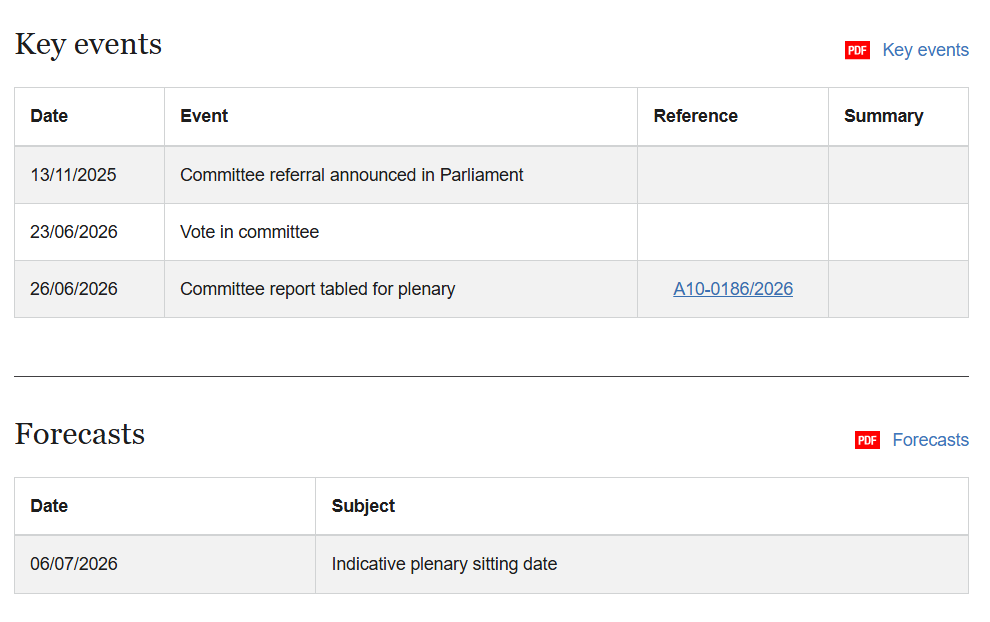
The initiative is scheduled to proceed to the full European Parliament for a definitive floor vote, which is widely anticipated to take place on July 6. Should the resolution successfully pass the vote, it will formally establish the European Parliament’s official institutional position on digital asset policy. However, analysts note that the resolution itself will not immediately amend MiCA or create brand-new legal compliance obligations for market participants, serving instead as a powerful political and directional compass for upcoming legislative agendas.
This legislative milestone follows a structured timeline within the committee, which first reviewed and approved the underlying text before formally routing it toward the plenary session. The evolving stance on digital finance also coincides with related parliamentary discussions, such as the European Parliament’s concurrent backing of the development of a digital euro, illustrating a synchronized legislative push toward a modernized European monetary landscape.
EU Warms Up to Regulated Stablecoins
The newly adopted recommendations reflect a notably evolving perspective on stablecoins among prominent European policymakers. The shift in tone comes mere days after former Bank for International Settlements general manager and longtime crypto skeptic Agustín Carstens publicly softened his stance on stablecoins, acknowledging their potential for safe coexistence with traditional fiat currencies.
In a similar spirit of adaptation, the ECON report formally welcomed euro-denominated stablecoins under the existing MiCA framework, actively encouraging their further development to bolster and streamline the bloc’s domestic payment sector.
This cooperative outlook marks a distinct tonal shift from previous years. Back in 2023, Johan Van Overtveldt fiercely called for much tighter restrictions on cryptocurrencies in the wake of the severe banking turmoil that engulfed Silicon Valley Bank, Signature Bank, and Silvergate Bank. That historic financial crisis was closely intertwined with the stability of digital assets; most notably, USD Coin issuer Circle held approximately $3.3 billion of its commercial reserves trapped inside Silicon Valley Bank when it suddenly collapsed, causing USDC to temporarily break its crucial one-to-one dollar peg and spark widespread panic across international markets. At the height of the turmoil, Van Overtveldt famously likened aspects of the cryptocurrency sector to illicit substances.
However, the tone of the latest parliamentary report is markedly pragmatic. It argues that well-regulated, euro-denominated stablecoins could effectively complement tokenized commercial bank deposits and wholesale central bank digital currencies. Furthermore, proponents suggest that these instruments could dramatically accelerate cross-border payment settlements while simultaneously reducing transaction costs. According to the committee’s findings, broader integration and adoption of such assets could significantly reinforce the competitiveness of European Union financial markets while elevating the international profile and usage of the euro.
This supportive outlook closely aligns with ECON’s broader overarching vision for Europe’s expanding digital money ecosystem. During committee proceedings, lawmakers overwhelmingly backed essential legislative frameworks for a digital euro central bank digital currency, emphasizing that public and private forms of digital money should peacefully coexist and complement one another rather than engage in destructive economic competition. This delicate balancing act forms the bedrock of the European Union’s current strategy to future-proof its economy against external financial shocks.
Lawmakers Look Beyond MiCA’s Current Scope
The path toward the current report has been iterative and deliberate. Johan Van Overtveldt first introduced an initial draft of the text back in February, which was followed by months of intense negotiations, debates, and amendments by ECON members. While the earlier draft focused primarily on the existing confines of MiCA—such as narrow stablecoin classifications and securing legal clarity for multi-issued digital tokens—the scope has since widened significantly.
The newly approved committee report strongly urges the consistent, harmonized application of MiCA across all member states to preserve a level playing field and prevent regulatory arbitrage for crypto asset service providers operating within the bloc. Additionally, the text issues a direct warning to individual national governments, cautioning them against introducing fragmented national requirements that go beyond MiCA, which could inadvertently fracture the European Union’s unified digital asset industry.
The European Commission is already actively engaged in reviewing the practical implementation and limits of MiCA. In May, the Commission launched a formal public consultation seeking detailed feedback from industry stakeholders, legal experts, and the public. The consultation specifically examines whether the regulatory framework should be aggressively expanded to cover previously untouched areas such as decentralized finance, staking operations, crypto lending, non-fungible tokens, and broader tokenized financial assets. It also reopens intense debates regarding the regulation’s initial restrictions on interest-bearing stablecoins.
Meanwhile, the broader regulatory clock continues to tick for the industry. The transitional grace period established under MiCA is drawing to a close, with the definitive deadline set for July 1. Following this cutoff date, crypto asset service providers generally must hold explicit, formal authorization under the regulation to continue legally offering their services across the European Union, signaling the dawn of a fully institutionalized era for European crypto markets.
 Non-Fungible Tokens (NFTs)
 Non-Fungible Tokens (NFTs)
 Non-Fungible Tokens (NFTs)