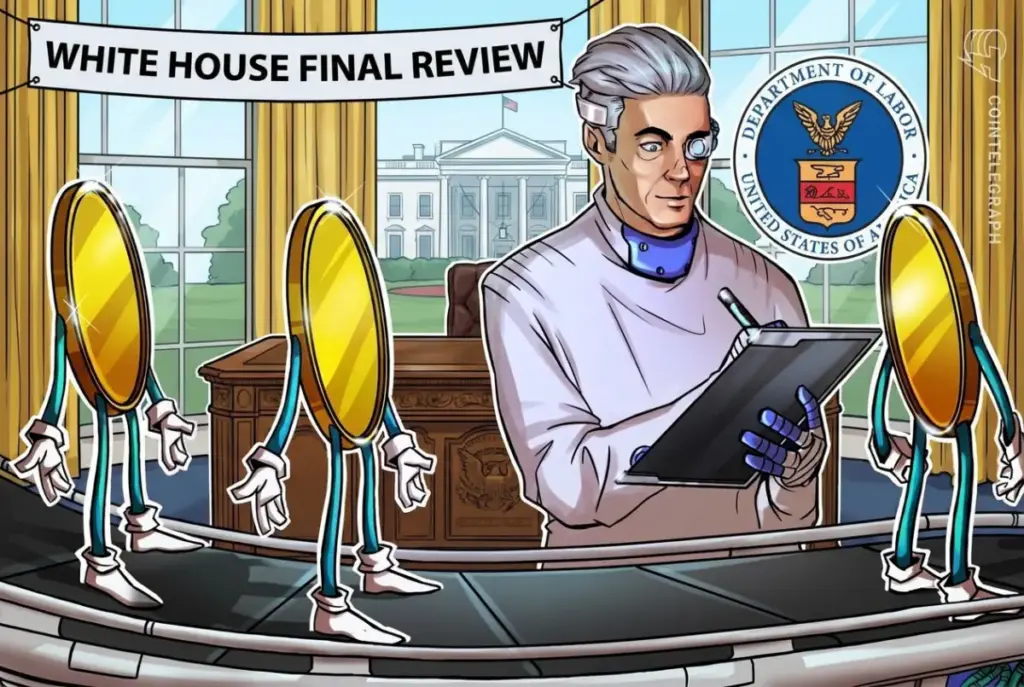
Smaller cryptocurrencies could soon find their way into United States 401(k) retirement accounts under a proposed Department of Labor rule, though legal, structural, and technical experts caution that altcoins will face significantly steeper hurdles than established giants like Bitcoin and Ether.
The policy initiative reached the White House for its final review phase on Thursday, according to official records from the Office of Information and Regulatory Affairs. The overarching objective of the proposed rule is to clear regulatory roadblocks, making it considerably easier for retirement plan sponsors to incorporate alternative asset classes—including digital assets—into mainstream investment menus. At the same time, the framework is designed to offer enhanced legal protections, commonly referred to as safe harbor provisions, for employers and plan managers who choose to include these volatile assets in long-term retirement portfolios.
Originally introduced in March, the Department of Labor’s proposal deliberately refrains from explicitly specifying which digital assets are eligible for inclusion. Furthermore, the framework does not establish a mandatory minimum market capitalization requirement that tokens must meet to qualify. Instead, the regulatory guidance directs retirement plan managers and investment fiduciaries to meticulously evaluate six core factors when determining whether to offer a specific digital asset: investment performance, fee structures, market liquidity, valuation methodologies, appropriate benchmarks, and overall product complexity.
While this forward-looking proposal formally opens the door for a wider array of cryptocurrencies to enter the multi-trillion-dollar retirement plan ecosystem, it does not guarantee that plan sponsors will rush to list them. When examining smaller altcoins and emerging tokens, industry experts emphasize that these digital assets face substantial uphill battles driven by limited historical trading data, thin liquidity profiles, and a host of unique operational risks that could easily deter cautious fiduciaries.
Why smaller cryptocurrencies could face challenges
Teresa Goody Guillén, managing partner at Bellementis PLLC, noted that Bitcoin and Ether are overwhelmingly likely to emerge as the first cryptocurrencies offered to everyday retirement savers. This prediction is grounded in the fact that both assets benefit from highly established markets, robust trading volumes, and regulated investment products that seamlessly integrate with legacy financial infrastructure. According to market data from CoinGecko at 20:01 UTC on November 6, Bitcoin and Ether stand comfortably as the two largest cryptocurrencies by market capitalization, boasting valuations of approximately $1.5 trillion and $273 billion, respectively.
Despite the dominant market share of the top two tokens, Guillén stressed that the regulatory proposal does not automatically exclude smaller altcoins from consideration. Rather, the onus falls squarely on the shoulders of those managing 401(k) plans to demonstrate through rigorous documentation that their investment selections are prudent, justifiable, and aligned with fiduciary standards.
"The real question isn’t which cryptocurrencies regulators pick – it’s whether an investment meets the same standards of prudence, liquidity, valuation and investor protection as any other retirement option," Guillén explained.
She added that while a digital asset’s market capitalization is undeniably a factor, it should never serve as the sole or definitive deciding metric for plan committees. "Big doesn’t mean suitable, and small doesn’t mean disqualified," Guillén said. "Digital assets shouldn’t get special treatment, or be excluded because they use different technology."
Bernardo Brites, co-founder and chief executive officer of Trace Finance, echoed Guillén’s sentiments regarding the stringent practical hurdles facing lesser-known digital assets. He emphasized that the strict criteria outlined by regulators effectively filter out the vast majority of the broader cryptocurrency market before fiduciaries even begin looking at market valuations.
"Run any token through that list and the answer is short. Bitcoin passes clearly. Ether passes; everything else fails on track record or benchmark before a fiduciary ever gets to market cap," Brites remarked.
Brites explained that within this regulatory framework, market capitalization matters only in an indirect capacity. The primary test for any prospective addition to a retirement menu is far more operational and immediate. "The practical test is simpler: can a plan committee document a daily, reliable price from a regulated wrapper?" he said. "If not, it is not going in."
ETFs could come before direct crypto holdings
Although the Labor Department’s pending proposal does not explicitly restrict crypto-related retirement investments exclusively to exchange-traded funds or professionally managed pooled vehicles, market analysts and legal experts anticipate that these packaged products will inevitably materialize long before any direct, spot crypto holdings are permitted within standard 401(k) accounts.
"ETFs and managed funds will likely come first because they fit existing custody and recordkeeping systems," Guillén observed. In contrast, she pointed out that holding cryptocurrencies directly within a retirement plan infrastructure would introduce a complex array of additional operational concerns, including secure digital storage, cybersecurity vulnerabilities, and reliable independent pricing mechanisms. Nevertheless, she maintained that while these challenges are formidable, they should not automatically rule out direct ownership if proper safeguards can be implemented.
Brites similarly anticipates that the integration of digital assets into retirement portfolios will unfold gradually over several years. He projects that existing brokerage window options within 401(k) plans will likely serve as the initial entry point, followed subsequently by standalone exchange-traded funds and multi-asset retirement funds that allocate a modest, controlled percentage of their portfolios to cryptocurrency exposure.
Looking ahead at the timeline for adoption, Brites estimates that specialized crypto investment options could begin trickling into select retirement plans by 2027. This initial phase would likely be followed by the introduction of dedicated crypto ETFs for employees at larger corporations later that same year. By the arrival of 2028, digital assets could potentially achieve much wider availability across mainstream retirement funds, provided regulatory conditions remain stable.
"The rule changes the legal risk, not the plumbing, and the plumbing is slower," Brites noted, highlighting the technical and administrative lag inherent in the massive retirement plan industry. "White House review can take up to ninety days, then publication, then an effective date typically sixty days later."
Legal uncertainties remain
Even if the Department of Labor successfully finalizes the rule and clears the administrative hurdles, Brites cautioned that persistent legal uncertainties could significantly temper the pace of adoption across corporate America. While the proposed regulatory framework is intended to afford retirement plan managers a degree of legal protection from litigation, it does not create an absolute shield, meaning employers could still theoretically find themselves the targets of lawsuits regarding their fiduciary investment decisions.
Furthermore, Brites raised concerns regarding the shifting political and regulatory landscape in Washington, warning that future administrations could easily seek to overturn or revise the policy. This looming possibility of regulatory reversal could understandably make corporate employers hesitant to introduce volatile digital assets into long-term retirement planning vehicles designed to span decades.
"The 2022 guidance was reversed in 2025; a fiduciary signing a ten-year plan design has to consider that this rule could be reversed too," he pointed out. "And with courts giving less deference to agencies, how much weight the safe harbor carries in litigation is itself unsettled."
 Crypto Regulation & Policy
 Crypto Regulation & Policy
 Crypto Regulation & Policy