The information used to perpetrate modern financial scams often exists long before the first phone call, text message, or phishing email ever reaches its target. In the digital age, most individuals remain largely unaware of just how much of their personal information is actively scattered across a vast landscape of disparate databases, public websites, social media networks, and specialized data broker sites. Taken individually, these fragmented details frequently appear harmless or insignificant. However, when aggregated by malicious actors, they provide precisely the context required to engineer highly convincing phishing attempts, sophisticated identity theft schemes, and other damaging financial frauds.
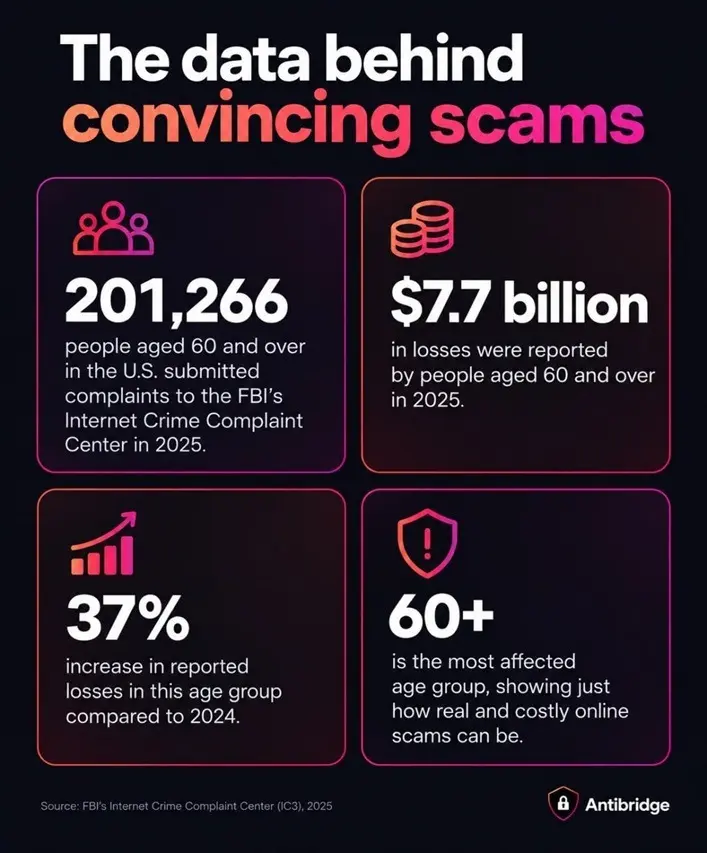
This digital exposure problem is amplified by a broader, ongoing surge in global fraud. To contextualize the scale of the threat, older adults in the United States alone submitted 201,266 complaints to the Federal Bureau of Investigation’s Internet Crime Complaint Center in 2025, reporting approximately $7.7 billion in total losses. Within this specific demographic, the FBI noted that reported financial losses surged by 37 percent compared to the previous year, highlighting an urgent need for proactive consumer protection mechanisms.
Lithuanian technology company WhiteBridge AI has been examining this challenge within a broader operational context for several years. Recently, the firm has sharpened its focus on a critical question: exactly how much personal data remains accessible online, and what actionable steps can individuals take with that knowledge? As part of its preliminary research, WhiteBridge AI has mapped 1,200 individual data broker sites, a figure the company describes as merely the tip of the iceberg regarding databases holding unmanaged personal information.
This work recently garnered significant industry recognition. WhiteBridge AI was selected to join the prestigious Mastercard Lighthouse MASSIV Fall 2026 program, standing out alongside five other Nordic and Baltic impact-tech participants. Announced on August 26 by Mastercard Lighthouse, the cohort features WhiteBridge AI for its innovative approach to online identity, reputation, and network management. The initiative specifically highlights AntiBridge, the company’s consumer protection technology designed to mitigate digital identity risks, which the firm characterizes as a next-generation antivirus for personal digital identities.
When Digital Identity Becomes a Security Issue
WhiteBridge AI was founded on the premise that the volume of personal data living online is on an inevitable upward trajectory. The core technology powering the company’s platform aggregates public and social information to educate users comprehensively about their digital footprint and online reputation.
However, this underlying capability reveals a dual-use dilemma. If legitimate software can efficiently locate, index, and organize publicly available information about an individual, that exact same data can be discovered and exploited by individuals harboring malicious intentions.
This realization drove WhiteBridge AI to develop AntiBridge, a platform designed to pivot the company’s analytical capabilities toward personal data defense. Rather than simply helping users understand their public visibility, AntiBridge establishes a secure environment where individuals can monitor precisely where their personal information has been exposed and implement remediation steps to mitigate associated risks.

“It is still important to understand that removing information cannot and will not cease every scam, identity theft attempt, phishing action, or data leak. The existence of your personal information also does not mean you will automatically become a victim of such actions. Reducing information, at the core of the action, means removing some of the available material, preventing a person with bad intentions from a very personal and believable approach,” says Paulius Taraškevičius, CEO of WhiteBridge AI.
The Information Behind a Convincing Scam
Discussions surrounding fraud prevention frequently focus on the moment suspicious activity becomes directly visible to the victim, such as receiving an unexpected scam call, noticing an unauthorized financial charge, or reading a suspicious message. Yet, the underlying social engineering powering contemporary scams is far more intricate, requiring a fundamental shift in how digital safety is approached.
Before a bad actor can successfully impersonate an individual, a corporation, or a close friend or family member, they require specific, accurate personal data. This foundational information is exceptionally valuable to fraudsters, yet obtaining details such as a residential address, the full names of relatives, a current employer, or an age rarely requires sophisticated hacking techniques. Much of this data is already readily available on public social media profiles. When combined, it supplies enough material to construct a believable deception, particularly when a target is caught off guard or lacks technical experience.
The fraud statistics compiled by the FBI underscore the severe risks this poses to vulnerable demographics, particularly adults aged 60 and older. This group remains a primary target for cybercriminals, sustaining approximately $7.7 billion in financial losses throughout 2025 alone. Because many older individuals did not grow up navigating a complex digital ecosystem, they often rely heavily on younger relatives to help them understand and protect their personal information. Consequently, falling victim to high-dollar fraud at this stage of life carries devastating personal consequences.
To address these systemic vulnerabilities, WhiteBridge AI is leveraging the development of its AntiBridge technology to expand its operational impact globally, securing key partnerships to amplify its reach. Pitching successfully to the Mastercard Lighthouse leadership team, WhiteBridge AI earned its place as one of the top five companies chosen for the Mastercard Lighthouse MASSIV Fall 2026 cohort. Mastercard Lighthouse operates as an open collaboration platform designed to support sustainability and social-impact technology companies operating across the Nordic and Baltic regions, providing selected participants with access to an extensive ecosystem of partners, advisors, and corporate networks.
The Lighthouse initiative bridges the gap between early-stage scaleups and prominent financial institutions, partner banks, institutional investors, and corporate advisors, fostering business growth and strategic partnerships. For the MASSIV program specifically, participating enterprises receive specialized guidance and mentorship from a consortium that includes Mastercard Lighthouse, Swedbank, UNDP, Danske Bank, Nets/Nexi, Synch, and VEQ VC, tapping into an associated network comprising over 270 active investors and corporate partners.
“We are very excited to start working together with the five selected qualified impact-tech companies this fall. Companies bring innovative solutions that are at the forefront of social impact and sustainability. Mastercard, together with our partner banks and advisors, can help provide the impact tech startups with the network to scale beyond their markets and realizing their impact faster through partnerships,” shares Mats Taraldsson, Head of Fintech and Impact Tech Engagement at Mastercard Northern Europe.
 FinTech News
 FinTech News
 FinTech News