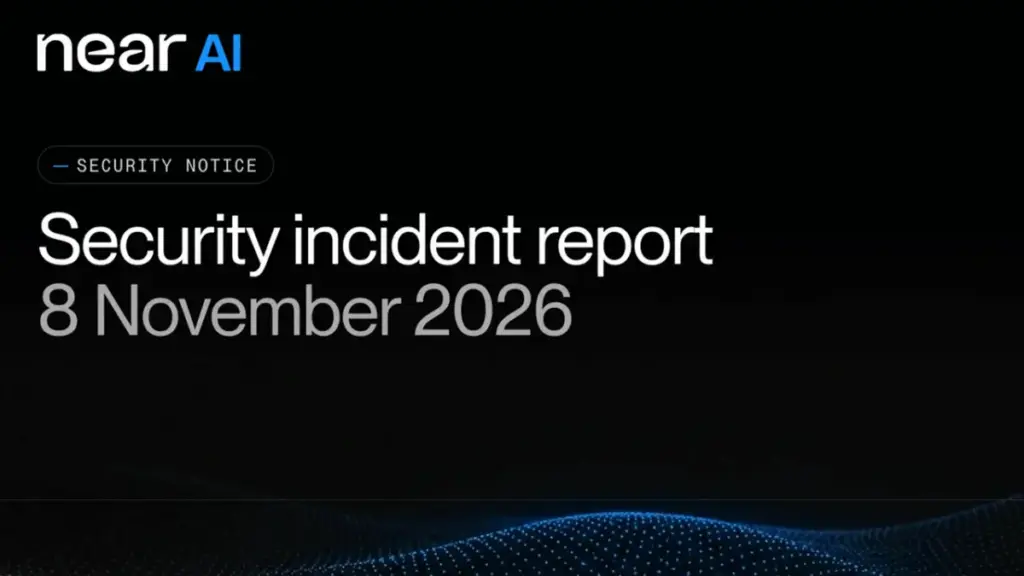
Near AI has disclosed a security breach that compromised account information for approximately 100 users and exposed operational data belonging to 18 legacy artificial intelligence agents. The security incident, which took place on November 8, 2026, stemmed from an exploited vulnerability in an open-source inference engine, raising fresh questions regarding the security boundaries of confidential computing and the software layers powering advanced artificial intelligence infrastructures.
According to Near AI’s official security incident report published on Monday, November 9, an unauthorized party successfully leveraged a remote code execution vulnerability within SGLang. SGLang is an open-source inference engine widely utilized throughout the tech industry to process artificial intelligence workloads efficiently. The flaw permitted unauthorized code execution on a single inference server, which then served as a critical entry point allowing the intruder to pivot into additional internal systems and surrounding network architectures.
From that initial foothold, the intruder navigated toward infrastructure associated with Near AI’s previously deprecated Private Chat service. Within this environment, the unauthorized party downloaded account records belonging to approximately 100 users. The compromised information primarily included names and email addresses, while certain individual accounts also exposed subscription plan details and remaining balance information.
The scope of the intrusion, however, extended well beyond customer account records. Subsequent internal investigations confirmed unauthorized access to 18 distinct agents operating on a legacy Near AI Agents deployment that functioned outside the company’s trusted execution environment. The data retrieved from these legacy agents encompassed chat histories, configuration settings, and operational logs, creating potential downstream risks for the users and developers who relied upon them.
Furthermore, two Near AI Cloud customers suffered exposure of their application programming interface keys through those same operational logs. Prompted by the discovery, Near AI security teams immediately revoked both sets of credentials to forestall any potential unauthorized usage or system integrations.
Importantly, Near AI reported finding no direct evidence indicating that stored Private Chat conversations or uploaded user files were accessed during the breach. Nevertheless, the company acknowledged a critical distinction regarding real-time processing: requests that were actively handled on the compromised server on November 8 could have been observed by the intruder. This potential exposure applied even to requests operating under confidential mode, highlighting a nuanced vulnerability during the active computation phase.
The disclosure carefully distinguishes between confirmed data theft involving stored files or historical chats—which Near AI says did not occur—and the potential observation of information while it was actively undergoing processing. Near AI has not yet quantified precisely how many confidential requests might have been observed during the window of vulnerability.
SGLang Vulnerability Opens Door to Near AI Infrastructure
The mechanism of the breach has drawn sharp focus within the artificial intelligence security community, particularly regarding the inherent limitations of confidential computing. Confidential computing is a specialized technology engineered to safeguard sensitive information through hardware-isolated execution environments, protecting data from unauthorized access by underlying hosts and cloud operators alike.
However, Near AI explained in its incident report that these robust hardware protections cannot automatically defend against vulnerabilities residing within the applications and software operating directly inside those secure environments.
As the company acknowledged in its public disclosures, confidential computing successfully protects data from the operator and the host, but it does not protect against a software vulnerability inside the environment itself, which is precisely what occurred during the November 8 intrusion.
In practical terms, the malicious actor bypassed the need to defeat complex hardware isolation mechanisms by attacking the inference software itself. Once the malicious code successfully executed inside the affected server, data and requests undergoing real-time processing became potentially visible to the intruder.
This technical distinction carries profound implications for the artificial intelligence industry, as confidential computing is broadly marketed and relied upon to restrict access by infrastructure operators and underlying hosts. It does not, however, serve as an absolute guarantee that the software handling sensitive data is free from exploitable defects. Following the incident, Near AI announced that its ongoing security analyses would expand to examine inference software and surrounding support services with the same rigorous standards traditionally applied only to protected computing environments.
Near AI Restores Cloud Services Following Comprehensive Security Response
Upon detecting the unauthorized activity, Near AI engineering and security response teams initiated swift containment protocols. Active user sessions and administrative credentials were immediately revoked, agent tokens were replaced, and the Private Chat service was taken completely offline to prevent further exposure. Engineers rapidly deployed a comprehensive fix for the SGLang vulnerability across every inference server in the fleet while executing additional credential rotations across the network.
The company also confirmed the completion of a thorough forensic review. Affected users were notified directly, and the owners of all 18 compromised AI agents were contacted individually to appraise them of the situation. Near AI confirmed that normal access to its cloud services has since been fully restored following successful containment and remediation efforts. Additionally, the underlying vulnerability was formally reported to the SGLang open-source project developers so that the broader developer community could patch the flaw.
Impacted customers received tailored instructions and security guidance through [email protected], while corporate communications urged users to remain vigilant against any unsolicited communications referencing account information, subscription plans, or balances. Near AI noted that formal regulatory notifications will be submitted wherever legally required by regional jurisdictions. The security incident notably did not impact the underlying Near Protocol network itself or other independent services operating within the broader ecosystem.
Nevertheless, the compromise raises uncomfortable questions for infrastructure providers building confidential artificial intelligence systems. The central dilemma facing the sector remains straightforward: how private is protected computation when the software actively processing the requests retains exploitable vulnerabilities? While hardware isolation provides a crucial and necessary security boundary, the Near AI incident demonstrates that true confidentiality ultimately depends on the uncompromised integrity of every software application operating within those secure spaces.
The Near AI security breach also unfolds against a turbulent backdrop of digital security incidents across the broader technology and blockchain ecosystems. Over recent months, a succession of high-profile vulnerabilities and cyberattacks has tested the resilience of digital asset platforms, exchanges, and infrastructure providers. From massive cryptocurrency exchange hacks and wallet breaches to exploits affecting decentralized finance networks and hardware security keys, attackers have repeatedly exposed weaknesses spanning customer records, software dependencies, and authentication systems.
These widespread episodes illustrate an increasingly complex security landscape where challenges extend far beyond stolen digital currencies, reaching deep into the enterprise software, customer data repositories, and cloud infrastructures entrusted with safeguarding modern digital operations.
 Bitcoin & Major Altcoins
 Bitcoin & Major Altcoins
 Bitcoin & Major Altcoins