Bypasses U.S. AI Export Controls as Banned Chinese Users Access Frontier Models via Crypto-Powered Proxies
Developing frontier artificial intelligence models is an intensely resource-heavy undertaking with profound national security implications. Because of these stakes, the United States government strictly bars users and companies located in China—a primary competitor in the fast-paced global AI arms race—from directly accessing powerful, state-of-the-art AI systems like Anthropic’s Claude and OpenAI’s ChatGPT.
Yet, despite sweeping export controls, a new investigative report from the Chainalysis Global Intelligence Team reveals that banned and suspected Chinese users are continuously accessing these models anyway. They are bypassing geopolitical barriers by tapping into a burgeoning shadow economy of export control-sidestepping services. These intermediary platforms sell access to restricted models, often at a discount, allowing banned users to cheaply mine advanced U.S. systems to dramatically improve their own domestic platforms at a fraction of the traditional research and development cost.
Referred to broadly as "proxy services," these digital waystations expertly route complex queries into restricted AI models while thoroughly concealing the true origin of the requests. They typically accept standard fiat currency payments through popular China-based processors such as WeChat Pay and AliPay. However, a comprehensive survey of 100 active proxy services conducted by researchers found that roughly 40% also gladly accept cryptocurrency as a form of payment, predominantly relying on stablecoins to settle accounts.
Industry analysts suggest that these crypto payment rails are likely part of a deliberate, calculated strategy by proxy operators to obfuscate financial infrastructure, deftly bypass stringent state capital controls, and maintain off-grid access for sensitive, high-profile users seeking to fly under the regulatory radar.
Chinese AI Companies Use Proxy Services to Train Local Models, Undermining U.S. Restrictions
By providing covert, indirect access to advanced American large language models, these proxy services are actively undermining the rigorous, national security-focused restrictions painstakingly implemented by U.S.-based AI laboratories.
Through a sophisticated practice known in the industry as "distillation," Chinese AI laboratories can leverage the superior outputs of advanced foreign models to train and refine their own competing models. This method is exponentially cheaper than training models entirely from scratch. Illustrating the scale of this threat, Anthropic recently issued a public accusation against three prominent China-based AI labs—DeepSeek, Moonshot, and MiniMax—alleging that they systematically extracted advanced capabilities from Claude by utilizing roughly 24,000 fraudulent user accounts routed entirely through proxy services.
As Anthropic and other cybersecurity authorities have pointed out, such illicitly distilled models often spread dangerous capabilities because they frequently lack the robust safety guardrails built into the original, parent systems. Highlighting these escalating dangers, the U.S. National Security Agency (NSA) issued a stark warning cautioning that these compromised, derivative models pose significant, multifaceted risks to critical national infrastructure, military readiness, economic stability, and sensitive technology domains.

What once began as a loose, informal grey market facilitating occasional access has now matured into a highly structured, industrialized economy. It features a deeply segmented supply chain and dedicated financial infrastructure. Today, specialized providers sell access through flexible credits and account top-ups, cementing a thriving commercial ecosystem built entirely around unauthorized, workaround access to U.S. frontier models. Within this commercial ecosystem, cryptocurrency payments are steadily gaining traction, offering an appealing alternative for developers and entities eager to avoid traditional domestic digital payment rails.
Suspected Chinese Wallet Activity in the Proxy Economy Spikes After New U.S. Model Releases
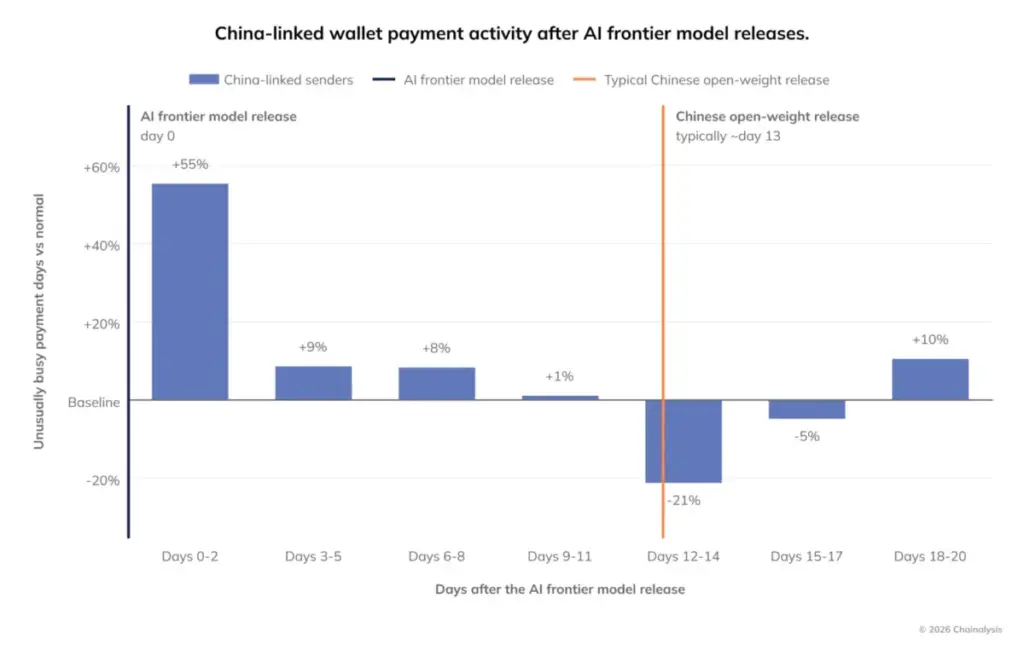
To better understand the mechanics of this shadow market, researchers analyzed suspected Chinese-linked cryptocurrency wallet activity surrounding major U.S. AI model releases. The hypothesis was straightforward: if Chinese developers are routinely using proxy services to extract capabilities from newly unveiled models—and utilizing cryptocurrency to settle bills for those services—transaction volumes should noticeably spike immediately following a high-profile product release.
The data strongly supported this theory. Researchers discovered that suspected China-linked wallets consistently ramp up their transaction activity in the days immediately following a frontier model release, well in excess of baseline activity observed across all other wallets interacting with these proxy services. This distinct behavioral pattern is highly consistent with an organized effort to gain rapid, first-hand access to brand-new model capabilities. Furthermore, it strongly reflects the operational reality of crypto being utilized as an agile payment rail to facilitate rapid model distillation. Researchers note, however, that aggregate blockchain data alone cannot definitively confirm the precise intent driving every observed transaction.
An analysis of the specific wallets paying for these AI proxy services revealed a heavy concentration not only within mainland China, but also across key regional financial hubs including Japan, Hong Kong, Singapore, and South Korea. This geographic distribution aligns closely with expectations that Chinese operators routinely route their traffic through regional proxy corridors to obscure their location and successfully access restricted models.
User Crypto Payments in the Ecosystem Typically Pass Through Custodial Services Before Reaching Proxy Providers
Another critical finding from the research is that AI proxy services do not always collect user payments directly. Instead, the vast majority rely on custodial cryptocurrency payment processors and third-party financial intermediaries.
These intermediary services deliver a range of strategic benefits to proxy operators. They help insert a layer of operational distance between end-users and the actual service providers, assist in smoothly bypassing state capital controls, and maintain strictly off-grid access for sensitive actors. Given that China maintains sweeping, comprehensive restrictions on domestic cryptocurrency trading and payment activities, this heavy reliance on third-party processors also appeals strongly to proxy operators because it shields them from the severe regulatory and operational risks of managing their own payment architecture.
This layered, complex payment structure creates hidden financial exposure for fully regulated crypto exchanges and other mainstream digital asset companies. Funds linked directly to illicit proxy services can easily wind up washing onto regulated platforms without any obvious, clear direct ties pointing back to the original proxy source.
How Blockchain Intelligence Can Help Crack Down on the Proxy Shadow Market
The proliferation of AI proxy services presents a formidable enforcement challenge for American authorities attempting to restrict foreign adversary access to cutting-edge artificial intelligence. Simply blocking direct access to frontier models at the corporate level is no longer sufficient when an entrenched, highly mature shadow economy exists explicitly to resell that access on demand.

The proxy economy’s multi-tier supply chain makes it exceptionally difficult to dismantle through traditional means. Upstream vendors routinely obtain model access through stealthy tactics like automated account farming and model swapping. Meanwhile, intermediary proxy services handle downstream tasks such as pooling user access, routing complex queries, and selling subscription credits. If law enforcement or platform operators disrupt a single vendor, others quickly step into the vacuum to maintain continuity.
This is where advanced blockchain intelligence becomes an indispensable tool for investigators. By tracing complex financial flows across the digital ecosystem, blockchain analysts can effectively expose hidden links between elusive proxy operators, their end-users, the operational intermediaries sustaining them, and the digital asset platforms where funds ultimately come to rest.
By mapping these intricate connections, regulatory authorities and private AI companies can pinpoint critical pressure points within the network. Disrupting this underlying financial and technical infrastructure is essential to undermining the shadow market that currently enables unauthorized access to America’s most sensitive artificial intelligence systems.
Frequently Asked Questions
What are Chinese AI proxy services?
Chinese AI proxy services are commercial operations that resell access to otherwise restricted artificial intelligence models—such as Claude, ChatGPT, and Gemini—enabling users in China and other restricted jurisdictions to utilize systems they cannot legally or technically access directly. Most of these services operate on a pay-as-you-go model where account sign-up is free, and users subsequently purchase credits or tokens to run their queries.
Why are AI proxy services a concern for U.S. authorities and AI companies?
Beyond individual users simply satisfying their curiosity, a primary concern is that Chinese AI developers utilize proxy services to systematically extract capabilities from U.S. frontier models. This allows them to train and improve their own domestic systems without bearing the massive research and development costs incurred by American labs. These workarounds actively circumvent U.S. AI export controls and introduce serious national security risks if the resulting derivative models lack the fundamental safety guardrails of the original platforms.
How do AI proxy services use cryptocurrency?
Cryptocurrency, particularly stablecoins, allows proxy services to accept cross-border payments smoothly without relying on traditional international banking infrastructure. Crypto payments also reduce payment friction and, depending on the transaction parameters, limit the mandatory identity verification required of customers. Chainalysis research revealed that 40% of the 100 AI proxy services surveyed actively offered cryptocurrency payment options.
How do AI proxy services process cryptocurrency payments?
Many proxy operators do not receive cryptocurrency payments directly from customers. Instead, they rely heavily on custodial services and third-party payment processors. These financial intermediaries help providers create a buffer between customers and service operators, bypass state capital controls, and maintain off-grid access for sensitive users while shielding the core business from direct regulatory scrutiny.
How can blockchain intelligence help investigate AI proxy networks?
Blockchain intelligence enables investigators and corporate compliance teams to trace cryptocurrency transaction flows and map complex relationships among proxy operators, payment processors, and digital exchanges. By examining these connections across multiple transactions, investigators can identify critical intervention points and gain a clearer understanding of the financial plumbing supporting unauthorized access to advanced AI technology.
 Crypto Wallets & Security
 Crypto Wallets & Security
 Crypto Wallets & Security