Blockchain intelligence firm Chainalysis has formally attributed the historic $6.4 billion breach of cryptocurrency exchange Binance to TraderTraitor, a prolific North Korean state-sponsored cybercrime organization. The incident, which unfolded late last month, stands as the largest cryptocurrency hack in history and ranks among the single-largest financial crimes ever recorded globally. According to investigators, the sophisticated assault underscores a persistent and escalating threat model targeting digital asset infrastructure, centralized exchanges, decentralized finance protocols, and individual investors to generate illicit revenue streams for the North Korean regime.
The intelligence assessment released by Chainalysis relies heavily on detailed on-chain activity captured in the immediate aftermath of the security breach. The attack sequence was meticulously orchestrated, beginning around 4:20 p.m. Eastern Time on October 29, when unauthorized outflows were detected streaming out of Binance hot wallets deployed across multiple distinct blockchain networks. On the Ethereum network specifically, the threat actor utilized an operational wallet initially funded through the privacy-focused mixing protocol Tornado Cash. This operational wallet was employed to submit valid, cryptographically signed authorizations that effectively permitted a Binance hot wallet to execute attacker-deployed code.
Once that malicious execution environment was established, the attacker invoked the compromised wallet to sweep its accumulated digital assets directly into addresses under their explicit control. Meanwhile, across other affected blockchains, additional unauthorized transfers mirrored the heist, appearing to execute ordinary signed transfers that successfully drained liquidity. By the time the dust settled on the initial breach window, the cumulative unauthorized transfers had stripped approximately $6.4 billion USD from the exchange’s reserves.

A High-Stakes Race Against Time and Freezing Protocols
Following the initial execution of the exploit, the perpetrator found themselves locked in an intense, high-stakes race against the clock. While a substantial portion of the stolen capital was denominated in native, decentralized, and unfreezable cryptocurrencies such as Bitcoin and Ethereum—assets that operate independently of centralized oversight—billions of dollars more were held in stablecoins like USDT and USDC. Unlike native cryptocurrencies, stablecoin smart contracts inherently possess administrative mechanisms that allow issuers to freeze tokens, effectively blacklisting specific wallet addresses to prevent the movement or liquidation of stolen funds.
Recognizing this vulnerability, the attacker knew it was only a matter of time before stablecoin issuers, acting in close coordination with international law enforcement agencies and blockchain analytics firms like Chainalysis, would intervene to lock down the assets.
To stay ahead of this impending defensive action, the exploiter rapidly funneled approximately $500 million worth of stablecoins into dedicated stopover and intermediary wallets designed explicitly to swap freezable assets into non-freezable alternatives. Over a compressed window lasting nearly 20 minutes, the attacker successfully converted $325 million in stablecoins into roughly $285 million in Ether. Approximately ten minutes later, the bad actor attempted to route the remaining $175 million in stablecoins through additional stopover wallets in a desperate bid to outpace blacklisting procedures.

Despite the speed of the attacker’s operations, the broader cryptocurrency industry mobilized faster than anticipated. By 5:14 p.m. Eastern Time, the first wave of coordinated asset freezes went into effect, catching the exploiter mid-stream.
Throughout multiple blockchains, a collaborative coalition comprising Chainalysis investigators, law enforcement bodies, stablecoin issuers, and diverse industry participants raced concurrently to intercept the stolen capital. Much of this defensive response unfolded organically as organizations acted in parallel, with Chainalysis proactively disseminating critical investigative leads to industry partners to aid in the rapid identification and freezing of targeted addresses. To date, approximately $2.8 billion of the stolen funds have been successfully frozen. While this intervention does not diminish the staggering scale of the initial theft, cybersecurity experts note that the rapid and synchronized response highlights an increasingly mature digital asset ecosystem capable of mounting coordinated defenses against major cyber threats in real time.
Commingled Funds Strengthen the Link to TraderTraitor
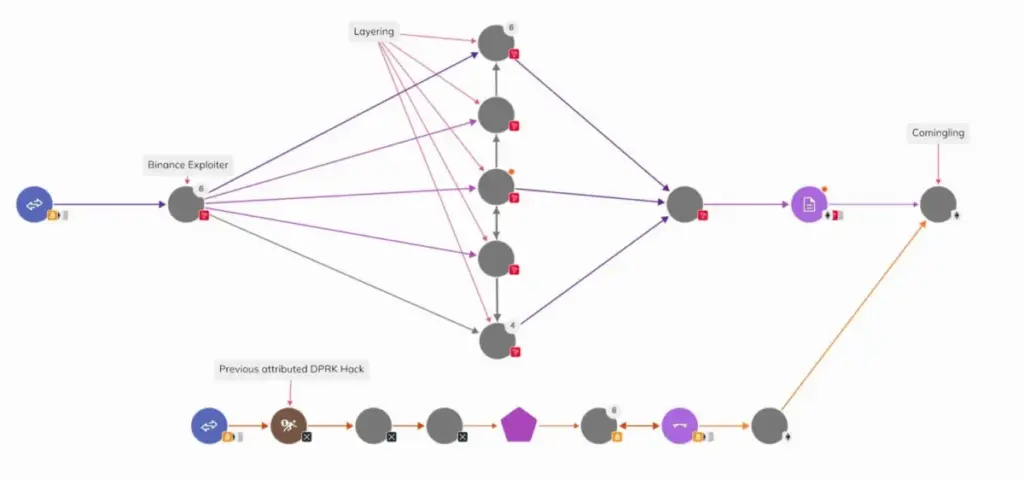
Initial analysis of the laundering patterns deployed during the early hours of the breach pointed toward the operational footprint of TraderTraitor, but the definitive link emerged through real-time blockchain tracking. Chainalysis investigators observed funds stolen during the Binance breach directly commingling with capital stolen during the previous month’s high-profile exploit of the Bitget exchange—an incident that had already been conclusively attributed to North Korean state-backed cyber actors.

This direct and verifiable on-chain connection provided the concrete evidence required to solidify the assessment. Armed with this intelligence, Chainalysis officially announced its attribution of the Binance attack to TraderTraitor at 12:30 a.m. Eastern Time on October 30, less than nine hours after the breach began.
Automated Laundering Patterns Reveal Novel Tactics
As investigators continue to trace the dispersion of the remaining unfrozen funds, they have uncovered complex laundering behaviors that break new operational ground. The sheer volume of transactions—numbering in the thousands executed within compressed timeframes—strongly indicates that the attackers are leveraging advanced automation to obscure the transaction trail. Rather than simply forwarding stolen assets through a linear chain of intermediary addresses, the automated scripts repeatedly circulate funds among networks of addresses, frequently bouncing capital backward to wallets that played a role earlier in the laundering sequence.
A recurring operational footprint has been identified across numerous participating addresses. These wallets consistently follow a rigid transactional pattern: they first receive an exact amount of 1 TRX (Tron’s native token), subsequently receive additional tranches of funding, and then rapidly forward the accumulated capital onward to subsequent destinations. This repetitive, highly structured sequence points toward a programmatic, algorithmic process designed to obfuscate ownership, fragment liquidity, and accelerate the redistribution of the billions of dollars in illicitly acquired assets.

The ongoing investigation highlights the persistent vulnerability of centralized cryptocurrency exchanges, which remain prime targets for state-sponsored threat groups due to the sheer concentration of capital they custody, regardless of their geographic jurisdiction or regulatory standing. Although the scale of the Binance breach is unprecedented in the history of the digital asset sector, large-scale targeting of exchange infrastructure is an established vector. Security analysts emphasize that digital asset platforms globally must maintain heightened vigilance and robust, real-time incident response capabilities to mitigate the fallout of high-velocity cyber assaults.
Chainalysis continues to support Binance and the broader cryptocurrency industry by tracking fund movements, disrupting ongoing laundering efforts, and aiding in the containment of additional financial losses. Analytics clients are utilizing specialized blockchain monitoring solutions to identify potential exposure to the wallet addresses flagged in connection with the incident, while intelligence teams continue updating network labels as new transactional data emerges.
 Crypto Wallets & Security
 Crypto Wallets & Security
 Crypto Wallets & Security