Papertrade, the newly launched 1,000x perpetual exchange built on Hyperliquid, has delivered a striking blow to its user base by announcing that PAPER token holders will be strictly prohibited from selling or transferring their tokens off-contract for the foreseeable future. The decision, executed deliberately by the core development team, marks a dramatic pivot from the project’s original roadmap and has sent shockwaves through the emerging "house pool" derivatives sector.
On Monday, the protocol’s team made it official, stating plainly that there are currently no plans to enable off-contract token transferability. This development represents a complete reversal of their initial launch strategy. When the exchange made its debut earlier this month, PAPER was explicitly slated to become transferable eventually, with official announcements as recently as October 1st promising that transferability would be unlocked "after a sufficient period of time has passed."
Now, that transition has been taken entirely off the table for the foreseeable future. In response to the sudden policy shift, multiple external venues, including Paragon and Aster, have promptly delisted their pre-market PAPER perpetual contracts. Meanwhile, a significant segment of the trading community—specifically those who willingly took heavy losses on the platform to farm the token—has expressed profound frustration and anger over the locked liquidity.
Regardless of polarizing opinions on the fairness of the move, the underlying rationale behind Papertrade’s decision has exposed a fundamental vulnerability in this novel style of decentralized exchange architecture. When a native governance or utility token acts as a direct claim on the protocol’s house bankroll, shorting that token transforms into a direct bet against the house itself. More critically, the profits generated from that short position can effectively finance the exact exploit used to drain the pool.
Papertrade’s Tough Decision
To understand the weight of this maneuver, it helps to review the core mechanics of the protocol. Papertrade operates by acting as the counterparty to every single trade executed on the platform through a single, shared USDC pool. This central vault is funded directly by the cumulative losses of the platform’s traders.
When a user incurs a trading loss, they are minted PAPER tokens. Staking these tokens allows participants to earn a steady stream of USDC derived from the protocol’s revenue take, including any excess funds that spill over once the central pool surpasses its designated cap. In essence, losing traders slowly accumulate a fractional ownership stake in the house.
However, Monday’s update abruptly altered this dynamic. The protocol queued structural changes through a timelock to go live twenty-four hours later, pending final security reviews. The catalyst for this sudden emergency pivot came down to an unexpected surge in external market demand. Paragon listed its pre-market PAPER perpetual contract on October 18th, just eight days after the exchange’s launch, with Aster following suit on Monday morning. As co-founder Jez candidly admitted following the fallout, the team had specifically underestimated the overwhelming market demand for pre-market perpetuals tied to their token.
Tradable PAPER as a Weapon
The valuation of the PAPER token is inextricably tied to the health of the underlying house pool, as its yield stems directly from the protocol’s earnings. If an attacker manages to drain the pool, or if winning traders find themselves trapped in a payout queue waiting on fresh losses to materialize, the market value of PAPER will inevitably collapse.
This creates a severe structural vulnerability due to how Papertrade handles price feeds. The exchange marks its trades against Hyperliquid’s midpoint—the exact halfway point between the top bid and ask. Consequently, temporarily manipulating the price on Hyperliquid forces a corresponding movement in Papertrade’s internal pricing.
On launch night, for example, a single wallet successfully nudged Ethereum’s price by roughly 0.12% on Hyperliquid and walked away with approximately $1.28 million in profit, according to reports from The Block, though Papertrade noted that the trader later returned the majority of those funds through subsequent accounts. While the Papertrade team acknowledged early on that manipulation attacks are theoretically possible, the primary question has always been whether attempting such an exploit is economically viable.
Under normal circumstances, the math heavily discourages attacks. For instance, if the central pool holds $10 million, an attacker attempting to manipulate Bitcoin or Ethereum prices enough to completely drain that pool would incur roughly $15 million in trading losses. Standing alone, the attack results in a net financial loss.
However, introducing a tradable PAPER short position completely upends this equation. If that same attacker opens a $10 million short position on PAPER across an external exchange, draining the protocol pool would crash the value of the token. The resulting profits from the short position would easily cover the initial cost of the price manipulation, turning an otherwise unprofitable exploit into a highly lucrative attack vector. In Papertrade’s own assessment, a tradable PAPER perpetual effectively converts into a leveraged bet on the absolute solvency of the bankroll.
The core dilemma for the team is that these short positions reside on external platforms entirely outside of Papertrade’s operational control. While the protocol can establish strict limits on the size of its own bankroll, it cannot prevent platforms like Paragon, Aster, or decentralized derivatives aggregators from listing PAPER markets. Consequently, the team’s only defense is to restrict how much users can trade and transfer on Papertrade itself. Every new external PAPER market effectively places a hard ceiling on how large Papertrade can safely grow. Faced with a stark choice between maintaining a liquid, freely tradable token or preserving the security and longevity of a growing exchange, the team decisively chose the exchange.
Interestingly, this specific blind spot was absent in pre-launch stress tests. Back in August, research models from Sumcap replayed roughly 3.6 million historical Hyperliquid trades through Papertrade’s design across more than 600 distinct scenarios, demonstrating that the house pool remained solvent in every single test. The critical caveat, however, was that those models explicitly excluded the external market price of the PAPER token—the exact vector where this systemic attack vulnerability ultimately resides.
What Now for Token Holders?
The immediate reality for current PAPER holders is complex. Users retain a pro-rata share of the protocol’s USDC revenue payouts which they can successfully claim, but the underlying equity shares cannot be cashed out or sold on an open secondary market. Co-founder Jez noted that it is much more accurate to think of PAPER as a revenue-share mechanism in the exchange rather than a traditional speculative crypto token.
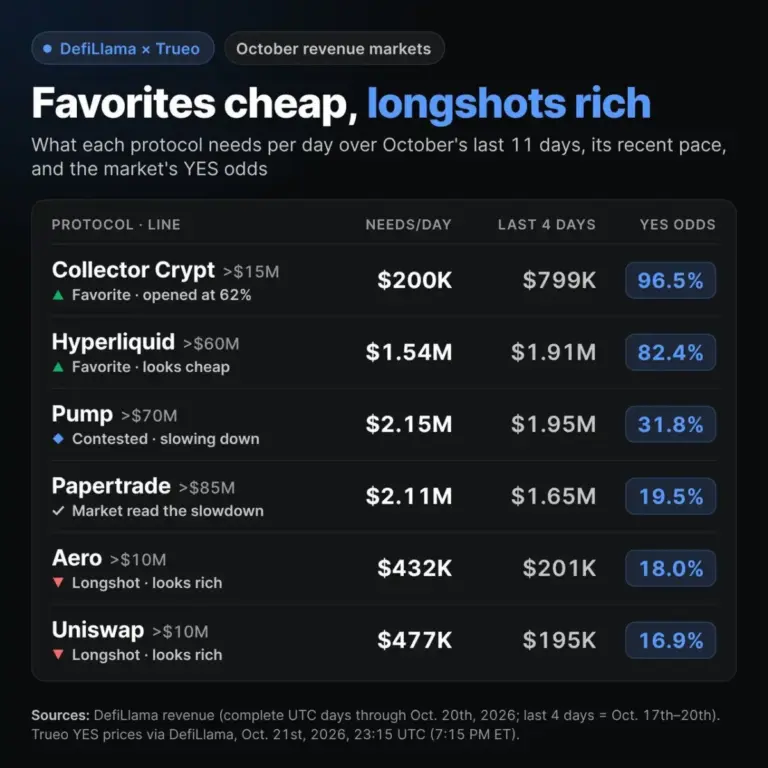
The revenue distributions themselves are substantial, though they have experienced notable fluctuations. According to on-chain data from DefiLlama, the protocol had distributed roughly $58 million to PAPER holders since its October 10th launch. However, daily payouts have cooled considerably from a peak of approximately $6.7 million on October 15th, averaging around $1.5 million per day between October 17th and 19th.
Simultaneously, the economic proposition for new losing traders has deteriorated. With recent daily payouts hovering around $0.00017 per token, the 10 PAPER tokens generated from a standard $1 trading loss yield roughly $0.002 per day, meaning it would take nearly 600 days just to recoup the initial $1 loss purely through staking yields. On-chain analytics from Lookonchain indicate that even the largest liquidity farmers remain deeply in the red despite factoring in their accumulated staking rewards.
Market pricing prior to the delistings reflected similar skepticism. Paragon settled its perpetual contract at $0.026, which valued the circulating supply of roughly 8.85 billion PAPER tokens at approximately $230 million. Had the recent $1.5 million daily payout pace held steady for an entire year, stakers would collect roughly $560 million—more than double the token’s implied market valuation—demonstrating that traders fundamentally doubted the sustainability of those yields.

The development team’s recent updates frame this aggressive overhaul as an effort to return PAPER closer to its original design as an exchange rakeback system, functioning essentially as a slow-motion loss rebate paid out to the very players funding the house.
The Broader Implications for House Pool Exchanges
Papertrade’s policy reversal raises critical questions for the broader decentralized finance ecosystem regarding the viability of liquidity farming and risk management in high-leverage derivatives protocols.
A primary concern is whether traders will continue to absorb voluntary losses to farm a token that cannot be exited. Many participants farmed PAPER specifically on the assumption that transferability would eventually allow them to cash out. Without an exit route, farming transforms into a grueling wait of nearly two years just to break even, assuming payouts do not continue to shrink. Once these opportunistic farmers drift away, the protocol will rely entirely on organic trading volume from high-risk speculators willing to trade at 1,000x leverage, revealing the true baseline demand for the platform.
While platforms like Paragon were forced to shut down their PAPER perpetual markets due to the lack of a convergent spot price, alternative side doors and wrapper tokens continue to emerge. Projects like PaperDAO have introduced derivative tokens that trade on decentralized exchanges like Uniswap, offering pro-rata claims on treasuries that farm PAPER, though their documentation explicitly limits ultimate redemption until official transferability is unlocked. While these tradable wrappers remain minor today, they represent the exact type of external exposure that protocol developers cannot easily cap or control.
The broader industry is already adapting to these architectural challenges. Newer protocols entering the high-leverage market have taken different approaches to tokenomics. Jupiter’s YOLO platform, which launched with similar payout math, opted to skip a native token entirely, utilizing a closed house pool funded strictly by losses and walled off from its primary liquidity pools to eliminate any underlying asset available to short. Conversely, Solana-based competitor Cardboard adopted Papertrade’s original model, minting reward tokens against eligible losses with explicit rules preventing transfers until officially enabled by the protocol.
For Papertrade, the decision to freeze token transfers will undoubtedly carry a heavy cost in terms of community goodwill and user sentiment. Participants who accepted heavy trading losses expecting a liquid asset now find themselves holding a locked yield stream subject to diminishing returns.
Nevertheless, defenders of the protocol argue that the move was a necessary defensive measure to preserve system solvency. Because the central pool exists to honor winning trades, permitting a tradable token that facilitates profitable attacks against the pool ultimately threatens every single user on the platform, not just token stakers.
The overarching lesson for the emerging class of house-pool exchanges is profound: when a protocol’s native token functions as the equity of the house, allowing that equity to trade freely on external markets inadvertently equips attackers with a potent financial hedge. As the sector matures, upcoming protocol launches will undoubtedly have to navigate this exact structural obstacle, ensuring that the house continues to win while remaining insulated from systemic manipulation.
 Tokenomics & Digital Assets
 Tokenomics & Digital Assets
 Tokenomics & Digital Assets