DefiLlama, long established as a dominant force in cryptocurrency analytics and data provision, is leveraging its market positioning to enter the realm of prediction markets—literally settling bets based on its own telemetry.
On October 20, DefiLlama announced a strategic partnership with Trueo, a permissionless prediction market protocol operating on Base. The collaboration introduces a suite of specialized prediction markets that settle strictly according to DefiLlama data. These newly minted offerings cover critical onchain metrics, including protocol revenue milestones, potential DeFi exploits, and high-profile chain statistics.
While the "revenue meta" has become a central focus for market participants treating decentralized applications like cash-flowing businesses, security risks and exploits remain the industry’s most persistent specter. The introduction of these markets attempts to attach a live, crowd-priced probability to both growth and catastrophic risk. Although the venues remain modest in size given their early stage, industry observers note significant potential for these financial instruments to gain widespread traction as liquidity deepens.
How the Markets Work
The initial roster of offerings spans several distinct categories. Current options include monthly revenue lines for prominent platforms such as Hyperliquid, Pump, Uniswap, Aero, Papertrade, and Collector Crypt. Additionally, the platform features binary markets tracking whether October will see exploit or bad debt events for lending heavyweights like Aave and Morpho, alongside weekly markets questioning whether any crypto hack exceeding $1 million or $5 million will occur.
Trading within these markets utilizes TYD, Trueo’s USDC-backed stablecoin. The mechanism operates such that minting one TYD generates a "YES" share and a "NO" share, with the winning side ultimately redeeming for a single unit of TYD upon resolution. Because both YES and NO shares trade independently within their own Uniswap liquidity pools, market participants can easily translate prices into implied probabilities. For instance, a YES share trading at 0.82 TYD reflects an 82% implied probability of that outcome occurring.
While DefiLlama serves as the definitive source of truth for the underlying data, Trueo’s optimistic oracle handles the actual market resolution process. This system incorporates bonded proposals, a strict 12-hour challenge window, and a formal escalation path for handling potential disputes. As part of the arrangement, DefiLlama earns creator fees in its capacity as the curator for each market.
At present, individual markets feature relatively slim liquidity, typically ranging between $10,000 and $25,000 per venue. This nascent liquidity profile naturally creates an environment rich with potential mispricings for active traders.

Earnings Estimates for Onchain Businesses
The launch arrives amid a broader shift in how crypto assets are evaluated. As industry analysts increasingly focus on holder revenue as a core dividend metric, the market has begun treating crypto projects more like traditional equity businesses. However, the ecosystem has historically lacked the traditional corporate earnings ritual, which typically involves analysts publishing consensus estimates and stocks reacting sharply to earnings beats and misses.
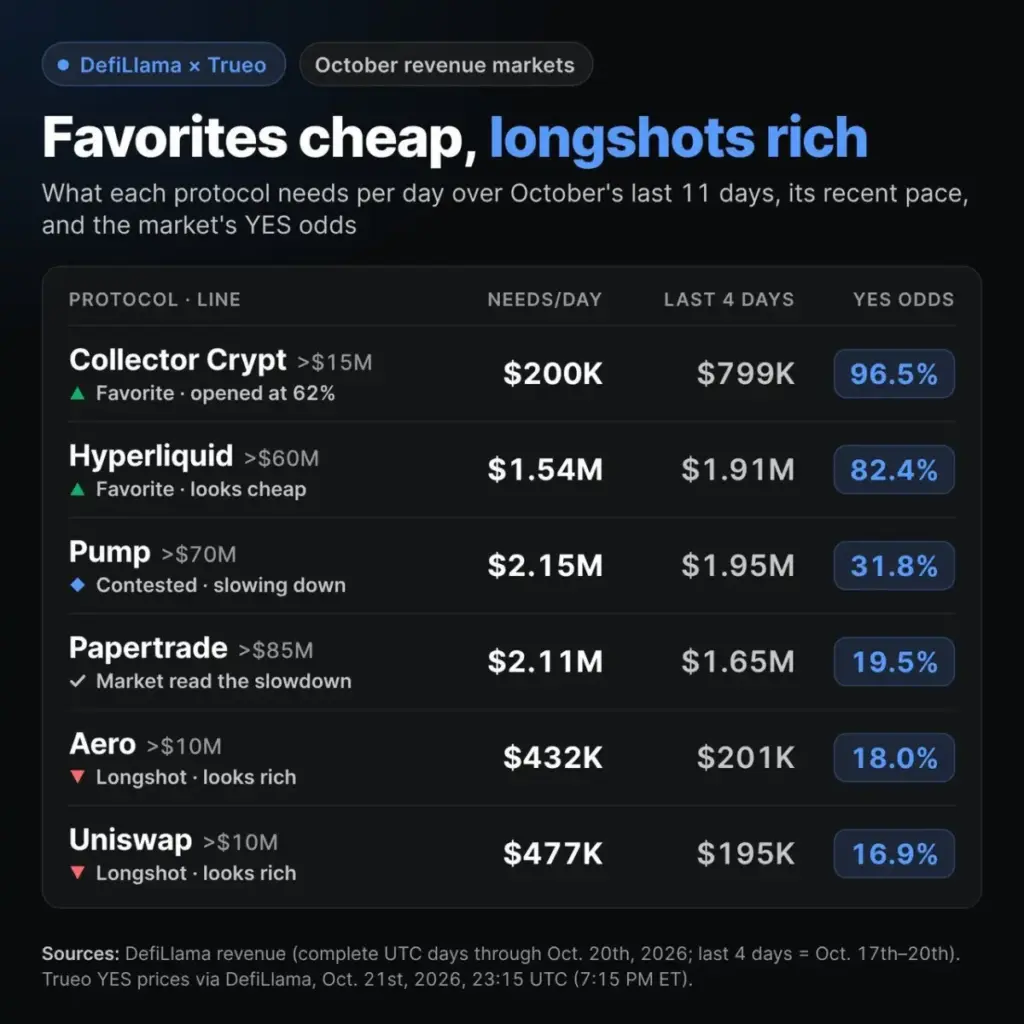
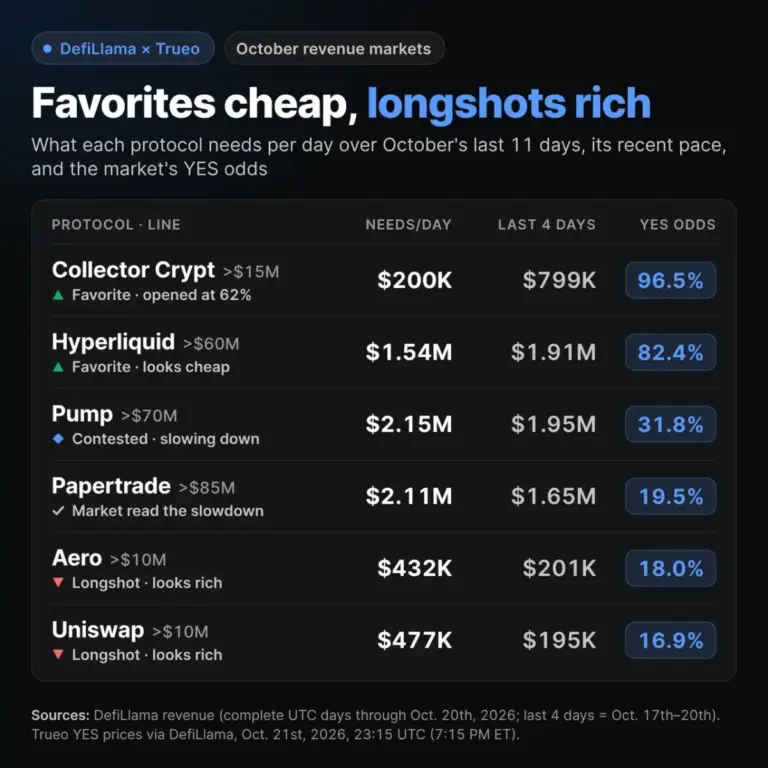
DefiLlama’s new revenue markets offer a crowd-priced equivalent to this traditional financial ritual. Because onchain earnings are generated and tracked in real time, each market page displays the current run rate directly alongside the prevailing betting odds. Analyzing October revenue data through October 20 against what each tracked protocol requires over the remainder of the month reveals several notable market tendencies.
One prominent trend is that heavy favorites are currently trading quite cheaply relative to their actual performance. For example, Collector Crypt requires roughly $200,000 per day to clear a $15 million monthly revenue threshold. Given that its worst full day of October yielded $218,000, market participants expressed surprise when its prediction market initially opened at a 62% probability. This discrepancy prompted DefiLlama Chief Revenue Officer Patrick Scott to remark that the market was essentially "selling dollars for $0.94." Similarly, Hyperliquid has averaged approximately $2.15 million per day against the roughly $1.54 million it requires, yet the market continues to assign an 18% chance of a miss.
Conversely, longshots have frequently traded rich. Uniswap requires roughly $477,000 per day to hit a $10 million target—a figure exceeding its best single day of October, sustained every day for eleven straight days. Aero requires approximately 90% of its best daily performance sustained through Halloween. Despite these steep hurdles, both protocols trade at 17% to 18% odds. While both platforms cleared $15 million during September, replicating that performance requires an immediate and sustained surge.
Meanwhile, platforms like Papertrade have exhibited pricing that more closely mirrors actual activity. The 1,000x exchange booked roughly $61.8 million from its launch on October 10 through October 20, pointing toward an effortless clearing of an $85 million monthly target using a naive average. However, launch day alone accounted for approximately $25.2 million in revenue, and daily figures have since slid from $7.5 million to $1.45 million. Reflecting this deceleration, the prediction market adjusted accordingly, sliding from 68% to 19.5% in under two days.
These pricing anomalies illustrate the classic favorite-longshot bias, a phenomenon documented at traditional racetracks for decades where bettors tend to overpay for longshots and underpay for favorites, particularly within thin and newly established markets. Consequently, market observers noted early on that substantial opportunities exist for arbitrageurs willing to correct these mispricings.
Putting a Price on Hack Risk
Beyond revenue tracking, the integration of exploit markets introduces a novel mechanism for pricing smart contract risk. Patrick Scott noted that if the market prices an exploit at a 1% probability, spending that 1% to purchase YES shares allows a protocol or investor to effectively hedge their position. However, the two distinct categories of exploit markets behave very differently in practice.

Weekly hack markets are priced closely to historical averages. With roughly five days remaining in the tracking period, the market for a hack exceeding $1 million sat at 82.7%, while the market for a hack exceeding $5 million sat at 50.6%. DefiLlama’s historical hacks database indicates that roughly 82% of all five-day stretches over the preceding 12 months experienced a hack of at least $1 million, while 47% saw a hack exceeding $5 million, meaning the market is pricing the trailing base rate with high accuracy.
However, market participants note that the broader regulatory and security environment has run hot, with DefiLlama logging 111 hacks exceeding $1 million so far in the year, compared to 70 throughout the entirety of the previous year. Over the preceding six months, 92% of five-day windows recorded a major hack, suggesting that weekly YES shares may be undervalued if historical pacing holds.
In contrast, protocol-specific exploit markets are priced more like a premium product. With roughly ten days left in October, Aave’s YES side traded at 6.8%, while Morpho’s traded at 11.9%. The Aave market is structured to pay out upon either a hack exceeding $1 million or the accumulation of $1 million in bad debt.
The bad debt component represents a particularly tangible risk vector. Aave’s most significant recent security scare stemmed not from a code bug, but from collateral fallout. When the rsETH bridge operated by Kelp DAO was drained earlier in the year, an attacker borrowed funds against the stolen assets on Aave V3, leaving the lending protocol managing between $124 million and $230 million in potential bad debt.
When evaluating cost, traditional decentralized insurance protocols like Nexus Mutual remain significantly cheaper for end users. Nexus Mutual previously quoted roughly $6.75 to cover $10,000 worth of Aave V3 deposits for a standard 28-day minimum term. Securing equivalent protection through Trueo currently requires purchasing roughly $680 worth of YES shares at a 6.8% probability, limited to the remaining days of October and restricted by available liquidity.
Industry analysts emphasize that these are fundamentally distinct financial products. Traditional cover protocols require proof of an individual user’s personal loss, enforce a standard deductible, and often exclude complex collateral blowups like the Kelp incident. In contrast, a Trueo YES share pays out automatically based on the protocol-wide data point, regardless of whether the holder suffered personal losses. While some of the premium reflects this broader payout trigger, part of the spread is attributed to the persistent favorite-longshot bias affecting rare tail-risk events.
The question of who supplies the liquidity on the opposing side—specifically selling NO shares to underwrite the risk—has sparked debate among developers. While figures like BOB founder Alexei Zamyatin suggested that major decentralized finance applications could supply treasury capital into these markets, industry participants have questioned the conflict of interest inherent in a protocol underwriting its own exploit risk. A more robust model may eventually resemble traditional reinsurance, characterized by diversified capital spread across a wide array of markets.

Evaluating Abuse and the Path Forward
A natural concern accompanying prediction markets tied to security exploits is the potential for malicious actors to manipulate market outcomes by executing hacks specifically to profit from winning prediction shares.
Addressing these concerns, Patrick Scott argued that attempting to abuse prediction markets in this manner would substantially increase an attacker’s risk of apprehension and identification while offering minimal financial compensation relative to the vast sums available from simply executing the underlying exploit itself.
Nevertheless, as these exploit markets grow in depth to accommodate larger institutional deposits, the risk profile could evolve. Ideal hack markets require sufficient depth to provide reliable informational signals without becoming a secondary financial incentive for bad actors.
As the platform matures, further expansions in liquidity and product offerings are anticipated. Trueo’s planned migration to Ethereum, combined with DefiLlama’s openness to scaling the initiative, points toward an expanding catalog of onchain prediction venues. Market participants will continue monitoring how these crowd-priced risk and revenue metrics perform as they scale alongside the broader decentralized economy.
 Tokenomics & Digital Assets
 Tokenomics & Digital Assets
 Tokenomics & Digital Assets