
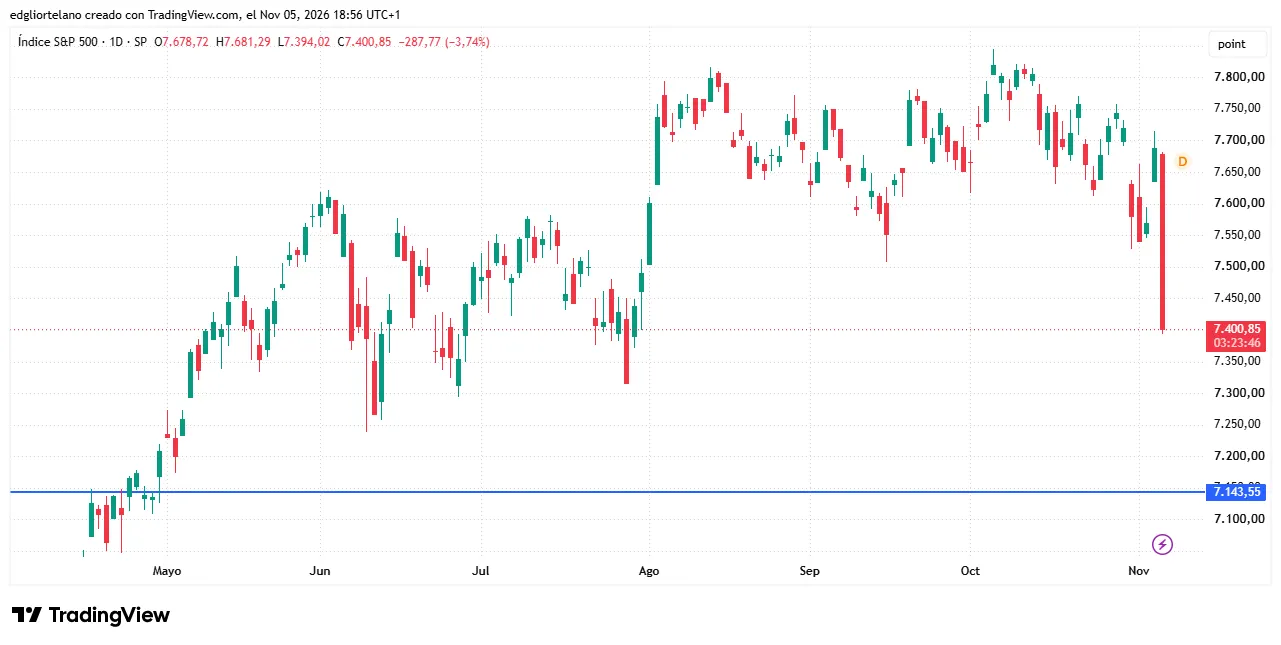
The sudden and aggressive selloff forced traders and market analysts to closely monitor the market’s official circuit-breaker thresholds. These established regulatory mechanisms are designed to temporarily suspend trading across all United States stock exchanges when market-wide losses reach critical levels of panic selling. As the S&P 500 descended during Thursday’s session, calculations showed that the index would need to fall by another 3.2 percentage points from its ongoing decline to trigger the very first emergency trading halt.
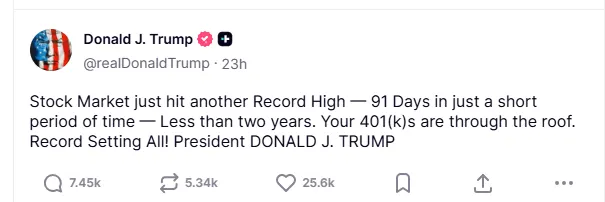
The timing of the market downturn proved particularly awkward for the Trump administration. The president has consistently pointed to strong stock market performance as primary, tangible evidence of his economic policies succeeding. Just hours before the steep market slide, Trump took to his Truth Social account to highlight the market’s milestones.

"Stock Market just hit another Record High—91 Days in just a short period of time—Less than two years. Your 401(k)s are through the roof," Trump wrote on Wednesday, concluding his message with the declaration, "Record Setting All! President DONALD J. TRUMP."
That optimistic sentiment followed a powerful Wall Street rally on Wednesday, which had been sparked by the Democratic Party’s sweeping victories in the midterm elections. During that session, the S&P 500 surged 1.6% to mark its strongest daily performance in three months, while the blue-chip Dow Jones Industrial Average jumped more than 1,500 points to close at 53,361 points. However, Thursday’s aggressive downturn completely erased those gains in a single trading session, with technology shares bearing the heaviest burden of the losses.
How Close Is Wall Street to a Circuit Breaker?
The United States stock market relies on three distinct emergency thresholds to slow down rapid panic selling and give investors time to absorb information. Known formally as Market-Wide Circuit Breakers (MWCB), these mechanisms automatically suspend trading across all U.S. equities when the S&P 500 drops by predefined percentages relative to its previous day’s closing price.

The first of these safety thresholds is a 7% decline from the previous close, which corresponded to an S&P 500 level of 7,150.41 points during Thursday’s session. If the broader market were to fall to that level prior to 3:25 p.m. ET, it would trigger a mandatory 15-minute trading halt across all U.S. equity markets, pausing activity to cool off panicked sentiment.
Should the selloff deepen significantly further, a 13% decline—equivalent to 6,689.09 points on Thursday—would trigger a second 15-minute suspension. The most severe and restrictive threshold is set at a 20% drop, or 6,150.89 points, which would completely shut down stock trading for the remainder of the business day, regardless of what time it occurs.
According to the official rules set by the New York Stock Exchange, the first two circuit breaker thresholds carry time restrictions and stop applying if the specified drop occurs at or after 3:25 p.m. ET. Meanwhile, the most extreme 20% threshold remains fully active throughout the entirety of the trading session. These regulations apply universally to the entire U.S. equity market, meaning a market-wide halt would suspend trading for companies listed on the Nasdaq, the New York Stock Exchange, and all other domestic exchanges simultaneously.
AI Stocks Lead the Wall Street Selloff
The technology sector bore the brunt of Thursday’s brutal market correction as investors continued to digest the broader political and economic consequences of Tuesday’s midterm election results. By approximately 11 a.m. ET, the tech-heavy Nasdaq Composite had plummeted nearly 5%, while the S&P 500 sat down 3.2%.
Individual corporate giants experienced heavy losses, with Nvidia shares falling more than 6%. The broader semiconductor index plunged nearly 11% in a dramatic reversal. Companies involved in the aggressive expansion of artificial intelligence infrastructure came under intense selling pressure amid growing investor anxiety that the newly empowered political landscape could usher in much stricter federal oversight regarding data-center construction and energy consumption.
"We suspect there is going to be some scrutiny on this aggressive AI buildout," Ipek Ozkardeskaya, a senior market analyst at Swissquote Bank, told Reuters while evaluating the tech sector’s vulnerability.
The severe risk-off sentiment quickly spilled over into alternative asset classes, hitting the cryptocurrency market hard. Bitcoin suffered a sharp decline, falling below $76,000 and completely erasing its own post-election recovery gains. The sudden price drop triggered a cascade of liquidations across digital asset derivatives exchanges, with approximately $428 million in leveraged crypto long positions wiped out within a single hour.
Beyond the immediate fallout from the election and tech sector scrutiny, stocks also faced heavy pressure from persistent macroeconomic concerns. Investors remained anxious about sticky inflation trends and mounting uncertainty regarding the Federal Reserve’s future path for interest rates. Market participants spent the latter half of the week preparing for Friday’s crucial October employment report, which economists noted could provide definitive clues about the central bank’s upcoming monetary policy decisions.
Despite the sharp intraday losses and the palpable tension on trading desks, the S&P 500 managed to stay clear of its first market-wide circuit breaker threshold by the conclusion of the session.
 Web3 & Decentralized Web
 Web3 & Decentralized Web
 Web3 & Decentralized Web