Energy has become the ultimate denominator in the modern digital infrastructure race. As data center operators, cryptocurrency miners, and artificial intelligence developers increasingly vie for the same scarce power capacity, a fierce economic rivalry has emerged between three distinct types of high-performance computing hardware. A detailed comparative market analysis released this October reveals how Antminer Z15 Pro machines mining Zcash, top-tier Bitcoin ASICs, and rented NVIDIA H100 artificial intelligence graphics processing units stack up against one another when sharing the exact same megawatt of electricity.
The findings highlight a complex financial landscape where revenue generation, capital expenditure intensity, and machine utilization dictate winners and losers. Priced under a standard industrial power assumption of $0.08 per kilowatt-hour, the economic return of each machine diverges sharply depending on whether the metric of choice is gross revenue per unit of energy or the speed of capital payback.
Three Machines, One Megawatt
Because electricity is the primary operational input shared by all three computing classes, evaluating gross revenue per megawatt-hour provides the cleanest baseline for comparison. Market data gathered on October 13, 2026, when Zcash traded at $1,185 with a network hashrate of 27.8 GSol/s, demonstrates the stark performance divide.
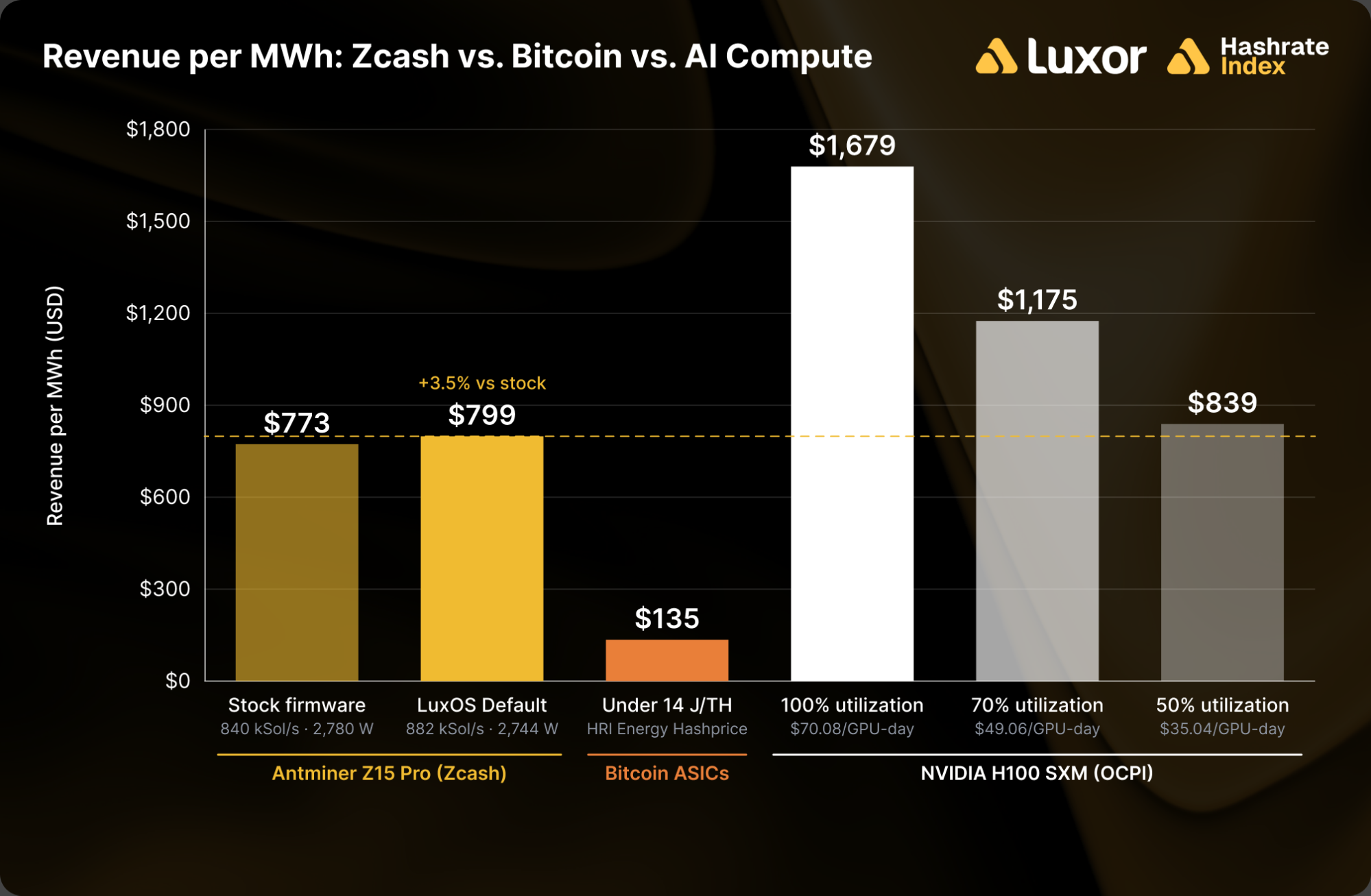
Under these network conditions, the Zcash network distributes 1,440 ZEC daily to miners. A stock Antminer Z15 Pro running on standard firmware grosses approximately $51.54 per day, incurs an energy cost of $5.34, and retains $46.20 in gross profit. This translates to an impressive 90% operating margin and a power break-even threshold of $0.77 per kilowatt-hour—nearly ten times what typical industrial mining facilities pay for electricity.
In comparison, Bitcoin mining hardware lags significantly behind. With the broader hashprice standing at $39.71 per petahash per second daily, energy hashprice metrics place Bitcoin ASIC fleets operating under 14 joules per terahash at roughly $135 per megawatt-hour, while newer S21-class generation hardware hovers around $98 per megawatt-hour. While financial projections published by firms like Grayscale earlier in the autumn estimated Zcash mining returns at roughly four times that of traditional proof-of-work options, continued upward momentum in the price of ZEC has widened that performance gap even further.
The real wild card in the equation, however, is artificial intelligence infrastructure. Powered by the OCPI-H100 settlement rate of $2.92 per GPU-hour, a single NVIDIA H100 generates roughly $70.08 in daily revenue. When evaluated against facility power consumption—calculated at 1.74 kilowatts per GPU factoring in a power usage effectiveness (PUE) multiplier of 1.3—this revenue equates to approximately $1,679 per megawatt-hour. This return is more than double that of a stock Antminer Z15 Pro. If analysts calculate power consumption using only the raw board power of the GPU, the figure inflates to roughly $4,170 per megawatt-hour, underscoring the critical importance of utilizing standardized facility-level denominators when comparing specialized hardware classes.
Yet, this lucrative financial advantage for artificial intelligence hardware is entirely contingent upon continuous rental demand. If an H100 experiences downtime or drops to a 50% utilization rate, its revenue generation declines to approximately $839 per megawatt-hour, bringing it roughly on par with the Zcash ASIC. Industry models indicate that the crossover point for economic parity between the two hardware types sits right around 46% to 48% utilization.
Where the ASIC Wins: Capital, Not Energy
While artificial intelligence hardware frequently claims dominance in revenue per unit of energy, the financial hierarchy completely flips when evaluating return on capital expenditures. Deploying a megawatt of Zcash computing power requires roughly 360 Antminer Z15 Pro units, which list between $8,800 and $16,000 per machine, housed inside a standard warehouse shell costing a few hundred thousand dollars per megawatt.
Conversely, deploying a megawatt of artificial intelligence infrastructure requires approximately 575 H100 GPUs. According to specialized artificial intelligence hardware pricing indices, new eight-GPU H100 nodes have commanded between $31,000 and $40,500 per GPU since launch. Consequently, the hardware alone demands an upfront investment of $18 million to $23 million—or approximately $13 million for refurbished units—housed inside a Tier-3 data center facility that frequently costs more than the computing equipment itself.
By comparison, the Zcash ASIC demonstrates exceptional capital efficiency, achieving full payback on its hardware investment in roughly six to eleven months on the back of $46 in daily gross profit. This capital intensity dynamic validates the prevailing industry sentiment that Zcash mining offers a viable, highly liquid alternative to traditional cloud-based artificial intelligence infrastructure, particularly in terms of build-out speed and upfront financial risk. However, that advantage does not extend to energy efficiency when artificial intelligence hardware commands peak rental rates.
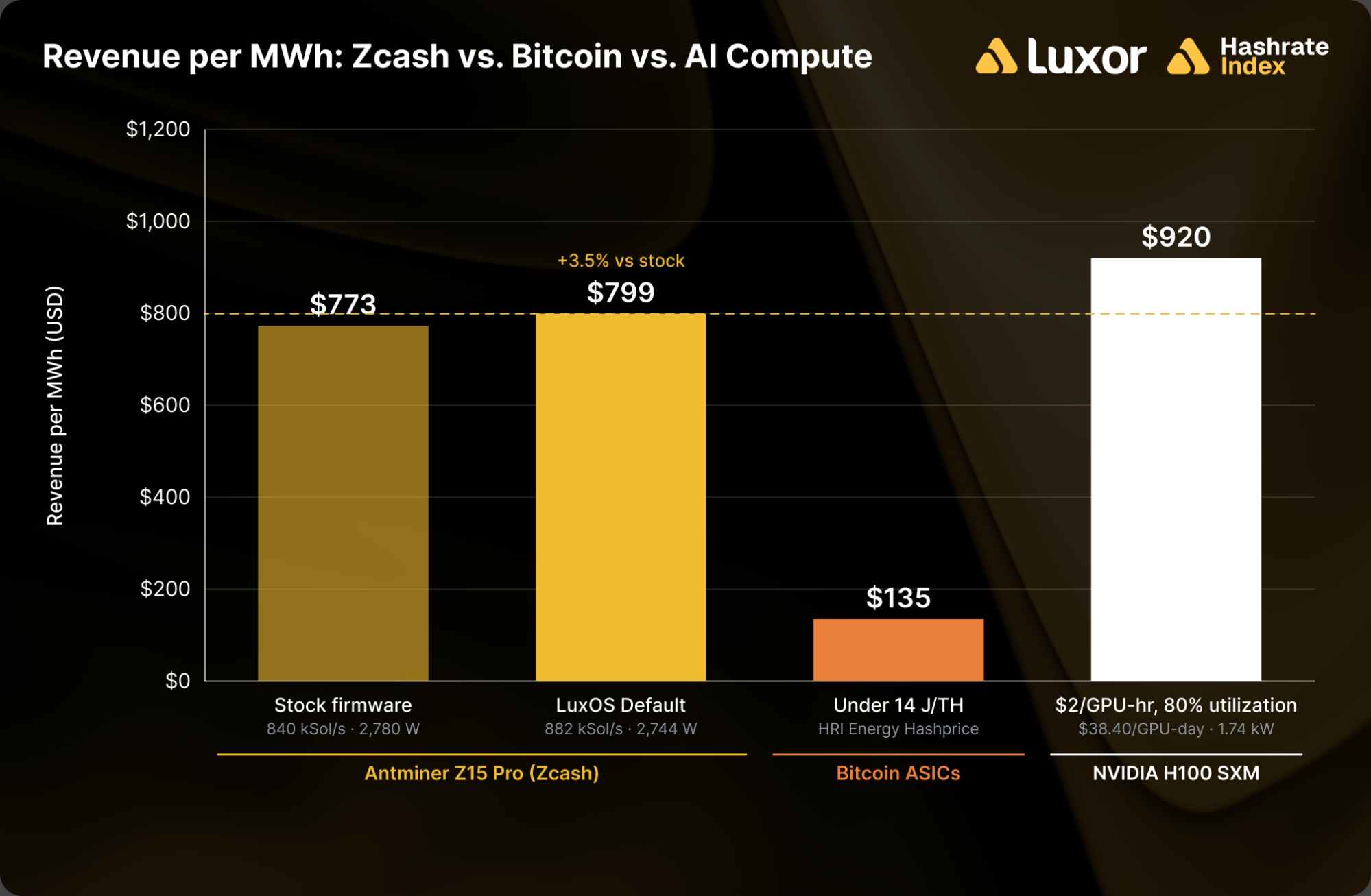
Lower rental rates for artificial intelligence compute close this gap rapidly. At a rental rate of $2.00 per GPU-hour and an 80% utilization rate—assumptions frequently utilized by decentralized cloud computing providers—an H100 earns roughly $920 per megawatt-hour, representing a modest 15% premium over a Zcash ASIC running optimized firmware. If utilization drops below 70% at that rental rate, or if the hourly rental price falls below $1.70 at 80% utilization, the specialized cryptocurrency mining ASIC outperforms the artificial intelligence hardware on a megawatt-hour basis before even accounting for its vastly superior capital expenditure profile.
Price Outran Hashrate in the Zcash Ecosystem
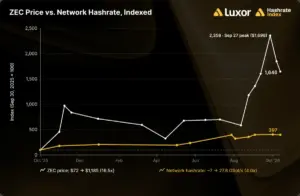
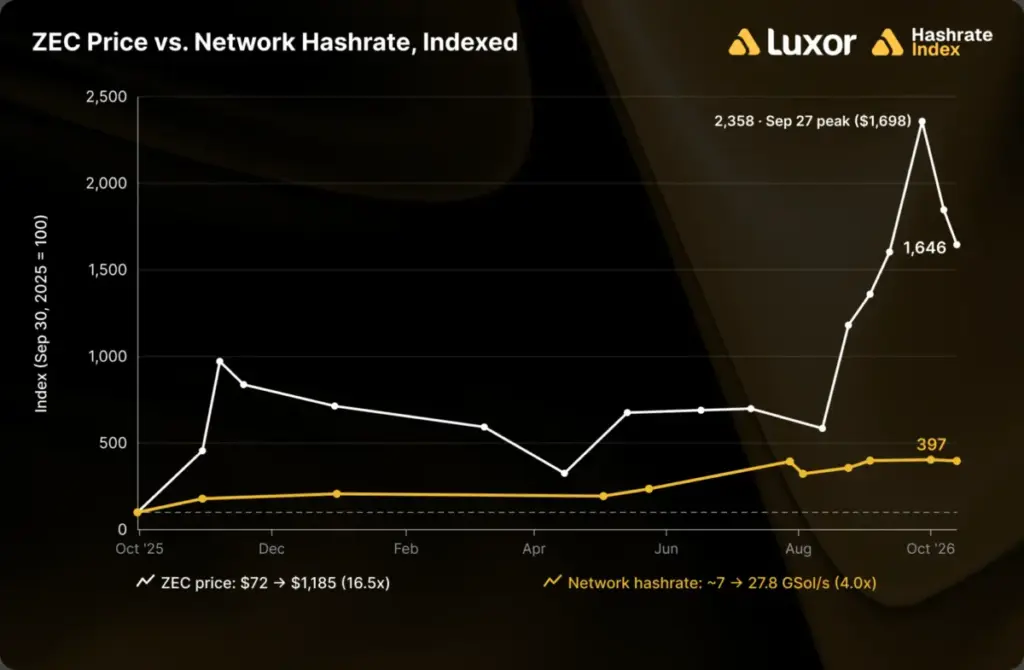
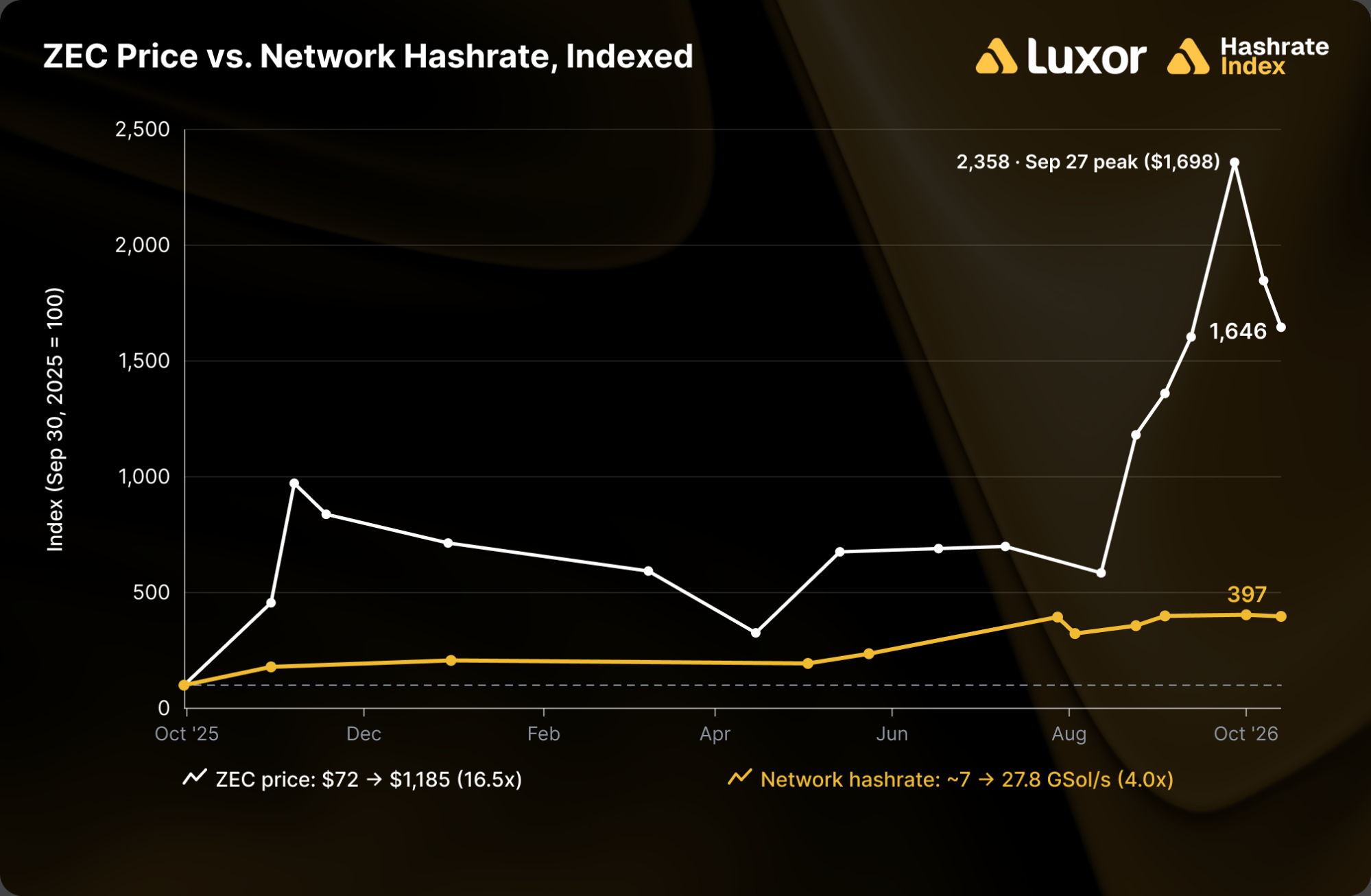
The dramatic surge in Zcash mining profitability is fundamentally rooted in a market dynamic where asset price appreciation drastically outpaced network hashrate growth. Over a twelve-month period, the total network hashrate for Zcash climbed roughly fourfold, rising from approximately 7 GSol/s prior to a major market rally to 27.8 GSol/s. Simultaneously, the price of ZEC surged from $72 to a peak of approximately $1,698 before correcting downward by roughly 30%.
Because network hashrate lagged behind price appreciation during both the upward surge and a subsequent spring drawdown, per-machine revenue remained remarkably stable near $0.06 per kSol per day. The total daily reward distributed to miners remains fixed at approximately 1,440 ZEC, meaning every newly deployed machine dilutes the revenue share of existing operators.
Despite the network expanding to accommodate the equivalent of roughly 33,000 Antminer Z15 Pro units consuming 90 megawatts of power, current market prices ensure that the hardware remains cash-positive unless the network hashrate expands by another tenfold. Consequently, the primary binding constraint for network growth is physical hardware supply rather than available electrical power. In-stock Z15 Pro units remain scarce, pushing secondary market prices up significantly over the course of the year, while next-generation Equihash hardware from manufacturers like Bitmain remains limited ahead of anticipated 2027 shipping schedules.
Firmware Optimizations Bridge the Gap
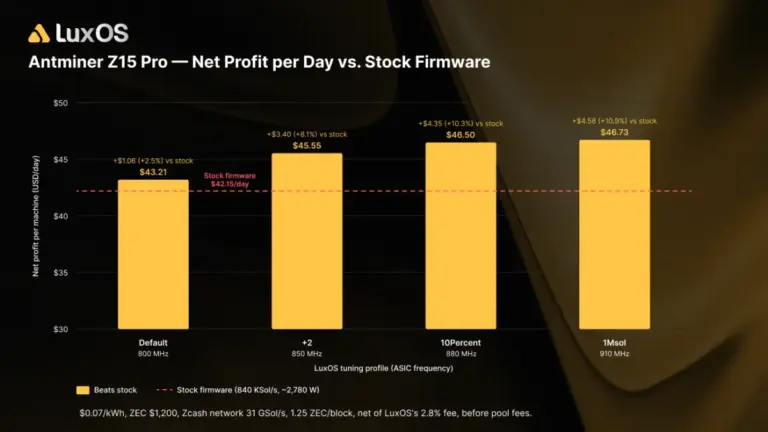
With new specialized silicon manufacturing constrained until the second quarter of 2027, data center operators seeking to expand Equihash hashrate from currently deployed infrastructure have relied almost exclusively on aftermarket firmware development. Custom firmware solutions, such as LuxOS, have introduced advanced overclocking and underclocking tuning profiles previously reserved for Bitcoin mining fleets.
Benchmarking data comparing stock factory settings against various firmware profiles reveals distinct operational trade-offs. The default tuning profile successfully outperforms stock configurations on multiple fronts, delivering approximately 5% higher hashrate while consuming 1% less electrical power, thereby lifting gross returns. However, aggressive overclocking profiles trade electrical efficiency for absolute dollar returns, pushing power consumption higher relative to hashrate gains. While these aggressive profiles make economic sense in low-cost energy environments boasting wide operating margins, they remain impractical for power-constrained facilities where efficiency is paramount.
Ultimately, the ongoing compute competition cannot be neatly categorized into a single race. On a megawatt-hour basis, a continuously utilized artificial intelligence graphics processor outperforms a Zcash mining rig, which in turn vastly outearns traditional Bitcoin mining hardware. On a capital expenditure basis, however, cryptocurrency mining ASICs win decisively through rapid payback periods. Across all sectors, profitability remains inextricably tied to high operational uptime, cementing the operational viability of hybrid facilities capable of dynamically deploying multiple computing workloads within the same physical footprint.
 Cryptocurrency Mining
 Cryptocurrency Mining
 Cryptocurrency Mining