
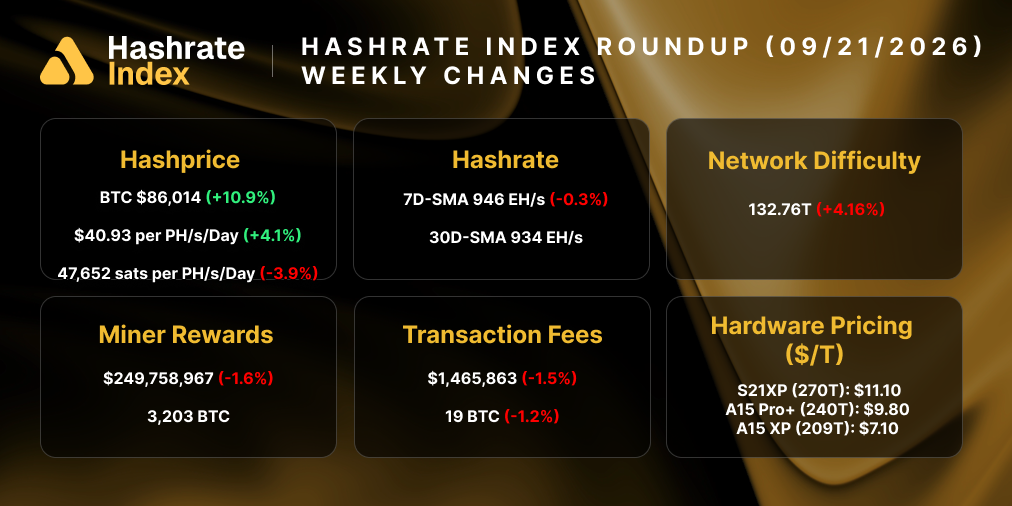
Bitcoin miners experienced a broadly positive week as market conditions aligned to provide a much-needed boost to profitability across the board. According to the latest Hashrate Index weekly update for the week ending September 21, 2026, the intersection of rising spot prices, a slight dip in network hashrate, and climbing transaction fees pushed mining economics into a stronger position heading into the final stretch of the year.
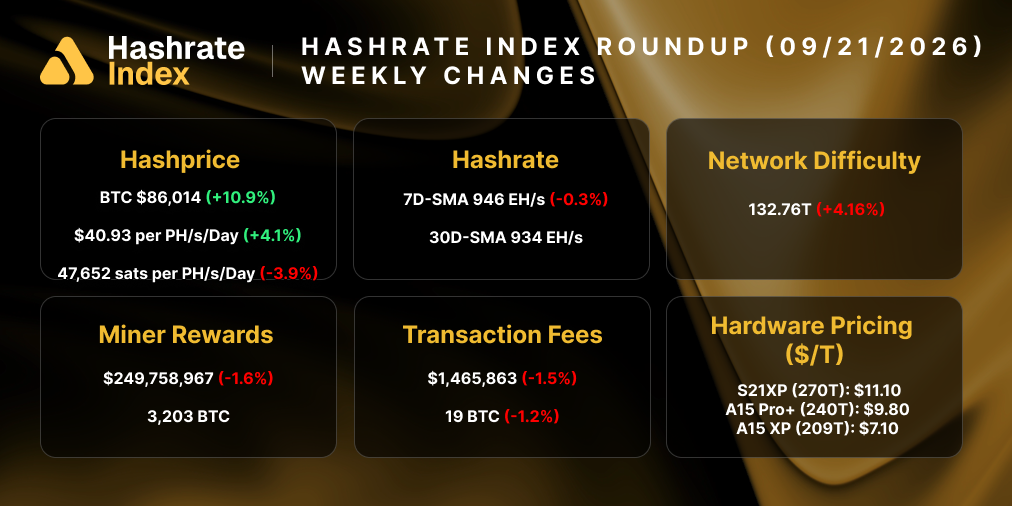
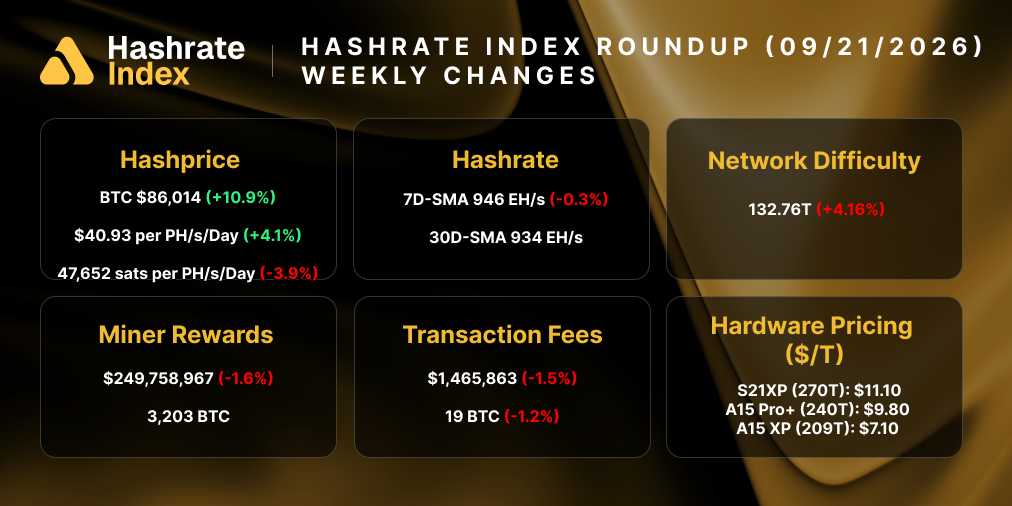
Over the past week, Bitcoin staged a notable rally, surging by 10.9% to move from approximately $77,567 to a spot price hovering around $86,003. This upward momentum provided immediate relief to an industry that has navigated tight operational margins following previous network adjustments and high hardware saturation. Across the global mining landscape, operators collected a total of approximately 3,203 BTC in block rewards over the seven-day period, valued at roughly $249 million based on prevailing market rates. Transaction fees accounted for a modest yet welcome portion of these earnings, constituting 0.59% of total block rewards, which translated to 19 BTC or approximately $1.47 million.
Bitcoin Price Action and Futures Markets
The sharp appreciation in Bitcoin’s spot price served as the primary catalyst for improving miner revenues. Moving from the mid-$77,000 range up to the $86,000 threshold, the leading cryptocurrency demonstrated renewed strength, narrowing its year-to-date performance to a modest -1.6%. Short-term momentum remained robust, with the 24-hour previous spot price sitting at $81,234, marking a 5.9% increase leading up to the end of the weekly cycle.
Derivatives markets mirrored this bullish sentiment, with Chicago Mercantile Exchange (CME) futures indicating continued confidence across traditional financial sectors. September CME futures traded closely with the spot price at $86,065, reflecting a 0.1% change, while October and November contracts climbed further out on the curve to $86,580 and $86,950, respectively. This upward pricing structure across near-term futures contracts suggests that institutional sentiment remains supportive of higher valuation floors as the fourth quarter approaches.
Hashprice Recovers Amid Shifting Compute Dynamics
The direct beneficiary of Bitcoin’s price appreciation and steady network metrics was the hashprice—a critical gauge of miner profitability that measures the expected daily revenue of 1 terahash per second (TH/s) of computing power.
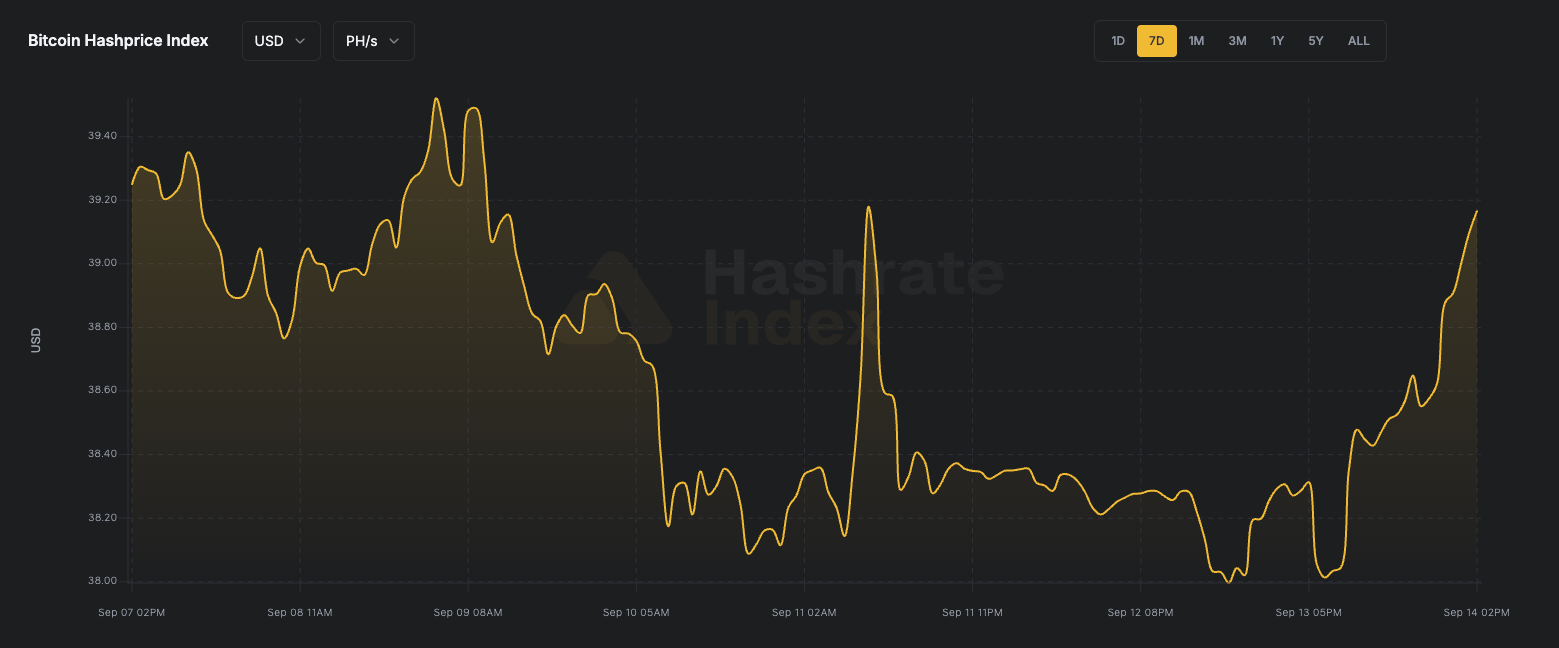
Measured in U.S. dollars, the spot hashprice climbed 4.1% over the week, moving from $39.31 per PH/s/Day to $40.93 per PH/s/Day. Short-term averages reinforced this recovery, with the 24-hour previous spot hashprice hitting $38.58 before rebounding by 6.1%. Over a broader horizon, the 7-day average hashprice settled at $38.49, while the 30-day average hovered slightly higher at $39.08.
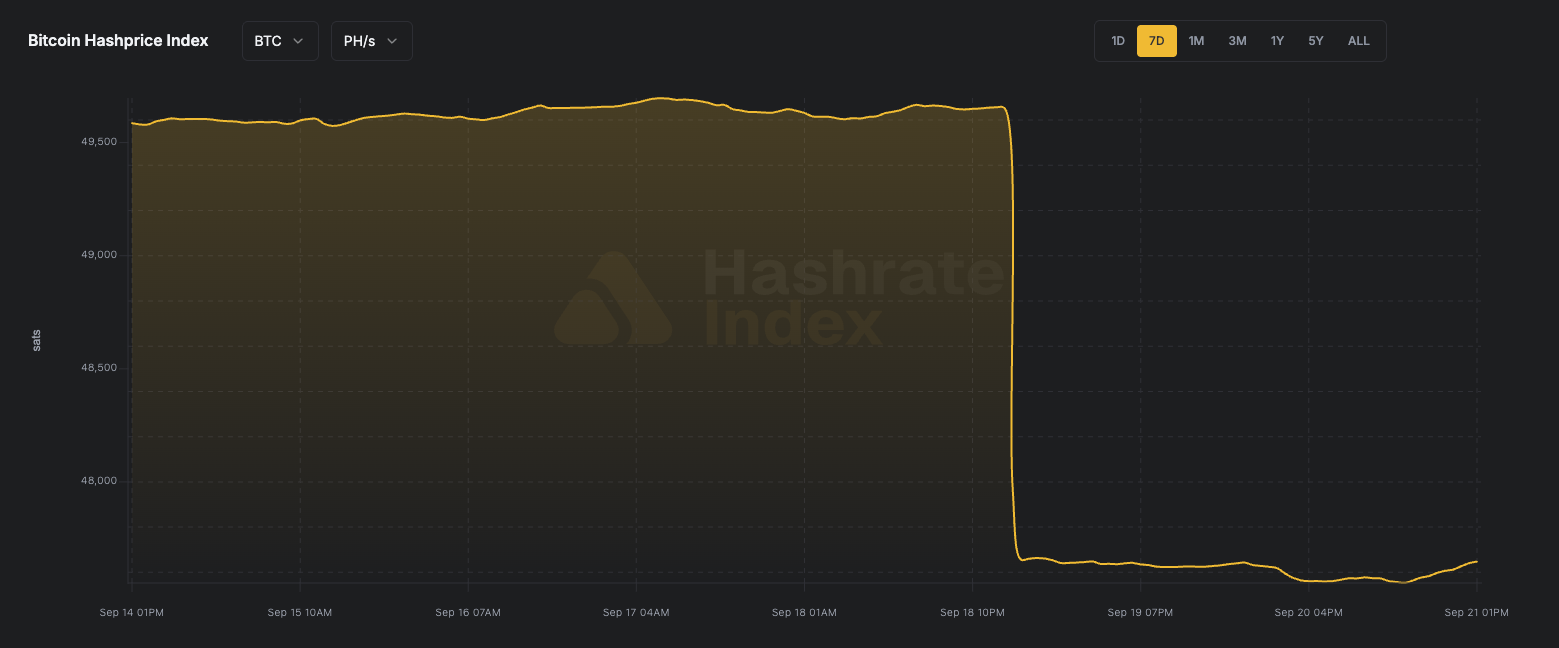
However, when measured in Bitcoin terms, the narrative shifted slightly due to the previous week’s difficulty adjustments. The BTC hashprice moved -3.9% downward, shifting from 0.00049594 BTC per PH/s/Day to 0.00047652 BTC per PH/s/Day. The 7-day average BTC hashprice stood at 0.00048960 BTC, while the 30-day average remained relatively stable at 0.00049780 BTC.
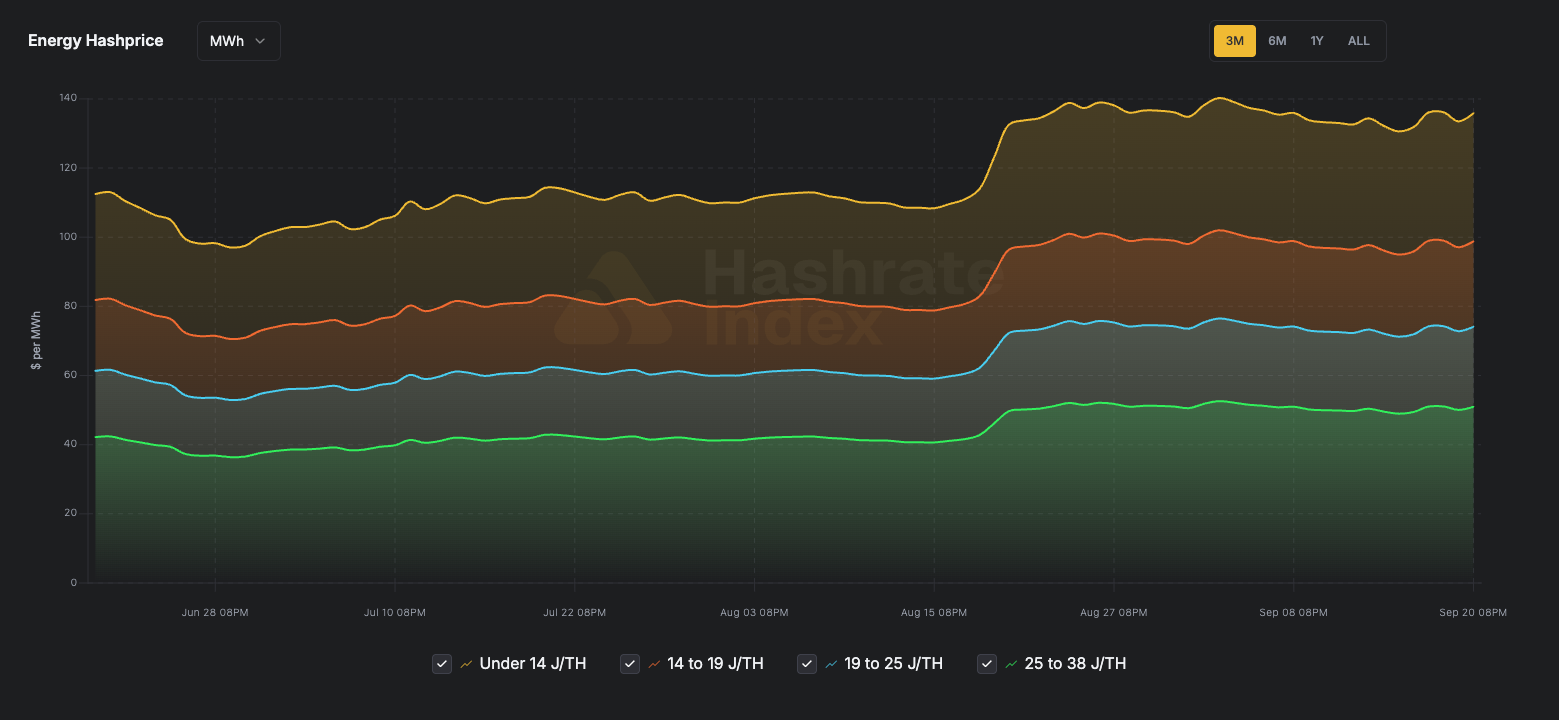
At a hashprice threshold hovering near $40 per PH/s/Day, mining operations continue to run at or near breakeven depending on individual power purchase agreements, facility overhead, and the efficiency rating of deployed hardware models. Operators utilizing older-generation rigs have increasingly turned to optimized firmware solutions, such as LuxOS for S19 and S21 series equipment, to squeeze additional efficiency and hash output out of their fleets in order to stay competitive.
Hashrate and Network Difficulty Adjustments
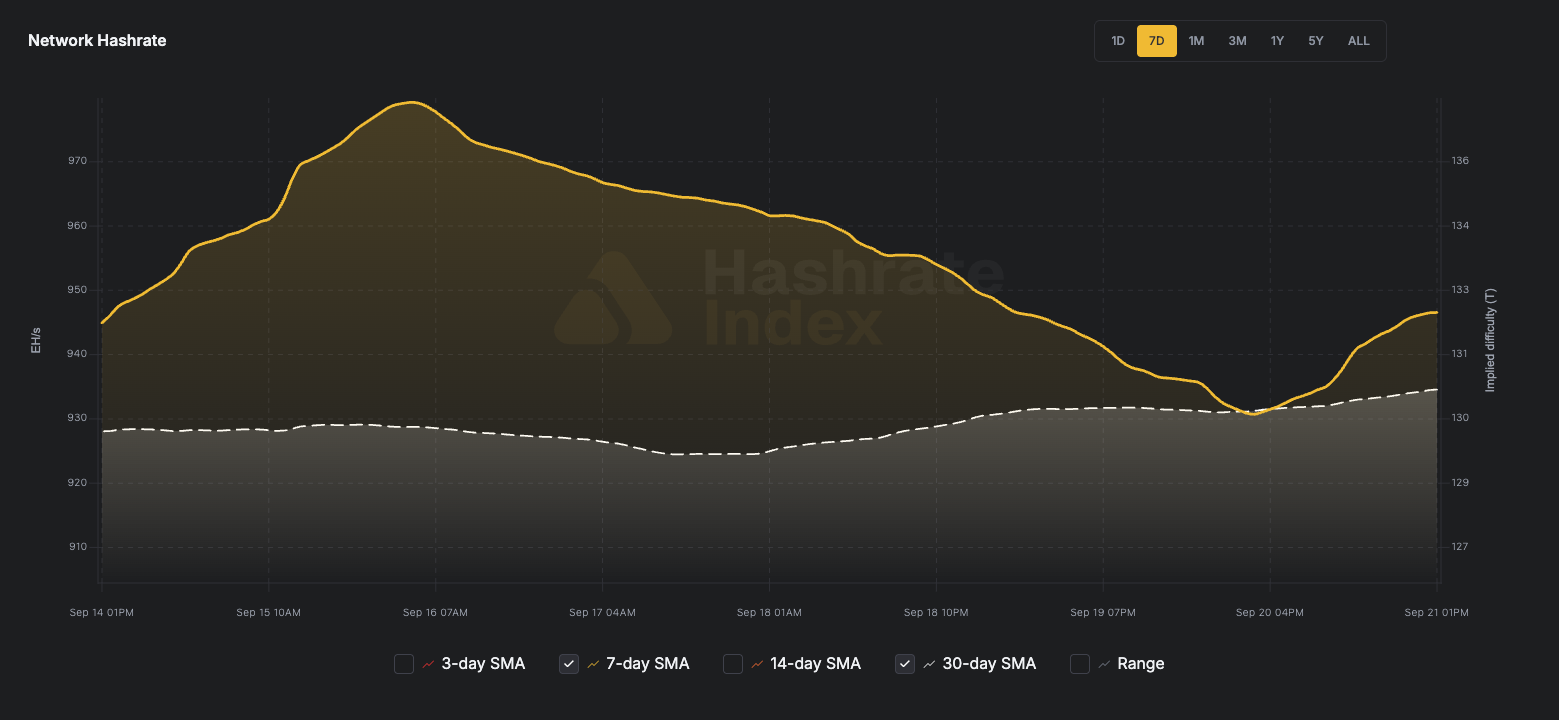
Network hashrate experienced a minor contraction over the weekly monitoring period, dropping 0.3% as the 7-day simple moving average (SMA) shifted from 949 exahashes per second (EH/s) down to 946 EH/s. The broader 30-day SMA remained anchored at 934 EH/s, demonstrating remarkable stability in global aggregate hashing power despite fluctuating energy costs and macroeconomic pressures.
The most recent network difficulty adjustment occurred on September 19, 2026, pushing network difficulty up by 4.16% to 132.76T. This upward adjustment reflected the intense competition among miners during preceding epochs. Over the subsequent 24-hour window, block times averaged 10 minutes and 11 seconds, running slightly behind the protocol’s targeted 10-minute cadence.
Looking ahead to the next adjustment cycle projected for October 3, 2026, initial estimates point toward a potential downward correction of approximately 1.80%. Analysts note, however, that early-epoch projections are inherently volatile due to short-term variance in block generation times. As more blocks are processed and the epoch progresses, statistical noise typically fades, providing a clearer signal for the final adjustment figure.
Transaction Fees Show Steady Upward Momentum
Transaction fee contributions provided a minor incremental boost to miner revenues over the past week. Miners collected an average of 0.0191 BTC per block per day in transaction fees, marking a 4% increase compared to the previous week’s average of 0.0185 BTC.
Looking at broader moving averages, the 14-day average transaction fees settled at 0.0188 BTC with a +1.7% change, while the 30-day average held steady at 0.0192 BTC. While base block subsidies remain the dominant source of income for miners, these steady fee revenues offer a supplementary cushion as the network gradually transitions toward a fee-reliant economic model over the long term.
Forward Markets and Mining Equities
In the broader derivatives sector, the Luxor Hashrate Forward Market is currently pricing in an average hashprice of $38.96, or 0.00045 BTC, over the next six months. The forward curve, spanning from September 2026 through February 2027, indicates that market participants anticipate relatively stable mining economics through the winter months, avoiding drastic volatility while pricing in steady network growth.
Publicly traded Bitcoin mining stocks closed out the week with overwhelmingly positive momentum, tracking the broader rally in Bitcoin spot prices. Across major mining equities, double-digit weekly gains were commonplace as investors piled back into digital asset infrastructure companies.
Firms such as CANG led the pack with a dramatic 37.8% surge, while BTBT gained 23.7%, ABTC climbed 20.2%, and CIFR rose 20.8%. Other major industry players also enjoyed strong green closes, with MARA posting a 17.4% weekly increase, RIOT gaining 17.3%, and IREN climbing 11.6% to reach a market capitalization of nearly $19 billion. CleanSpark (CLSK), Core Scientific (CORZ), and TeraWulf (WULF) similarly reflected the bullish sentiment, posting gains of 13.9%, 9.7%, and 14.1% respectively, as market capitalization figures expanded across the sector.
 Cryptocurrency Mining
 Cryptocurrency Mining
 Cryptocurrency Mining