The staggering $6.4 billion theft from cryptocurrency exchange Binance has exposed a deeply calculated, multi-year cybercrime playbook orchestrated by North Korean threat actors. According to blockchain intelligence firm Chainalysis, the historic breach did not happen overnight. Instead, it represents the culmination of a sophisticated, evolving strategy built on employment fraud, social engineering, and advanced malware deployment that has been meticulously perfected over years of trial and error.
For security experts who have tracked the Democratic People’s Republic of Korea’s (DPRK) hacking syndicates, the tactics deployed against Binance bear the familiar hallmarks of nation-state operations designed to fund the regime. However, the sheer scale of the Binance incident marks a dangerous escalation in the sophistication of state-sponsored crypto thefts, demonstrating how persistent attackers can turn a simple job application into a gateway for the largest digital currency heist in history.
The Anatomy of the Binance Breach: From Interview to Infrastructure
Binance released its initial findings detailing the multi-stage attack that breached the global exchange. The operation began in September, targeting a Binance engineer through a seemingly legitimate employment opportunity delivered via a professional hiring platform.
Over the course of several weeks, the attackers worked diligently to cultivate trust with the employee. Posing as representatives of a fictitious company, they conducted two rounds of interviews designed to appear entirely authentic, lowering the target’s guard and establishing a professional rapport.
Once trust was secured, the employee was asked to download a routine coding assignment as part of the interview process. Unbeknownst to the victim, the file contained heavily obfuscated malicious code. Once executed, this payload established an initial foothold on the engineer’s device.
From that single point of entry, the attackers deployed sophisticated malware and systematically exploited access to an internal artificial intelligence tool. This allowed them to navigate deeper into Binance’s corporate and technical infrastructure, ultimately bypassing traditional perimeter defenses and enabling the catastrophic theft.
Security researchers emphasize that while the scope of the Binance breach is unprecedented, the vector of entry follows a well-worn path. Industry specialists frequently refer to these operations as "contagious interviews." By specifically targeting employees who possess privileged access to sensitive corporate infrastructure, DPRK hackers leverage the credentials and permissions of trusted insiders to infiltrate core systems without needing to crack enterprise-grade firewalls head-on.

Perfecting the Methodology Through Smaller Attacks
Long before the Binance incident commanded global headlines, Chainalysis investigators had been tracking similar DPRK-linked fake interview schemes across the cryptocurrency ecosystem. Over the preceding 18 months, blockchain analysts attributed more than $14.3 million in cumulative losses to smaller-scale malware and fake interview campaigns targeting individual crypto holders, private wallets, decentralized autonomous organizations (DAOs), and various protocols.
While individual losses in these earlier incursions ranged from tens of thousands to millions of dollars, their true significance lay in the feedback loop they provided for the attackers. Senior intelligence analysts note that across successive compromises, DPRK actors were actively perfecting and evolving their methodology. They refined their technical approaches, tested new payload delivery mechanisms, and progressively built the operational capabilities required to target high-value institutions like major exchanges.
This trial-and-error process allowed the threat actors to scale their ambitions. The smaller breaches served as live-fire exercises, training grounds where state-sponsored hackers could evaluate which social engineering hooks worked best and how deeply they could embed malware before detection. Viewed through this analytical lens, the Binance attack was not an isolated anomaly, but rather the logical culmination of years of preparation, rehearsal, and strategic refinement.
Advanced Evasion Tactics and Blockchain Dead Drops
As their targets grew more sophisticated, North Korean hacking teams similarly advanced the infrastructure used to manage infected machines. Investigations into these campaigns reveal a heavy reliance on stealthy command-and-control (C2) mechanisms designed to evade traditional cybersecurity monitoring and law enforcement seizure.
Among the more notable innovations observed by researchers is the use of public blockchains to conceal malware instructions—a technique known as blockchain dead drops, or "Etherhiding." Research indicates a sharp surge in blockchain-assisted cyberattacks, driven in part by state-sponsored actors utilizing open-weight artificial intelligence models to optimize their operations.
DPRK actors began deploying these methods to maintain a persistent, resilient link between compromised victim computers and their C2 infrastructure. Because public ledgers are decentralized, they offer a far more durable hosting environment than traditional servers, which can be easily taken offline by hosting providers or law enforcement agencies.
On-chain analysis has uncovered instances where hackers built intricate redundancy into their systems by spreading C2 communications across multiple blockchains. In certain campaigns, infected devices were programmed to query the TRON blockchain for instructions. If the primary query failed, the malware would automatically fall back to Aptos as a secondary source. Ultimately, both paths directed the infected machine to the Binance Smart Chain (BSC), where the actual payload was stored.

More recently, operators have utilized null receiver techniques, embedding communication instructions directly into specially crafted blockchain addresses that are not controlled by any entity and do not hold cryptocurrency assets. The address strings themselves are designed to be decoded as executable instructions by the malware running on infected local machines.
The Broader Illicit Employment Ecosystem
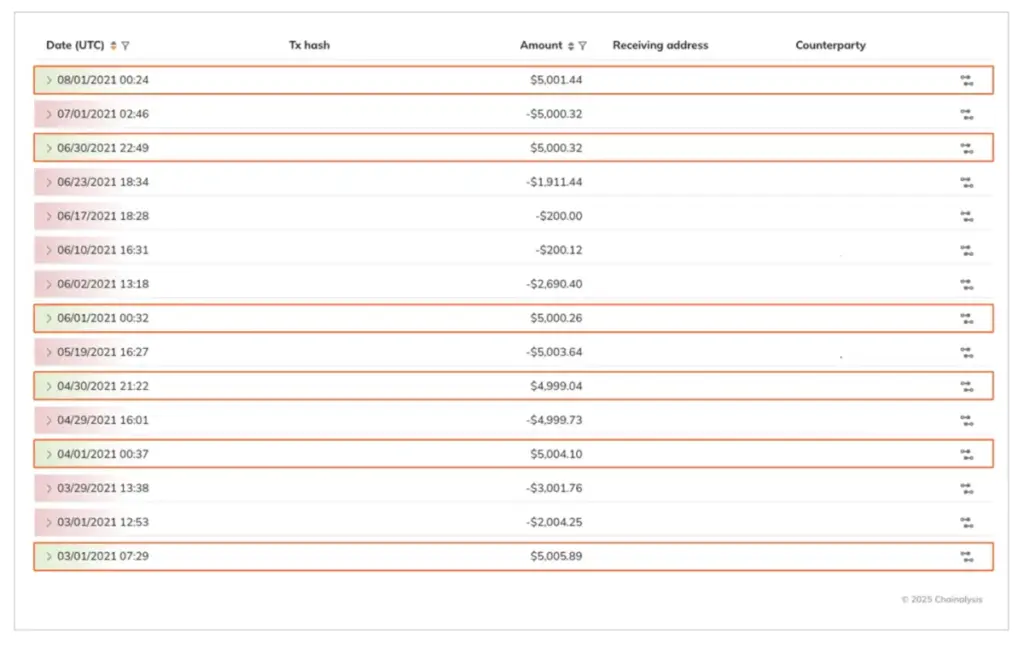
The malicious interview vector is only one half of a massive, dual-pronged employment fraud ecosystem operated by North Korea. The other major component involves large-scale IT worker schemes, where operatives deploy around the globe using stolen identities, forged documents, and virtual private networks to secure remote employment at legitimate companies.
Once hired, these fraudulent IT workers earn legitimate salaries—frequently requested in stablecoins—while simultaneously seeking opportunities to compromise corporate systems from within. According to estimates by the United Nations, this expansive shadow workforce generates upwards of $600 million in annual revenue for the regime, serving as a vital financial lifeline for state programs.
Last year, international authorities cracked down on several elements of this network, resulting in sanctions against Russian and North Korean nationals who facilitated these employment rings. Chainalysis closely tracks the flow of these illicit proceeds on-chain, mapping out how stablecoin salaries paid to remote workers are systematically funneled through intermediary networks and pooled into centralized laundering operations.
Tracing the Funds and Protecting the Ecosystem
The Binance heist underscores the urgent need for organizations to look beyond conventional cybersecurity perimeters and examine the broader financial infrastructure that underpins modern cybercrime. Because North Korean threat actors weaponize recruitment platforms, infiltrate corporate environments, and leverage cryptocurrency networks to launder billions, defending against them requires a synchronized approach.
Blockchain intelligence remains a critical pillar in this defense. By combining traditional threat intelligence with real-time on-chain analysis, investigators can trace stolen funds across multiple protocols, identify intermediary consolidation wallets, and uncover patterns that support international sanctions enforcement.
As the investigation into the Binance breach continues, security analysts expect the stolen funds to remain active as the hackers attempt to fragment and launder the digital assets. Collaborative efforts across the cryptocurrency industry are ongoing to trace the capital, disrupt laundering channels, and mitigate further risks to the digital asset economy.

Frequently Asked Questions
How did North Korean hackers steal funds from Binance?
The attack began when a Binance engineer received an invitation to a job interview through a professional recruitment platform. After several rounds of interviews with a fictitious company, the employee was asked to complete a coding assignment that contained malicious code. This gave the attackers an initial foothold, allowing them to deploy malware and exploit access to internal AI tools to move deeper into the exchange’s infrastructure.
What are DPRK fake interview schemes?
Often referred to by security researchers as "contagious interviews," these are fraudulent recruitment operations where state-sponsored actors pose as employers or recruiters. They conduct realistic interviews to build trust with job candidates and deliver malware through malicious assignment files, software downloads, or compromised links.
Have North Korean hackers used fake interviews in other crypto attacks?
Yes. Over an 18-month period, blockchain analytics firms attributed millions in losses to similar DPRK-linked fake interview and malware campaigns targeting individual crypto holders, private wallets, decentralized protocols, and DAOs. These earlier incidents helped the actors refine their methodologies before targeting larger institutions.
How do fake job interviews help hackers infiltrate organizations?
By compromising a job applicant’s device, attackers can harvest sensitive credentials, browser sessions, and personal cloud storage artifacts. If the targeted individual holds privileged access to sensitive corporate infrastructure, their compromised accounts can serve as an internal bridge for attackers to navigate deeper into enterprise networks.
What is a DPRK illicit IT worker scheme?
North Korean operatives use stolen identities, VPNs, and synthetic documents to secure remote employment at companies worldwide. While earning salaries that generate significant annual revenue for the regime, these workers may also seek opportunities to compromise sensitive corporate systems or assist in money laundering operations.
How does North Korea use cryptocurrency in cybercrime?
DPRK-linked syndicates use cryptocurrency to receive proceeds from fraudulent IT employment, move and consolidate stolen funds, and launder illicit capital through cross-chain swaps and intermediary networks. They also utilize public blockchains to host resilient command-and-control instructions for their malware.
How do investigators track DPRK-linked cybercrime?
Investigators rely on blockchain intelligence to monitor how illicit funds are received, moved, and laundered. Tracing transactions on-chain helps law enforcement and compliance teams identify intermediary networks, support sanctions investigations, and freeze stolen assets where possible.
 Crypto Wallets & Security
 Crypto Wallets & Security
 Crypto Wallets & Security