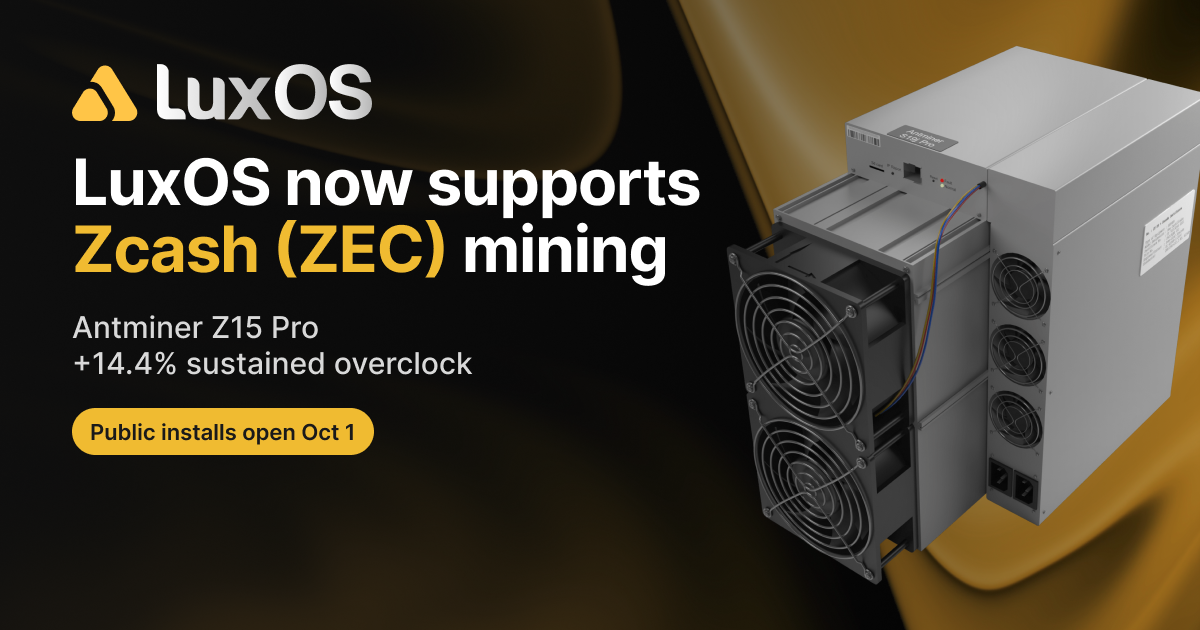
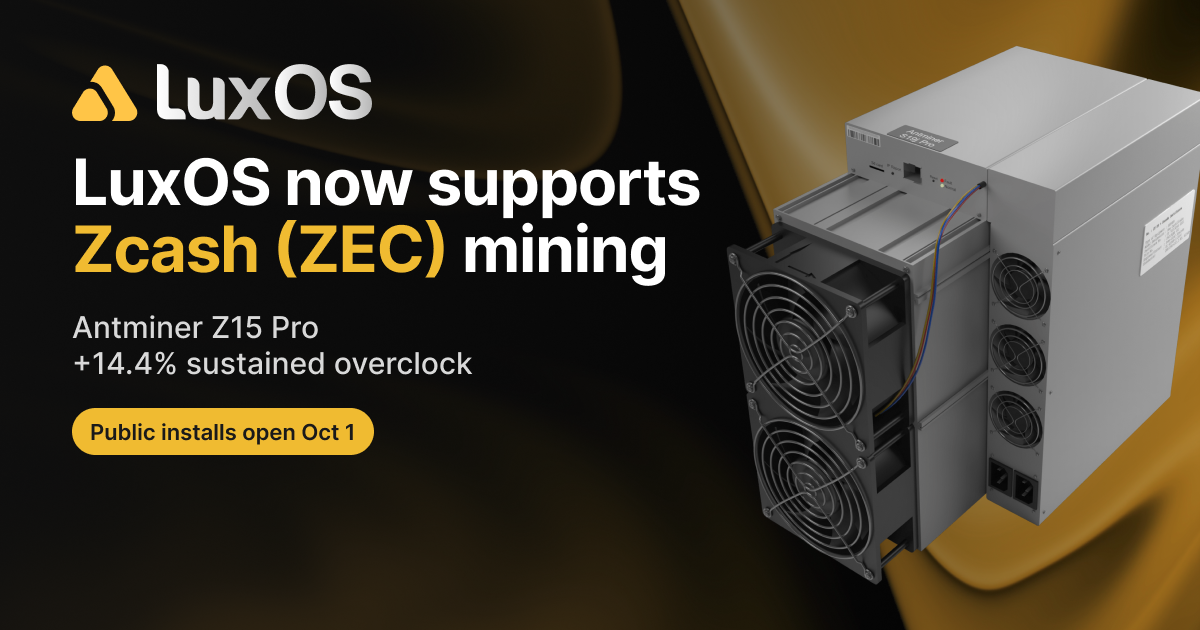
Luxor Technology Corporation is expanding its flagship mining firmware ecosystem beyond the Bitcoin network for the first time, introducing native support for Equihash hardware starting with the Bitmain Antminer Z15 Pro. The development marks a major shift for LuxOS, which has historically operated exclusively on Bitcoin application-specific integrated circuit (ASIC) machines. Public installations for the new firmware are scheduled to open on October 1, bringing advanced tuning, telemetry, and monitoring capabilities to Zcash mining fleets.
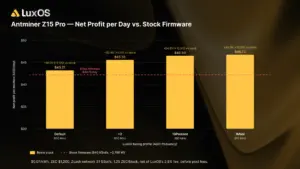
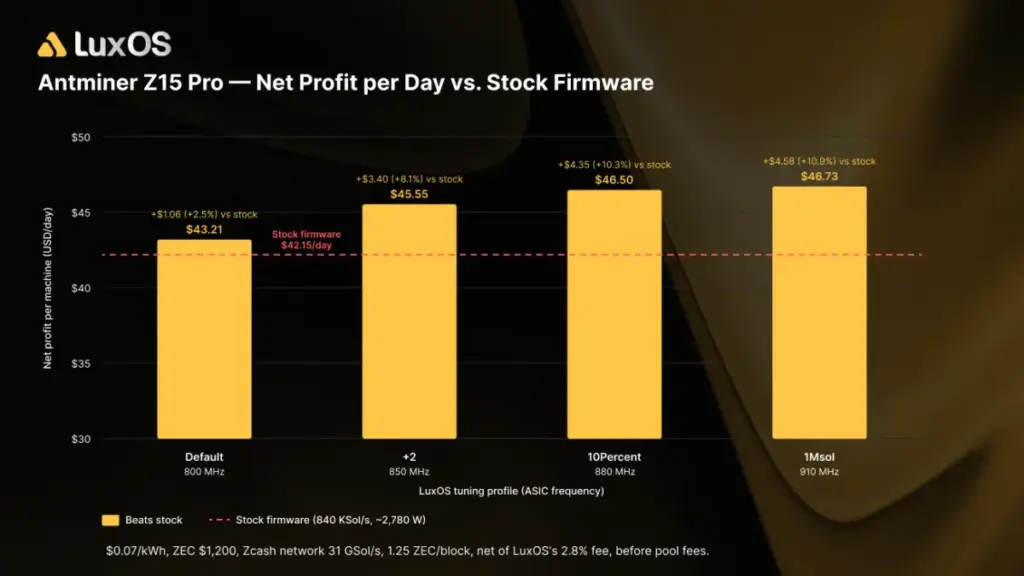
The integration comes at a notable time for the Zcash network. With ZEC trading near $1,200 and the network hashing at approximately 31 GSol/s, a stock Antminer Z15 Pro typically yields roughly $42 per day under a standard power cost of $0.07 per kWh. However, testing conducted by Luxor on early machines running LuxOS demonstrates a noticeable performance uplift. The test machine netted approximately $47 per day under the same electricity pricing, even after accounting for LuxOS’s 2.8% developer fee.
What Changed: The First Equihash Machine on LuxOS
Until now, LuxOS firmware has been strictly dedicated to optimizing SHA-256 Bitcoin mining hardware. By incorporating support for the Antminer Z15 Pro, Luxor is bringing the same granular tuning and monitoring stack used by large-scale Bitcoin operations over to the Equihash ecosystem.
Out of the box, stock firmware restricts the Antminer Z15 Pro to a fixed output of 840 KSol/s, drawing approximately 2,780 watts. Bitmain’s factory configuration provides no native mechanism for operators to adjust operating frequencies or voltages, nor does it offer per-chip visibility or health scoring metrics. LuxOS effectively transforms the machine from a rigid, sealed unit into a fully tunable asset that operators can adapt to their specific power pricing agreements and environmental cooling constraints.
The performance trade-off mirrors the realities of hardware overclocking across the cryptocurrency mining industry. Pushing the hardware harder generates more solutions per second and higher daily revenues, but it also increases power consumption. Whether this trade-off makes financial sense depends heavily on an individual operator’s electricity costs and prevailing market prices for ZEC.
What Stock Firmware Leaves on the Table
Under comparative testing conditions, the performance gap between stock operations and LuxOS tuning is substantial. While stock firmware operates at 840 KSol/s and consumes roughly 2,780 watts, the LuxOS test profile pushes the machine to a sustained hashrate of 961 KSol/s, with peak test rates reaching approximately 991 KSol/s at around 4,032 watts.
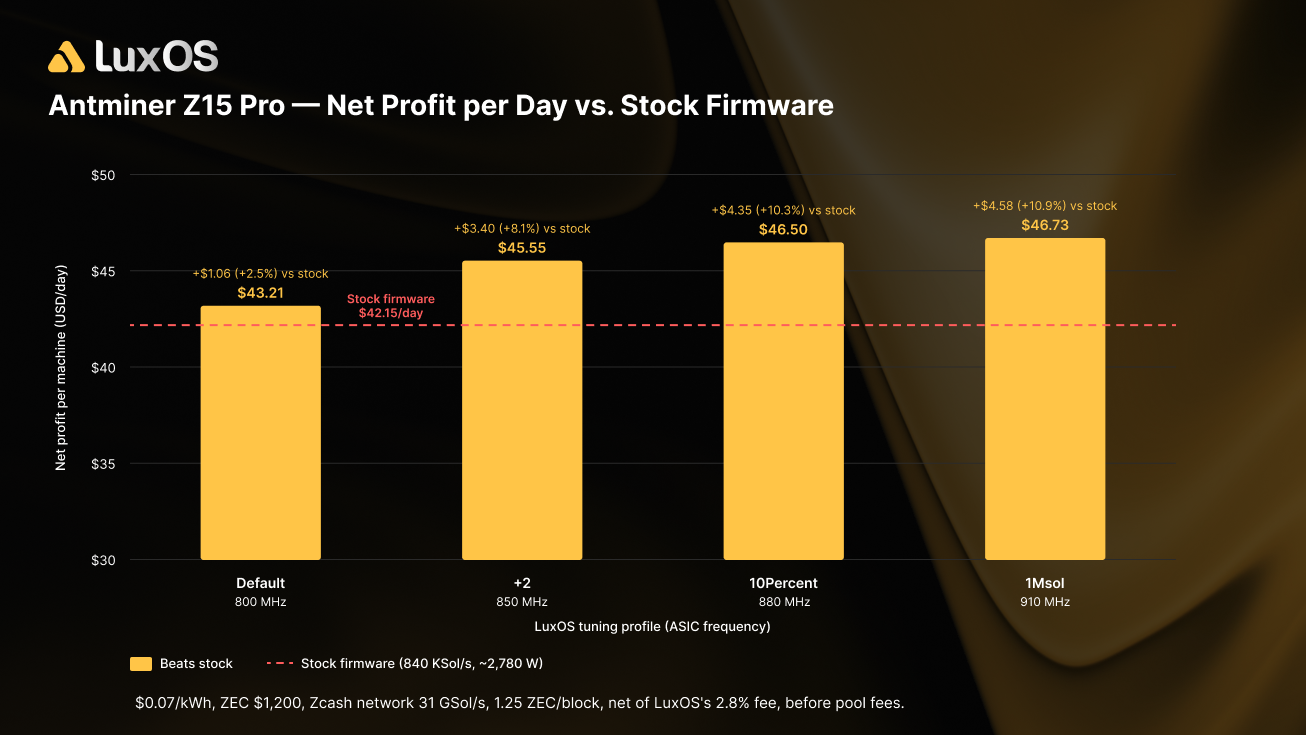
When translated into financial returns, these efficiency and hashrate gains accumulate rapidly. Assuming a ZEC price of $1,200, a network hashrate of 31 GSol/s, 1,152 blocks per day, and a miner reward of 1.25 ZEC per block, net earnings over an initial 90-day period illustrate the financial impact of the firmware upgrade. A machine running LuxOS generates approximately $4,223 over 90 days, compared to $3,794 on stock firmware, creating a $429 difference per machine. Factoring in a unit acquisition cost of $7,475 for a Z15 Pro—based on Luxor’s futures quotes for early 2027 delivery—simple hardware payback shortens from roughly 177 days on stock firmware down to approximately 159 days with LuxOS.
Fleet Economics and Economic Sensitivities
For commercial mining operations managing large fleets of Equihash hardware, evaluating the profitability of an overclock requires a close look at two primary variables: power costs and token price volatility.
Power expenses dictate how much of the increased revenue survives after electricity bills are paid. At a ZEC price of $1,200, the net daily gain delivered by the LuxOS overclock ranges from $5.67 per machine at an electricity rate of $0.04 per kWh, to $4.77 at $0.07 per kWh, $3.87 at $0.10 per kWh, and $2.36 at $0.15 per kWh. Because the overclock remains gross-margin positive at electricity costs up to approximately $0.23 per kWh, grid-connected operators across most regions will see positive returns, though high-tariff jurisdictions will capture a smaller net margin.
Token price fluctuations introduce a second layer of sensitivity. Maintaining a constant power cost of $0.07 per kWh, the net daily gain stands at $1.33 per machine if ZEC trades at $600, expanding to $3.05 at $900, $4.77 at $1,200, and $6.48 at $1,500. The breakeven point for the firmware’s power draw rests at approximately $370 per ZEC. If market prices fall below that threshold, the additional 1,252 watts consumed by the overclock would cost more than the extra ZEC generated, shifting the economic equation. Furthermore, overall network hashrate scales down both revenue streams proportionally; if network difficulty rises from 31 GSol/s to 40 GSol/s, both stock and LuxOS revenues decrease by roughly 22.5%, though the relative performance gap between the two remains steady.
Early Performance Data from Test Machines
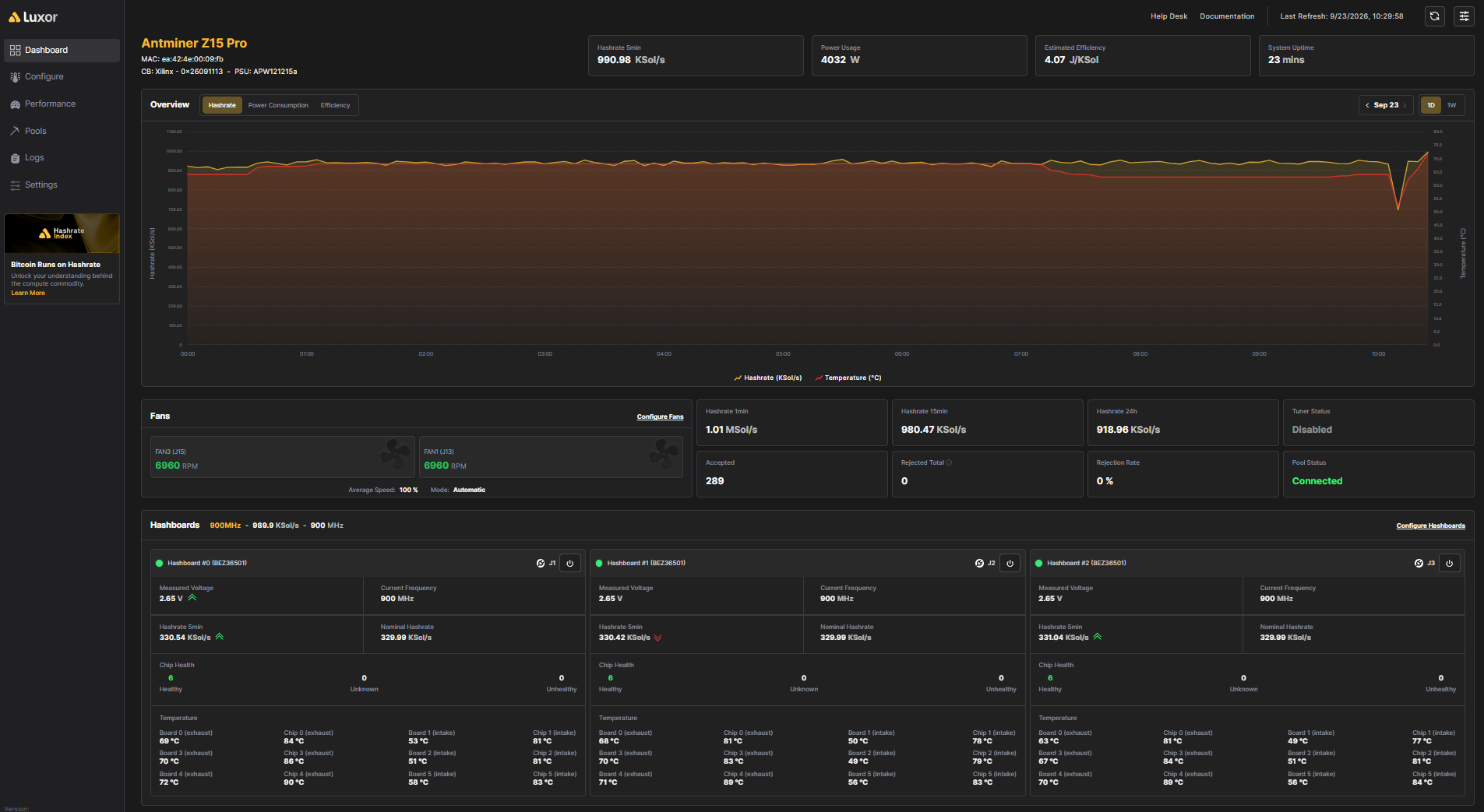
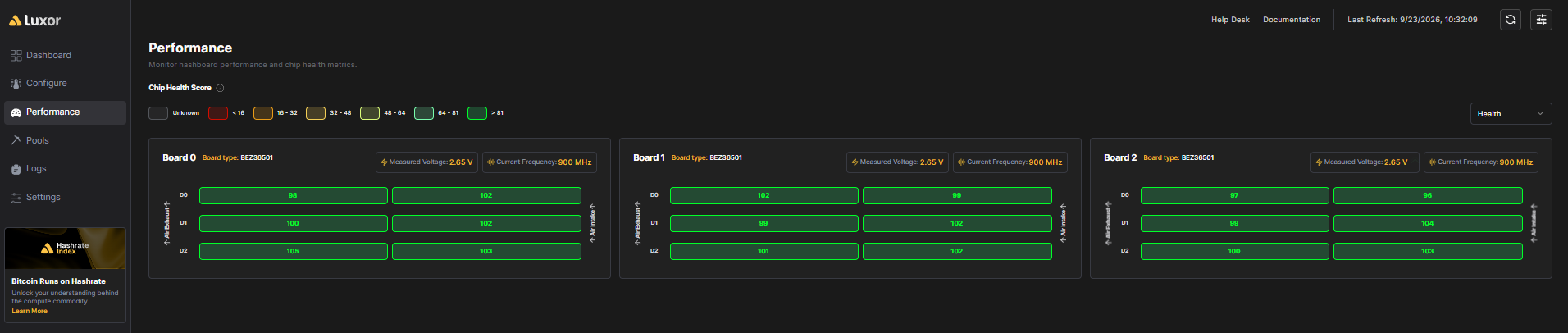
Initial data deployed from live test machines running LuxOS on the Z15 Pro highlights the stability of the firmware in production environments. Telemetry dashboards confirm that units are successfully holding a sustained hashrate of approximately 991 KSol/s at 4,032 watts, maintaining a zero percent rejection rate across all three onboard hashboards.
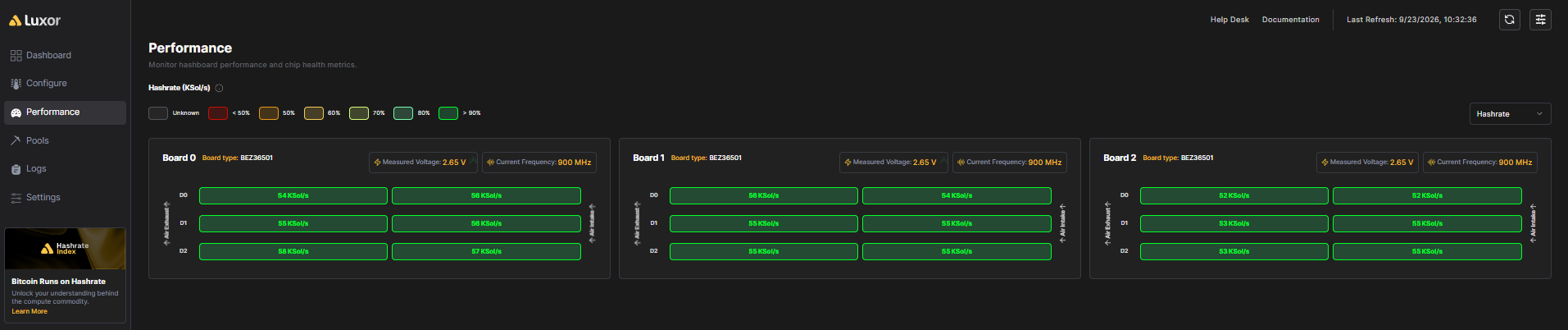
In addition to aggregate performance metrics, LuxOS introduces advanced monitoring tools previously unavailable on Equihash hardware. Operators gain access to granular, per-chip hashrate visibility and automated health scoring. Telemetry views show that all 18 chips across the Z15 Pro’s hashboards operate comfortably above 90% of their target output, placing them securely within the healthiest performance bands.
Moving Forward
The introduction of LuxOS to the Antminer Z15 Pro marks an important milestone for Equihash miners seeking enterprise-grade fleet management tools historically reserved for the Bitcoin sector. By unlocking tunable performance, granular telemetry, and advanced thermal monitoring, Luxor aims to provide commercial operators with the tools necessary to maximize their operational margins in a competitive market environment. Public software installations are set to officially commence on October 1, with early access coordination currently underway for select mining operations.
 Cryptocurrency Mining
 Cryptocurrency Mining
 Cryptocurrency Mining