Within just four days of its deployment, the FWA protocol consumed so much Ethereum gas that it briefly became the network’s largest gas consumer by fees over a single 24-hour period. At the peak of this surge on July 25, the application generated approximately $1.53 million in daily fees. This surge in blockspace demand allowed FWAs to temporarily leapfrog major stablecoin issuers Tether and Circle, placing the protocol among the top consumers of Ethereum blockspace. Proclaiming the milestone on social media, its creators at TokenWorks declared that four days after launch, Fake World Assets were positioned as the next big thing in the digital asset space.
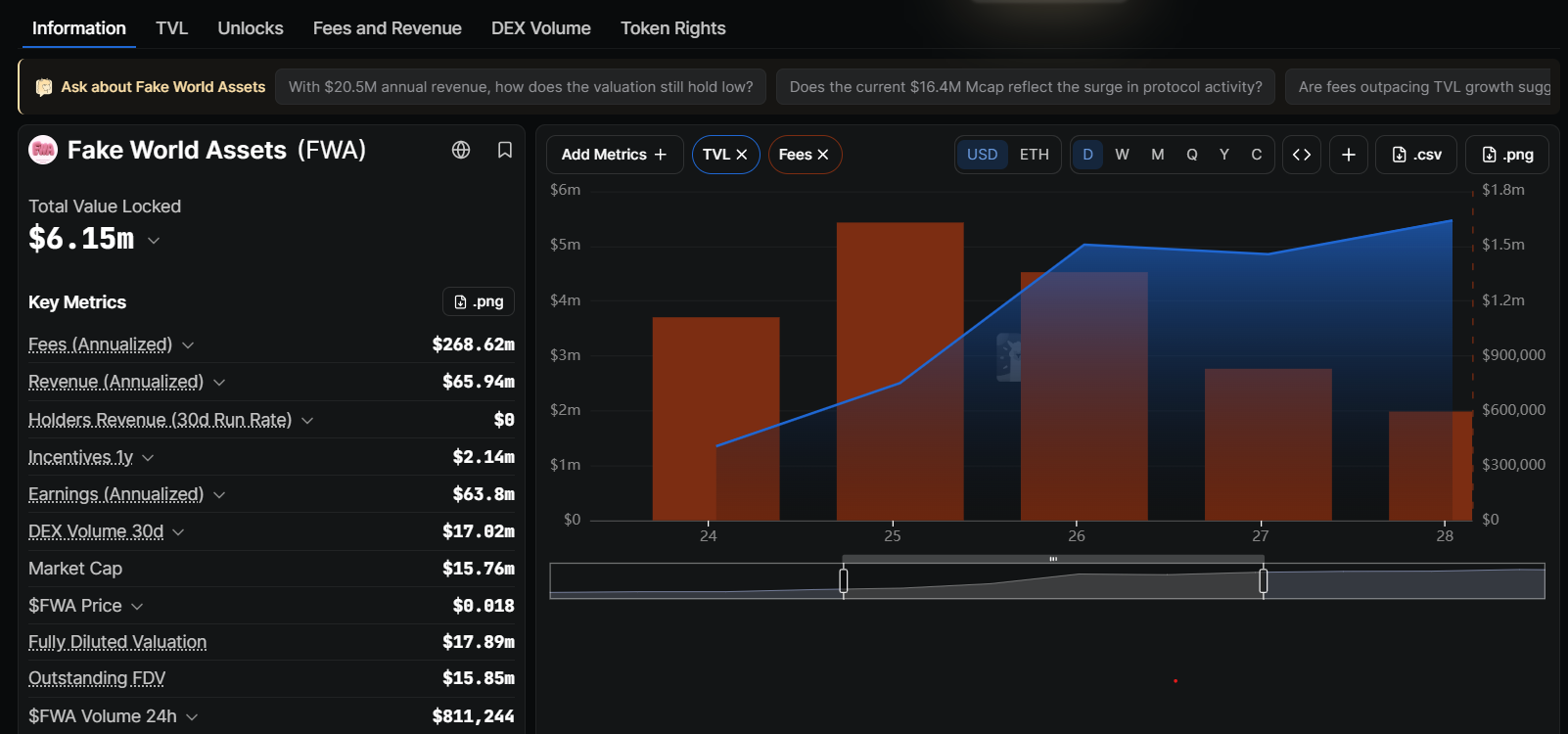
Although TokenWorks is far from an impartial observer given its stake in the protocol, underlying metrics show sustained interest. Total Value Locked (TVL) continued to climb steadily in the weeks following the launch, reaching over $6.15 million by July 31. While fee revenue subsequently moderated to around $350,000 per day—equating to an annualized run rate of roughly $268 million—volume metrics continued to expand. By August 1, the FWA protocol recorded a volume of 10,000 Ether alongside 100,000 individual purchases. Industry observers note that while a portion of this activity is undoubtedly driven by users seeking early FWA token incentives, there appears to be genuine, organic interest in the underlying gamified mechanic itself.
Not everyone in the blockchain sector is convinced that the frenzy surrounding FWAs represents a sustainable paradigm shift. Simon Dedic, founder of venture capital firm Moonrock Capital and an early backer of various onchain collectible platforms, expressed measured skepticism regarding the protocol. While acknowledging that he remains broadly optimistic about the future of gamified commerce, Dedic pointed out that his reservations regarding FWAs are quite specific. He argues that a significant portion of the current user activity is sustained by generous token incentives rather than long-term, organic demand. From his perspective, the entire ecosystem is primarily engineered to cater to crypto traders seeking speculative gambling opportunities.

This dynamic raises a central question for market participants: Is FWA simply another short-lived obsession fueled by speculative fervor, or has the decentralized finance and NFT community accidentally stumbled upon a permanent primitive built to last?
For years, the broader cryptocurrency industry has attempted to bridge the gap between traditional finance and the blockchain by bringing real-world assets onchain. These initiatives have ranged from tokenized stocks, bonds, and corporate credit to more unconventional experiments like tokenized Brazilian agricultural collateral. Parallel to these institutional-grade RWA projects, the market has witnessed a massive surge in the tokenization of physical collectibles, such as rare trading cards. As previously reported, onchain gacha mechanisms tied to physical collectibles reached record trading volumes, with tokenized Pokémon booster packs and similar collectibles seeing hundreds of millions of dollars in turnover.
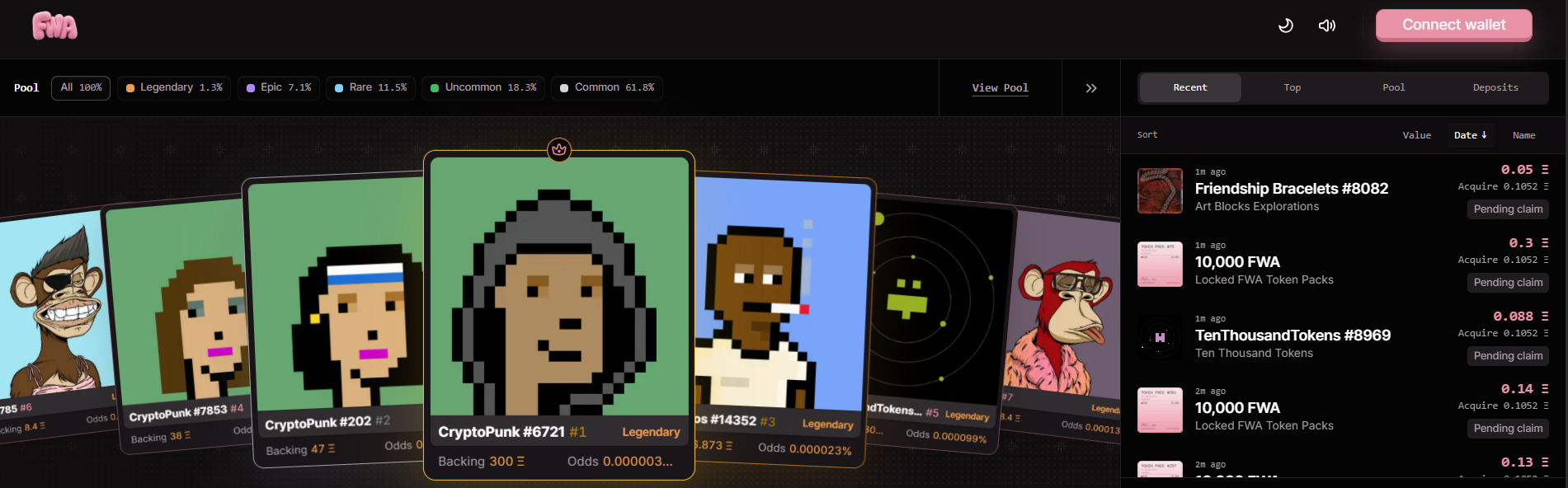
TokenWorks decided to invert this dynamic by introducing Fake World Assets, which function primarily as non-fungible tokens. Rather than purchasing a specific, designated collectible such as a Bored Ape, users pay to spin an onchain gacha machine for the chance to win a randomly selected NFT backed by Ether. The prizes featured within the protocol pool originate from dozens of recognized and established collections, ranging from blue-chip projects like CryptoPunks and Azuki to Lil Pudgys and Art Blocks.
The term gacha originates from gachapon or gashapon, the popular capsule-toy vending machines invented in Japan during the 1960s that dispense a randomized toy inside a plastic capsule. This psychological mechanic eventually migrated into digital environments, most notably with mobile and browser games like Dragon Collection in 2010. A parallel psychological framework has long existed in the physical world through trading card booster packs, which offer buyers a randomized assortment of cards featuring varying rarity levels and market values. These physical cards have increasingly been tokenized onchain by specialized projects, with many of those tokenized assets subsequently wrapped for integration into the FWA ecosystem.
The scope of this experimental sector continues to expand on a weekly basis. Developers are actively experimenting with randomized token packs containing ERC-20 tokens, while applications on alternative networks demonstrate how tokenized traditional equities can be wrapped into NFT-based gacha packs. As AzFlin, founder of the DAO launchpad daos.world and a former Uniswap engineer, observed, just when observers assume that every possible financial primitive has been invented in crypto, a novel variation emerges.
The enduring appeal of the onchain gacha mechanic lies in its intersection of decentralized finance, digital collectibles, and speculative gambling. As pseudonymous crypto commentator 2Lambroz notes, from the perspective of the individual player, participating in the pool functions essentially like purchasing a lottery ticket. This behavior taps into deeply established economic principles. Benjamin Lockwood, a Wharton economist whose academic research into state-run lotteries explored consumer motivations, found that individuals derive intrinsic value from the participatory experience itself, rather than solely focusing on the statistical probability of winning a major financial payout.
This sentiment is echoed by Meir Statman, a behavioral finance pioneer, professor at Santa Clara University, and author of A Wealth of Well-Being. Statman draws a direct behavioral parallel between onchain gacha mechanics and the traditional practice of bidding on the contents of abandoned storage units. Most bidders ultimately acquire items that hold little to no value, but the occasional participant uncovers rare items that can be resold for substantial sums on secondary markets. According to Statman, these activities effectively combine the psychological pull of hope for significant financial enrichment with a sense of playful entertainment, which forms the core appeal of lotteries across both traditional and digital economies.
Operating an FWA protocol involves two distinct participant profiles with contrasting objectives. On one side, NFT holders act as liquidity providers, depositing their digital collectibles alongside pools of Ether and earning a proportional share of generated fees for as long as their assets remain in the pool. On the other side, players pay a fee for the opportunity to pull a randomly selected NFT, retaining the flexibility to either keep the asset or redeem the vast majority of its attached Ether value. According to recent data from Blockworks Research, approximately 70% of purchasers currently choose to convert their winnings back into FWA ecosystem tokens.
This structure creates a delicate balancing act. As analysts have outlined, liquidity providers are essentially betting that their deposited NFTs will remain in the pool long enough to accumulate fees before being selected and claimed by a player. Conversely, players are chasing the statistical probability of landing a prize whose market value far exceeds the initial cost of a single spin. Materkel, an outspoken Ethereum community member, described the model as one of the most engaging NFT and casino-style primitives introduced in the decentralized finance sector in over a decade, noting that it allows users to simultaneously act as both individual players and the house.
While near-term metrics and social media engagement highlight massive interest, questions regarding the long-term sustainability of the model remain open. Simon Dedic reiterates his view that while short-term activity is heavily stimulated by token rewards, the broader concept of gamified commerce addresses a powerful generational shift. As Generation Z continues to expand its economic buying power within the global marketplace, consumer interactions and retail shopping experiences are increasingly expected to incorporate gamified elements designed to drive engagement.
Rather than relying on speculative digital artifacts originating from previous market cycles, Dedic suggests that gamified mechanisms are naturally better suited for physical assets and high-demand collectibles that consumers already actively desire, ranging from established trading cards and luxury timepieces to fine whiskey. Selling high-demand assets through gamified structures holds substantial commercial potential, in stark contrast to engineered token models designed solely to manufacture artificial demand for unwanted items.
The ultimate test for Fake World Assets and the wider onchain gacha sector will arrive when initial novelty fades and token-based incentives begin to taper off. If market participants continue to engage with the protocols regardless of promotional rewards, onchain gacha may successfully establish a durable retail use case that the blockchain industry has sought for years. Should that engagement falter, these experiments will likely join the historical registry of short-lived crypto trends that burned brightly before fading into obscurity.
 Non-Fungible Tokens (NFTs)
 Non-Fungible Tokens (NFTs)
 Non-Fungible Tokens (NFTs)