
Welcome to the weekly Bitcoin mining market roundup for the week ending September 28, 2026. This week presents a mixed bag for industry participants: while Bitcoin spot prices experienced a modest upward tick and overall network hashrate expanded, profitability metrics faced downward pressure. Miners continue to navigate a delicate balance between rising computational power, steady transaction fee contributions, and narrowing margins per petahash.
Market Overview and Block Rewards
Over the past week, Bitcoin miners collected a total of approximately 3,112 BTC in block rewards, translating to roughly $262 million based on prevailing market valuations. Transaction fees continued to play a supplementary role in miner revenues, constituting 0.70% of total block rewards. Miners brought in a collective 22 BTC from fees, equivalent to approximately $1.83 million.
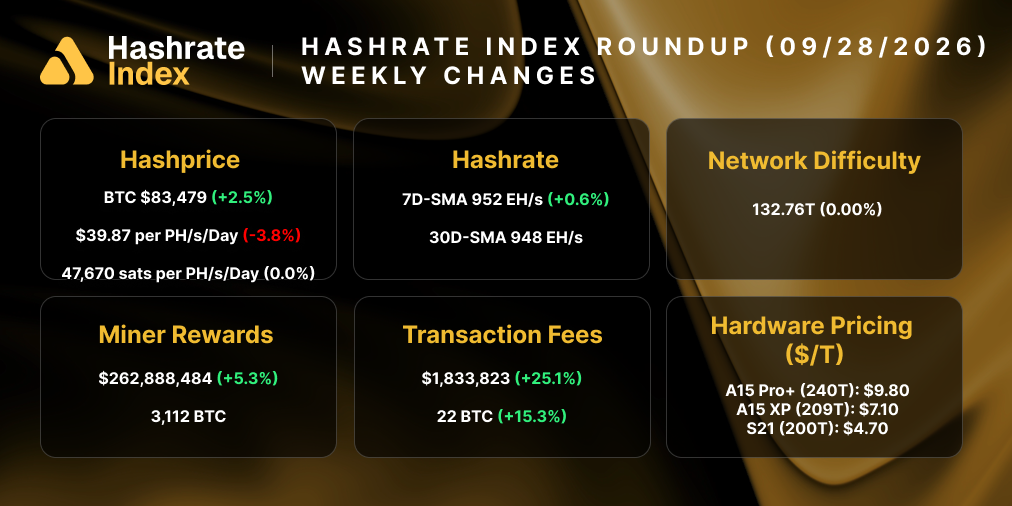
Despite the steady collection of block subsidies and fees, overall mining profitability experienced a contraction as network competition continued its relentless climb. Luxor Technology’s weekly data highlights a dynamic environment where infrastructure efficiency remains the primary differentiator for profitable operations.
Bitcoin Price Action and CME Futures
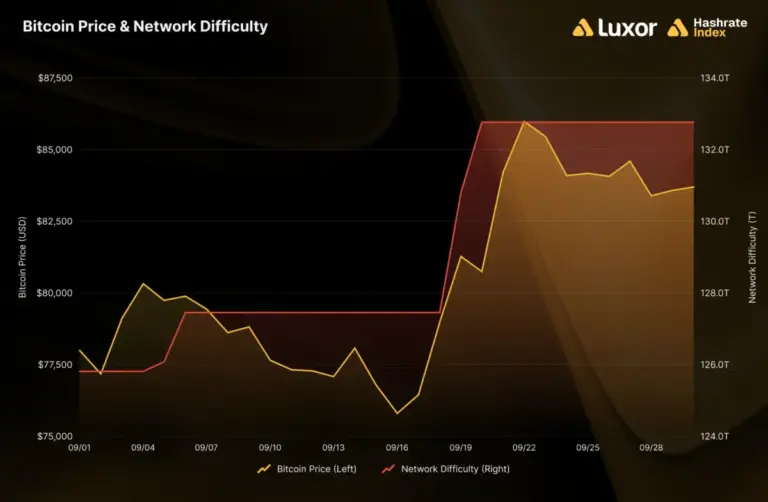
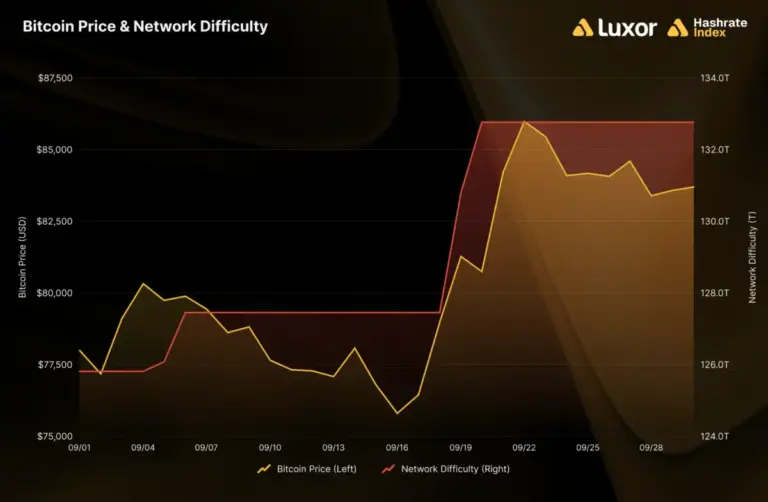
Bitcoin’s spot price moved higher over the seven-day observation window, climbing by 2.5% from approximately $81,412 to hover around $83,479 by the end of the period. Despite this weekly recovery, the asset’s year-to-date performance remains in negative territory at approximately -4.5%.
Intraday volatility saw the spot price dip 1.1% from a 24-hour previous high of $84,413. Meanwhile, Chicago Mercantile Exchange (CME) futures reflected cautious optimism across near-term contract months. September CME futures traded at $83,830, marking a 0.4% increase, while October and November contracts stood at $84,285 and $84,040, posting gains of 1.0% and 0.7% respectively.
Hashprice Dynamics and Fleet Efficiency
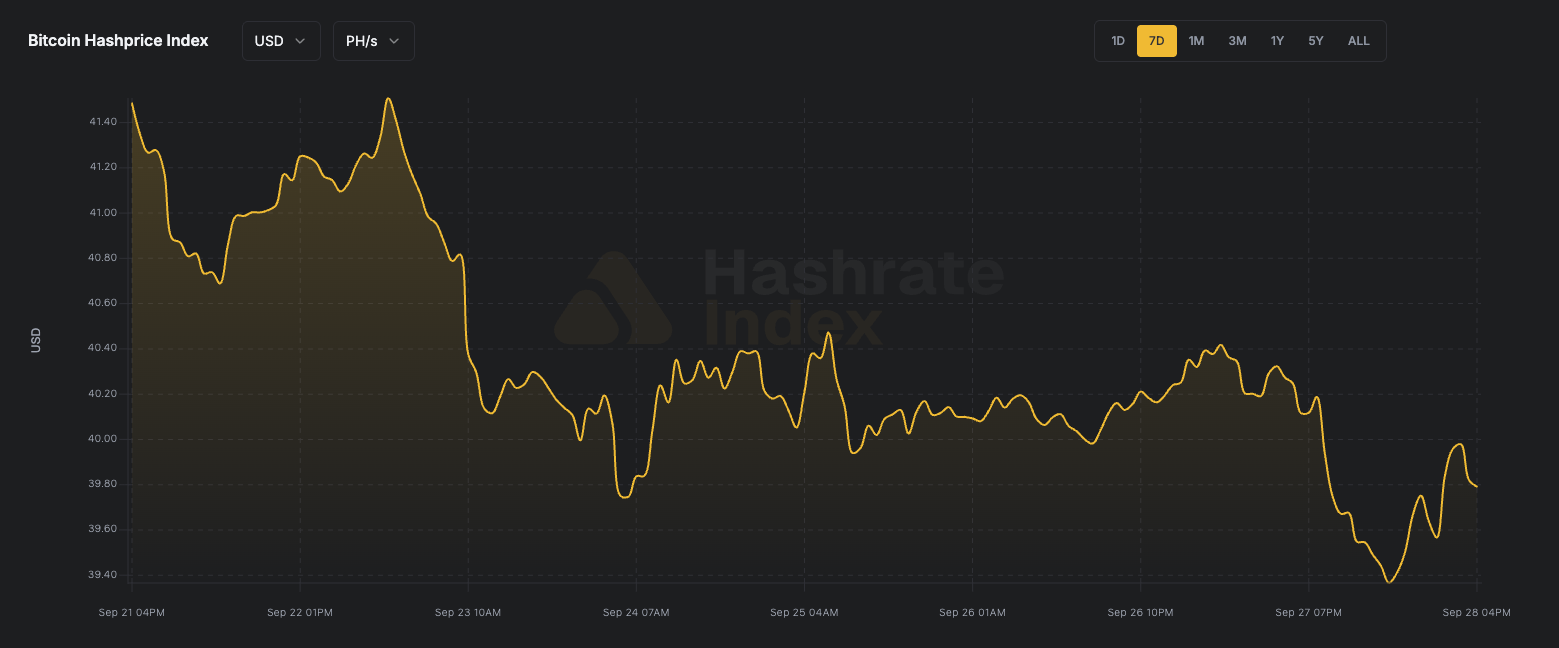
The USD hashprice—a key metric measuring the expected daily revenues of 1 PH/s of hashing power—contracted by 3.8% over the week, moving from $41.45 to $39.87 per PH/s per day. The 7-day average hashprice settled at $40.36, down 1.2%, while the 30-day average ticked up slightly by 1.5% to $39.29.
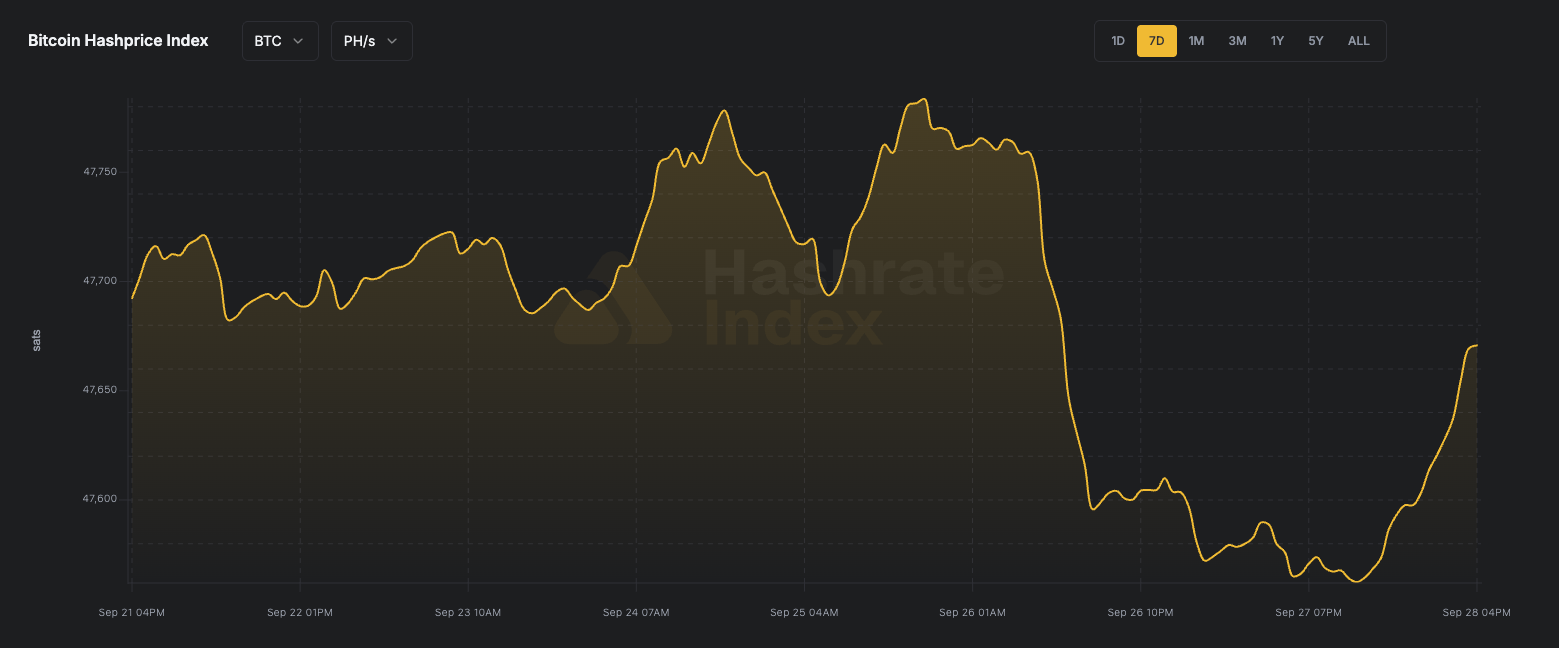
When measured in native cryptocurrency terms, the BTC hashprice remained essentially flat, shifting negligibly from 0.00047692 BTC to 0.00047670 BTC per PH/s per day over the seven-day span. The 7-day average held steady at 0.00047686 BTC, while the 30-day average drifted downward by 3.0% to 0.00049164 BTC.
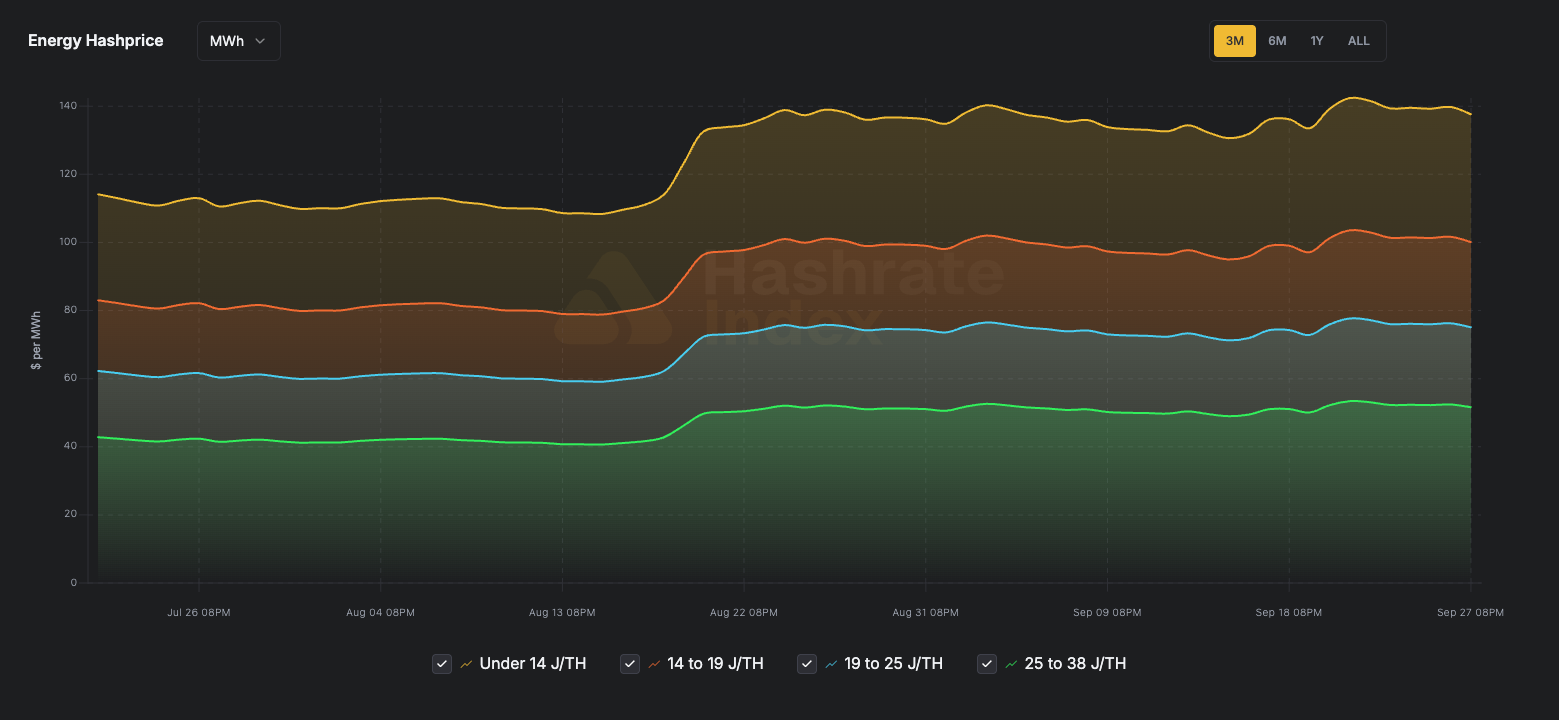
With hashprice hovering around the $40 threshold, operations are increasingly operating at or near breakeven depending on individual power purchase agreements (PPAs) and hardware efficiency tiers. Fleetwide metrics underscore the necessity for advanced firmware and next-generation Application-Specific Integrated Circuits (ASICs) to extract viable yields per watt-hour.
Hashrate and Difficulty Adjustments
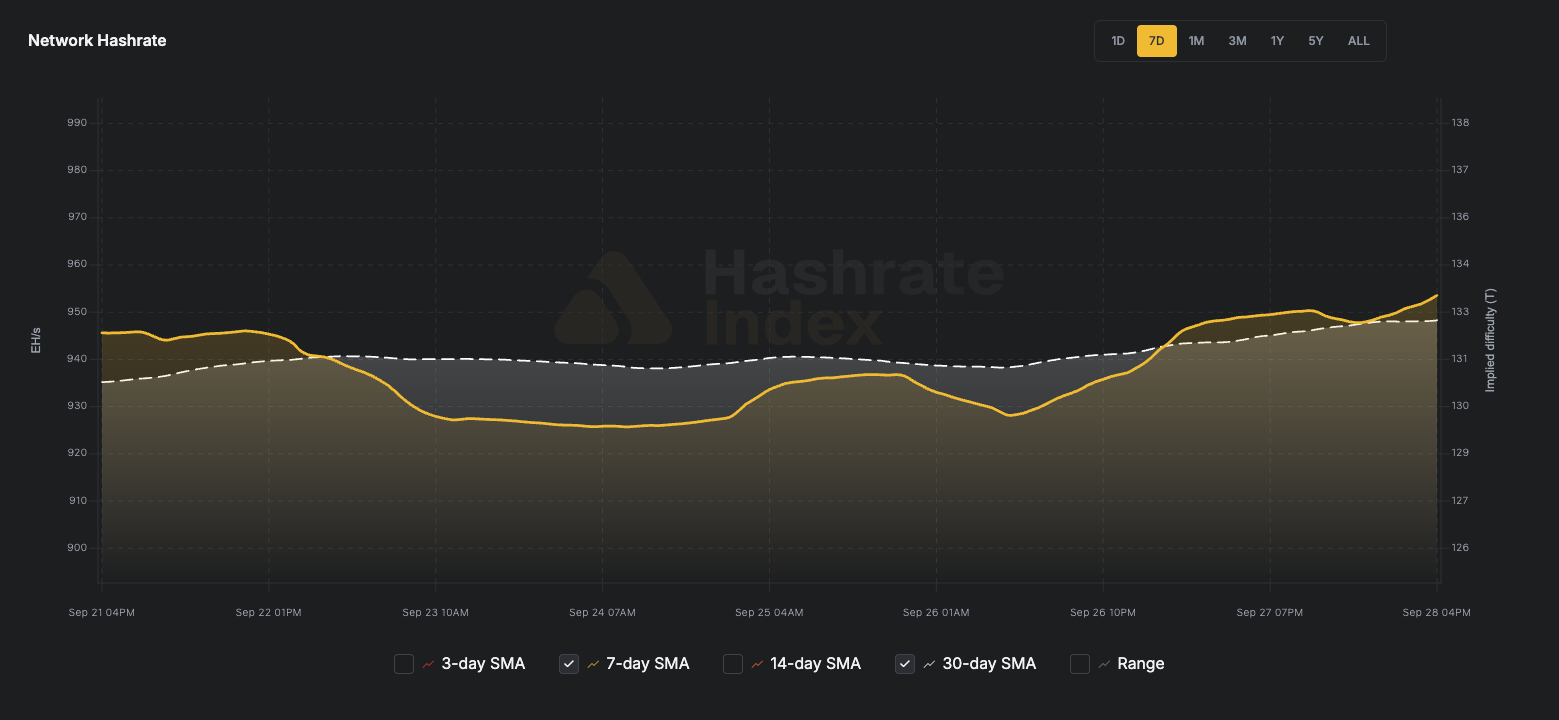
Network hashrate extended its upward trajectory, with the 7-day simple moving average (SMA) increasing by 0.6% from 946 EH/s to 952 EH/s. The broader 30-day SMA currently rests at 948 EH/s, demonstrating robust underlying participation and deployment of newer rig generations across global hosting facilities.
The most recent network difficulty adjustment occurred on September 19, 2026, pushing network difficulty up by 4.16% to 132.76T. Over the past 24 hours, block times have averaged 10 minutes and 4 seconds, running slightly slower than the protocol’s 10-minute target.
Looking ahead to the next adjustment, expected around October 3, 2026, current estimates project a slight downward adjustment of approximately -0.66%. The network is currently roughly 68% through the active difficulty epoch, having processed 1,363 blocks out of the standard 2,016-block cycle.
Transaction Fees
Transaction fee generation saw a positive bump over the week. Miners collected an average of 0.0217 BTC per block per day in transaction fees, marking a 12% increase compared to the prior week’s average of 0.0194 BTC.
Short- and medium-term averages reflect this upward pressure. The 14-day average transaction fee climbed to 0.0206 BTC, a 5.7% increase, while the 30-day average reached 0.0195 BTC, up 11.6% over the month-long observation window. While these fees provide a helpful cushion, block subsidies continue to drive the vast majority of miner top-line revenues.
Forward Markets and Outlook
Participants looking toward the derivative markets can gauge long-term expectations through the Luxor Hashrate Forward Market. The forward curve currently prices in an average hashprice of $38.34, or approximately 0.00046 BTC, over the next six-month period stretching from September 2026 through February 2027. This indicates that market participants anticipate relatively stable, albeit constrained, revenue conditions in the near-to-medium term.
Bitcoin Mining Equities
Publicly traded Bitcoin mining stocks experienced a broad-based pullback over the week ending September 28, 2026. Major industry equities posted significant week-over-week declines as broader macroeconomic sentiment and crypto market correlations impacted valuations.
Notable movers included Iris Energy (IREN), which saw shares trade around $41.72 with a market capitalization of $16.44 billion, down 11.7% over the five-day period. Riot Platforms (RIOT) fell 10.6% to $21.62 with an 8.11 billion valuation, while Marathon Digital (MARA) declined 8.8% to $12.11, bringing its market cap to $4.68 billion. Other prominent operators such as CleanSpark (CLSK), Core Scientific (CORZ), and Cipher Mining (CIFR) posted losses ranging between 9.6% and 11.4%. Smaller cap entities and specialized manufacturers also experienced downward adjustments across the board in alignment with the broader sector trend.
 Cryptocurrency Mining
 Cryptocurrency Mining
 Cryptocurrency Mining