
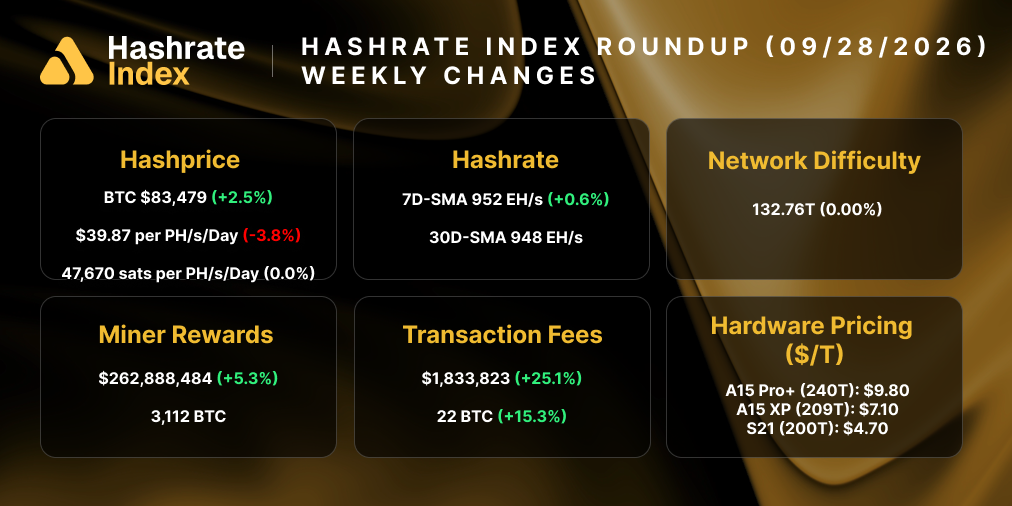
As the final stretch of September 2026 unfolds, the Bitcoin mining ecosystem finds itself navigating a familiar crosscurrent of rising computational power and contracting unit revenues. According to the latest weekly metrics compiled by Luxor Technology’s Hashrate Index, the macro picture for the week ending September 28 delivered a mixed bag for miners: while Bitcoin’s spot price, network hashrate, and transaction fee contributions ticked upward, the core profitability metric known as hashprice saw a noticeable decline.
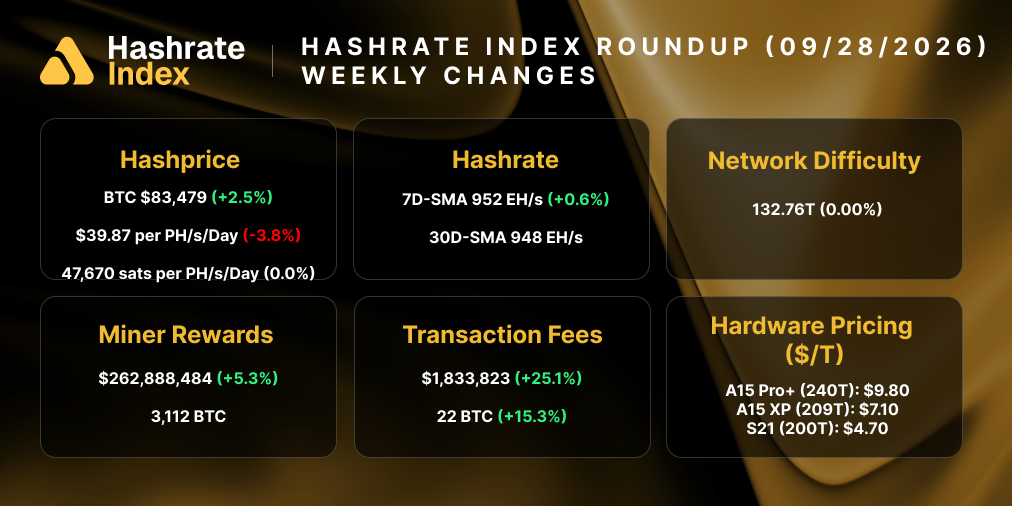
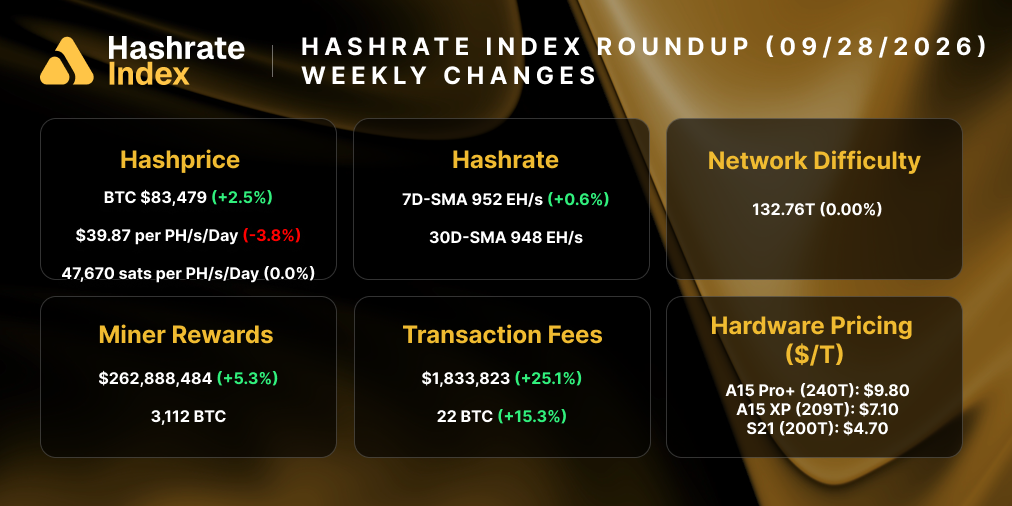
Over the past week, Bitcoin miners collected a cumulative total of approximately 3,112 BTC in block rewards, translating to roughly $262 million based on prevailing spot prices. Within that total, transaction fees played a slightly larger role than in previous weeks, constituting 0.70% of overall block rewards. Miners pulled in 22 BTC in transaction fees, equivalent to approximately $1.83 million. Despite this minor bump in fee generation, broader market pressures weighed on overall profitability across the SHA-256 sector.
Bitcoin Price Action and Futures Market
The underlying asset driving the mining economy experienced modest gains over the seven-day observation period. Bitcoin moved upward by roughly 2.5%, climbing from a local low of approximately $81,412 to trade around $83,479 by the close of the week. Despite this weekly recovery, Bitcoin’s year-to-date performance remains in negative territory, standing at approximately -4.5%.
On a 24-hour moving basis, the spot price pulled back slightly by 1.1% from a previous high of $84,413. Meanwhile, the Chicago Mercantile Exchange (CME) futures curve reflected steady near-term expectations among institutional traders. September CME futures hovered around $83,830, marking a 0.4% increase, while October and November contracts traded at $84,285 and $84,040, respectively, signaling cautious optimism heading into the final quarter of the year.
Hashprice Pressures Miner Margins
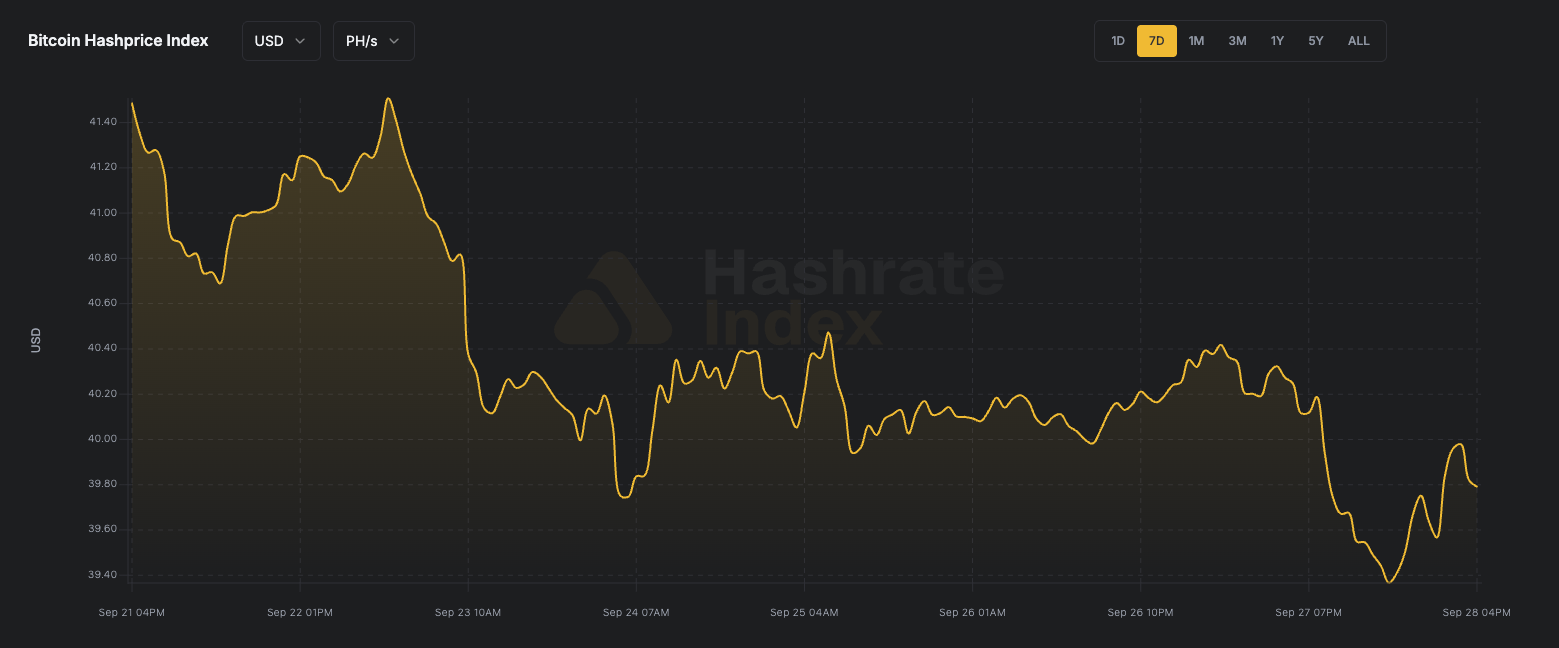
While Bitcoin’s spot price managed a weekly gain, the profitability of mining operations—measured by hashprice—moved in the opposite direction. USD hashprice dropped by 3.8% over the week, shifting from $41.45 per petahash per second per day (PH/s/Day) down to $39.87 per PH/s/Day. Looking at a broader historical window, the 7-day average hashprice settled at $40.36, while the 30-day average stood slightly lower at $39.29.
In native terms, the picture remained relatively stable. BTC hashprice registered virtually no change week-over-week, moving from 0.00047692 BTC per PH/s/Day to 0.00047670 BTC per PH/s/Day. The 30-day average for native hashprice rested at 0.00049164 BTC per PH/s/Day.
With USD hashprice hovering near the critical $40 threshold, operations are increasingly running at or near breakeven levels. Profitability heavily depends on a facility’s specific electricity costs and the fleet efficiency of its hardware. To counteract these narrowing margins, many operators continue to turn to efficiency-boosting firmware, such as Luxor’s LuxOS, to optimize S19 and S21 series mining rigs.
Hashrate and Difficulty Adjustments
Network security and computational power continued their persistent upward trajectory. The Bitcoin network’s hashrate, measured by its 7-day simple moving average (SMA), edged up by 0.6% from 946 exahashes per second (EH/s) to 952 EH/s. The 30-day SMA mirrored this robust computational footprint, holding steady at 948 EH/s.
The most recent network difficulty adjustment, which occurred on September 19, 2026, pushed network difficulty upward by 4.16% to 132.76T. Over the past 24 hours, block times have averaged 10 minutes and 4 seconds, running slightly behind the target 10-minute cadence. As the network progresses through the current adjustment epoch—having cleared roughly 68% of its blocks—analysts anticipate a minor downward correction. Current estimates place the next adjustment, expected around October 3, 2026, at approximately -0.66%.
Transaction Fees and Forward Markets
Transaction fee dynamics showed signs of life over the past week. Miners collected an average of 0.0217 BTC per block per day in transaction fees, representing a 12% increase compared to the previous week’s average of 0.0194 BTC. Looking at longer moving averages, 14-day and 30-day average transaction fees stood at 0.0206 BTC and 0.0195 BTC, respectively.
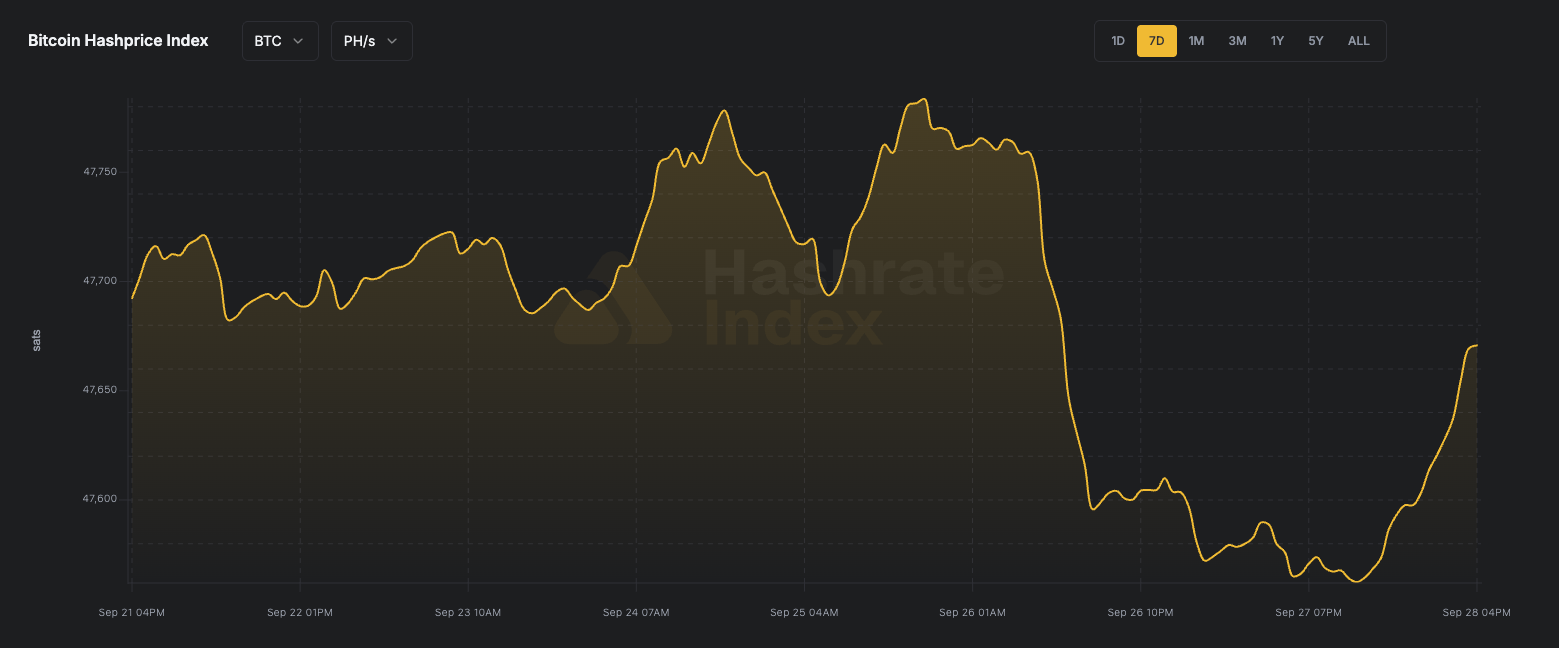
Looking ahead, the derivatives and forward markets continue to price in stable, albeit restrained, revenue expectations. According to the Luxor Hashrate Forward Market, the forward curve is currently pricing in an average hashprice of $38.34, or roughly 0.00046 BTC, over the next six months, stretching from September 2026 through February 2027.
Publicly Traded Mining Stocks Pull Back
Publicly traded Bitcoin mining equities experienced a difficult week across the board, matching the downward pressure on hashprice. Following the broader equity and crypto market close for the week, nearly all major mining stocks recorded double-digit percentage losses.
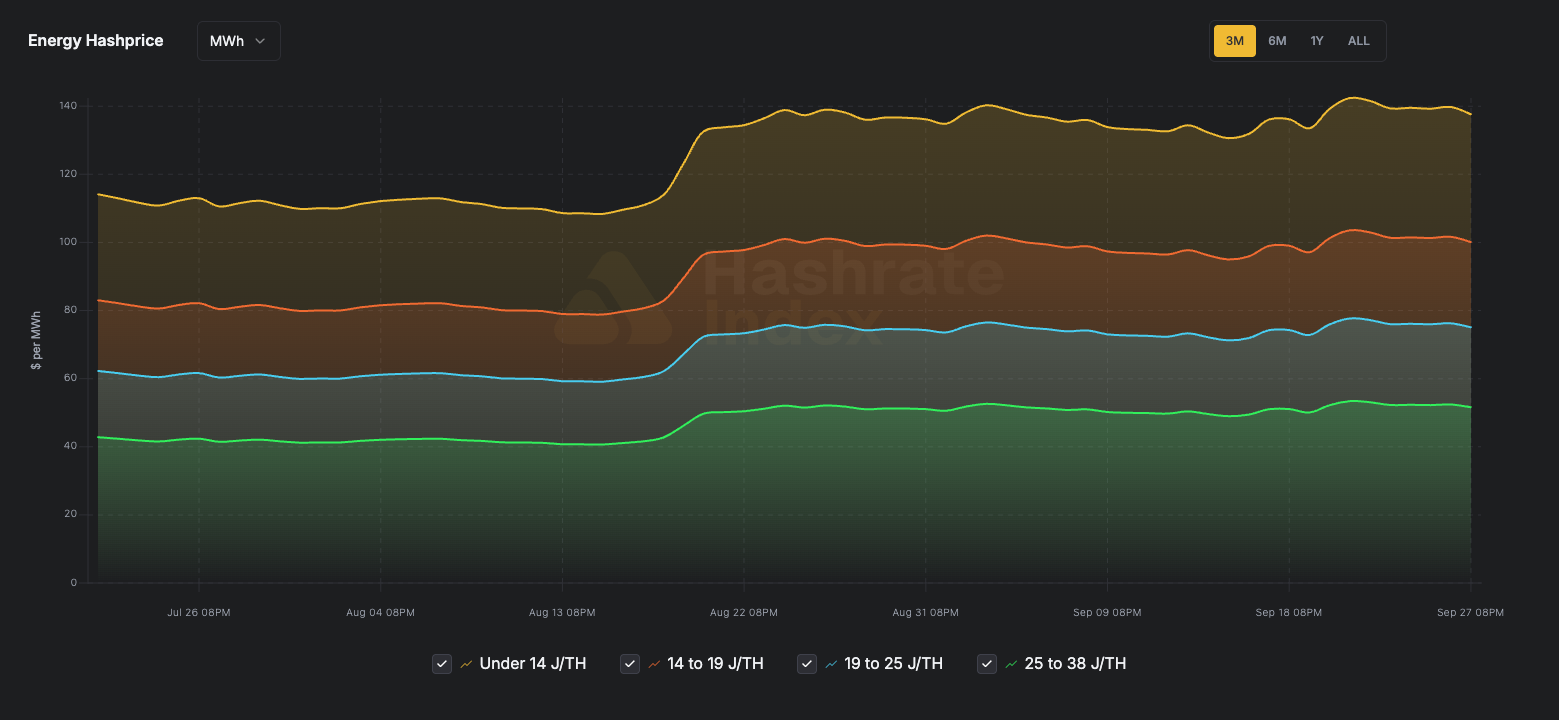
Firms such as Cipher Mining (CIFR), CleanSpark (CLSK), Core Scientific (CORZ), MARA Holdings (MARA), and Riot Platforms (RIOT) registered weekly declines ranging from roughly 8% to over 11%. Meanwhile, other sector participants like Bitdeer (BTDR), HIVE Digital (HIVE), Hut 8, and TeraWulf (WULF) saw pullbacks between 11% and 16%. Despite the broader equities downturn, operational expansions and strategic treasury management remain focal points for mining executives as the industry prepares to close out the third quarter of 2026.
 Cryptocurrency Mining
 Cryptocurrency Mining
 Cryptocurrency Mining