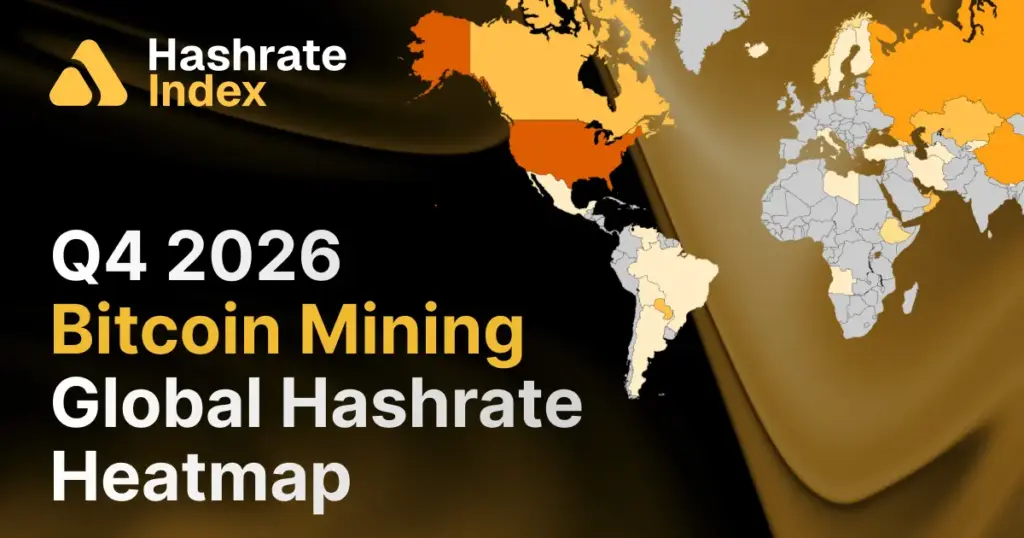
After two consecutive quarters of contraction, the Bitcoin network’s global hashrate has finally stopped falling, finishing the third quarter of 2026 at approximately 941 exahashes per second (EH/s) and holding virtually flat against the second quarter’s 940 EH/s.
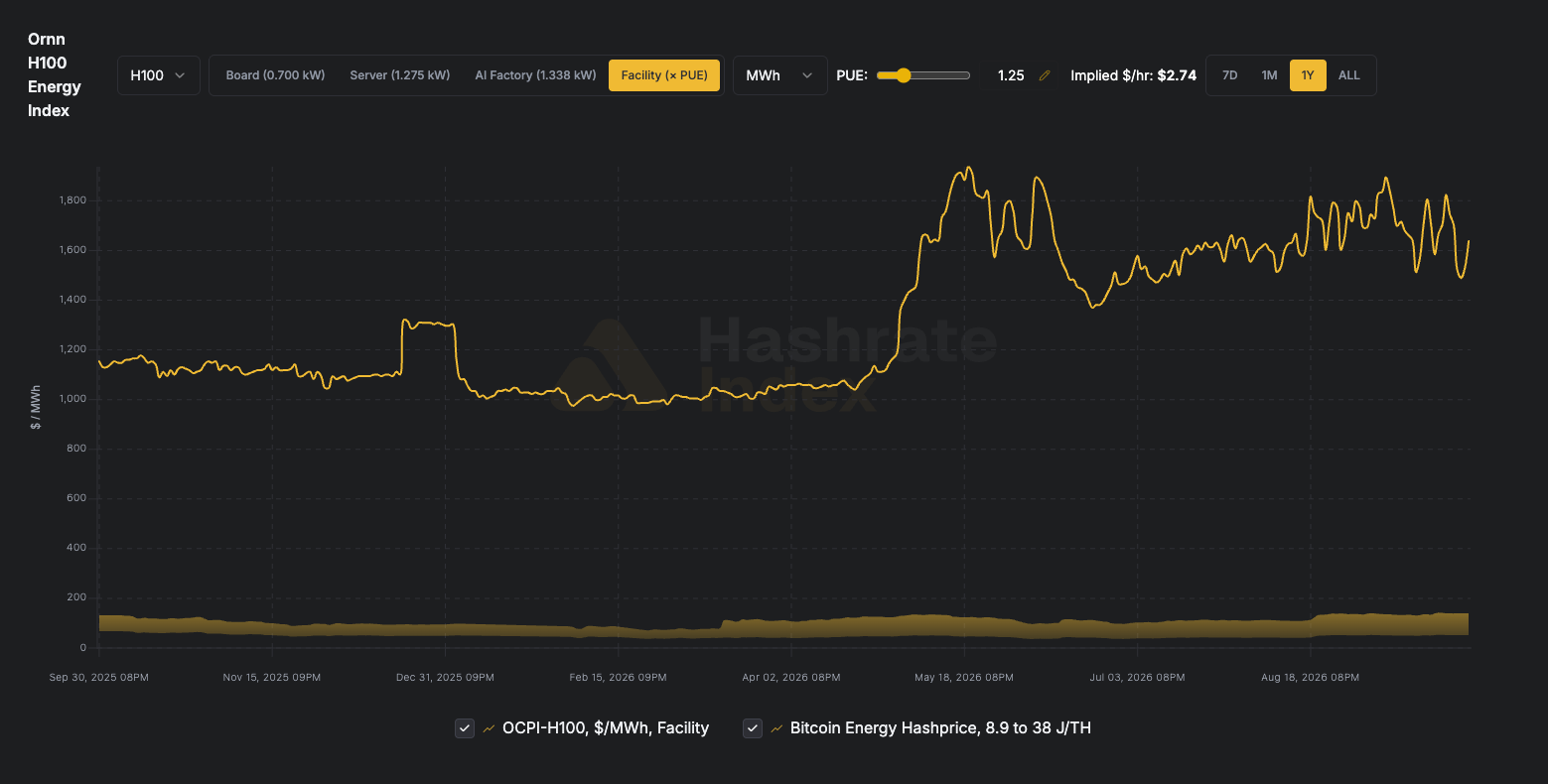
While a flat headline figure suggests a period of relative calm, a closer look at the Q4 2026 Global Hashrate Heatmap update reveals an unusually active quarter beneath the surface. Marginal mining operations continue to relocate around the globe as major developed markets shed compute power, alternative frontiers experience explosive growth, and established regions grapple with environmental constraints and the looming economic magnet of artificial intelligence infrastructure.
The United States shed another 10 EH/s over the course of the quarter, while Russia managed to add 8 EH/s. At the same time, Ethiopia saw its network share sharply contract, losing roughly a third of its compute power due to severe hydroelectric shortages, while Pakistan more than tripled its capacity. Although the global map is no longer shrinking at the rapid pace seen earlier in the year, the redistribution of Bitcoin’s underlying compute capacity continues unabated.
From Falling to Flat
The third quarter’s network hashrate reading of roughly 941 EH/s via the 30-day simple moving average marks the first time in 2026 that the metric has not experienced a quarter-over-quarter decline.
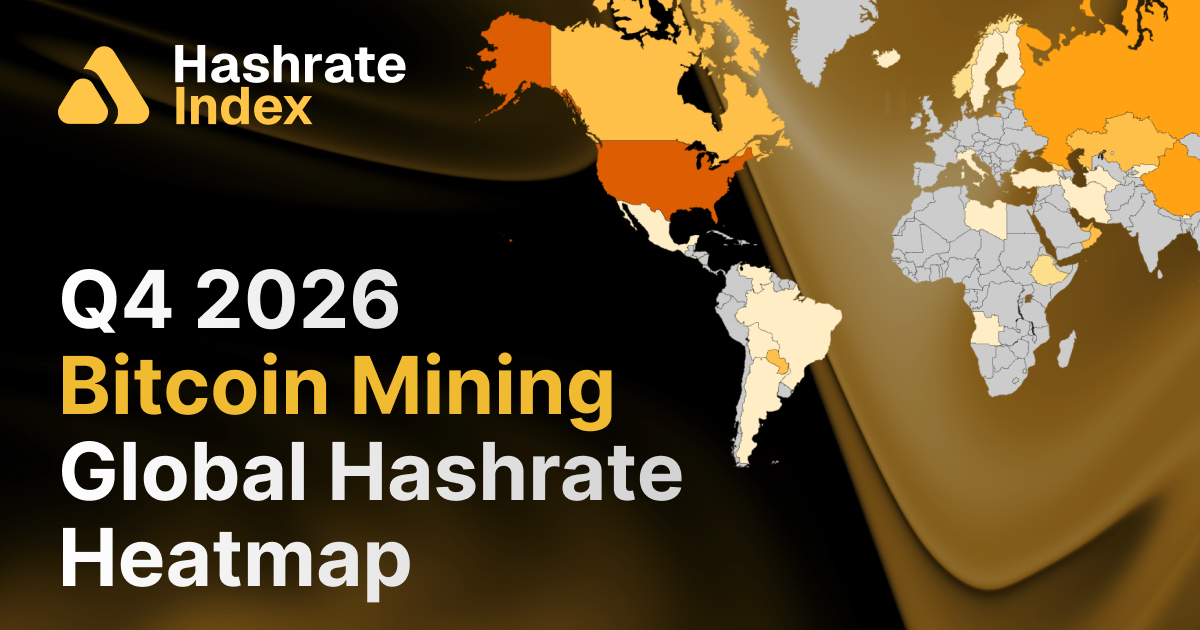
However, industry analysts note that a flat hashrate is not synonymous with a full market recovery. The network remains roughly 8.7 percent smaller than it was at this same point in the previous year, when it stood at approximately 1,031 EH/s in Q4 2025, and sits roughly 15 percent below its all-time peak recorded in November 2025.
What has fundamentally shifted is the rate of the industry-wide bleed. Marginal mining machines that were economically forced to switch off under prevailing hashprice conditions have largely been powered down, while network difficulty has adjusted downward sufficiently to keep surviving operators above water.
Even so, significant geographical shifts occurred over the quarter, with five different countries recording moves of more than 4 EH/s in either direction. This pure redistribution underscores how fluid Bitcoin’s global footprint remains.
Shifting Country-Level Concentration
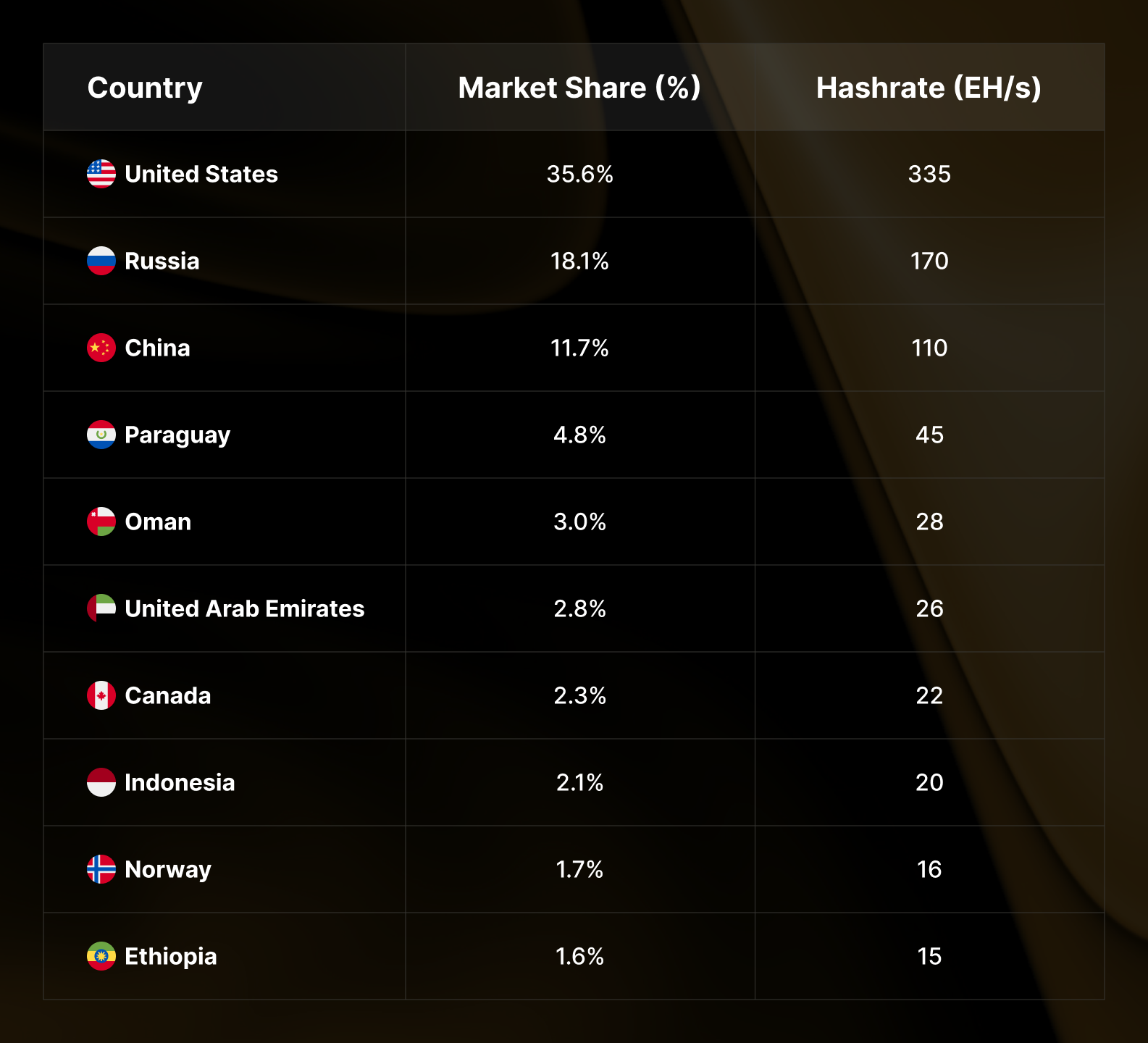
Bitcoin mining continues to exhibit a high degree of geographical concentration, with the top three countries commanding roughly two-thirds of the global hashrate. However, that concentration is slowly diluting. Top-three concentration slipped slightly from 66.2 percent to 65.4 percent during the quarter, marking the second consecutive decline as the United States sheds market share faster than primary competitors like Russia can absorb it.
The broader top-ten leaderboard saw considerable movement beneath the surface. While the composition of the top ten remained identical to the previous quarter, five distinct ranks changed hands. Oman successfully surpassed the United Arab Emirates to claim the fifth position globally. Indonesia climbed from ninth to eighth place following a genuine 3 EH/s capacity gain, while Ethiopia tumbled from eighth down to tenth place. Meanwhile, Kazakhstan held steady at the eleventh spot with approximately 15 EH/s for the second consecutive quarter, placing it in a virtual dead heat with Ethiopia for the final top-ten slot heading into the new year.
The Divergence Between Developed Cores and Frontier Markets
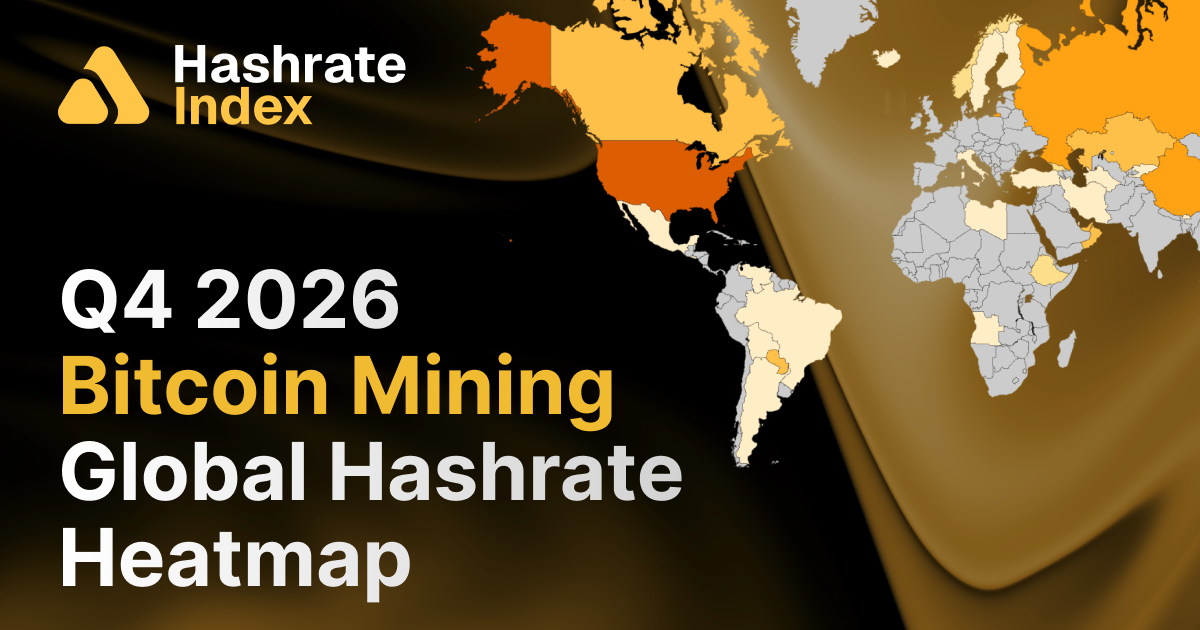
A comparative analysis of the quarter splits the global map cleanly between a shrinking developed core and a rapidly expanding frontier.
The decline in established markets is driven by several distinct factors, chief among them the ongoing commercial pivot toward artificial intelligence and high-performance computing (AI/HPC). Developed jurisdictions like the United States, Canada, and the United Arab Emirates are not losing hashrate because power has suddenly become unaffordable. Rather, local energy supplies are finding far more lucrative applications in AI compute. While traditional Bitcoin mining yields a range of $50 to $150 per megawatt-hour, AI workloads routinely generate anywhere from $1,500 to $3,500 per megawatt-hour.
This economic reality creates a permanent structural shift. A marginal mining machine that goes offline due to a temporary dip in hashprice can easily be switched back on if market conditions improve. However, electrical capacity that is locked into multi-year commercial contracts with AI tenants is permanently lost to the Bitcoin network, regardless of future price rallies or difficulty adjustments.
Beyond AI migration, other regions saw compute reductions driven by regulatory pressures—such as those seen in Kazakhstan, China, and Iran—or macroeconomic instability, as observed in Argentina.
Ethiopia’s Hydroelectric Shortfall
The most dramatic reversal of the quarter belonged to Ethiopia, which fell from a hashrate of roughly 23 EH/s down to 15 EH/s. This staggering 35 percent quarterly decline dropped the African nation from eighth to tenth place globally, wiping out nearly all the gains it had accumulated since mid-2025. Measured from its peak of 27.5 EH/s in the first quarter of 2026, the country’s mining market has contracted by 45 percent in just three quarters.
The contraction was not driven by regulatory crackdowns or a pivot to AI, but rather by severe environmental and infrastructure constraints. In mid-September, Ethiopian Electric Power enacted sweeping supply curtailments, slashing electricity deliveries to Bitcoin miners to roughly 23 percent of their contracted volumes—a reduction of approximately 75 percent. The emergency measures were triggered after El Niño-driven dry weather conditions caused reservoir inflows to drop by roughly 20 percent.
Because Ethiopia’s mining sector is overwhelmingly reliant on state-supplied hydropower from major installations like the Grand Ethiopian Renaissance Dam, the network proved acutely vulnerable to hydrological shocks. Unless seasonal water inflows recover, further restrictions and potential cuts to regional electricity exports remain possible.
The Frontier Reaccelerates
While established markets contracted, frontier jurisdictions stepped up to absorb displaced compute capacity. Pakistan and Venezuela combined to add roughly 9.5 EH/s over the quarter, nearly neutralizing the absolute decline recorded in the United States.
Pakistan experienced a dramatic acceleration, surging from approximately 2.5 EH/s to 8 EH/s. This represents a significant structural step change that places the country level with Bhutan and ahead of Finland and Malaysia.
Meanwhile, Venezuela crossed into double digits with approximately 10 EH/s, representing a 122 percent year-over-year increase. This growth occurred despite a blanket state prohibition on commercial cryptocurrency mining that has remained in enforcement since mid-2024. Geolocated network traffic and regional reporting indicate that the surviving activity is operating primarily through informal or semi-legitimate channels rather than state-sponsored programs. Iran also registered a modest uptick, moving from 2 EH/s to 3 EH/s despite lingering geopolitical tensions.
Regional Dynamics and Future Outlook
Regionally, North America remains the dominant hub despite ongoing contractions. The United States continues to lead the global market with a 35.6 percent share, though its national hashrate slipped to approximately 335 EH/s, representing a 14 percent year-over-year decline from its Q1 peak of 400 EH/s. Canada continued its steady slide down to 22 EH/s, marking the sharpest annual decline among developed economies.
In Europe and Central Asia, Russia emerged as the quarter’s largest absolute gainer, adding 8 EH/s to reach 170 EH/s and capturing an 18.1 percent global market share. Kazakhstan successfully stabilized its output at 15 EH/s, while Norway and Georgia held steady at 16 EH/s and 11 EH/s, respectively.
Across the Asia-Pacific region, China’s hashrate continued its multi-quarter bleed, easing down to 110 EH/s. Southeast Asian jurisdictions continued to absorb regional diversification, with Indonesia holding strong at 20 EH/s, Malaysia rising to 7 EH/s, and Laos expanding to 9 EH/s.
In the Middle East, Oman added 2 EH/s to reach 28 EH/s, successfully overtaking the UAE, which slid to 26 EH/s amid domestic energy reprioritization. Latin America saw Paraguay maintain its position as a regional anchor with 45 EH/s backed by Itaipú hydropower, alongside notable growth in Bolivia and Venezuela.
As the global mining industry navigates the closing quarters of 2026, the underlying narrative remains one of geographic decentralization and economic competition for power resources. With traditional power hubs increasingly turning toward high-yield artificial intelligence infrastructure, miners continue to seek out stranded, low-cost energy across emerging frontier markets, ensuring the global distribution of Bitcoin’s compute power remains in a state of constant evolution.
 Cryptocurrency Mining
 Cryptocurrency Mining
 Cryptocurrency Mining