Energy has become the ultimate common denominator in the modern technology landscape, creating a high-stakes arena where three entirely distinct classes of hardware compete directly for the same power infrastructure. As industrial facilities increasingly weigh the economic returns of various computational workloads, a recent market analysis from Hashrate Index highlights a striking reality: while artificial intelligence accelerators command the highest revenue per unit of energy when fully utilized, specialized cryptocurrency mining application-specific integrated circuits (ASICs) offer a radically different value proposition rooted in capital efficiency and rapid payback periods.
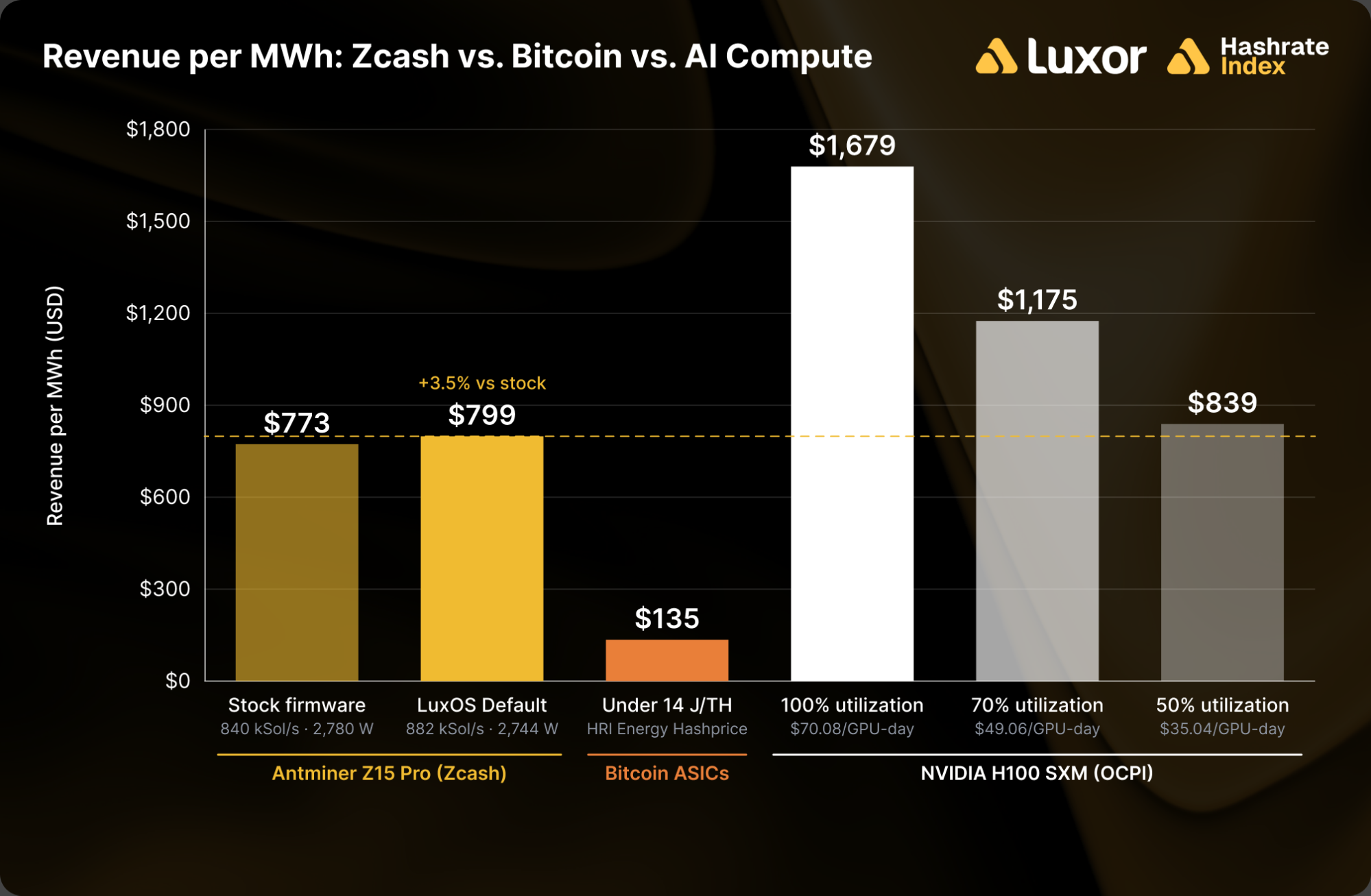
Priced against a baseline electricity cost of $0.08 per kilowatt-hour, the economic tension between these machines is shaped heavily by how much revenue they can extract from a single megawatt-hour of power. Under market conditions observed in mid-October 2026—with Zcash trading around $1,185 and network hashrate sitting at 27.8 gigasol per second—an Antminer Z15 Pro mining Zcash generates approximately $770 of revenue per megawatt-hour. By comparison, top-tier Bitcoin ASICs pull in roughly $135 under current energy hashprice regimes. Meanwhile, a rented NVIDIA H100 graphics processing unit pulls ahead on pure energy efficiency, yielding about $1,680 per megawatt-hour when continuously utilized and calculated against facility-level power consumption.
Three Machines, One Megawatt
Because energy is the single input shared by all three computational paradigms, revenue per megawatt-hour serves as the cleanest initial metric for comparison. Looking closely at Zcash mining operations, the network distributes a fixed reward of 1,440 ZEC daily to miners. A stock Antminer Z15 Pro grosses roughly $51.54 per day under these conditions, incurring about $5.34 in power costs and retaining $46.20 in gross profit. This translates to an impressive 90 percent margin and a power break-even threshold of $0.77 per kilowatt-hour—nearly ten times the electricity rates paid by most industrial-scale mining operations.
Bitcoin hardware, by contrast, lags significantly behind these figures. With hashprice hovering around $39.71 per petahash per day, energy hashprice metrics place fleets operating under 14 joules per terahash at approximately $135 per megawatt-hour, while Antminer S21-class hardware sits near $98 per megawatt-hour. Earlier projections suggesting that privacy coin mining could vastly outperform traditional sectors have proven resilient as market valuations for ZEC maintained upward momentum over extended periods.
The true wild card in this equation remains the NVIDIA H100. Based on recent cluster settlements of $2.92 per GPU-hour, a single unit generates $70.08 daily. When factoring in facility-level power draws of 1.74 kilowatts per GPU, this output scales to approximately $1,679 per megawatt-hour—more than double the revenue generation of a stock Z15 Pro. While isolating the board-level power draw alone inflates the figure past $4,170 per megawatt-hour, analysts emphasize that facility-level calculations provide the only fair comparison, as they account for the holistic infrastructure overhead that ASIC wall-draw measurements already incorporate.
Despite this revenue lead, the H100’s dominance is strictly conditional on high utilization rates. If rental demand dips and utilization falls to 50 percent, the GPU’s revenue generation drops to roughly $839 per megawatt-hour, bringing it nearly level with the Z15 Pro. Market models indicate that the crossover point between the two technologies sits between 46 and 48 percent utilization.
Where the ASIC Wins: Capital, Not Energy
When evaluated per dollar of capital expenditure, the operational hierarchy completely reverses. Deploying a megawatt of Z15 Pro miners requires approximately 360 machines, costing between $8,800 and $16,000 per unit in the secondary and retail markets, housed inside standard physical infrastructure that costs a fraction of a million dollars per megawatt. Conversely, a megawatt of H100 hardware equates to roughly 575 advanced GPUs. With new eight-GPU nodes commanding between $31,000 and $40,500 per processor since their commercial launch, the raw hardware investment alone scales between $18 million and $23 million—or roughly $13 million for refurbished alternatives—housed inside Tier-3 data center facilities that often cost more than the computational chips themselves.
Consequently, the Z15 Pro achieves complete capital recovery in roughly six to eleven months on its daily gross profit of $46. This dynamic underpins the broader industry observation that privacy coin mining can outpace artificial intelligence infrastructure on build speed and capital intensity, even if it cannot match the raw revenue generated per unit of electrical energy at index rental rates.
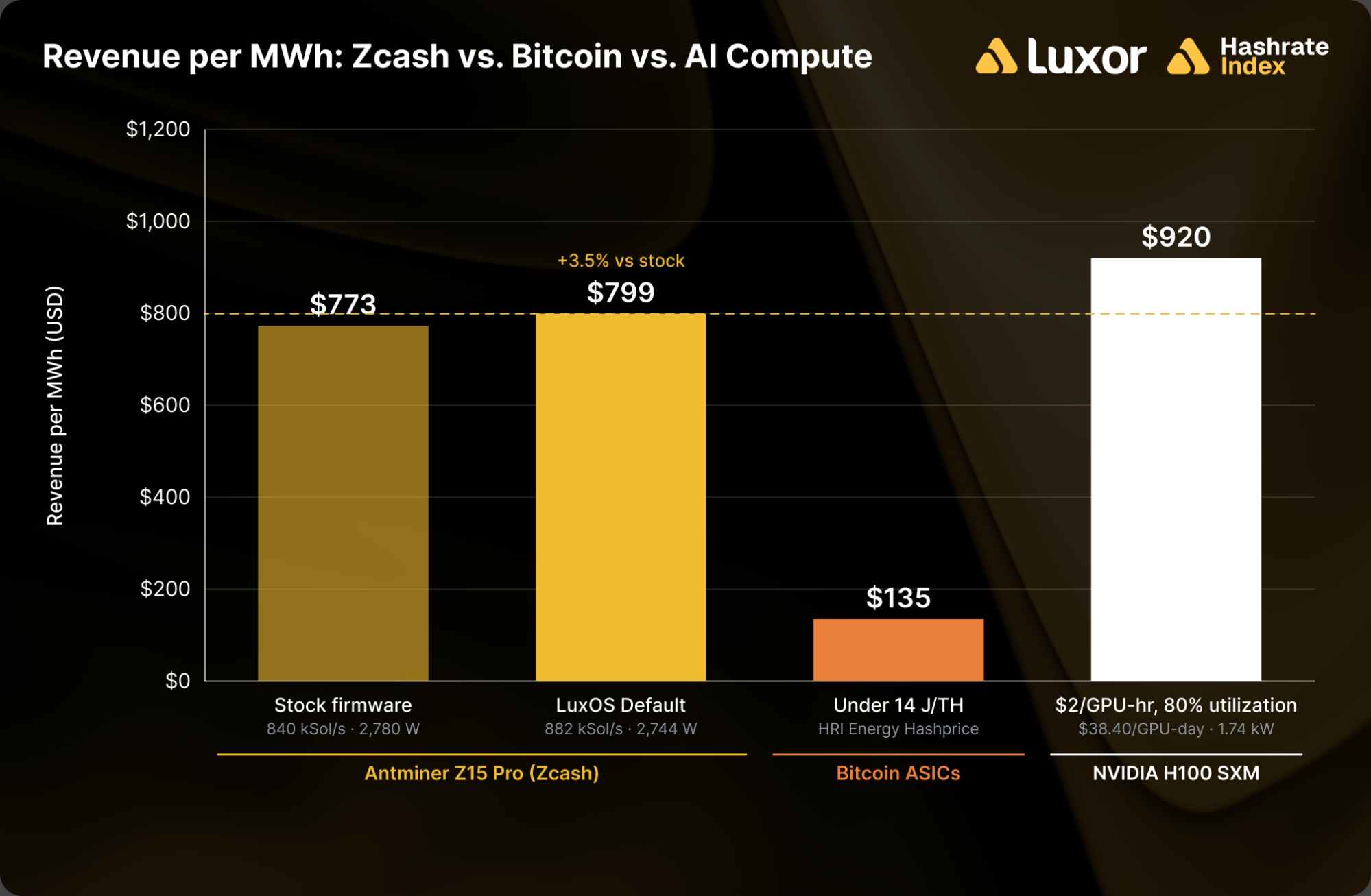
As neocloud assumptions shift, lower rental pricing quickly closes the performance gap. If H100 rental rates drop to $2.00 per GPU-hour at 80 percent utilization, the hardware earns roughly $920 per megawatt-hour—only a modest premium over a Z15 Pro running optimized firmware. Should rental rates or operational utilization slip further, the ASIC captures superior revenue per megawatt-hour before even factoring in its substantial upfront capital advantage. Transitioning facility infrastructure from traditional mining rigs to artificial intelligence accelerators ultimately represents a calculated bet on maintaining consistently high rental rates and uptime.
Price Outran Hashrate
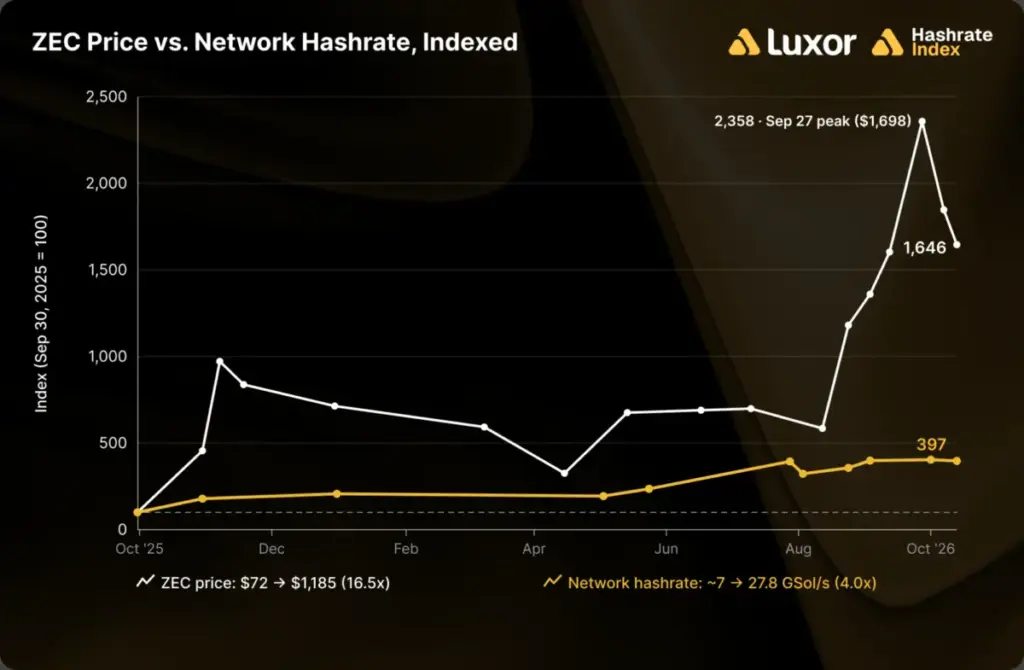
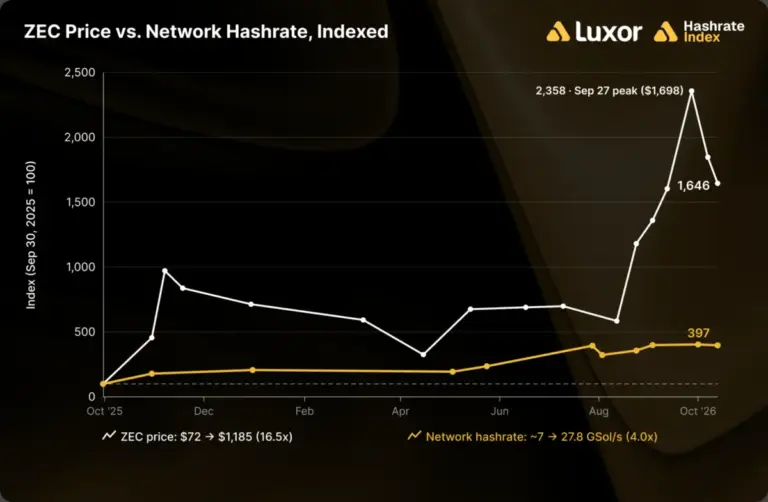
The economics of Zcash mining over the preceding year have been defined by a profound imbalance between token valuation and network hashrate growth. Zcash network hashrate expanded roughly fourfold over a twelve-month period, climbing from approximately seven gigasols per second prior to a major late-summer market rally to 27.8 gigasols per second. Concurrently, the price of ZEC experienced explosive volatility, surging from $72 to a peak of nearly $1,698 before correcting downward by roughly 30 percent.
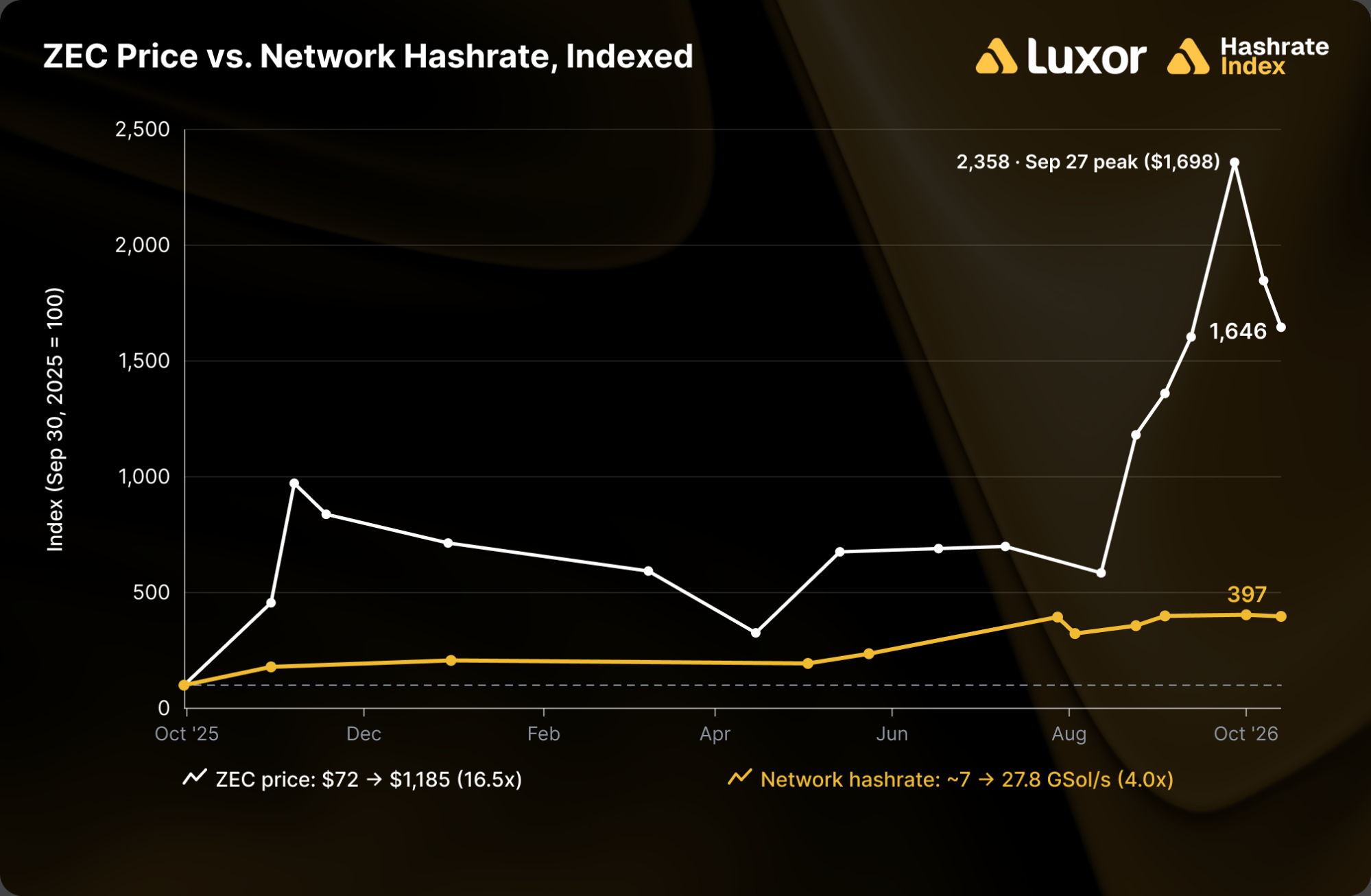
Throughout this hyper-volatile cycle, network hashrate consistently lagged behind spot price movements, remaining relatively flat even during subsequent market pullbacks. Per-machine revenue remained stable near $0.06 per kilosol per day because market valuations outpaced the influx of new hardware entering the network.
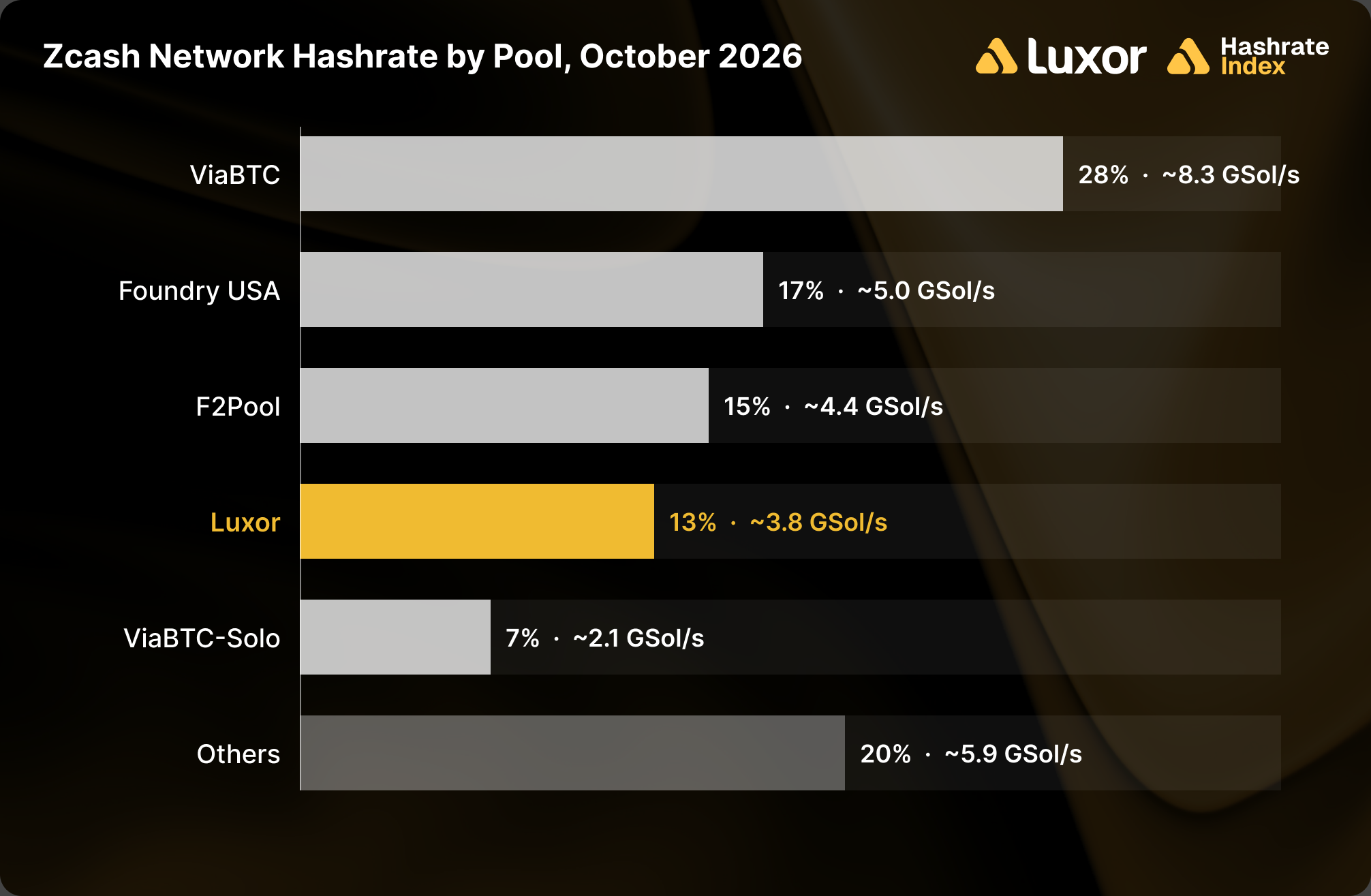
Because the daily miner reward remains capped at approximately 1,440 ZEC, every newly deployed machine dilutes the earnings of existing operators. The active network now represents the computational equivalent of roughly 33,000 Z15 Pro units drawing 90 megawatts of power. At prevailing price levels, however, the hardware remains comfortably cash-positive, requiring a tenfold increase in network hashrate to threaten basic operating margins. The primary constraint for operators remains hardware availability rather than power access, as retail inventories of the Z15 Pro have tightened significantly, pushing secondary market prices higher while next-generation Equihash silicon from manufacturers like Bitmain remains months away from broad commercial delivery.
Firmware Is the Only New Hashrate Until Next Year
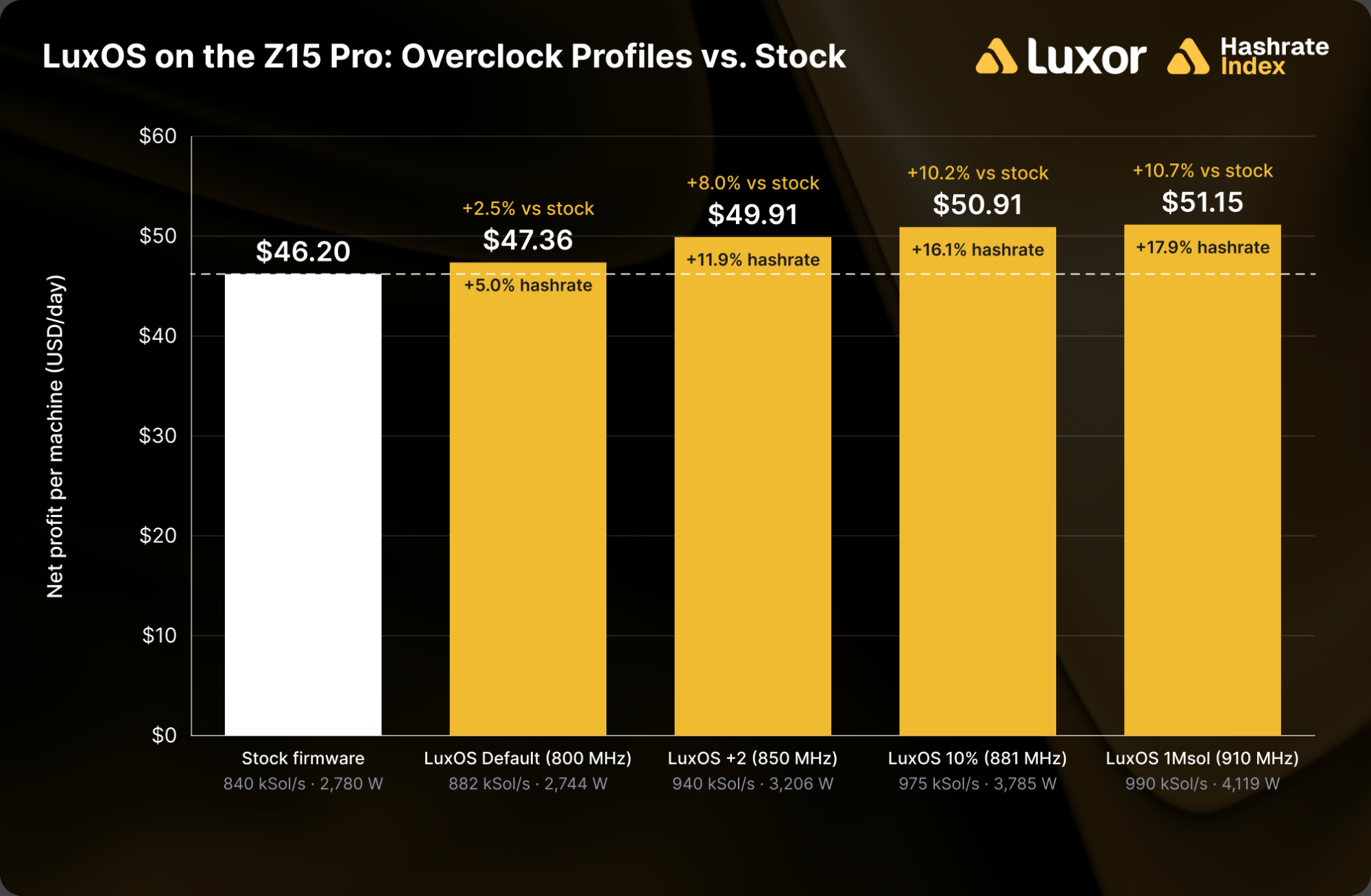
With major deliveries of new Equihash ASIC silicon largely delayed, operators seeking to expand hashrate from existing deployments must rely entirely on firmware optimization. Third-party developers have introduced specialized firmware support for the Z15 Pro, bringing advanced overclocking and underclocking profiles traditionally utilized in Bitcoin mining fleets to the privacy coin sector.
Benchmarking data from specialized testing facilities demonstrates that conservative tuning profiles can improve operational metrics over stock factory settings, delivering marginal increases in hashrate while slightly reducing power consumption. Aggressive overclocking profiles push processing capacity higher, trading energy efficiency for absolute daily dollar returns. While such profiles are highly profitable under low electricity cost regimes and wide profit margins, they remain impractical for power-constrained facilities or sites facing high utility tariffs. Because network-wide deployment of optimized firmware introduces only modest fractional increases to total hashrate, hardware scarcity continues to dictate the broader operational landscape.
Ultimately, the modern compute competition cannot be framed as a single race. When measured strictly by megawatt-hour, a continuously utilized artificial intelligence accelerator outperforms a Zcash ASIC, which in turn surpasses traditional Bitcoin hardware by a wide margin. When evaluated against capital expenditure, however, the ASIC secures a decisive victory through rapid payback periods. As operators navigate this evolving ecosystem, the overarching mandate remains operational uptime, cementing the viability of hybrid facilities capable of housing multiple forms of computational workloads under a single roof.
 Cryptocurrency Mining
 Cryptocurrency Mining
 Cryptocurrency Mining