Energy has become the ultimate denominator in the modern digital infrastructure landscape. Across data centers worldwide, three distinct types of compute—Zcash application-specific integrated circuits (ASICs), Bitcoin miners, and artificial intelligence graphics processing units (GPUs)—are increasingly competing for the exact same megawatts of electrical power. Determining which hardware emerges victorious in this high-stakes race depends entirely on how the economics are measured, balancing the delicate trade-offs between energy efficiency, capital intensity, and utilization rates.
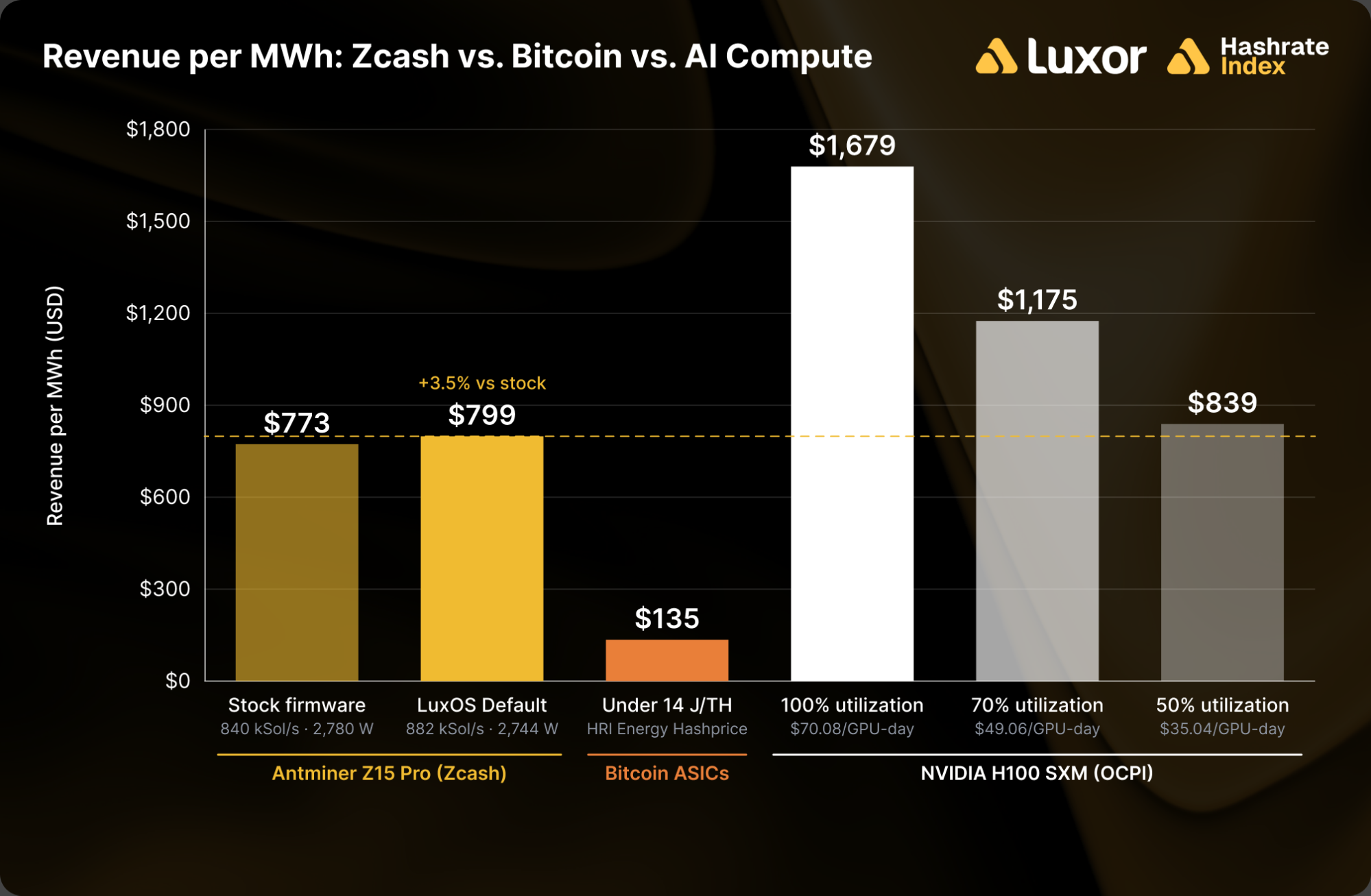
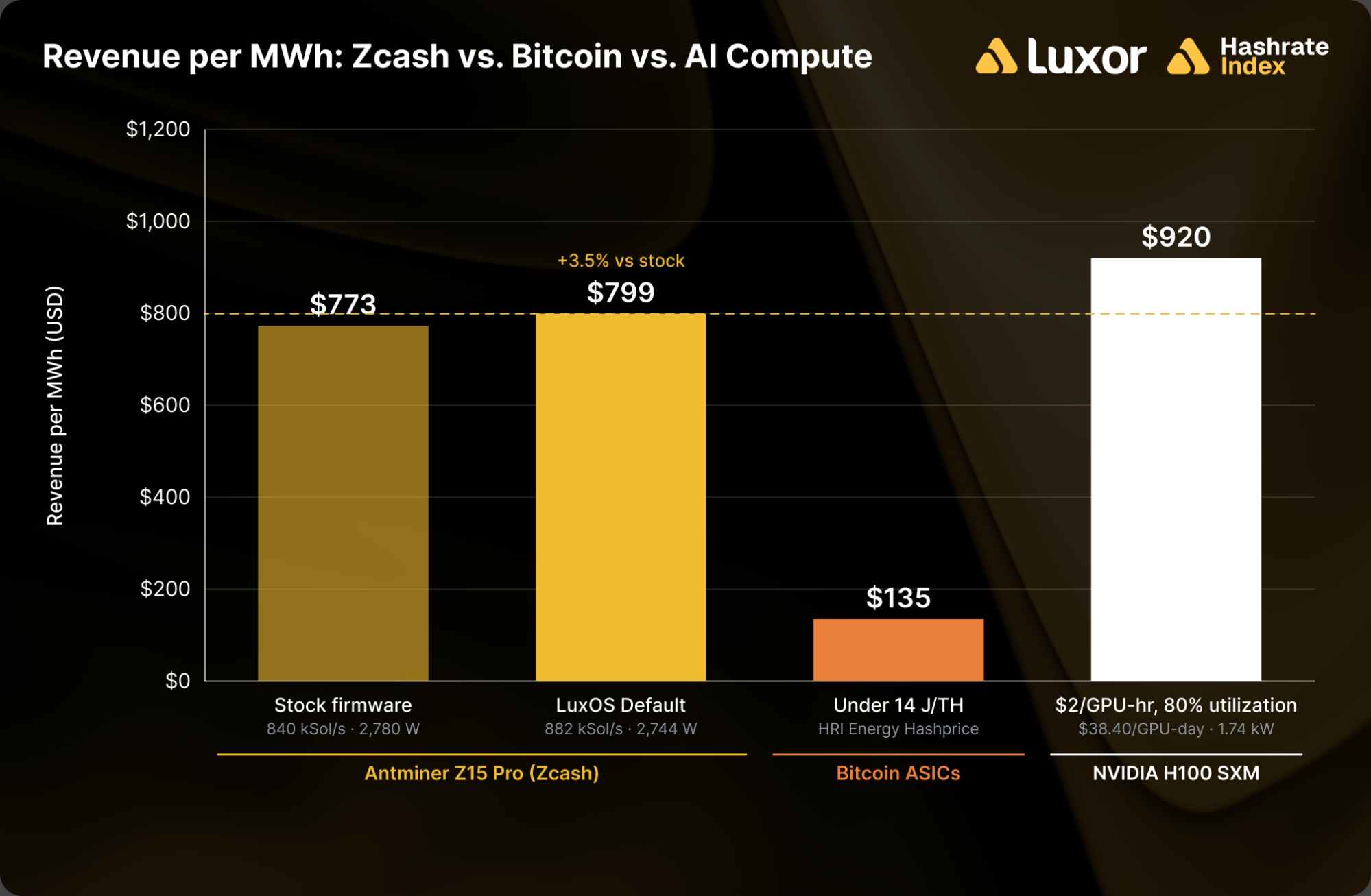
At a standard commercial and industrial power cost of $0.08 per kilowatt-hour, an Antminer Z15 Pro mining Zcash yields approximately $770 of revenue for every megawatt-hour consumed. By comparison, the most efficient Bitcoin ASICs on the market generate roughly $135 under the same electrical input. Meanwhile, a rented NVIDIA H100 GPU pulls in about $1,680 per megawatt-hour, provided it remains actively utilized. This convergence of high-performance computing, cryptocurrency mining, and artificial intelligence infrastructure highlights a shifting paradigm where energy assets are valued strictly on their output in digital tokens or computational yield.
Three Machines, One Megawatt of Power
Because electricity is the primary shared resource for all three machine types, evaluating revenue on a per-megawatt-hour basis provides the clearest baseline for comparison. Market metrics recorded in mid-October 2026 paint a vivid picture of this competition, calculated at a power rate of $0.08 per kWh, with Zcash (ZEC) trading at $1,185 and the broader Zcash network operating at a hash rate of 27.8 GSol/s.
With the Zcash network issuing 1,440 ZEC daily to miners, a stock Antminer Z15 Pro grosses around $51.54 per day. After deducting $5.34 for electricity, the machine retains a net daily profit of $46.20. This translates to an impressive 90% operating margin and an electricity break-even ceiling of $0.77 per kWh—nearly ten times higher than the power rates paid by most industrial-scale cryptocurrency miners.
In contrast, leading Bitcoin mining hardware struggles to compete on a pure energy revenue basis. With hashprice hovering around $39.71 per petahash per day, fleets equipped with hardware under 14 joules per terahash generate roughly $135 per megawatt-hour, while newer Antminer S21-class hardware brings in about $98. Early market predictions suggesting Zcash mining could outpace AI infrastructure returns have proven increasingly accurate as ZEC prices sustained their upward momentum.
The true wildcard in this equation is the NVIDIA H100. Based on standard cloud settlement pricing of $2.92 per GPU-hour, a single H100 generates $70.08 daily. When factoring in a facility power draw of 1.74 kW per GPU—accounting for cooling and power usage effectiveness (PUE) overhead—the revenue reaches approximately $1,679 per megawatt-hour. This is more than double the output of a stock Z15 Pro. If analysts look solely at the GPU board’s direct power draw, the figure climbs past $4,100 per megawatt-hour, reinforcing the critical importance of using consistent denominators when comparing GPUs against ASICs. Utilizing facility-wide power metrics provides an equitable comparison, as it mirrors the total wall-draw measurements already standard for ASIC deployments.
However, the H100’s commanding lead is strictly conditional upon high rental utilization rates. If utilization drops to 50%, revenue declines to approximately $839 per megawatt-hour, bringing the AI hardware nearly level with the Z15 Pro. Market analysis indicates the crossover point where ASICs match GPU revenue efficiency sits between 46% and 48% utilization.
Where the ASIC Wins: Capital Intensity Over Energy
When the perspective shifts from energy efficiency to capital expenditure, the financial hierarchy completely flips. Deploying one megawatt of capacity using Antminer Z15 Pros requires approximately 360 machines. Given prevailing market listings, this hardware investment totals between $3.2 million and $5.8 million, housed within a basic physical shell costing a few hundred thousand dollars per megawatt.
Conversely, outfitting a megawatt with NVIDIA H100s requires roughly 575 GPUs. Industry hardware indices tracking new eight-GPU H100 nodes price them between $31,000 and $40,500 per unit, driving the raw hardware expenditure alone to between $18 million and $23 million for new units, or roughly $13 million for refurbished models. Furthermore, these GPUs must reside within a sophisticated Tier-3 data center facility, where the infrastructure build-out can easily cost more than the computing hardware itself. Consequently, the Z15 Pro achieves a full capital payback within a remarkably short window of 6 to 11 months on its robust daily gross profits.
This dynamic underpins the argument that cryptocurrency mining can occasionally outmaneuver traditional AI cloud deployments. While AI infrastructure wins decisively on raw revenue per unit of energy at index rental rates, ASICs maintain an insurmountable advantage in capital intensity, deployment speed, and payback velocity.
Lower cloud rental rates narrow this gap rapidly. If H100 rental rates drop to $2.00 per GPU-hour at an 80% utilization rate, the hardware earns roughly $920 per megawatt-hour—only a modest margin above a Z15 Pro running optimized firmware. Should utilization slip below 70% at that rental rate, the Equihash ASIC outperforms the AI hardware on a per-megawatt-hour basis before even accounting for its massive capital expenditure advantage. Transitioning facilities from ASICs to GPUs is, at its core, a high-stakes bet on maintaining consistently elevated rental prices and steady utilization rates.
Price Outpaces Hash Rate Growth
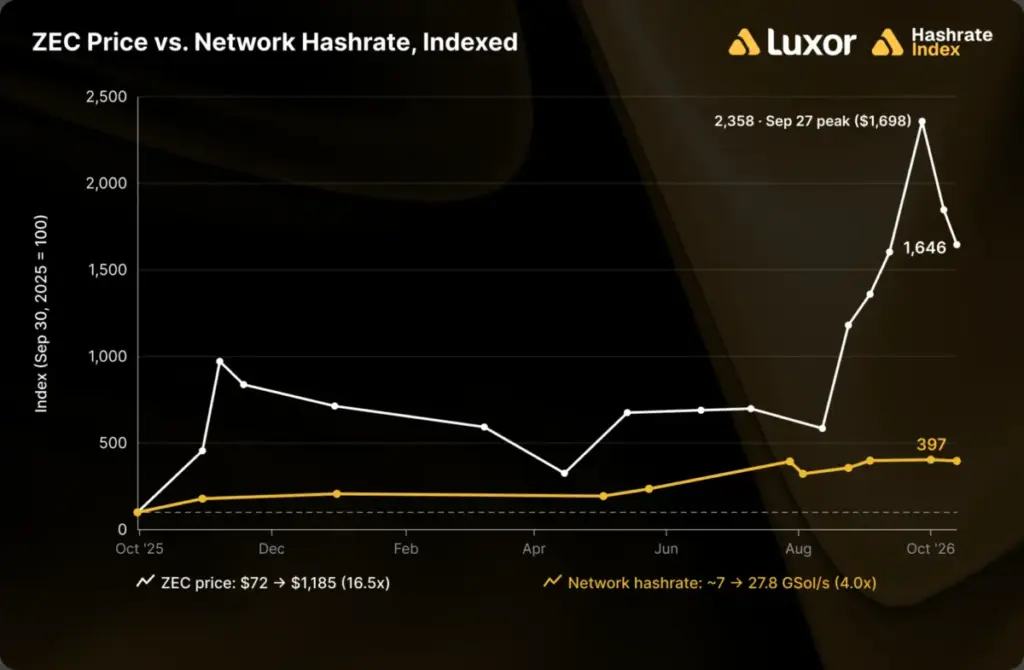
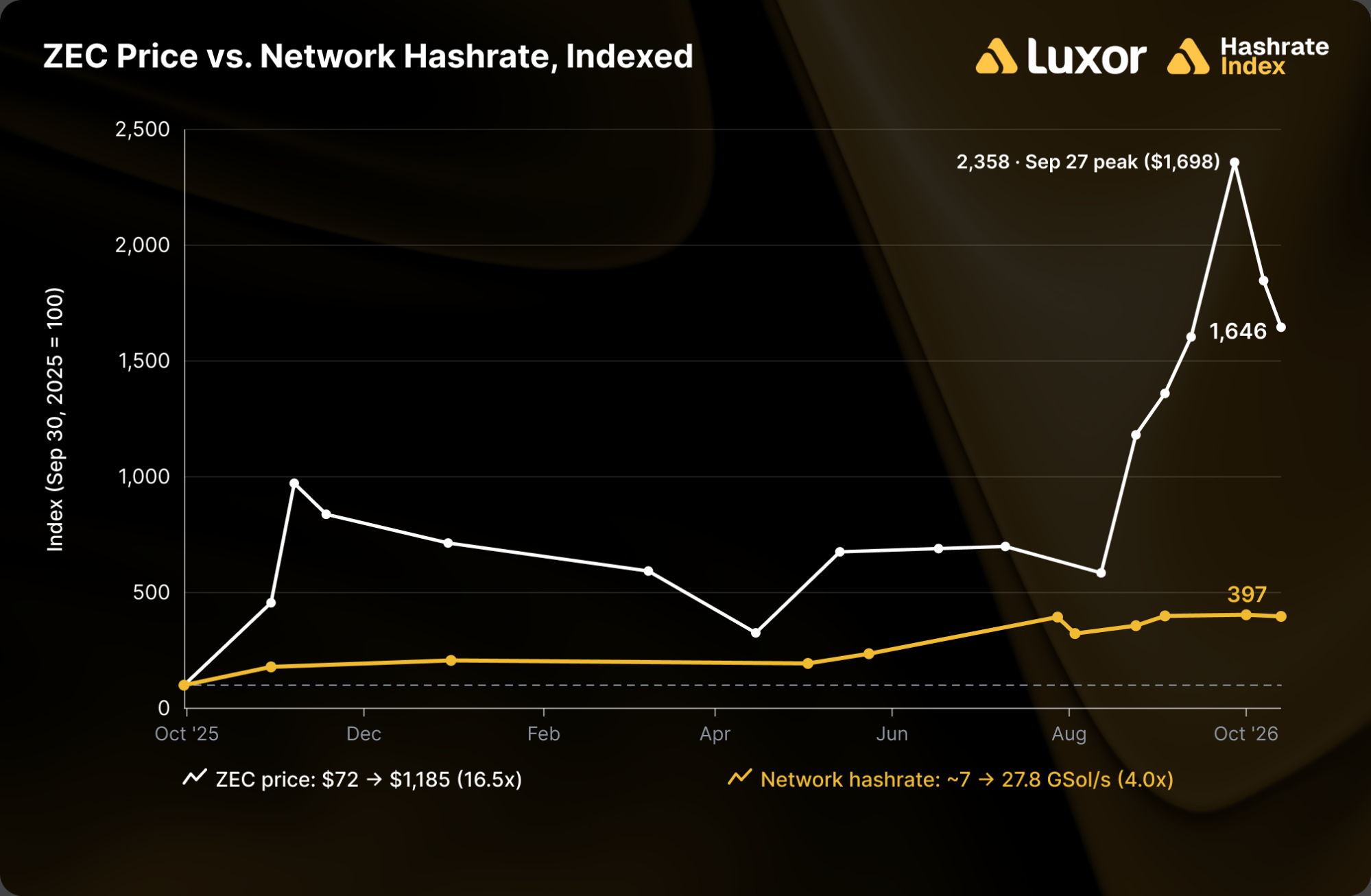
Over a twelve-month observation window, the Zcash network experienced a dramatic fourfold increase in hash rate, scaling from roughly 7 GSol/s prior to a major market rally to 27.8 GSol/s. Concurrently, the price of ZEC surged from $72 to a peak of nearly $1,698 before experiencing a subsequent market correction. Throughout this extreme volatility, network hash rate consistently lagged behind price movements, allowing per-machine mining revenues to remain remarkably resilient because asset prices outpaced the deployment of new mining hardware.
Because the daily miner reward pool remains fixed at approximately 1,440 ZEC, every newly activated machine dilutes the earnings of existing operators. The active network capacity now equates to roughly 33,000 Z15 Pros consuming about 90 megawatts of power. Yet, at prevailing asset prices, the machines remain comfortably cash-positive, remaining viable even if the total network hash rate expands tenfold.
The primary operational constraint facing Zcash miners is hardware supply rather than electrical capacity. In-stock Z15 Pros have grown increasingly scarce, with market prices climbing significantly over the prior year, while next-generation Equihash hardware from manufacturers like Bitmain remains constrained by advance enterprise allocations.
Firmware as the Primary Near-Term Lever
With major deliveries of next-generation silicon delayed, facility operators looking to expand Equihash computing capacity from existing infrastructure have turned exclusively to third-party firmware solutions. The integration of specialized mining firmware for the Z15 Pro introduced advanced overclocking and underclocking profiles comparable to those long utilized by Bitcoin mining fleets.
Performance benchmarking of these firmware profiles reveals nuanced operational choices. Default optimization profiles can deliver modest hash rate improvements while simultaneously reducing power consumption, yielding higher revenue per megawatt-hour than stock manufacturer settings. However, aggressive overclocking profiles trade electrical efficiency for absolute daily profit, boosting processing output at the expense of higher energy consumption per unit of work. For sites operating under favorable power cost structures, these aggressive profiles maximize absolute returns, whereas power-constrained facilities prioritize efficiency profiles to optimize margins.
Ultimately, the broader compute landscape is defined by distinct operational races rather than a single standardized metric. While high-utilization AI graphics processors capture superior revenue per megawatt-hour, specialized cryptocurrency ASICs secure unmatched capital efficiency and rapid payback periods. Across all digital infrastructure sectors, operational success hinges on maintaining continuous hardware uptime, validating the strategic viability of hybrid facilities designed to house multiple forms of compute beneath a single roof.
 Cryptocurrency Mining
 Cryptocurrency Mining
 Cryptocurrency Mining