The modern industrial data center is increasingly becoming a crucible where vastly different computational workloads compete for the exact same scarce resource: electrical power. When evaluated on a strict baseline of power consumption, the economic dynamics of contemporary hardware reveal a surprising hierarchy. At an energy cost of $0.08 per kilowatt-hour, an Antminer Z15 Pro mining Zcash yields approximately $770 in revenue per megawatt-hour. Meanwhile, top-tier Bitcoin ASICs lag significantly behind at roughly $135 per megawatt-hour. Yet, when a rented NVIDIA H100 stays consistently busy, it commands an impressive $1,680 per megawatt-hour.
This stark divergence highlights how three fundamentally different forms of compute are now locking horns for grid capacity. Which technology emerges victorious, however, depends entirely on the denominator used to measure their output.
Three Machines, One Megawatt
Because energy serves as the universal input shared by all three machine types, calculating revenue per megawatt-hour offers the clearest initial lens for comparison. Analyzing these figures requires standardizing market conditions; pricing metrics gathered on October 13 evaluated Zcash at $1,185 with a network hashrate resting at 27.8 gigasol/s.
Under these conditions, Zcash miners collectively receive 1,440 ZEC daily. A stock Antminer Z15 Pro grosses $51.54 per day, incurs a modest $5.34 power expense, and retains $46.20 in gross profit. This translates to a staggering 90 percent profit margin and a power break-even ceiling of $0.77 per kilowatt-hour—nearly ten times the electricity rates paid by most industrial-scale mining operators.
Traditional Bitcoin mining hardware falls well short of these figures. With the Hashrate Index’s energy hashprice sitting at $39.71 per petahash per day, energy hashprice metrics place mining fleets operating under 14 joules per terahash at approximately $135 per megawatt-hour, while S21-class hardware hovers around $98. Previous estimates suggesting Zcash mining yields roughly quadruple the returns of Bitcoin mining have proven conservative, buoyed by sustained upward momentum in Zcash valuations.
The wild card in this equation remains the NVIDIA H100. Based on the OCPI-H100 settlement rate of $2.92 per GPU-hour, a single unit generates $70.08 daily. When accounting for a facility power draw of 1.74 kilowatts per GPU, this output scales to approximately $1,679 per megawatt-hour—more than double the revenue generation of the Z15 Pro. If analysts calculate figures using only the GPU’s internal board power, the figure balloons to roughly $4,170 per megawatt-hour. This discrepancy underscores why cross-industry comparisons between GPUs and ASICs demand uniform denominators, with total facility power offering the most equitable baseline since it mirrors the wall-draw metrics already standard for ASICs.
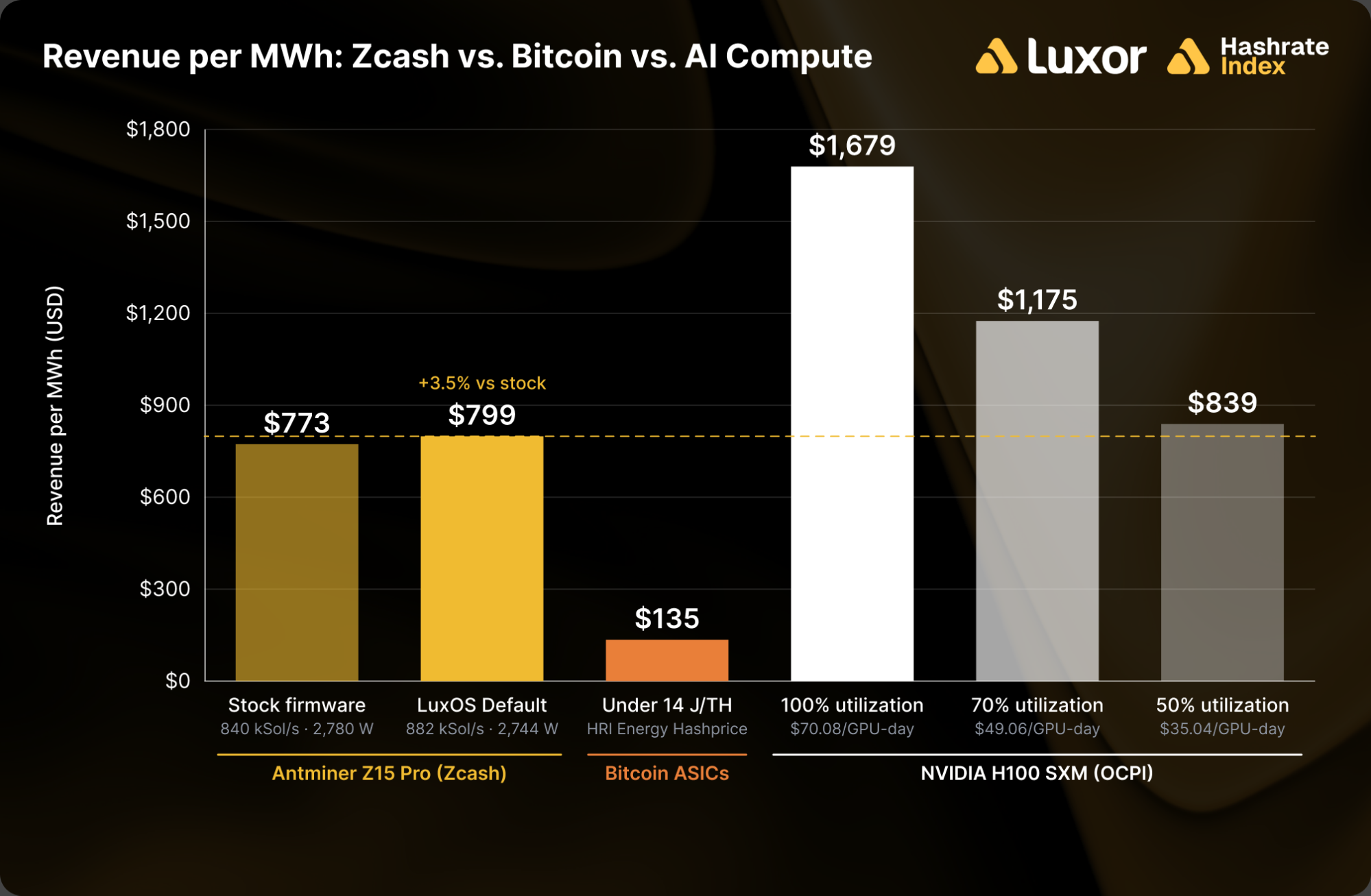
Crucially, the H100 only maintains this financial lead when fully rented. Should utilization slip to 50 percent, daily revenue drops to $839 per megawatt-hour, bringing it roughly on par with the Z15 Pro. Market analysts note that the crossover point where GPU and ASIC returns intersect sits between 46 and 48 percent utilization.
Where the ASIC Wins: Capital, Not Energy
Inverting the metric to examine returns per dollar of capital expenditure tells a distinctly different story. Deploying one megawatt of Z15 Pro hardware requires approximately 360 machines at prevailing market prices ranging between $8,800 and $16,000, housed within a basic shell infrastructure costing several hundred thousand dollars per megawatt. Conversely, a megawatt of H100 GPUs translates to roughly 575 individual processors. Tracking data for new eight-GPU H100 nodes indicates hardware costs between $31,000 and $40,500 per GPU, pushing total hardware expenditures to between $18 million and $23 million—or roughly $13 million for refurbished alternatives. Furthermore, these units require Tier-3 data center facilities that can easily exceed the cost of the computing hardware itself.
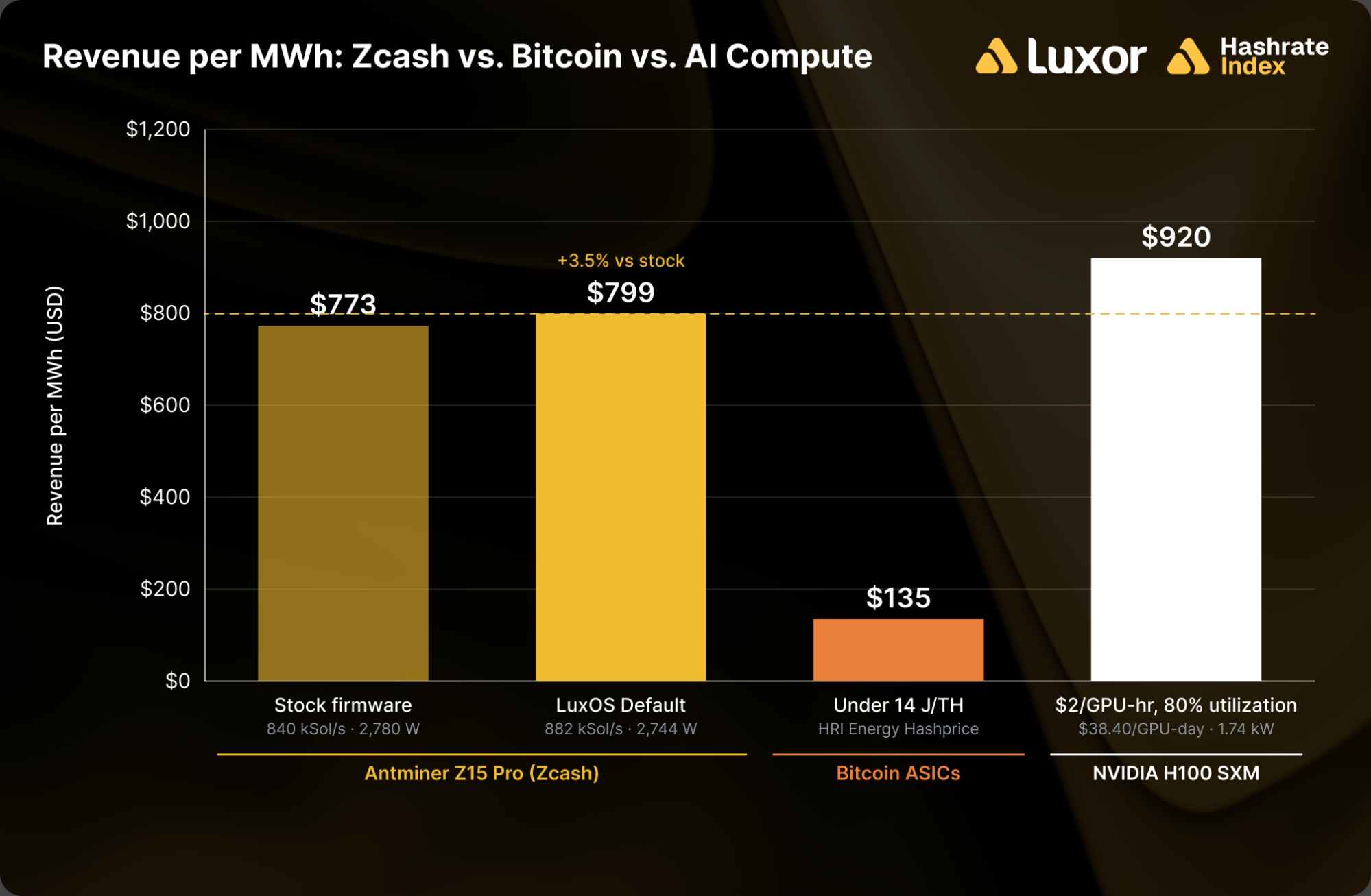
By contrast, the Z15 Pro achieves complete capital payback within six to eleven months on daily gross profits of $46. This dynamic validates the core thesis that Zcash mining outperforms artificial intelligence infrastructure in capital intensity and deployment speed. However, this advantage vanishes when evaluating revenue generated per unit of energy at index rental rates.
Lower rental rates narrow the gap rapidly. If an H100 is priced at $2.00 per GPU-hour with 80 percent utilization, it yields roughly $920 per megawatt-hour—about 15 percent higher than a Z15 Pro running on optimized LuxOS firmware. Pushing utilization below 70 percent at that rental rate, or dropping the rental rate beneath $1.70 at that utilization level, allows the ASIC to generate superior revenue per megawatt-hour before factoring in its massive capital expenditure advantage. Consequently, transitioning operations from ASICs to artificial intelligence GPUs represents a high-stakes bet on maintaining consistently elevated rental rates and utilization metrics.
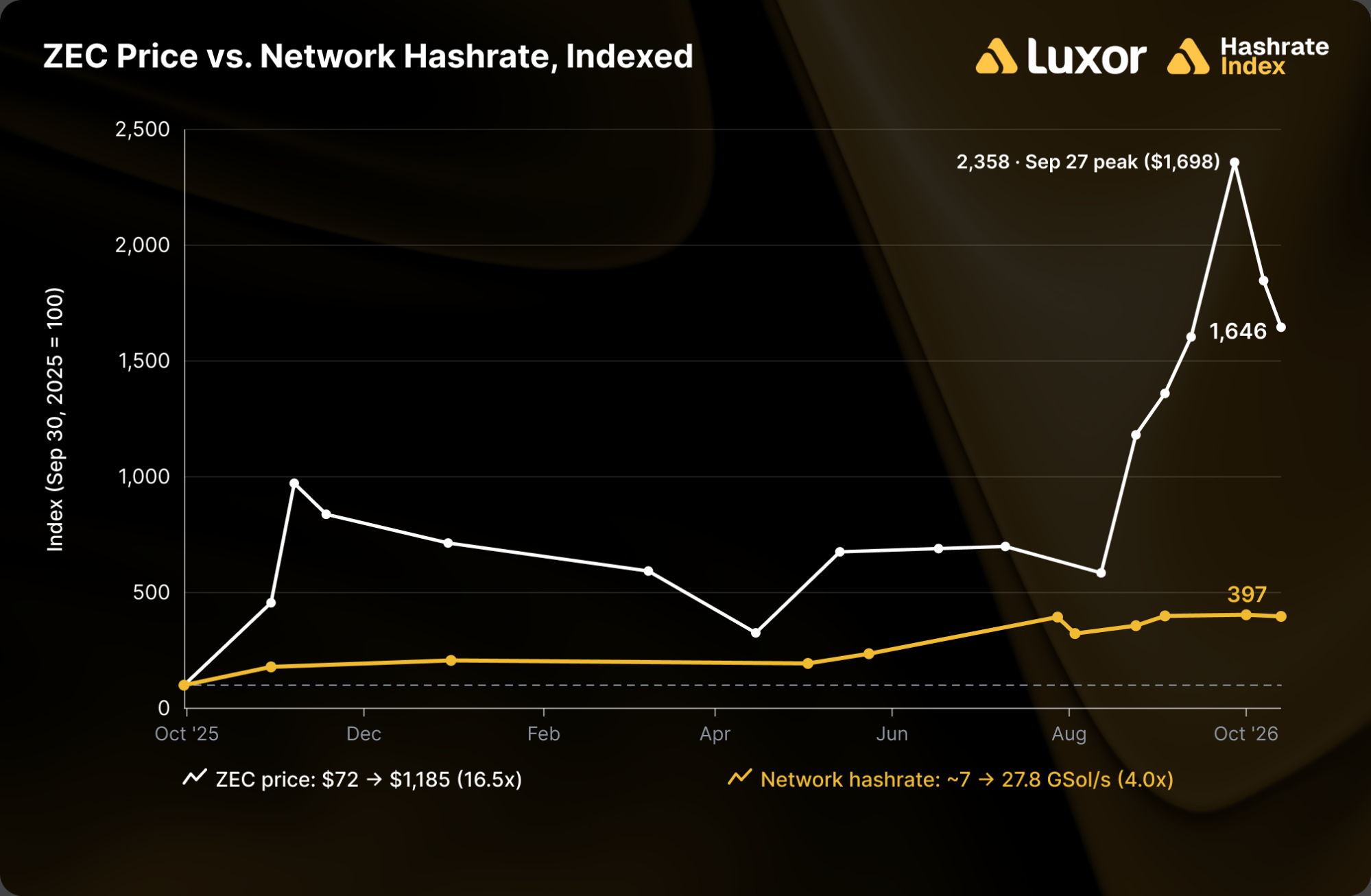
Price Outran Hashrate
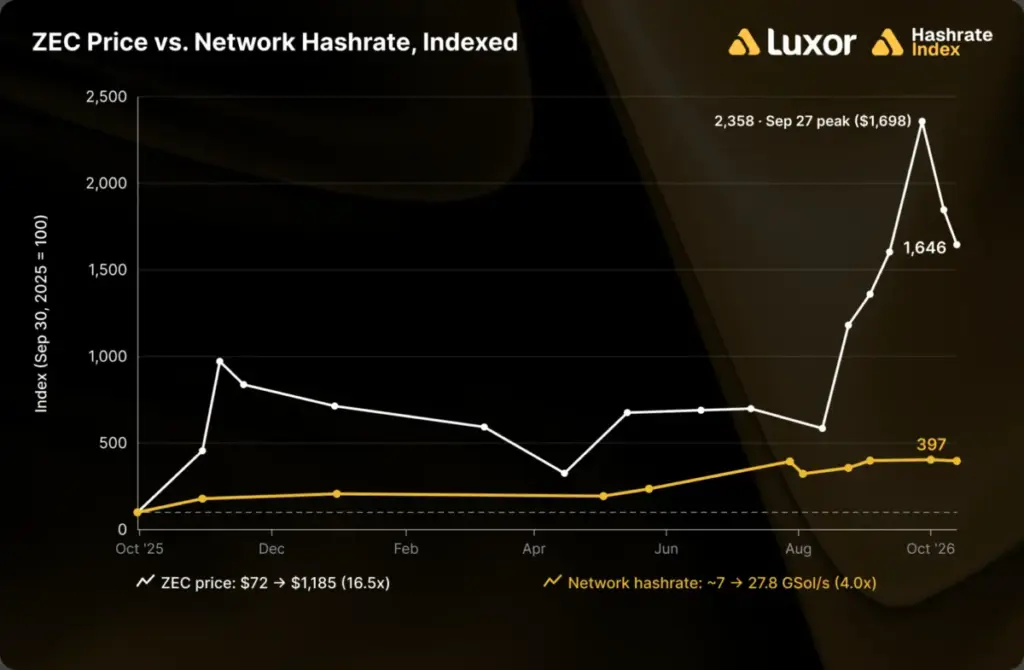
Over the twelve months leading into October 2026, Zcash experienced extraordinary network dynamics. The network’s aggregate hashrate surged roughly fourfold, climbing from approximately seven gigasols per second prior to a September 2025 market rally to reach 27.8 gigasols per second. Concurrently, the price of ZEC rocketed from $72 to a peak of approximately $1,698 on September 27—a 23.6-fold appreciation—before pulling back roughly 30 percent.
Throughout this cycle, hashrate consistently lagged behind price movements, remaining flat even during a spring market drawdown that saw valuations dip toward $235. Per-machine revenue held remarkably steady near $0.06 per kilosol per day because asset prices consistently outpaced the influx of new hardware entering the ecosystem.
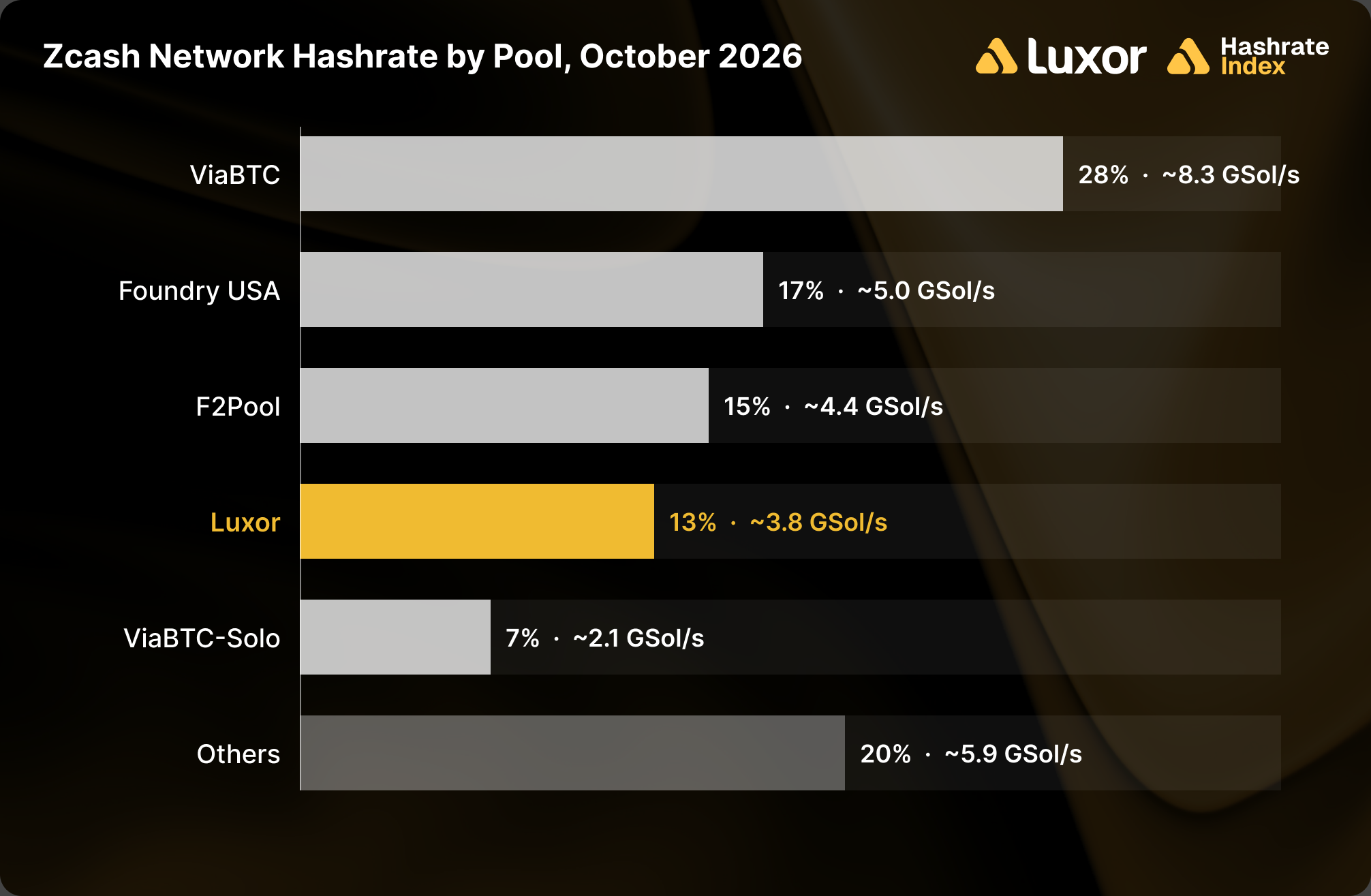
Because the daily miner reward pool remains strictly capped at approximately 1,440 ZEC, valued near $1.7 million, every newly activated machine dilutes the earnings of existing operators. The network currently equates to roughly 33,000 active Z15 Pro units drawing 90 megawatts of power. At prevailing asset prices, these machines remain cash-positive until network hashrate expands by another factor of ten.
At present, hardware supply rather than power availability acts as the primary constraint. In-stock Z15 Pro units remain exceptionally scarce, driving market prices up by 2.4 to 4.3 times since April. Bitmain’s next-generation Equihash ASIC is not anticipated until the second quarter of 2027, with priority hardware allocations already secured by major entities like Fortitude Mining.
Firmware Is the Only New Hashrate Until 2027
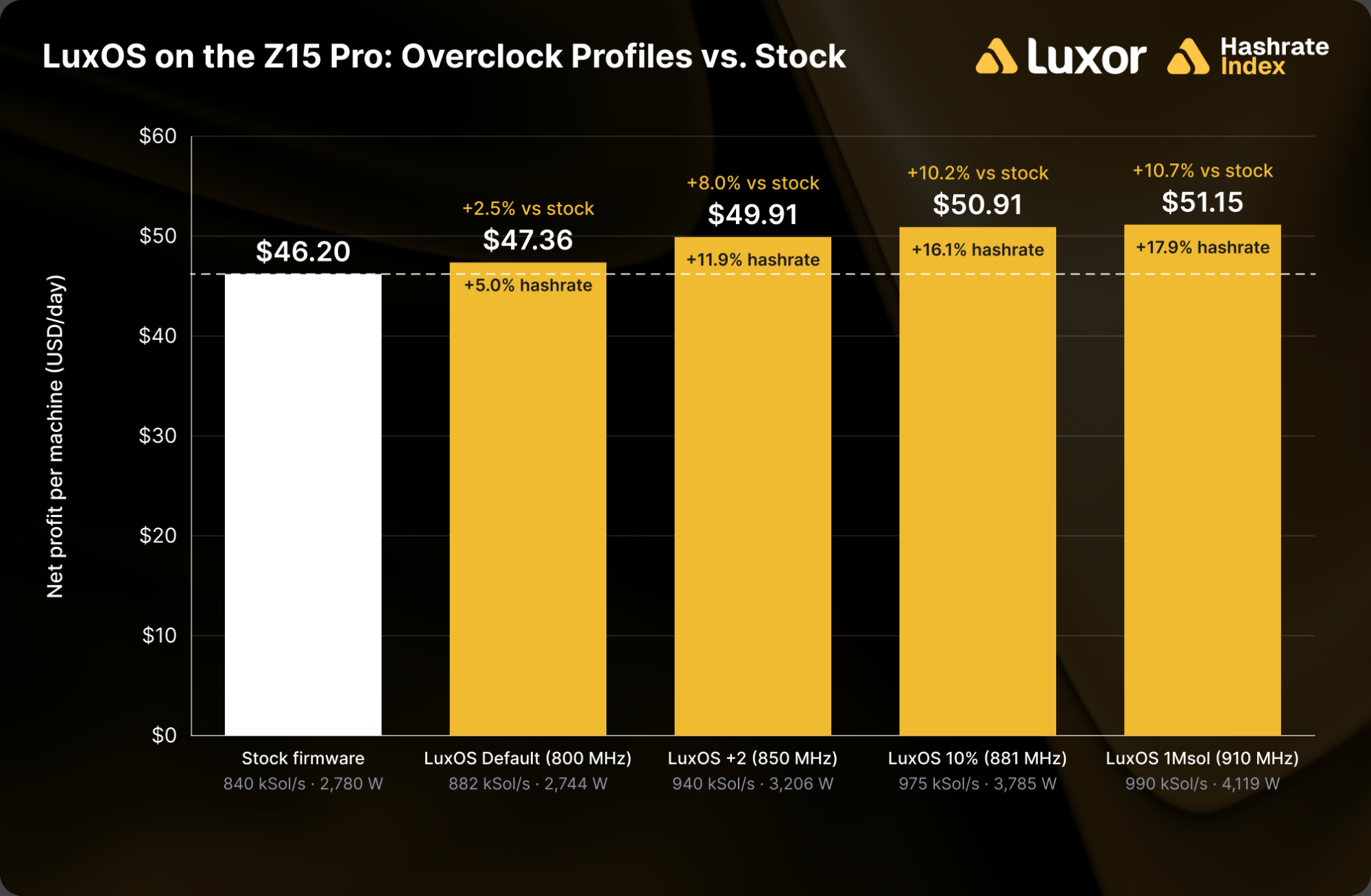
In the absence of new silicon manufacturing deliveries before mid-2027, the primary mechanism for expanding Equihash hashrate from currently deployed machines is custom firmware. Software developers introduced Z15 Pro support in October, marking their first venture into Equihash hardware utilizing the same overclocking and underclocking tuning profiles long established within Bitcoin mining fleets. Bench testing of four distinct overclocking profiles compared against Bitmain’s stock configuration of 840 kilosols per second at 3.31 joules per kilosol revealed nuanced performance trade-offs.
Only the default tuning profile improves upon stock metrics across both operational axes, delivering five percent higher hashrate with a one percent reduction in power consumption, lifting revenue to $799 per megawatt-hour compared to the baseline $773. Every aggressive profile beyond that baseline trades energy efficiency for absolute dollar returns, reducing efficiency down to approximately $600 per megawatt-hour at peak profiles. While these aggressive profiles add measurable hashrate on the test bench and maintain stability over a 24-hour cycle, they represent optimal choices exclusively for sites benefiting from low electricity costs and wide profit margins, whereas power-constrained facilities must exercise caution.
 Cryptocurrency Mining
 Cryptocurrency Mining
 Cryptocurrency Mining